A Modern Review of Thidrekssaga
Merovingians by the Svava
|
| |
|
by Rolf Badenhausen
|

|
Date:
2025-03-15
| Update
History | |
|
|
|
|
Introduction
The reviewing literary research
into Old Norse and Swedish traditions, as initiated by Heinz
Ritter-Schaumburg, PhD († 1994), might motivate
not only experts in Late Antiquity and prae-mediaeval times
to take note of some new interesting context: The Old Norse
Thidrekssaga and Old Swedish ‘Didriks chronicle’, both
appearing closely related to the sagas or legends about an
«Ostrogothic Dietrich von Bern», seem to throw back certain
narrative light from Frankish
history, whose Merovingian origin and its 5 th–6 th-century
period have been retold by Gregory of Tours,
Fredegar’s Chronicle and the Liber Historiae Francorum, a
further important chronicle of Frankish history.
|
 |
Contradicting
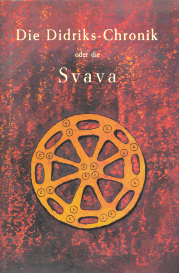
scholastic conviction, Ritter has evaluated the mediaeval Old Swedish
texts he
shortly called Svava, catalogued as E 9013, of
Skokloster-Codex, formerly No. I/115 & 116
quarto, at the ‘Riksarkivet’ Stockholm, as
more objective copy from an early but unknown archaic manuscript
being prior to the more longwinded narrating Thidrekssaga
which, however, is of surviving elder version and sometimes
rendering more topographical information.(1)
As the late philologist was able to prove by means of his numerous
German
publications and lectures, these manuscripts cannot mean the
‘Ostrogothic Theoderic’ mainly for both topographical and biographical
reasons,
but rather provide narration related to an equally named Frankish
king, the Old Swedish Didrik, who started his rise at ‘Bern(e)’
in the northern Rhine-Eifel outland.(2)
|
| |
|
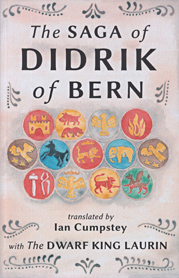 |
Heinz
Ritter’s and Ian Cumpstey’s translations of the ‘Didriks-Chronicle’
are based on Sagan
om Didrik af Bern efter svenska handskrifter by Gunnar
Olof Hyltén-Cavallius, Stockholm 1850–1854.
Regarding the literary style of the Old Swedish manuscripts,
Hyltén-Cavallius
classified at first the Old Swedish manuscripts as prosaic
‘krönikan’. Henrik Bertelsen
and Bengt Henning also shared this evaluation
(Bertelsen, ‘Didrikskroniken’ 1905–1911; Henning,
‘Didrikskrönikan’
1970). Edward R. Haymes translated the supplemental chapters of
the Old Swedish scribes under the headline The
End of Vidga and King Thidrek according to the Swedish Chronicle of
Thidrek.
The first complete translation of Hyltén-Cavallius'
svenska
handskrifter into English
language has been provided by Ian
Cumpstey: The
Saga of Didrik of Bern.
Although he follows a few questionable and inappropriate geonymic
equations by
elder scholarship (cf. for
instance ‘Spain’ with Ispania/Yspania, ‘Greece’
with Greken in his Index
of Place Names, he neither
situates Didrik’s seat in an Ostrogothic milieu nor connects the
leaders of Nyfflingaland with a
Burgundian environment in his appended
indexes. He briefly constates, p. vi,
that it
seems that the Swedish writers based their version of the saga on a
translation from the Norwegian (Old Norse). But rather than merely
translating, they produced an edition that was somewhat shorter,
with some repeated passages omitted, and with some parts of the
text reordered to give a more coherent reading order. It also seems
that they may have added from other unknown sources.
|
|
|
Regarding a circumspect
re-evaluation of the aforementioned manuscripts and other records of
occidental antiquity, we obviously have to contemplate a sharp natural
limit
that was previously forming the big border between the Roman Empire
and Germanic tribes, and, later again, the Franks and more eastern
folks: The Rhine. Apparently, our first
Frankish historiographers or ‘chroniclers’ would hardly cross that
river to have
a look at the outlandish tribes beyond;
and almost all their foreign colleagues seem to have left an almost
blank sheet about their history, particularly from the times
after the downfall of the Roman Empire to Charlemagne.
|
|
1.
The
original narrative geography: The Old Norse and Swedish texts
Heinz Ritter’s primal
geographical terminology of Thidrekssaga and Old Swedish
‘Didriks
chronicle’ represents an interesting result of his diligent
verification of intertextual location and hydronymic names.
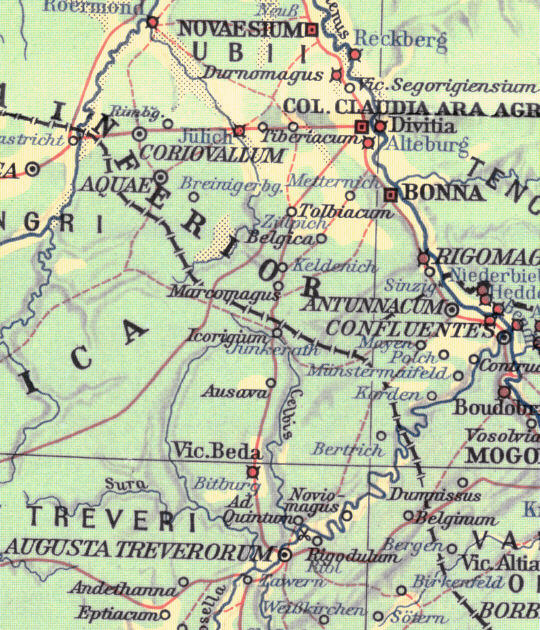
With respect to the environment and localization of Bern, the 1 st-century
Roman Eifel Map, issued by Kurt
Stade, provides a
Roman based mining location nowadays called Breinig (‘ Breinigerbg.’)
at the exceptional Gallic-Roman temple site VARNE (VARN
→ VERN → BERN).(3)
Although the contemporary name of Breinig was not
handed down, the name of this place has been suggested as a derivation
based on Varneniacum
→ Bereniacum → Breniacum (Otto
Klaus Schmich, Hünen,
Viöl 1999, p. 306), as we have to come back later to the
region
of these
and other related places on account of both geohistorical and the
narrative
geostrategical contexts.
|
|
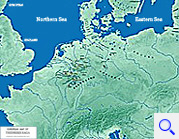
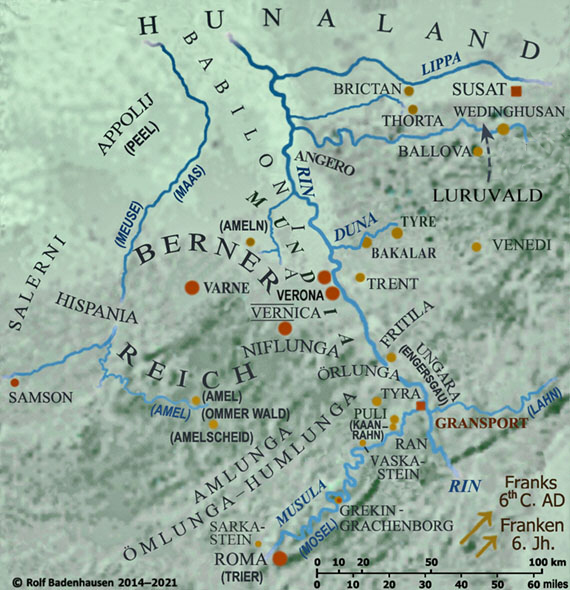
Some
important
locations of ‘Didriks chronicle’ and Thidrekssaga.
The place being named VARNENUM
has been excavated at Kornelimünster, suburban location of
Aachen (the Roman AQUAE GRANNI ), a place of
residence of Charlemagne.
With respect to Vereinnahmungsstrategien
für die Gestalt des Thidrek aus dem Milieu des
ostgotischen Theoderich – strategical
claims for setting up a
non-negligible ‘Ostrogothic Theoderic milieu’ for Thidrek –,
in particular created by elder German scholarship of 20th
century and vastly
colported by not a few philologists writing for the RGA
and Wikipedia, there is, for example, no passage
in the Old Norse + Swedish manuscripts
which connects their protagonists ‘Thidrek’
and ‘Ermenrik’ with the ‘gens Amalorum’, as these texts
do refer to this German Eifel folk ‘Amlunga’ in nothing more than
geographical
context. As regards Dietrich’s follower ‘Amlung’, son of ‘Hornboge’,
Ritter introduces the former clarifyingly in Dietrich
von
Bern, Munich 1982,
p. 296, en. 77.
Since the earlier and/or in Migration Period insufficiently recorded
ancestors of Sayn-Wittgenstein dynasty have been estimated between
Westfalia and the confluence of the Rhine and Moselle rivers,
Dietrich’s contemporary ‘Widga’
(this spelling form by the translators August Raszmann
and Fine Erichsen) must not necessarily come from
the other side of the Alps; see Mb 79 & 283.(4)
Generally, the Old Swedish forms ‘Wideke’, ‘Wideki’ might potentially
reflect the result of shortening derivation from Old German
‘Widechinstein’.
Ritter underlines well that the mediaeval scribes of the ‘Didriks
chronicle’
and Thidrekssaga may refer to geographical names ‘formerly
known as’ or, instead, ‘recently known as’. As concerns historical
records with limitations to less comprehensive context,
Ritter also subsumed that name giving to locations, their
etymological history and early historical events could have
taken place even before ‘first certified documentary
mention’.
|
|
|
Some geonyms
of the Old Norse + Swedish texts are not provided by other records of
Migration Period and Middle Ages, whereas
many other geographical expressions can be recognized in several
sources. For example Bardengau
(→ Berdengau)
→ (‘understood as’) Bertanga, the former
localized on the Lower
Elbe in connection with Charlemagne’s Saxon War campaigns, the latter
being used by the scribes of the
Old Norse and, with some spelling derivation, Old Swedish texts. (The paco
Badinc provided by the Annales
Petaviani has been annotated as «pagi
Bardengan caput Bardowik erat» by the MGH
editor G. H. Pertz, see William J. Pfaff 1959.(5)
The ‘Örlunga’
or ‘Harlungen’ region includes the former Roman BRISIACUM which is in
current German spelling (Bad) Breisig.
|
|
European Map
of
Thidrekssaga.
(3840 px
x 2880
px)
|
|
|
|
|
|
Since Heinz Ritter has thoroughly
translated the Old Swedish ‘Didriks
chronicle’ into German language and reviewed the Thidrekssaga
manuscripts, the regions of today’s North Rhine-Westphalia,
the Rhineland and its Palatinate, Low
Saxony, Jutland and western Baltic territories appear as authentic
locations focused by ancient and mediaeval historiographers who
enticingly forwarded lifetime events related to a king of an obvious
Franco-Rhenish descent.
|
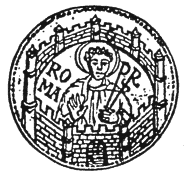
An
ancient seal of Trier on the Moselle, 11th
century.
Source: Ernst F. Jung, Der
Nibelungenzug
durchs Bergische Land (1987), p. 97.
|
|
|
Nonetheless, we must carefully
study their records to find some synchronous or completing
passages about Franco-Rhenish politics
of 5th
and the first third of 6th
century. Regarding the Rhine again as dominant natural and
cultural border, they seem to have had nearly the
same limited geographical horizon of recitation as
their Frankish colleagues vice versa. Thus, besides
primal geographical terminology, we have to interpret the Old
Norse + Swedish writers'
farthest known
southern centre ROME as ‘Roma
secunda’, whose spelling, localization and significance
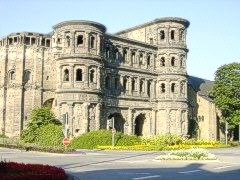
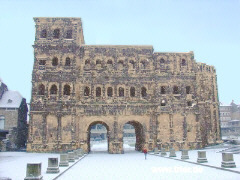
is unmistakably provable as the Roman Augusta Treverorum
(today: Trier on the Moselle) through both historical and
geostrategical contexts. However, we should
not expect a detailed recitation of the Merovingian bloodline from
Thidrek’s ‘biographers’ who certainly were not crossing the
Meuse westward, therefore providing fragmentary views,
and we also should keep an eye on the right sequence of more
than 300 chapters written by the scribes of the ‘Didriks
chronicle’ and Thidrekssaga.
|
|
2.
King
Theuderic I = King Thidrek of Bern
|
|
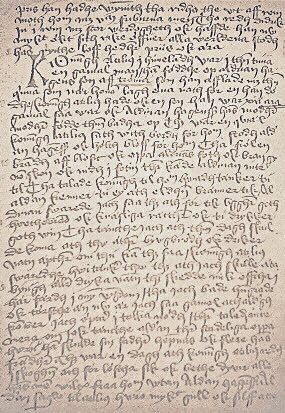 |
A page of Thidrekssaga (→ Mb 151), manuscript
perg. fol. nr 4, f. 49v (927 px x 1280 px)
|
A photocopy from
Old Swedish manuscript,
ch. 365 of the mediaeval Skokloster folio
|
|
|
|
Since the ‘Didriks chronicle’ and its derived
epic novel Thidreks saga,
as Ritter prefers this literary classification (see Der
Schmied Weland; posthumously published by Olms, Hildesheim 1999),
like to put forward
some coherent historical information and relations
upon large territories of today’s Central and North Europe, we
should estimate with him that these texts would basically not prefer
depiction of any less important provincial antics against more
reasonable reports on superior events. Evaluating Ritter’s conclusions
by means of the momentous context of the Old Norse +
Swedish
manuscripts on
such level, we finally will be confronted with the impasse
of not enough geographical, temporal and personal space for
Theuderic ‘&’ Thidrek.
|
|
It has been considered that
– Thidrek, Franco-Rhenish king, died c.
534–36
according to Ritter’s estimation;
– Theuderic, not only Franco-Rhenish king, died at the end
of
533.
|
|
Kemp Malone (1959) and Karl Simrock,
German translator of the Nibelungenlied, Old Norse Epics and the Old
English Beowulf, identify Dietrich
von Bern with Frankish king Theuderic I.
Simrock,
reviewing and basically following his colleague Prof. Laurenz Lersch,
pleads for a primordial (Franco-)Rhenish tradition that centers
on Bonn = Verona (notably already Franz
Joseph
Mone) which, as these scholars do generally combine, thereafter
was assimilated and enriched by receiving authors of southern Dietrich
von Bern
epics. (F. J. Mone, Untersuchungen zur Geschichte
der
teutschen Heldensage, 1836, p. 67; id. Anzeiger für Kunde
der teutschen Vorzeit, 1836, p. 418.
Laurenz Lersch, Verona., in: Jahrbücher
des Vereins von Alterthumsfreunden im Rheinlande. Bonn 1842, I, pgs
1–34. Karl Simrock, Bonna Verona. In: Bonn. Beiträge
zu seiner Geschichte und seinen Denkmälern. Festschrift Bonn
1868, III, pgs 1–20.)
Karl Müllenhoff, another 19 th-century
scholar, tried to discern Dietrich von Bern as an amalgamation
of Frankish kings Theuderic and his son Theudebert with a poetical
‘Ostrogothic Theoderic’ (Die austrasische
Dietrichsage,
in: ZfdA 6 (1848), pgs 435–459). Thereafter
Hermann Lorenz declared Frankish king
Theuderic I as the prototype serving for the Dietrich
epics, estimating [transl.] «Theuderic utterly drawn into
the
circle of the Gothic Dietrich saga, in it only faint echoes that denote
him here as the historical Frankish king.» (Das
Zeugniss für die
deutsche Heldensage in den Annalen von Quedlinburg, in: GERMANIA
31 [19, 1886], pgs 137–150, p. 139.)
Regarding newer publications, Helmut G. Vitt renders short but astute
initial intercessions resulting in Thidrek =
Theuderic I and Samson = Childeric I: Wieland der Schmied
(ISBN 3 925498 00 1), pgs 127–138.
However, all these authors do not provide detailed studies which ought
to
substantiate more firmly their opinion.(6) |
|
We must state deficient biographical
information about that young Theuderic before 507 and, again, before c.
525. He is mentioned as most talented son of C(h)lodovocar
I
or ‘Clovis’ in the texts written by Bishop Gregory of Tours, principal
Frankish ‘chronicler’ whom we obviously have to credit
with
truth telling and who might appear to some item more informative than
the pseudonymous Fredegar.
Unfortunately, Gregory has not left a
line to find the answers to these urgent questions about this
Franco-Rhenish king:
|
|
| 1. |
May a clerical raconteur punish
Theuderic
with a certain portion of ignorance, since he has taken him for
a son of any heathen concubine?
|
| |
|
| 2. |
Has that skilled young man kept
a respectable distance to his rude and bloodthirsty father?
|
|
|
|
Fact is that King Clovis could rely
on Theuderic for daring missions, e.g. against the
Visigoths. On the subject of this operation, the history reveals
that only the powerful appearance of Theoderic the Great
could stop the conquests made by Theuderic in 507/508.
Nonetheless, we may wonder whether or how much Gregory did
discriminate him against Clovis' sons Chlothar,
Chlodomer and Childebert, whose mother was the honourable
Saint Clotilde (Chrodechildis, Chrodigildis)
of Burgundian dynasty; and we may also wonder
whether Theuderic trained his skilfulness and sophistication by
keeping out of Clovis' gory ways. Thus, we may
consequently
ask: Did that young-aged man rather turn to an adventurous eastern
border area of the Franks? We may assume that he
could have received a certain part of Rhenish territory as
operation base and place of residence from his father and/or the
local leader of this area – that large region which Theuderic
actually inherited later as an important part of eastern Frankish
kingdom. The
territory between the German towns Aachen – Cologne – Bonn –
Zülpich was an excellent geographical centre
of an area that was called later Ripuaria, and a good place for
Theuderic ‘and’ Thidrek to
start an exiting exploration into the dangerous depth of miraculous
woodlands beyond the Rhine, where all those Roman Eagles were driven
back or torn into bits and pieces just a few centuries ago. A regnal
seat in this Berner Reich was not too far from important
economic locations on the Rhine, e.g. such as the Confluentes
(Koblenz), and it was also a good place for King Thidrek
to ride out
to his good friend King Atala who was residing some dozen miles
away at one of the most important settlements on a territory of today’s
Westphalia: Susa–Susat–Soest. The form
‘Attila’ appears as a popular derivation of a genuine
Atala bearing the diminutive form of the
(Proto-)Indo-European ā̆tos, atta = father.
He is
spelled ‘Aktilius’ or ‘Atilius’ in the Old Swedish manuscripts, and
also ‘Attala’ in Icelandic MS B.
However, turning again to both
questions above, we are leaving at this point Gregory’s Frankish
horizon of recitation for real barbaric outland.
|
|
| 3.
Some literary and historical environments |
|
|
3.1 Gransport
|
|
|
The manuscripts report
that one day King Ermenrik expelled Thidrek from his Bern
residence. He immediately fled to King Atala’s
for
that reason. After ‘20 years’ (cf.
Ritter by counting up these ‘20 years’ to c. 515)
Thidrek goes out to meet martially his kinsman Ermenrik.
Thidrek’s messengers finally find him at Roma II
(Trier on the Moselle) where Ermenrik, being informed likely earlier
than expected, prepares the counter-attack (Sv 272–273, Mb 322–323). As
all manuscripts unmistakably provide,
Thidrek has to take big losses in the battle on that location on the
Moselle
location which the literati call ‘Gransport’,
‘Gränsport’ or
‘Gronsport’.
The location of not only this battle appears on the Moselle, where the
ancient TRAVENNE – ‘Travenna’ by
Ausonius († 393/394), see his monography Mosella – might have been
understood as the Italian Ravenna by the southern Dietrich
Epics poets. Traben (Traben-Trarbach), certified in 11th
and
12th century as Travena, Travana,
Travina, Travene, Traven and Travenne, lies in an area
where the Moselle could swell into a huge lake, where remains of Roman
buildings and a Frankish burial ground
were found, where the castle called Grevenburg
is 5 km far from Bernkastel; cf. Wolfgang Jungandreas, Historisches
Lexikon der Siedlungs- und
Flurnamen des Mosellandes (Trier 1962–1963) pgs 1040–1043.
Ritter, however, decided on Rauenthal at the mouth of the
Moselle.
It seems not unproblematic to chronologize Thidrek’s campaign
against Ermenrik without
further contextual explorations (see farther below).
The writers of the Old Norse + Swedish texts
connect the age
of Thidrek’s brother Þetmar/Detmar,
aged ‘20 years’
at that time,
with the interim period of exile. However, it appears less
believable that Thidrek would have waited two decades for
the first real opportunity to regain his kingdom.
Since Sv 355 and Mb 413, both the last chapters
numerically taking up Thidrek’s expulsion, allow to check
again this span for a redating (see farther below),
the more or less questionable age of his alleged brother might have
inspired the primordial narrator to enlarge Thidrek’s interim
period of exile.
|
|
 |
|
Although
Ferdinand Holthausen
(Studien zur Thidrekssaga, in: Beiträge zur
Geschichte
der deutschen Sprache und Literatur, PBB, Band 9, Heft 3; pgs
451–503) quotes those
Italian localizations which are out of both historical and
historiographical probability, he proposes Gransdorf (see p. 482) on the
Moselle. However, the ‘Gänsefü(h)rtchen’,
diminutive form of ‘Gänse-furt’, is an evident historical nickname
of a notable historical rapid localized nearly one mile before the
Moselle’s mouth.
Ritter underlines that this name cannot originally derive from ‘a
ford that geese (Germ. ‘Gänse’) formerly used to cross the river
at that very place’. He rather estimates the concave rock of the
rapid filled or covered with stony ‘grant’ (cf. En. ‘gravel’,
‘granule’) for
the original name based upon spelling like ‘Grantfurt’.
Ritter also notes well that ‘Rauenthal’ (Raven →
Raben -tal) may indicate rather the more believable historical location
for detracting epics
dealing with the battle known as the Rabenschlacht.
|
| |
|
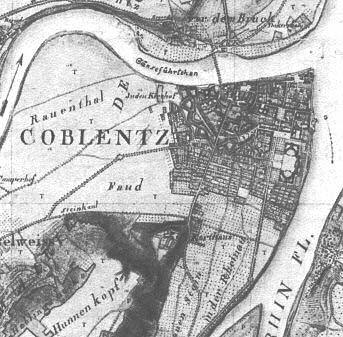
This
cartographic detail is provided by the map of Tranchot & von
Müffling, 1806. The rapid’s name and
position was added by Ritter who refers to the research of Fritz
Michel, eminent local historian of Koblenz.
|
|
|
|
CONFLUENTES:
The panoramic copperplate engraving by Möbius (1820)
provides a view from the east bank of the Rhine to the hills
of traditional ‘Hunnenkopf’ (‘Huns Head’ field) on the
left. The Moselle’s mouth on the right appears as a lake
(Germ. ‘See’) in high-water times. See also the author’s
comprehensive article catalogued at the National German Library
DNB: Die
Mosel im Licht von Thidrekssaga und Dietrich-Chronik.
|

|
|
3.2 Some historical
and
literary
analogues
| 1. |
Thidrek’s
ancestor Samson started his expansive politics from the same area as
Childeric I:
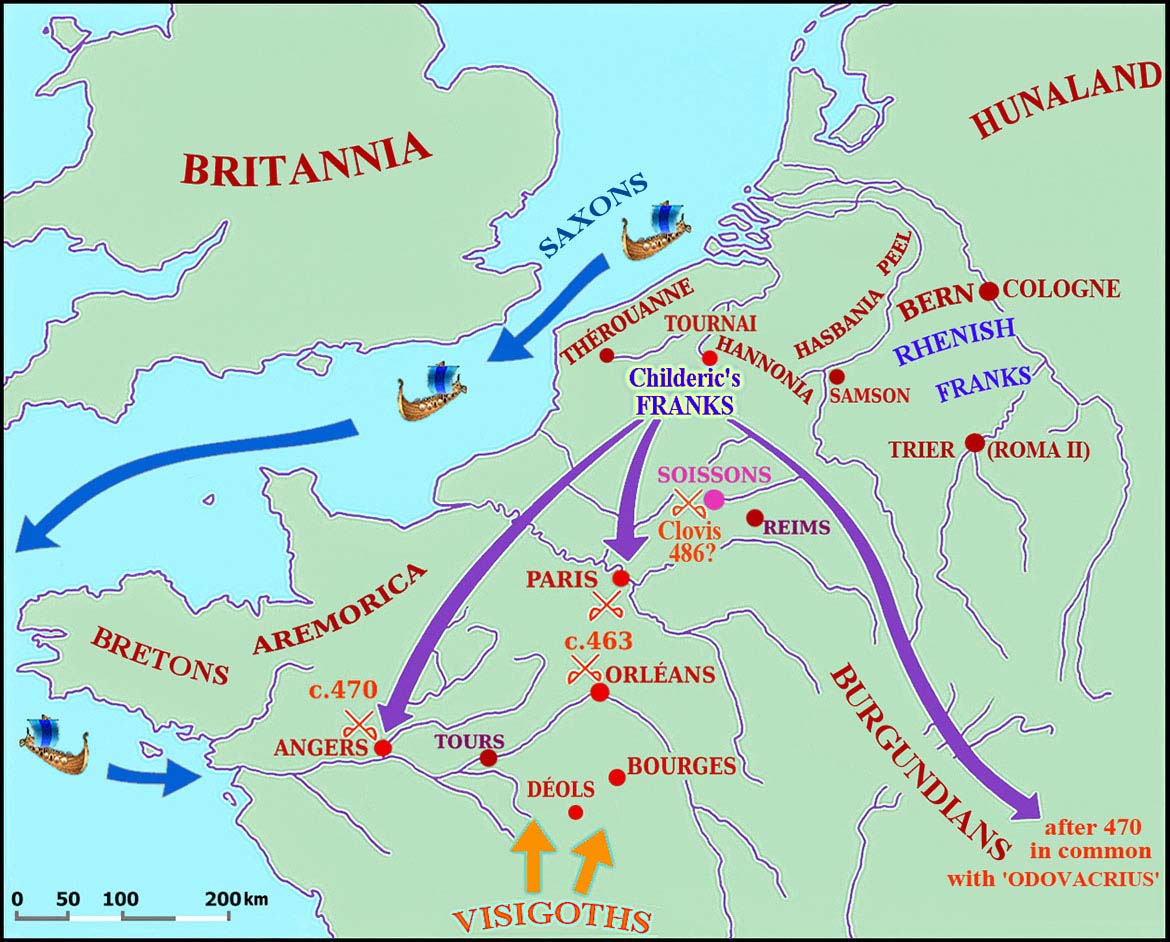
northeastern Gaul. Samson’s region included ‘Appolij’ (not
Apulia!), nowadays rather the Dutch Peel north of the Hesbaye which
is neither southern ‘Hispania’ nor Spain (!), as the authors of the Old
Norse + Swedish texts certainly provide Hispania
between the western foreland of the Eifel and the northern fringe of
the silva carbonaria, a woodland frequently mentioned in Roman
and Frankish
historiography. Furthermore, the scribes of these manuscripts have
connected Samson with an obvious geonymic ‘Salerni’, which seems to
express a corresponding relation to the region of the Salian Franks.
According to Ritter’s timeline of events provided by these
transmissions, this Samson
appears as a contemporary of this Childeric whose
grave was found east of the ‘charcoal wildwood’.
|
| |
|
| |
The writers of the Old Norse
+ Swedish texts relate in their early chapters
that Samson seduced the daughter of an influential ruler and went
with her into an interim refuge for that reason. We also remember
well that Gregory of Tours has ascribed a quite similar delicate
affair to Childeric in a northeastern 5 th-century
Gaulish region. The Old Norse
and Swedish scribes also note well that Samson had remarkable
black hair and an impressing beard.(7)
He slew two noble brothers of ‘Salerni’, the literary Salvenerias
by Ritter’s suggestion which, however, may represent nothing
more than generally the Salian region. Mentioned as dux and
king of ‘Salerni’, at that time already grey-bearded, he decided to
move martially to the Rhine-Eifel lands, as this region appears
contextually more plausible than any venue on an Italian territory.
From there, as the texts further relate, he impudently demanded 12
free-born virgins, the daughter called ‘Odilia’ of
the Bern ruler, and some other
tributes from him. |
| |
|
| |
Childeric’s place of
burial has been assigned to his seat in that region of his
likely early activities which extends from Tournai to Lys river. Thus,
the distance between this region and
the venues of Samson seems less significant
with regard to the spatiotemporal movements in Gaulish Migration
Period and the geographical understanding or knowledge of the
Old Norse and Old Swedish writers.
|
|
|
| 2. |
Samson, accompanied by his son
and successor Ermenrik, died on his martial way to Roma II,
as this concourse of circumstances was expressively remarked by Ritter.
Rather accordingly, Childeric died at that time when the Franks
were capturing Trier on the Moselle.
|
|
|
| 3. |
In 486/487, for the first time,
Clovis had good reason to call
out ‘Great Kingdom of the Franks’ after the martial removal of
Syagrius, last ‘post Roman governor’ of Gaul. Shortly before and
after this
event, as contextually deduced by Ritter, Ermenrik called in his
kinsmen, tribal leaders and some mighty followers
to his first and second ‘Imperial Diet’, a colloquium of obvious
Frankish leaders and some jovial guests at the Roma ‘cisalpina’.
|
| |
|
| |
‘Imperial Diet’:
I: Sv 124, more in detail: Mb 123–124.
II: Sv 227, Mb 269.
See HISTORIA
WILKINENSIUM, THEODERICI
VERONENSIS…
provided by J. Peringskiöld, ch. 100 (Mb 123):
Convivii magnum apparatum, regia pompa
celebrandum, instituerat Ermenricus, convocatis ad eam solennitatem
primariæ dignationis viris
ex principum, Jarlorum, comitumque…
|
|
|
| 4. |
The third redactor of the Membrane
makes use of an individual spelled Salomon in order to show
that the Frankish realm had already extended to the Rhineland .(8) |
|
|
| 5. |
As Gregory of Tours narrates
events between c. 488 and c. 492, King Clovis slew his cousin
Ragnachar, king of Cambrai on the Schelde (‘Scheldt’). Apparently
anticipating this
action of eliminating awkward Frankish chiefs and their potential
successors, Sv 231–233 and Mb 278–280 remark the insidious removals of
Ermenrik’s sons Frederik, Regbald and Samson. As the texts provide,
Ermenrik was induced to tolerate
them no longer by counsel of his advisor ‘Sifka’.
Regbald, ordered to a mission apparently to the
Anglo-Saxons and thus needing a watercraft, had to choose between
three ships for that passage. He sank on most ramshackle ship
deceitfully offered to him as best of all. Was it Frankish
kingdom of already believable force to demand tribute from a ruler
who was obviously dwelling in ‘Ængland’ as an Anglo-Saxon
territory? For potential or rather likely interest of the Merovings in
tribal regions between Jutlandic-Danish area and East Anglia
see Ian N. Wood, The Merovingian North Sea
(1983); id., The Channel from the 4th to the 7th Centuries AD,
in: Maritime Celts, Frisians and Saxons, ed. by
Seán McGrail (1990), pgs
93–97.
|
| |
|
| |
James Campbell, The
Anglo-Saxon
State, London 2000, p. 75, states on Wood’s notions that he
|
| |
|
| |
brings
out some of the connections between Merovingian Gaul and Britain,
including the
possibility of Merovingian overlordship over parts of England.84
He suggests that a factor in these may have been
Merovingian control
over the Frisian coastline for a substantial period. This could, of
course, have had important significance in relation to East Anglia and
raises important questions about Frankish sea power.
__________________
84 Ian N. Wood,
The
Merovingian North Sea (Alingsås, 1983).
Wood’s arguments have been also reviewed by Irene Bavuso, Balance
of power across the Channel: reassessing Frankish
hegemony in southern
England (sixth–early seventh century), in: Early Medieval Europe
(2021) 29 (3) pgs 283–304.
It should be noted for further estimations also Wood’s article Frankish
Hegemony in England, in: M.O.H. Carver
(Ed.), The Age of Sutton Hoo: The Seventh Century in
North-Western Europe (1992) pgs 235–242.
|
|
|
| 6. |
While Gregory mentions
Theuderic’s service for King Clovis in 507, Thidrek supported
King Ermenrik against an obvious southeastern leader called
‘Runsteinn’ or (Lat.) Rimsteinius, whom Ermenrik wanted to
punish for outstanding tribute, see Sv 144 and Mb 147. Ritter
chronologizes this border war between eastern Franks and
Alemannians at the end of 5th century. At
this point we may remember Gregory’s passages dealing with
Alemannic-Frankish war, whose battles were apparently going on for
several years on some more locations than the region of Zülpich,
where King Sigibert of Cologne was wounded and
became lame.
|
| |
|
| |
A leader called Alpkerus,
ruler of a territory on the Danube in 6th
century, is
mentioned as filium Rŏsteini in the manuscript De
Origine Gentis Swevorum, in: MGH SS rer. Germ. in us. schol. 60,
p.
161.
|
|
|
| 7. |
While King Clovis passes away
after possibly 511, as the chroniclers do not
mention any attempt on his life, King Ermenrik dies of an abdominal
disease apparently caused by obesity, cf. Sv 345 and Mb 401.
|
| |
|
| |
Ian
N. Wood, an author
of the RGA (Reallexikon
der Germanischen Altertumskunde), does critically review
scholarship’s
estimation on Clovis' date of death in his paper Gregory
of
Tours and Clovis, in: Revue belge de philologie et d’histoire
63
(2) 1985, pgs 254–255:
|
| |
|
| |
That Gregory himself
was faced with an absence of trustworthy dates
in his sources can be seen clearly in his attempts to compute the date
of Clovis' death. Clovis, we are told, died five
years
after
Vouillé, that is in 512; eleven
years after Licinius became bishop of Tours, which apparently gives a
date of 517 or later; and one hundred and twelve years after the death
of Martin which comes to 509(35).
Gregory’s later computations on the deaths of Theudebert and Chlothar(36),
however, and the regnal dating for the fifth council of Orleans(37)
seem to require an obit for Clovis of 511–2.
Nevertheless before
accepting this, it is worth recalling the fact that the king was
clearly alive at the time of the
first council of Orleans which consular and indictional dates place
firmly in 511(38).
Moreover the Liber
Pontificalis records Clovis' gift of a
votive crown
to the shrine
of St. Peter in the pontificate of Hormisdas, in other words between
514 and 523(39).
Although
the weight of the evidence does suggest that Clovis died in late 511 or
512 the chronological confusion in Gregory’s attempts to calculate this
can only imply that the bishop did not have reliable evidence on which
to base his computations. This coincides with the conclusions suggested
above, that Gregory’s known sources would have provided him with no
dates, and it means that even the most general chronological
indications in the second half of Book Two of the Libri
Historiarum, with the possible exceptions of the quinquennial
dates for the defeat
of Syagrius and the Thuringian war(40),
are invalid as historical evidence.
__________________
(35) Gregory, Liber
Historiarum, II, 43.
Licinius' predecessor was still alive at the time of the
council of
Agde in 506, to which he sent a representative; see Concilia
Galliae, A 314-A 506, ed. C. Munier, Corpus Chrislianorum
Series
Latinorum, 148 (Turnholt, 1963), pp. 214, 219. For further problems
on Licinius's chronology see Weiss, Chlodwigs Taufe,
p. 17.
(36) Gregory, Liber Historiarum, III, 37 ;
IV, 21. W. Levison, Zur Geschichte des Frankenkönigs
Chlodowech, in Aus rheinischer und fränkischer
Frühzeit (Düsseldorf, 1948), p. 208.
(37) Orleans, V (549), Concilia Galliae A
511-A 695, ed. C. de Clercq, Corpus Christianorum Series
Latinorum, 148 A (Turnholt, 1963), p. 157. Levison, Zur
Geschichte des Frankenkönigs Chlodowech, p. 208.
(38) Orleans, I, ed. de Clercq, pp. 13-5(?)
; Levison,
Zur Geschichte des Frankenkönigs Chlodowech, p. 208.
(39) Liber Pontificalis, ed. L. Duchesne
(Paris, 1955), LIIII.
(40) Gregory, Liber Historiarum, II, 27.
Two further quinquennial dates appear in some manuscripts only ;
Liber Historiarum, II, 30, 37. The authenticity of these dates was
defended by Levison, Zur Geschichte des Frankenkönigs
Chlodowech, pp. 205-7 and denied by Weiss, Chlodwigs Taufe,
p. 16. |
|
|
| 8. |
Thidrek goes martially
out
to take revenge for severe humiliation, his expulsion from Bern
by his kinsman Ermenrik, just about that time when King Clovis seems no
longer living or mighty.
|
|
|
| 9. |
Immediately after the
Soest Battle, as the texts provide, Thidrek moved to Bern
and recruited an army that won the decisive battle against
‘Sifka’, advisor of the apparent late Ermenrik, on location called Greken,
Graach on the Moselle in the Palatinate of Rhineland.
|
|
|
| 10. |
After the conquest of Roma
Thidrek certainly rose to a mighty leader of Frankish kingdom.
This is the version from the Old Swedish manuscript,
Sv 356:
|
| |
|
| |
He
rode into Roma,
got off his horse, went to take the same seat on which kings are
inured to sit and to be crowned … Hillebrand and Alebrand crowned him
and
appointed him King of the great realm that King Ermenrik had had
before… |
|
|
| 11. |
According to the Old Norse +
Swedish texts (Mb 426–428, Sv 367–369), Thidrek
took over a
region which covers parts of the later North Rhine-Westphalia and Low
Saxony after the death of Atala who had
lost
there many of his male subjects in
the Soest Battle which Ritter has dated into
6th century.
|
| |
|
| |
This
context does correspond with ethnographical and archaeological
studies which provide the Merovingian
Franks moving to the aforesaid regions and parts of the later
Hesse, Thuringia and Saxony-Anhalt.
|
|
|
|
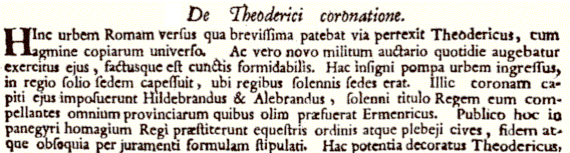 Clip from Latin text provided by J.
Peringskiöld: the beginning of ch. CCCLXXX, cf. 10th
item above.
Clip from Latin text provided by J.
Peringskiöld: the beginning of ch. CCCLXXX, cf. 10th
item above.
|
3.3 Theuderic’s
provenance and disappearance
after 507
It seems
noteworthy that both Theuderic’s and Theoderic’s name is
basically related to a composition of the Gothic þiuda (= grouping of peoples or
tribes as a ‘nation’,
cf. ‹ Proto-›
Indo-European teuta
plus reiks [=
‘rich’ + ‘ruler’, cf. ‘reign’] ), while the form *þeudō,
the generic root estimated for Ur-Germanic language, may encompass the
prime form also for the
etymology of the later term deutsch (cf. also
the
[Lat.] Teutones, a Germanic ‹ or
Celtic? › tribe
presumably related with the
Jutlandic
Thy).
Ritter-Schaumburg
estimated the birth
of Thidrek about 470, whereas Frankish king Clovis is believed
to be
born a half decade before him. This constellation
may appear as predominant item contradicting Thidrek’s
literary reflection of Frankish king Theuderic I.
Therefore, reviewing
research regards both Ritter and the Frankish chroniclers'
genealogy about the early Frankish kings Meroveus, Chlodio and
Childeric as (at least) either less reliable or insufficient. As
Gregory of Tours remarks in his Decem libri
historiarum, he
has no solid pedigree information especially about these
Frankish-Merovingian kings, and so he had left a meagre ‘Some People
say’-phrase in this records.
|
|
|
Widukind of Corvey calls in his Rerum gestarum
Saxonicarum libri tres the Frankish
Theodericus (= Theuderic I)
a descendant of Huga, but neither ‘Clovis’ nor another ancestor
or
progenitor of the Franks. He thus follows an obviously
different line of genealogical tradition than
Gregory, who himself concedes to be referring to oral tradition for the
early
Merovingians. Although his genealogical suggestion of Theuderic’s
father cannot be validated anywhere, a large part of the ‘communis
opinio’ just converts unreliably Widukind’s genealogical statement to
«Clovis'
second name».
The chronicler of the Annals of Quedlinburg (see ch. 4
with source reference), less scolded than Widukind for
‘infidelity to history’, specifies Theuderic under a progenitor
epilogue that appears based on Widukind’s transmission:
|
| |
|
Hugo Theodericus iste
dicitur, id est Francus, quia olim omnes Franci Hugones vocabuntur a
suo quodam duce Hugone.
|
| |
|
[Hugo Dietrich
is called this one, who is a Frank, because once
all Franks were called Hugones after their leader named Hugo(n).]
|
|
With Gregory’s Merovingian
projection the Quedlinburg annalist,
most likely female, intervenes in Widukind’s version of
Theuderic’s ancestor by means of the Liber
Historiae Francorum to
which she obviously must have had an access, cf. Martina Giese who
rejects the usage of the elder books of Gregory at Quedlinburg (Giese, op. cit. p. 140 note 366).
Nevertheless, the annalist wanted to forward the quoted passage, (most)
likely because she already knew that any Huga or Hugo(n)
is neither convertible by means of
Frankish chronicles nor at hand of Gallo-Roman sources about
Theuderic’s ancestry.
Gregory remarks Theuderic’s son
Theudebert being already sturdy at a time when Clovis died; see libri historiarum (hist) III,1.
Regarding Thidrek’s as well as Theuderic’s bloodline over a
band of three generations, all male names being recorded are strikingly
beginning with ‘Th’ but not with any other letters.
Theuderic’s line (Theuderic → Theudebert → Theudebald)
is outstandingly unique with a view to all the other early
Merovingian branches wherein we typically meet kingly names
formed with capital ‘C’.
Regarding Gregory’s claim that a concubine
of Clovis I
should have been
the mother of Theuderic, a significant parallel between the latter and
his Ostrogothic namesake has long been pointed out. Matthias Becher
reasonably constates:
|
| |
|
Im Übrigen war
auch
Theoderich der Sohn einer concubina; seine
Mutter Ereleuva war vermutlich eine katholische Römerin, weshalb
eine Vollehe mit seinem Vater Thiudimir nicht möglich gewesen war.
An diese Möglichkeit wäre also auch zu denken, wenn man
über die Mutter Theuderichs nachdenkt.
|
| |
|
(Matthias
Becher, Chlodwig I. Der Aufstieg der
Merowinger und das Ende der antiken Welt (2011) p. 169.)
|
| |
|
[By the way,
Theoderic was also the son of a concubina. His mother
Ereleuva was presumably a Catholic Roman, and therefore a full marriage
with his father Thiudimir had not been possible. So this possibility
would also have to be considered when thinking about Theuderic’s
mother.]
|
|
|
How credible sounds the coincidence
that two contemporary kings with
the same Latin name should come from both a
‘concubinate’? How convincing appears Gregory’s view on Theuderic’s
origin, to which he does not even provide a resilient annotation to the
age difference between him and Clovis? Why should Clovis, who obviously
had no lack of legitimate sons, bequeath the largest part of his empire
to a son of a concubinage that was apparently quite far back in time?
Regarding Gregory’s insufficient and questionable
early Merovingian origin relations, apparently based on his conception
of ‘work-fair’ genealogy of Clovis' line up at least
to Childeric, it is by no means excluded that he borrowed from the
Ostrogothic
ancestry!
Consequently, the Low German source provider and/or the Old West-Norse
editors of the Thidrekssaga could have then concluded that
Þetmar II
was also Thidrek’s father.
However, it is not only the uncritical adoption of Gregory’s accounts
by younger chroniclers that nourishes doubts about Theuderic’s true
father.
Matthias Becher raises this objection (op. cit. p.
273):
|
| |
|
In diesem Zusammenhang
verdient eine
Quelle Beachtung, die von Gregors
Darstellung abweicht. In der Vita sancti Chlodovaldi – der im 9. oder
10. Jahrhundert entstandenen Lebensbeschreibung eines Chlodwig-Enkels –
heißt es, Chlodwig habe sein Reich seiner Gemahlin Chrodechilde
mit den drei Söhnen Chlothar, Childebert und Chlodomer
hinterlassen und unter diesen aufgeteilt. Eine Teilung durch den Vater
ist indessen sonst nirgendwo bezeugt. Weshalb ist der Vitenschreiber,
der sonst Gregor von Tours fast wörtlich folgte, ausgerechnet in
diesem Punkt von ihm abgewichen? Die Frage muss unbeantwortet bleiben,
doch auch wenn diese Quelle insgesamt als wertlos gilt, gibt ihr
Bericht in der Einzelfrage, die für ihren Autor im Übrigen
nicht weiter von Belang war – so dass er etwa um einer speziellen
Argumentation willen hätte abweichen müssen – doch zu denken.
In diesem Zusammenhang ist auch die Beobachtung der regionalen
Verteilung der Bischöfe von Interesse, die am Konzil von
Orléans teilgenommen haben: Der Osten, grosso modo Theuderichs
Anteil, war nicht repräsentiert [...] Ging es also bei Chlodwigs
Tod tatsächlich nur noch um die Frage der Aufteilung des
verbliebenen Gebiets unter seine jüngeren Söhne?
[In this context, a source deviating from Gregory’s account deserves
attention. In the Vita sancti
Chlodovaldi – the biography of one of
Clovis' grandsons, written in the 9th
or 10th century – it is said that
Clovis left his kingdom to his wife Clotild with the three sons
Chlothar, Childebert and Chlodomer, and divided it among them. However,
a division by the father is nowhere else attested. Why did the author
of the vita, who otherwise followed Gregory of Tours almost
literally, deviate from him in this point of all things? The question
must remain unanswered, but even if this source as a whole is
considered worthless: Its report on the individual question, which
incidentally was of no further importance for its author – so that he
would have had to deviate, for example, for the sake of a special
argumentation – still gives food for thought. In this context, the
observation of the regional allocation of the bishops who
participated in the Council of Orléans is also of interest: The
East, grosso modo Theuderic’s share, was not represented (...) So, at
Clovis' death, was it really only a question of dividing
the remaining
territory among his younger sons?]
|
| |
|
|
In fact, Theuderic is not mentioned
anywhere
in the Vita sancti
Chlodovaldi, which was written in 9th
or 10th century, and indeed it
does give pause for thought why its hagiographically adroit author
systematically passed him over. Clodo(v)ald is
supposed
to have been born around 520 and was thus still a contemporary
of Theuderic. Fluduald, as the former is called as a saint also in
later sources, appears as the third and youngest son of the Merovingian
king Chlodomer, who is considered the second eldest son of Clovis and
Clotild.
The knowledge of the vita writer about Clovis points to the facts
that he must have had
knowledge at least of Gregory’s historical works and thus deliberately
ignored Theuderic. Implicitly, however, it cannot be excluded in this
respect that Clovis could have desired the kingship of Theuderic – as
here
the postulated descendant of another Frankish dynasty – and, at a
certain point in time, could have taken it over. It has been plead for
an deliberate embezzlement of Theuderic by the writer of Clodoald’s
biography, but the weak argument that he intentionally disregarded
Theuderic because of his ‘less noble’ origin seems less convincing
compared to the fact that not one dignitary
from Theuderic’s (hereditary) kingdom appeared at the First
Council
of Orléans, which was convened by or for Clovis. Rather,
this
constitutional context speaks straight
at least for a
territorially isolated status of Theuderic at this time. Moreover, it
is
especially thought-provoking that neither Clovis'
Baptist Remigius
nor a deligated deputy from the former Belgica II
(Church of Rheims) showed up at
this constitutively highly significant synod. Thus Becher’s next
important observation is (op. cit. p. 250):
|
| |
|
Aber vor allem ein
berühmter
Bischof fehlte: Remigius von Reims – und nicht nur er, sondern
überhaupt kein Bischof aus dem Osten des Reiches war nach
Orléans gekommen. Man wertet dies als Hinweis auf eine
zunehmende Entchristlichung dieser Gebiete. Die Bischofsstühle von
Köln und Mainz etwa waren vakant. Dies reicht als Erklärung
nicht aus, denn etwa auch der Bischof von Trier oder der von Sens und
viele andere fehlten in Orléans. Es waren also auch Gebiete
nicht repräsentiert, in denen die Kirche durchaus noch
funktionsfähig war (...) Es fällt auf, dass die Gebiete, die
in Orléans nicht durch
ihre Bischöfe repräsentiert wurden, nach Chlodwigs Tod an
dessen ältesten Sohn Theuderich fallen sollten. Hatte Chlodwig ihm
diese Gebiete vielleicht bereits zu Lebzeiten als Herrschaftsbereich
anvertraut? Oder hing die Absenz der Bischöfe aus dem Osten des
Reiches mit den Wirren zusammen, die durch die Unterwerfung der
kleineren fränkischen Königreiche – insbesondere der
rheinischen Franken – unter Chlodwigs Herrschaft ausgelöst worden
waren?
[But especially one famous bishop was missing: Remigius of Reims – and
not only he, but no bishop at all from the east of the empire had come
to Orléans. One interprets this as an indication of an
increasing
de-Christianization of these areas. The bishoprics of Cologne and
Mainz, for example, were vacant. However, this is not sufficient as an
explanation, because the bishops of Trier and Sens and many others were
also missing in Orléans. Thus, areas were not represented in
which the
church was however still functional (...) It is noticeable that the
territories which were not represented by
their bishops in Orléans were to fall to Clovis'
eldest son
Theuderic after his death. Had Clovis already entrusted these
territories to him as a domain during his lifetime? Or was the absence
of the bishops from the east of the empire related to the turmoil
caused by the subjugation of the smaller Frankish kingdoms – especially
the Rhenish Franks – under Clovis' rule?]
|
| |
|
|
But why did not come Clovis'
Baptist Remigius of Reims? Already these questions point
to the highly questionable political-constitutional
condition that under Clovis the Auvergne (!) with bishop Eufrasius was
represented on this confessionally reformist as well as long since
socio-political summit on the one hand, but on the other, however,
Theuderic brought this part of the Frankish kingdom under his
rule after Clovis' death, to wit about
Theoderic’s death (526
!), with
considerable military force, cf. Gregory hist.
III,12–13.
As Gregory states earlier in hist. II,37,
Theuderic is said to have martially moved on behalf of Clovis
against the Visigothic cities Albi and Rodez, then marching to the
Auvergne, over which he
apparently held sway until it was taken over by Clovis. Until the
Council of Orleans (in the summer of 511), an Auvergne protectorate of
the Ostrogothic Theoderic therefore seems unlikely. Nevertheless,
Gregory’s later dating in hist. III,21
gives food for thought that the Visigoths
after Clovis' death – since 511 Theoderic was de facto
ruling
over them after Gesalec’s expulsion (!) – made remarkable
reconquests.
We may thus assume that the well-read author of the Vita
sancti Chlodovaldi
contradicts per ‘argumentum e silentio’ Gregory’s
genealogical inclusion
of Theuderic among Clovis' sons. Their closest
relationship had gained
its unimpeachable corona
because Gregory was undoubtedly the dominant source for the Chronicle(s)
of Fredegar and the Liber Historiae
Francorum, which was then
trusted by the Quedlinburg Annalist (QA) and copying chroniclers.
Therefore, the question of the division of
the Frankish kingdom among Clovis' sons, which Matthias
Becher posed
and which he tried
to point out openly, will have to be queried against the background of
a kingship claimed by Theuderic and insofar by his
line of descendants.
|
Theuderic’s mission to the Visigoths
to
satisfy Clovis, a campaign
in 507/508 with sizeable territorial gains which, however,
were stopped and massively reverted by Theoderic the Great,
is related to that very time-frame of approximately one
decade where Thidrek was expelled according to Ritter’s
rough estimation.
Regarding the
ambitions of Ermenrik, rivaling Frankish relative of Thidrek
and mighty ruler of Roma II – the
metropolis that only a short time before was known as
largest colonia on the north side of the Alps –, consequently
might have had good reason to follow Theoderic’s
standpoint and decision to put or see the Frankish Theoderic
in an isolated position. Ermenrik’s advisor ‘Sifka’ was
contributing this significant speech before Thidrek’s
expulsion; see Mb 284 and Sv 238:
|
| |
|
Mb 284:
One time King Erminrek called Sifka to counsel and Sifka
spoke to the
king:
"Sir, it seems to me you should be wary of your kinsman, King
Thidrek of Bern. It seems to me that he is preparing some great deed
against you, because he is an unfaithful man and a great fighter. I
suspect that you will maintain or lose your royal power as a result of
his desire to fight. You will have to prepare to defend yourself. Since
he became king, he has expanded his kingdom in many places and has
reduced your kingdom. Who has tribute from Amlungland, which he took
with his sword, and which belonged to your father? It is none other
than King Thidrek, and he will not share it with you, and you will
never receive it as long as he rules in Bern."
The king
answered:
"What you remind me of is true; that land belonged
to my father, and I do not know whether it should belong less to me
than to King Thidrek, but I shall certainly take it."…
[Translation
by
Edward R. Haymes]
|
| |
|
Sv
238:
One day Seveke talked to King
Ermenrik:
‘It seems to me that you soon have to be on the
lookout for your relative, King Didrik of Bern. He is an
unfaithful man and a mighty fighter. Watch out for him, see that he
will not win your realm! He enlarges his realm every day, but thereby
he is making yours smaller. I have come to know that it is your due to
demand tribute from him.
Your father won this land with his sword!’
The king
answered:
‘My father was owner of this land as a whole and it is to be mine not
less than to be his one.’…
|
| |
|
[Translation:
Ritter-Badenhausen. The Old Swedish scribe does not mention the
‘Amlung(a)land’ which has been localized as the important region
between
the Meuse and the Middle Rhine, thus not far from Ermenrik’s Roma
secunda.]
|
|
|
Johan
Peringskiöld’s Latin manuscript, cap. CCLIX:
Apud Ermenricum regem
de rerum publicarum commodis in medium consulturus Sifka, multa
de Theoderico rege sermocinari exorsus est. Huius inprimis
potentiam formidandam maximopere Ermenrico; iam multa magna moliri
ipsum viribus confisum suis atque bellicarum claritudine operum,
de palma etiam regni cum Ermenrico haud dubio disputaturum.
Proinde non aliud magis idoneum sibi videri consilium, quam istud
præsens nunc
suggerendum. Nimirum, a suscepto regiminis
tempore primo regni sui fines majorem in modum augendo
extendisse Theodericum, etaim cum decremento commodorum ad
Ermenricum pertinentium. Amlungiæ quippe regno iustis
Ermenrici genitoris armis acquisito, vectigalium proventum omnem sibi
vindicavisse Theodericum, quasi iure quodam legitimo inposterum
retinendum. Rex, probe Sifkam
meminisse ait, paternæ
quondam possessionis fuisse
provincias istas. Quapropter etiam sibi, utpote qui legitimo prognatus
est thoro, æquis rationibus competere ius
easdem vindicandi terras…
|
|
It is obvious that these versions,
substantiating the background of Thidrek’s Flight Legend,
cannot be
sufficiently
based
even on a ‘saga’ about the historical vita of Theoderic the Great.
With respect to the accounts by the Thidrek saga and the
contextual probabilities or possibilities related to the
period of Clovis and
Theuderic I, the advisor of Ermenrik, mighty
ruler
at Roma II from 2 nd
half of 5 th century to ‘c. 526’ (by Ritter’s
estimation),
could certainly fathom that Theuderic–Thidrek
would be vulnerable if his South Gaulish campaign would be repelled.
Regarding this military expedition, Gregory dates
the removal of Sigibert of Cologne at (nearly) the same time.
He has been identified with King Sigmund’s son Sigurð(r),
Old Swedish Sigord,
the eminent champion who follows Thidrek as designated
brother-in-law
of the Niflunga rulers. The leaders of this folk
between the Meuse and the Middle Rhine, as situated by the manuscripts,
might have had good reason to accept and serve the expansion politics
of either Clovis or – as we can postulate alternatively with
intertextual consistency –
a potential loyalist at the former Colonia Treverorum for the
opportunity to administrate the northern Eifel lands of a
disempowered Thidrek.(9) |
Except for Deor’s
Lament, the
thirty to thirty-two years of exile are attested as Hildebrand’s period of banishment,
but only weakly to that of Dietrich
in the MHG epics; cf. esp. Hans
Kuhn, Dietrichs dreißig Jahre,
in: (Ed.) Hugo Kuhn and Kurt Schier, Märchen, Mythos,
Dichtung. Commemorative publication for
Friedrich von der Leyen, Munich 1963, pgs 117–120.
As Guðrún complains in the Guðrúnarkviða
III (in þriðja), Þjóðrek
had lost 30 warriors
in the fights of her brothers against Atli. Regarding this numerical
figure,
however, it is challenging but uncertain whether the source of this
tradition may subtly allude to rather the exile span of Dietrich
and Hildebrand.
Regarding Old German counting of years, however,
it seems apt to reassess Hildebrand’s remarkable exorbitant
time of outlandish exile as quoted in Mb 396. Before this,
however, we should
regard at the outset the measure of time we will be confronted with.
The manuscript versions published by J. Peringskiöld 1715 conveys
quotations that Hildebrand died at an age of either 180 or 200 years.
H. Bertelsen (op. cit. II. p. 359) transcribes
the passage of the obvious eldest text as halft annad
hunndrad wetra þa er hann anndaþist. enn þydersk
kuæde seigia ath hann hefdi .cc. wetra.
The German translator F. H. von der Hagen agrees with
Peringskiöld’s transmission and supplements at hand of the
Icelandic texts which are explicitly referring to German tradition.
According to Hagen,
these manuscripts specify Hildebrand’s age of death with 150 (MS
A) or 170 (MS B) winters,
see
Mb 415–416.
Hans-Jürgen
Hube follows Ritter’s explanation of this kind of number rendering on
the subject of half-years counting related to
the life of Hildebrand and, implicitly by the transmissions, Dietrich
von Bern; see
Ritter, Dietrich von Bern,
Munich 1982, p. 205f., 267; see Hube, Thidreks
Saga (Wiesbaden
2009) p. 354, ann. 1, accordingly Edo W. Oostebrink, Die Anfänge der Merowingerherrschaft am Niederrhein
(2017) p. 88. See also Hans Friese, Thidrekssaga
und
Dietrichepos (1914), who points out that ‘reckoning by
half-years is a natural Nordic custom’.
Thus, the corresponding passages of Mb
396 obviously admit to comprehend Hildebrand’s and
Thidrek’s «32 winters»
outside the country – Ek hæfi
nu latit mitt riki
.xxx. vætra oc ij vætr; (see
Bertelsen
op. cit. II, p. 331) – originally as the half of this sum (i.e. 16
years).
While the Latin redactor of Peringskiöld’s edition has modernly
equated winters with years in this instance, the
scribe of the ‘Didriks chronicle’ does not relay
the length of their exile (Sv 340–341). The time
span
provided by these
texts reiterates also the Jüngeres
Hildebrandslied, first attested in 15th
century. However, this special context
related to the time of Dietrich’s
and Hildebrand’s grief may not
automatically legitimize recalculations or halvings of other times
conveyed by the Old Norse
manuscripts and Old German traditions. Incidentally, the poet
of the 9th-century Hildebrandslied
knows of summers and winters sixty – line
50: ih wallota sumaro enti wintro
sehstic...
Did the oral provider and his listener or writer mean sixty or rather
sixteen?
The latter number seems plausible for an original period of ‘32
years’ based on 16 winters and 16 summers, as this
appears more acceptable in view of fast-changing relationships
of Migration Period. However, as quoted from Mb 415, there was
evidently confusion, at least among mediaeval authorship,
dealing with Hildebrand’s age. Furthermore, Ute Schwab (op.
cit. below, see p. 576) notes well that the Low German Hildebrandlied was transferred by a
linguistically less experienced Bavarian writer (!): Diese
verniederdeutschte Fassung des ‘Hildebrandliedes’ war von einem Baiern
durchgeführt worden, der nur die Faustregeln des
Altsächsischen beherrschte, also z.B. die hochdeutschen frikativen
Ʒ ‹ germ. t
wieder mechanisch zurückverschob, auch dann, wo kein Grund
dafür vorhanden war (suasat etc.).
Regarding the contextual interpretation of this apparent transcription,
obviously
made rushedly or at least extemporaneously at the monastery of Fulda
(in the later German state Hesse),
with the Old English Deor, Ute
Schwab underlines that [transl.] «the historicizing details
of the son’s
speech remain (intentionally) vague – nothing points to the return of
Dietrich’s army, to which Hildebrand is supposed to belong here
according to modern philologists – except the 30 years in the later
lament of the old man (...) This time does not agree with the saga
exile of Theoderic at all as naturally as is always claimed: only the
Old English ‘Deor’ (9th/10th
century) knows the 30 years of exile: (18–19) Ðeodric ahte
þritig wintra /
Mæringa burg; þæt wæs monegum cuþ (also
quoted below for further exploration). But the identity of this
Ðeodric, as well as the place where he ruled for thirty winters, is
not necessarily to be connected with Ostrogothic history: Kemp Malone
identifies this Ðeodric with the Frankish Þeodric of
‘Widsith’ (v. 24 Hugdietrich, king of the Franks; v. 115 Wolfdietrich
[?]). Thirty years – ‘sixty summers and winters’
– is, moreover, a period which elsewhere also means merely “long
years”.»
|
| |
|
Die historisierenden
Details der Sohnesrede bleiben (gewollt) vage – auf die Rückkehr
des Dietrichheeres, zu dem Hildebrand hier nach Auffassung der modernen
Philologen gehören soll, deutet nichts hin – außer den 30
Jahren in der späteren Klagerede des Alten (...) Diese Zeit stimmt
mit dem Sagenexil Theoderichs jedoch gar nicht so
selbstverständlich überein, wie immer behauptet wird: nur der
altenglische ‘Deor’ (9./10.Jh.) kennt die 30 Exil-Jahre: 18
Ðeodric ahte pritig wintra / Mæringa burg; þæt
wæs monegum cuþ. Doch ist
die Identität dieses Ðeodric und auch der Ort, wo er
dreißig Winter lang herrschte, nicht unbedingt mit der
ostgotischen Geschichte zu verbinden: Kemp Malone identifiziert diesen
Ðeodric mit dem fränkischen Þeodric des ‘Widsith’ (v. 24
Hugdietrich, König der Franken; v. 115 Wolfdietrich [?]).
Dreißig Jahre – ‘sechzig Sommer und Winter’ – sind überdies
eine Zeitspanne, die auch anderswo lediglich “lange Jahre” bedeutet.
|
| |
|
(Ute
Schwab, Waffensport, Rauba und
Dietrichs Schatten....
In: Neophilologus
84 (2000) pgs 575–607, see p. 581.)
|
|
|
Kemp Malone argues on Dietrich’s
time span of exile (op. cit. 1959, pgs 119–120;
highlighted passage
by the quoting author):
|
| |
|
There is no
statement in the Wolfdietrich, it is true, that the
hero possessed the burg of Meran for 30 years, but his stay
there, as child and young man, seems to have lasted some such time, and
30 is, of course, only
a conventional or “typical” number, used in Deor to
indicate a considerable
stretch of time, in Wolfdietrich to indicate a considerable sum
of money, in Beowulf to indicate unusual strength (379) or
prowess (123, 2361). Moreover, the important point to note is that the
hero’s stay at the burg is looked upon, both in Deor and
in the Wolfdietrich, as a period of misfortune, and this in
spite of the fact
that he is master there and well served (in the German story, it ought
to be
added, the hero’s legal overlordship begins only with Hugdietrich’s
death). As regards the faithful retainer, Schneider and Schröder
between them have shown that Berchtung of Meran belongs to Frankish,
not to Ostrogothic tradition, and that he is to be identified, in name
and function alike, with the Clarembaut of French story.10
In sum, the existence of an early and intimate connexion of Theoderic
the Frank with Meran can hardly be disputed, while we have no evidence
that Theoderic the Ostrogoth was ever thought of as living in exile
either in Meran or in any other place of like name.
|
|
__________________
|
| |
|
10. H. Schneider,
Die Gedichte und die Sage von Wolfdietrich (1913) and Germanische
Heldensage I (1928); E. Schröder, ZfdA LIX (1922) 179f.
|
|
|
As concerns the Old Norse + Swedish
texts, we
furthermore can stumble
upon Mb 413 and Sv 355 whose writers and heroes look apparently back to
the time
of Thidrek’s Gransport expedition:
Relating now the death of
Ermenrik’s advisor, he had survived his king certainly by some years,
both chapters provide a period of two decades
(vicennium, ch. CCCLXXIX Latin manuscript)
after the battle of Gransport.
The Icelandic redactions specify this time span, which ends by all
texts just before Thidrek’s
appearance in Roma II,
remarkably
shorter: MS A = ix , MS B
=
xi. This approximate halving seems to point to an attempt to convert
the ‘elder mode of counting years’ likewise, albeit both numerical data
are
still specified – apparently shortened – into winters only.
Regarding
this context in so far, the
second or last period of Thidrek’s exile, starting from his
military endeavour to regain his kingdom at Gransport, was
lasting not less than nine and not more than eleven years, as this
seems
plausible for even the entire exile period of rather 16 than 32 years.
Besides, the
Danish-born philologist Adolfine ‘Fine’ Erichsen
translated only the period given by MS A (Thule.
Altnordische Dichtung und Prosa, 22, Jena 1924). Thus, this
battle on the Moselle
can be dated between 510 and 515; cf. Ritter’s proposal about 515
by his rough
approach. Although estimations on the historicity of the latest
possible date of Clovis' death
should not be attested, at most compared with a Nordic historia
or ‘saga’, the Frankish Ermenrik seems to be still alive in this
stretch of time.
Furthermore, it seems noteworthy to reconsider the numeric
ascription of the Icelandic texts in Mb 429 where the scribe of MS B
may have rounded down slightly the period of Dietrich’s and Hildebrand’s
exile to xxx winters, see Mb 396. Regarding the difference of x
winters
left by the scribe of MS A at the same passage,
however, he has seemingly lost one decade character; cf. F. Erichsen
who consequently resigned her preference of this redactor for this
item!
|
|
|
3.5 Some
interliterary
receptions
|
|
Regarding Upper German traditions of
lesser connectedness for Dietrich contexts, the Waltharius
comes with an obvious 10 th-century account
about two champions known later as followers of Dietrich. This
work, most likely written by a Gaeraldus and presumably edited by Ekkehard
I at
Upper German St. Gall(en)
Monastery, seems to reflect Hunnic invasions from earlier times up to 10 th
century. Interestingly, the author of this lay calls his protagonists Guntharius
and Hagano heroes of
the Franks. This appears to be a smart
contemporary relocation based on 6 th–10 th-century
Frankish politics with a territory that actually encompassed Worms. It
may also seem
noteworthy that the Franks annexed
this and other location west of the Rhine to their territory after the
Alemannic Wars, thus even in 5 th
century; cf. e.g. RGA 9 (1995) ‘Francia
Rinensis’,
p. 372;
Eugen Ewig, Die Rheinlande in fränkischer Zeit, in: Franz
Petri, Georg Droege (Ed.), Rheinische Geschichte 1,2, p. 16f.
The Waltharius is also known as the poem
of Walter
and Hildigund. The Old Norse +
Swedish texts provide her as daughter of a Russian or Slavic ruler Ilias
and, according to the texts, female hostage at the court of the
northern Ata la; see
the coherent localization of Hildigund’s father Ilias
af
Gercekia by Hans-Jürgen Hube at ch.
Early activities in Baltic lands and Western Russia.
Hǫgni, trying to stop the fleeing two lovers, loses one
eye in the fight against Walter who later falls at Gransport as
Duke of Waskenstein – as this location appears also
transferable to the papally mentioned Vosca on the Lower
Moselle. It is obvious that the author of the Waltharius
implanted
thrilling elements in
his much embellished adaptation that some reviewer would judge
between ‘subtle’ and ‘oversubtle’. Ritter argues that the
archaic version
appears to be conveyed by the Scandinavian manuscripts of the
Thidrekssaga, see Sv
222–225.
The Latin text of the Upper German tradition, preserved at bibliotheca
Augustana, is available at
http://www.fh-augsburg.de/~harsch/Chronologia/Lspost10/Waltharius/wal_txt0.html
(retrieved
Aug. 2008). |
|
|
|
As already mentioned above, the Lament of Deor (10th
century, the Exeter
Book) conveys Ðéodríc’s
period at the ‘Mæringa burg’ as of thirty winters – the
author or his source supposedly neglecting the original ‘summers’
apposition. Deor likes to substantiate this relation:
|
|
(18–20)
Ðéodríc áhte
þrítig wintra
Máeringa burg; þæt
wæs
mongegum cúþ.
Þæs oferéode, ðisses
swá mæg .
|
Theodric had thirty winters
Mæringa burg; that was known to many.
As that passed away, so may this. |
The author continues with these lines (21–22):
|
|
Wé
geáscodan
Eormanríces
wylfenne geþóht; áhte
wíde folc
…
|
We learned of Eormanric’s
wolfish mind; he ruled people far and wide
…
|
Does the strophe of lines 18–20 provide a more
or less tendentious retrospective view to Þeodric’s
location of exile? Westphalian regions between the Rhine and Soest,
residence of King Ata la
by the Old Norse + Swedish texts, have been
estimated
historically under Mær(ov)ingian
rulership or administration in and after the first half of 6 th century.
Taking scope within Kemp Malone’s approaches, however, there might
be more interesting detections, e.g. of Þeodric’s outlandish
location
name which may be found in ‘old continental Saxony’ and, according to
the Old Norse + Swedish texts, in King Ata la’s
large kingdom.
Malone points out that those Myrgingas, the
tribesmen to which the writer of The Widsith
belonged, have been scholarly detected in continental Saxony, more
narrowly in southern Jutland which partially
belongs to modern Schleswig-Holstein. He furthermore remembers,
besides, that the Geographer of Ravenna has already situated (roughly
enough!) the Maurungavi
on the Elbe – patria Albis
Maurungavi
certissime antiquitius dicebatur – and adds that there was once the
frontier mark of the Franks (‘prima linea Francorum’). A Curtius
Moranga
in pago Morangano
appears connected
with the region around Hildesheim: The Vita
Meinwerci
episcopi Patherbrunnensis remarks on the life of the
meritorious 11 th-bishop
of Low German Paderborn a Bernwardo
Hildesheimensi
(…) quandam regiam curtem Moranga dictam, in pago Morangano, ch.
XXII. (Malone, Widsith,
Copenhagen 1962, p. 183–186 quoting i.a. Karl Müllenhoff,
1859, p. 279–280.) Müllenhoff’s
foregoing colleague Ludwig Ettmüller has been suggesting the form
‘Mar’ as common root of both ‘Mer’ and ‘Myr’ in this interlingual
context (Scopes vidsith, p. 11), whilst
Müllenhoff assesses ‘Maur’ and ‘Myr’ transposable, the latter even
in spite of the following ‘binding consonant’. As noted
farther below, he finally may be right on *myr
in the (phonetical) meaning of mire
– miry (adj.),
ON. mýrr, OE. mór,
German moor, Old Frisian mor. It may be worth
mentioning that the meaning of
Zoëga’s ‘ mæ ringr
(-s, -ar),
m.: a noble man‘
is not related to a tribal region in so far (Geir T.
Zoëga, A Concise Dictionary of Old Icelandic,
1910), while Jan de Vries (op. cit.)
places a
‘boundary mark or line’ at the disposal for the preferential
interpretation of ON. *mæ ri.
As regards the ruler called ‘Þiaurikr’ on the Rök
Runestone, see
endnote
6 i quoting from the Studies
(1959) of Malone,
who might clarify the geographical context for the castle
called Máeringa in Deor.
Thus, we obviously have no reliable source context to identify the Mæ ringa
with any forms which have
been suggested, less convincingly, from North Italian and Istrian
‘Merania’ by means of mainly Upper German poetry.
Raymond W. Chambers rejects Ettmüller’s and Müllenhoff’s
conceptual coincidence during his Widsith
analysis, claiming rather that the derivation of Mauringa,
Maurungani (cf.
Lat. Maurus = moor) from a
root
connected with O.H.G. mios, English moss and mire
‹ are› distinct from English
moor (…) which
is linguistically impossible (Widsith,
1912,
p. 160 & 236).
Nonetheless, Chambers presents a geographical version with overlapping Maurungani
and Myrgingas (op.
cit. p. 259).
Regarding another geographical approach, Alfred Anscombe prefers the
remark made by Paulinus of Nola who
knows of an obvious Gaulish terra
Morinorum
beside the English channel (Nola, Ep. 18.4).
Thus, we may re-estimate a
stronger relationship of these apparently concurring geonyms provided
by the Widsith, Deor and the Rök
Runestone.
|
| |
Besides:
If the translating scribes of the Thidrekssaga had mistaken
an
original form of Mæringar for their Væringiar
(Waringi at chs 13 and 17 in Johan Peringskiöld’s Latin
script), the annotations provided with Mb 13, 19, 69, 185 and 194 would
make more sense for narrating tribesmen living between the Rhine and
Jutland but not people originated in Scandinavia or Slavic regions; cf.
‘Värend’ location in Middle Ages. Bertelsen ascribes the
‘Varangians’ = Væringiar to ‘Nordic traveling
merchants’. As regards the apparently typical ‘g’ consonant,
these people should not have been mistaken as the Varini of
Tacitus or the Varni of Procopius or the Varinnæ
of Plinius. The War(i)ni have been frequently
identified with
the German ‘Warnen’ who, in common with the Thuringii and Heruli, were
urged by Theoderic the Great upon an alliance against Clovis, king of
the rapidly expanding Franks.
|
| |
Between
507 and 510 the Italian
Theoderic was warring against the equally named Gaulish general,
at that time in service of the power-craving king of the
Franks. Did this Clovis appear to some narrator as the second
Gaulish–‘Gothic’ Eormenric?
|
|
The Wolfdietrich,
an epic of different versions dated from 13 th
century to Late Middle Ages about a hero whom literary research has
identified with the twinship of Theudebert and his father Theuderic I, contradicts genealogically Dietrichs
Flucht provided by the Ambraser
Heldenbuch.
The Wolfdietrich
cycle provides at least two significant narrative references to the
Thidrek saga: the dragon fight at Bergara/Brugara (cf.
2 nd
part of the Ortnit A)
and Wolfdietrich’s exile and return. The obvious majority of
elder and
newer scholarship votes for a Frankish but not (Ostro-)Gothic origin of
this epic, notably Joachim Heinzle (1999) who does not follow
Roswitha Wisniewski and other analysts who are arguing
unconvincingly in favour of an Ostrogothic Theoderic environment; see
e.g. Lydia Miklautsch (2005). With a view to the basic interliterary
reflections between the 5 th–6 th-century
Frankish kings, apparently with an epically drawn Frankish Dietrich,
and the Wolfdietrich
cycle, one of the most characteristic epithets of ‘Hugdietrich
sired
by the devil’ ( Wolfdietrich
A quoting Sabene) seems reflected at least by Mb 435 and
Sv 379.
Thus, as regards the obvious narrative
prototype by means of an intertextual exploration,
Joachim Heinzle reasonably argues for rather a Frankish than an
Ostrogothic sphere of Dietrich [transl.]:
|
| |
|
Wolfdietrich and
Dietrich von Bern have much in common: both have a lion on the shield,
fight dragons, possess the horse Valke and the sword Rose*; both
are rumoured of an illegitimate (demonic) origin; both are driven out
of their kingdom by close relatives at the instigation of an evil
counsellor and win it back; both have their old tutor at their side;
and
in the above-mentioned Hertnit account of the ‘Thidrekssaga’, behind
which the ‘Ortnit’ obviously stands, Dietrich even entered the
rôle of
Wolfdietrich. These commonalities can support the hypothesis repeatedly
discussed since Wilhelm Grimm: the Wolfdietrich saga represents a
doublet
of the Dietrich saga, that Wolfdietrich too can be traced back to
Theoderic the Great. However, the historical and philological reasons
that speak against this hypothesis are overwhelming. The Wolfdietrich
tradition must be regarded as an independent saga whose origins are
to be sought not in the Gothic but Frankish history. The
commonalities
are first of all similarities in the typus, which may have
intensified in the course of transmission in mutual exchange,
perhaps favoured by the (partial) identity of the names. Such an
approach could also explain the fact that Wolfdietrich appears on
various occasions as Dietrich’s ancestor (see below p. 44f., 67f.).
[Wolfdietrich und
Dietrich von Bern haben vieles gemeinsam: beide führen einen
Löwen im Schild, kämpfen gegen Drachen, besitzen das Pferd
Valke und das Schwert Rose*; beiden wird eine illegitime
(dämonische) Herkunft nachgesagt; beide werden auf Anstiften eines
bösen Ratgebers von nahen Verwandten aus ihrem Reich vertrieben
und gewinnen es zurück; beiden steht ihr alter Erzieher zur Seite;
und in der oben erwähnten Hertnit-Erzählung der
‚Thidrekssaga’, hinter der offensichtlich der ‚Ortnit’
steht, ist Dietrich sogar in die Rolle Wolfdietrichs eingetreten. Diese
Gemeinsamkeiten können die seit Wilhelm Grimm immer wieder einmal
diskutierte Hypothese unterstützen, in der Wolfdietrichsage liege
eine Dublette der Dietrichsage vor, auch Wolfdietrich sei auf
Theoderich den Großen zurückzuführen. Die historischen
und philologischen Gründe, die gegen diese Hypothese sprechen,
sind jedoch erdrückend. Die Überlieferung von Wolfdietrich
muß als eigenständige Sage gelten, deren Ursprünge
nicht in der gotischen, sondern in der fränkischen Geschichte zu
suchen sind. Die Gemeinsamkeiten sind zunächst Gemeinsamkeiten im
Typus, die sich im Lauf der Überlieferung in wechselseitigem
Austausch, begünstigt vielleicht durch die (teilweise)
Identität der Namen, verstärkt haben mögen. Aus solcher
Annäherung könnte auch zu erklären sein, daß
Wolfdietrich verschiedentlich als Vorfahr Dietrichs erscheint (s.u. S.
44f., 67f.).
|
| |
|
(Joachim
Heinzle, Einführung in die
mittelhochdeutsche Dietrichepik, 1999,
p. 42–43.) ]
__________________
*
In Thidrekssaga the swords Nag(e)lring and Ekkisax
were also created by Alfrik, Alberich in the MHG epics.
|
|
| The RGA 9 (1995) gives
this more
extensive
summary of Wolfdietrich under the lemma Franken
(p. 384): |
| |
|
In der dt.
Heldendichtung kommen 3 Personen mit dem Namen Hugdietrich
vor. Erstens wird in den Fassungen B und D des → Wolfdietrich (21) das
Kind eines Ritters erwähnt, das bei der Geburt den Namen
Hugdietrich erhält, aber gleich darauf stirbt. Es mag in der
Dichtung nach einem der beiden folgenden Hugdietriche genannt sein, ist
aber selbst ohne Bedeutung. Ein zweiter Hugdietrich ist der Sohn
Wolfdietrichs. Auch er tritt in verschiedenen Fassungen des
‚Wolfdietrich’ auf, außerdem aber auch in ‚Dietrichs Flucht’ (9),
wo er Sigeminne von Francrîche heiratet und mit ihr Amelunc, den
Großvater Dietrichs von Bern, zeugt. Auffällig ist hier die
Verbindung der Genealogie des Goten Kg.s Dietrich von Bern mit einer
frk. Dynastie. Der hist. Theoderich war verheiratet mit Audefleda,
einer Schwester Chlodwigs. Der bedeutendste der 3 ist jedoch
Hugdietrich, der Vater Wolfdietrichs. Dieser kommt sowohl in den
verschiedenen Fassungen des ‚Wolfdietrich’ wie in denen des → Ortnit
(21) vor. Gegen eine Verbindung Hugdietrichs mit dem Stamm der Frk.
spricht allerdings, daß sich seine Residenz in diesen Dichtungen
in Konstantinopel befindet und sein Reich Griechenland, Bulgarien und
die hunnische Mark umfaßt. In ‚Wolfdietrich’ D wird zudem noch
von einem Kampf gegen die Babylonier berichtet. Die mögliche
Umlokalisierung einer frk. Heldensage nach Konstantinopel wird wohl
erklärt, indem man darauf hinweist, daß Chlodwig der erste
bedeutende christl. Herrscher im w-röm. Reich seit der Absetzung
des letzten Ks.s im J. 476 war und daß er deshalb als
Äquivalent zu Ks. Konstantin d. Gr. betrachtet wurde. Plausibler
ist, daß die verschiedenen Fassungen des ‚Wolfdietrich’ unter
frz. Einfluß entstanden sind. In dem afrz. Epos ‚Floovant’
(Chlodovinc, ‚Sohn des Chlodwig’) heißt der Vater des
Protagonisten Constantine (24, 130). Auch Gregor von Tours nennt
Chlodwig bei der Beschreibung seiner Taufe einen neuen Konstantin (II,
31). Daß dessen Residenz sodann in der Dichtung Konstantinopel
genannt wird, ist verständlich, hat aber nichts mit der Stadt am
Bosporus zu tun. In den inhaltlich zusammenhängenden Epen ‚Ortnit’
und ‚Wolfdietrich’ hat man reine frk. Stammessage zu erkennen geglaubt
(19, 24): Hugdietrich sei Theuderich I., Wolfdietrich sei dessen Sohn
Theudebert I. († 548). Die uneheliche Geburt Theuderichs habe einen
Ausgangspunkt für die Entstehung der Sage geboten, sei aber auf
den Sohn übertragen worden. Auch afrz. Helden mit den Namen
Hugon/Huon können aus der frk. Heldensage stammen.
Der Poeta Saxo berichtet im 9. Jh.
von der Existenz von Liedern (vulgaria carmina) über Pippin
und Karl, Chlodwig und Theuderich, Karlmann und Chlothar (Grimm [13,
30]). Eine Stelle im ae.
‚Widsith’, (Theodric weold Froncum, v. 24) scheint ebenfalls auf
die Existenz von frk. Heldenliedern hinzuweisen. Die Inhalte dieser
Heldenlieder sind uns aber nicht bekannt, es sei denn,
man nimmt an, daß viele der Einzelheiten, von denen
Chronisten berichten, solchen Dichtungen entnommen sind.
[There
are 3 persons named Hugdietrich in German heroic epics. First,
the redactions B and D of the → Wolfdietrich (21) mention a knight’s
child that received the name Hugdietrich at its birth, but it died soon
after. It might be named after one of the following Hugdietrichs,
albeit this may be not of any importance in the poetry. A second
Hugdietrich is the son of Wolfdietrich. He, too, appears in various
redactions of the ‘Wolfdietrich’, further in ‘Dietrichs Flucht’ (9)
where he marries Sigeminne of Francrîche and fathers with her
Amelunc, grandfather of Dietrich von Bern. The connection of the
genealogy of the Gothic king Dietrich of Bern with a Frankish dynasty
is striking here. The historical Theoderic was married with Audefleda,
a sister of Clovis. Yet, the most important of these 3 persons is
Hugdietrich, father of Wolfdietrich. He appears both in the different
redactions of the ‘Wolfdietrich’ as in those of the → Ortnit (21).
However, Hugdietrich’s connection with the Frankish tribe does neither
correspond with Constantinople as his residence, nor Greece, Bulgaria
and the Hunnic region as his kingdom. ‘Wolfdietrich’ D reports on a
fight against the Babylonians. The potential re-localization of a
Frankish heroic tradition with Constantinople is probably explained by
the fact that Clovis was the first important Christian ruler of the
Western Roman Empire after the deposition of the last emperor in the
year 476, and, therefore, was regarded as an equivalent of the emperor
Constantine the Great. However, it seems more plausible that the
different redactions of the ‘Wolfdietrich’ had been created under
French influence. In the Old French epic ‘Floovant’ (Chlodovinc, son of
Clovis) the father of the protagonist is called Constantine (24, 130).
Gregory of Tours does also call Clovis a new Constantine (II, 31) in
the description of his baptism. The fact that his residence was then
called Constantinople in the poem appears reasonable, but has nothing
to do with the city on the Bosporus. One believed to have recognized a
pure French legend in the epics ‘Ortnit’ and ‘Wolfdietrich’, both with
regard to their depending contents, as a pure Frankish tribal
legend (19, 24): Hugdietrich as Theuderich I, Wolfdietrich as his son
Theudebert I († 548). The
illegitimate birth of Theuderich thus had offered a starting point for
the origin of this legend, but was transferred to the son. The Old
French heroes named Hugon/Huon may be also originated in Frankish
heroic tradition.
In 9th century the Poeta
Saxo reports
on the existence of lays (vulgaria carmina) about Pepin and
Charlemagne, Clovis and Theuderic, Carloman and Chlothar (Grimm [13,
30]). A passage in the Old English ‘Widsith’ (Theodric weold Froncum,
v. 24) seems to point also to the existence of Frankish heroic lays.
Yet, the contents
of these heroic lays are unknown to us unless we presume that many
details provided by chroniclers had been taken from these poetries.
Sources
(9) Dietrichs Flucht, in: E. Martin (Hrsg.), Dt.
Helden-B. 2, 1866,
57–215.
(13) Grimm, DHS.
(19) J. Nadler, Lit.-Gesch. der dt. Stämme und Landschaften 1, 31929.
(21) Ortnit und Wolfdietrich, in: A. Amelung u. a. (Hrsg.), Dt.
Helden-B. 3–4, 1871–1873.
(24) Schneider, Dt. Heldensage, 1930.]
|
|
|
Although the degree of the
interrelated connectedness among these
aforementioned traditions seems to point to rather a Frankish origin,
it is self-evident that the mittelhochdeutsche
Dietrichepik, a scholarly classified collection of basically Upper
German poetry with very remarkable contradictions in the narrative
environments of its apparently comparable protagonists and plots, is
undoubtedly of insufficient historical credibility.
|
|
|
It may be noteworthy to annotate
that the Low German tradition Koninc
Ermenrîkes Dôt, published on a 16th-century
leaflet under the title Van Dirick van dem Berne,
clearly provides Dietrich’s
most evil antagonist as ruler of Franckriken.
This lay has been estimated as an episodic work, appearing as legendary
as an âventiure. Furthermore, the leaflet’s
text nowhere allows to cognize ‘Ostrogothic ambiance’. As regards Dietrich’s
expeller, locally titled van Armentriken, Heinzle
remarks also the proverb
collection of Johannes Agricola, follower and, for a certain period,
close friend of Martin Luther. As being noted in this ‘anthology’ of
1523, the ‘Franks under Ermentfrid had conquered the
«Lombardy» whence they killed the Harlungen’.
|
|
| 4.
Low
Saxon Historiography and the Annals |
|
|
Widukind of Corvey, 10th-century
historiographer of the continental Saxons (Res
gestae
Saxonicae –
Rerum gestarum Saxonicarum libri tres), disagrees with some
basic accounts and narrative items on Gregory of Tours'
versions.
Relating the
protagonists in the war between the
Franks and the Thuringians, for instance, the Saxon historiographer
conveys Thiadricus as an
illegitimate
son of Huga, rex Francorum, and recounts Amal(a)berga
as the daughter of the latter. Furthermore, the source of the Saxon
monk provides her as scheming spouse of Thuringian king Irminfridus.
Widukind neither provides Clodoveus
nor any related spelling form pointing satisfyingly to this name of
Theuderic’s father whom, however, the author(ess)
of the Annals copied later from an obvious Frankish historiography.
Widukind’s version of this Frankish-Thuringian War, likely
completed with a memorabilis
fama, places emphasis on the nobleman Iring.
He is serving the Thuringian couple
as emissary in the escalating conflict with Thiadricus who
finally makes Iring to kill the Thuringian king, cf. Gregory’s version hist.
III,8. After reciting Iring’s assassination of Thiadric,
however, Widukind instantly asks the truth of this version: si
qua fides his dictis adhibeatur, penes lectorem est; cf. liber
I,13. Interestingly,
Gregory relates that the rumour on Theuderic’s misfortune by capture
became known even in Clermont [hist. III,9].
|
|
Widukind remarks on the
Frankish-Thuringian War that Theuderic regarded the Saxons socii
quoque Francorum et amici (op. cit. ch. I, 13).
Since
Low Saxon historiography provides Iring
as contemporary of Frankish
king Theuderic I, it seems unlikely that
northern traditions were in dire need of transferring their
protagonists Þidrek and Irung
from any receptive Ostrogothic milieu. The author(ess)
of the Annales
Quedlinburgenses (QA) knows of an
emissary Iringus
who accompanied Thuringian king Irminfridus
(Gregory’s Hermenifredus), his spouse and sons on their escape
from Schidinga.
Obviously not interdependently, a passage
in the
manuscript De Origine Gentis
Swevorum, 9 completes that Irminfrid fled to an ‘Hunish
Attila’. The Thidrekssaga relates Irung at the Susat
residence of ‘Attila’, while Irminfrid is lured to Theuderic’s seat and
territory around Vernica
(today: Zülpich with Virnich and Vernich) by Gregory [hist.
III,8],
see quotations farther below.
The Quedlinburg Annals, remarkably supplemented with the Annales Hersfeldenses, Annales
Hildesheimenses, Chronicon Wirziburgense, cf. MGH SS
3, ed. G. H. Pertz, Hanover 1839, pgs 22–90,
recite the father and brothers of
Theuderic I = Hugo Theodoricus in
accordance
with a basic genealogy from Frankish historiography. Nonetheless, as
already mentioned above, the Quedlinburg chronicler would not reject
Widukind’s short dynastical ranking of Frankish kings. The
annalist rather uses this explication: |
| |
|
Hugo
Theodoricus iste dicitur, id est
Francus, quia olim omnes Franci Hugones vocabantur a suo quodam duce
Hugone.
(loc. cit. p. 31).
As recorded at Quedlinburg, apparently
after sending
a message to King Irminfrid ‘pro regni stabilitate’ – ad
electionem suam Irminfridum regem Thuringorum
honorifice invitavit –, Theuderic appeared in Thuringia
– on territory east of the Rhine – as
new
authority and legitimate successor of Chlodoveus about 532.
This dating, referring to rather an ‘invading new king of
our land’, seems conceivable in so far. Interestingly, as regards the
Frankish-Thuringian War breaking out about that time at hand of Gregory
of Tours' accounts, the Annals
connect
the meeting of this Frankish Theodericus with a chieftain of the Saxones,
who came ashore somewhere on the historic location Hadeln (Hadalaon
– an area named after an individual
called HADALA
or Hadolaun in the meaning of fighting location?) for alliance,
aid and territorial reward, with his twelve noblest companions
testifying with him as witnesses of
his oath:
|
| |
|
Audiens
autem
Theodoricus, Saxones, quorum
iam fortitudo per totum pene divulgabatur mundum, in loco Hadalaon
dicto applicuisse, in suum eos convocavit auxilium, promittens eis cum
suo suorumque XII nobilissimorum iuramento, si Thuringos sibi
adversantes vincerent…
(loc. cit. p. 32).
The Quedlinburg editor dates the
death of a ruler known as ‘Attila’ only a few lines below this passage,
recounting that a little girl, whom he had forcibly deported from
her slain father, daggered him to death with a knife:
|
| |
|
Attila,
rex
Hunorum et totius Europae terror,
a puella quadam, quam a patre occiso vi rapuit, cultello perfossus,
interiit.
The Annals allocate this text to the
period of Justinian I,
whilst Matthias Springer, possibly taking
the De Origine Gentis Swevorum 9 into
consideration, prefers to conclude that the Quedlinburg writer had
errorneously chronologized Attila’s death, Die
Sachsen, 2004, p. 92. Did the editor of
the Annals really have no idea about the circumstances of death of
that most impressing 5 th-century
ruler of the eastern Huns?
|
Other
passages, as contextually quoted from
Jordanes' Getica
(49, 254; ‘Ildico’),
Poeta Saxo (G. Caroli III,
17, 26–34) appear
less compelling for a solid receptive pattern which was serving for the
note
about Attila’s death written at Quedlinburg.
Rather, this account provided by the Annals seems to
be based on ‘confusion’ caused by a tradition on another ‘Attila
milieu’.
Hence, this context might be indicating at least an unclarified
problem of source and transmission – albeit the
version of Poeta Saxo
seems preferable for analysts who think of the motif that the
queen
herself assassinated the king in order to revenge her father’s death.
|
Quedlinburg Abbey
Column relief in the crypt of the Abbey Church.
Photo by S. Weigelt.
|
Martina Giese argues onto the problem of the Quedlinburg reception
of
‘Attila’s death’: |
| |
|
«Unter allen
historiographisch für Attila bezeugten Todesvarianten272
stehen diesem Satz der
Annalen der Bericht des illyrischen Chronisten
Marcellinus Comes († c. 534)273
und das Gedicht des Poeta Saxo aus
dem endenden 9. Jahrhundert am nächsten274,
doch deckt keine der
beiden Quellen alle Informationen der Quedlinburger Annalen ab275.
Während durch Übernahmen im annalistischen Teil gesichert
ist,
daß die Annalistin die Gesta Caroli des Poeta Saxo gekannt hat276,
liegen Berührungspunkte mit Marcellinus'
Chronik in
den Annalen
sonst
nicht vor. Gegen eine direkte Benutzung seines Werkes für die
Schilderung
von Attilas Ende spricht überdies die vergleichsweise geringe
Verbreitung
der Chronik um 1000277. Obwohl
sich die Frage nicht zweifelsfrei entscheiden
läßt, dürfte die Variante von Attilas Tod in den
Annalen
nach dem Vorbild der Gesta Caroli und auf Grund mündlicher
Erzähltradition
wiedergegeben sein278, auf die
sich auch der Poeta Saxo explizit beruft279.
Eine zusätzliche Benutzung von Marcellinus'
Werk
ist dagegen
unwahrscheinlich.
272) Vgl. dazu DE BOOR, Attilabild S. 19–25.
273) Marcellinus Comes, Chronicon ad a. 454 (MGH Auct. ant. 11 S. 86
l. 2–5): Attila rex Hunnorum Europa orbator provinciae noctu
mulieris
manu cultroque confoditur. quidam vero sanguinis reiectione necatum
perhibent.
Von der hier als Todesursache angebotenen Blutsturz-Variante findet
sich
in den Quedlinburger Annalen keine Spur. Zu Marcellinus Comes und
seinem
Werk vgl. Brian CROKE, Count Marcellinus and his Chronicle (2001).
274) Poeta Saxo, Gesta Caroli III, 26–34 (MGH Poetae 4, 1, S. 31): …
rex donec eorum / Attila, multorum totiens victor populorum, / Feminea
periit dextra sub Tartara trusus. / Namque ferunt, quod cum vino
somnoque
gravatum, / Cum nox omnigenis animantibus alta quietem / Suggereret,
coeptis
crudelibus effera conjunx / Ducens insomnes odiis stimulantibus umbras,
/ Horrendo regem regina peremerit ausu; / Ultra necem proprii tamen est
hoc crimine patris. Siehe zu dieser Quelle insgesamt unten S. 168.
Die Ähnlichkeit der in den Annales Quedlinburgenses
überlieferten
Todesvariante mit derjenigen der Gesta Caroli zeigten auf:
HÜFFER,
Studien S. 69; SIMSON, Exkurs III, in: ABEL / SIMSON,
Jahrbücher
5, 2 S. 592 mit Anm. 7. Vgl. auch DE BOOR, Attilabild S. 22. In
Unkenntnis
dieser Studie und ohne auf die Annales Quedlinburgenses einzugehen,
analysierte
die betreffenden Verse des Poeta Saxo BOHNE, Poeta S. 34–37. Diese
Studien,
mit Ausnahme derjenigen de Boors, ignorierte HAUBRICHS, Heldensage S.
185
f. Zu Attilas Tod in den Annalen vgl. auch WEDDIGE, Heldensage S. 100.
275) Von einem Messer als Mordwaffe weiß der Poeta Saxo nichts,
er hält die Mörderin für Attilas Frau, während die
Quedlinburgerin von puella quaedam spricht. Auch zur
gewalttätigen
Komponente (vi rapuit) der Annalen fehlt eine Parallele beim
Poeta.
Gemeinsam ist beiden das Wissen um den von Attila verschuldeten Tod des
Vaters der Täterin. Bei Marcellinus fehlt eine Entsprechung zu den
Angaben im Relativsatz der Annalen (S. 415 Z. 2: quam – rapuit).
276) Siehe unten S. 167 ff.
277) Vgl. die Auflistung der Handschriften von Brian CROKE, The
Chronicle
of Marcellinus. A Translation and Commentary (with a reproduction of
Mommsen’s
edition of the text) (Australian Association for Byzantine Studies.
Byzantina
Australiensia 7, 1995) S. XXVI, darunter als früheste
Handschriften
nur ein Codex des 6. und lediglich zwei Codices des 11. Jahrhunderts.
HAUBRICHS,
Heldensage S. 185 behauptet ohne Belege, die Chronik des Marcellinus
sei
„im Westen durchaus verbreitet” gewesen, S. 177 Anm. 31, S. 183, 185
und
198 nimmt er die Chronik des Marcellinus als Vorlage für den Satz
über Attilas Tod in den Annalen in Anspruch.
278) Im Unterschied zu HAUBRICHS, Heldensage S. 186, halte ich die
sprachlichen Unterschiede beider Versionen angesichts der aus der
Versform
der Gesta resultierenden Formulierungszwänge nicht für ein
zugkräftiges
Argument gegen eine Textabhängigkeit.
279) Poeta Saxo, Gesta Caroli III, 17 und 29 (S. 31): Sic veteres
memorare solent… / Namque ferunt…»
[Among
all the variants of death being historiographically attested to Attila272,
the closest to the Annals' account are the
report of the
Illyrian
chronicler
Marcellinus Comes († c. 534)273
and
Poeta Saxo’s poem274
of the ending 9th century, but
none of the two sources reveals all
information given by the Quedlinburg Annals.275
Since it is ascertained by receptions in the annalistic part that the
annalist knew the Gesta Caroli
of the Poeta Saxo276, there are
no meeting points with Marcellinus'
chronicle in the Annals. The comparatively small circulation of the
chronicle
about 1000277 contradicts a
direct use of his work for the presentation
of Attila’s end. Although the question can not be decided without
doubt,
the variant of Attila’s death in the Annals might follow the pattern of
the Gesta Caroli and oral tradition278
to which the Poeta Saxo
explicitly refers279. An
additional use of Marcellinus' work, on the
other hand, is unlikely.
272) On this item see DE BOOR,
Attilabild pgs 19–25.
273) Marcellinus Comes, Chronicon ad a. 454 (MGH Auct. ant. 11, S.
86 l. 2–5): Attila rex Hunnorum Europa orbator provinciae
noctu mulieris
manu cultroque confoditur. quidam vero sanguinis reiectione necatum
perhibent. There is no trace in the Quedlinburg Annals of the
cortical variant
offered here as cause of death. On Marcellinus Comes and his work see
Brian
CROKE, Count Marcellinus and his Chronicle (2001).
274) Poeta Saxo, Gesta Caroli III, 26–34 (MGH Poetae 4,
1, S. 31): … rex donec eorum / Attila, multorum totiens victor
populorum,
/ Feminea periit dextra sub Tartara trusus. / Namque ferunt, quod cum
vino
somnoque gravatum, / Cum nox omnigenis animantibus alta quietem /
Suggereret,
coeptis crudelibus effera conjunx / Ducens insomnes odiis stimulantibus
umbras, / Horrendo regem regina peremerit ausu; / Ultra necem proprii
tamen
est hoc crimine patris. See in all on this source p. 168 below.
The
similarity of the variant of death given by the Annales
Quedlinburgenses
with that of the Gesta Caroli show: HÜFFER, Studien, p. 69;
SIMSON,
Exkurs III, in: ABEL / SIMSON, Jahrbücher 5,2 p. 592 with
note
7. See also DE BOOR, Attilabild p. 22. Ignoring this study and without
referring to the Annales Quedlinburgenses, the relevant verses of Poeta
Saxo were analyzed by BOHNE, Poeta, pp. 34–37. These studies, with the
exception of those of de Boor, ignored HAUBRICHS, Heldensage, p. 185f.
On Attila’s death in the Annals see also WEDDIGE, Heldensage, p. 100.
275) The Poeta Saxo does not know of a knife as the
murder weapon,
he regards the murderer to be Attila’s spouse, whereas the
Quedlinburg
nun
speaks of
puella quaedam. There is also a parallel at the Poeta
to the
violent component (vi rapuit) of the Annals. Both know that
Attila
caused the death of the father of the committer. Marcellinus lacks a
correspondence
with the statements in the relative clause of the Annals, p. 415
l. 2: quam – rapuit.
276) See below p. 167f.
277) See the list of manuscripts by Brian CROKE, The
Chronicle of
Marcellinus. A translation and commentary with a reproduction of
Mommsen’s
edition of the text, in: Australian Association for Byzantine Studies,
Byzantina Australiensia 7, 1995, p. XXVI, including the earliest
manuscripts
which are only one code of the 6th and only
two codices of the 11th
century. HAUBRICH, Heldensage, p. 185, maintains without evidence that
the Chronicle of Marcellinus was "widespread in the West", p. 177 note
31. On p. 183, 185 and 198 he claims the chronicle of Marcellinus as a
model for the sentence on Attila’s death in the Annals.
278) In distinction to HAUBRICHS, Heldensage, p. 186, I
do not estimate
the linguistic differences between the two versions as a compelling
argument
against the dependence of the text in view of the forced formulation
resulting
from the verse form of the Gesta.
279) Poeta Saxo, Gesta Caroli III, 17 & 29 (p. 31):
Sic
veteres memorare solent… / Namque ferunt…]
|
| |
|
(Martina
Giese, Die
Annales Quedlinburgenses. Doctoral thesis,
Ludwig Maximilians University Munich, 1999. Reprint at Hanover 2004.
Quotation from pgs 109–111.)
Review:
http://scholarworks.iu.edu/journals/index.php/tmr/article/view/16073/22191
(retrieved on July 2015).
|
|
|
The approximate position of
‘Attila’ in
the timeline of these Annals does not contradict the De
Origine Gentis Swevorum (op.
cit. p.
160).
Martina Giese reconfirms the conclusion of newer research that some
‘Ostrogothic interpolation’ in(to) the Annals does not seem genuine
in a closer context of historical and/or editorial authenticity.
Thus, this very passage seems to belong to the later edits:
|
| |
|
Amulung
Theoderic dicitur; proavus suus Amul
vocabatur, qui Gothorum potissimus censebatur. Et iste fuit Thideric de
Berne, de quo cantabant rustici olim.
(loc. cit. p. 31)
|
|
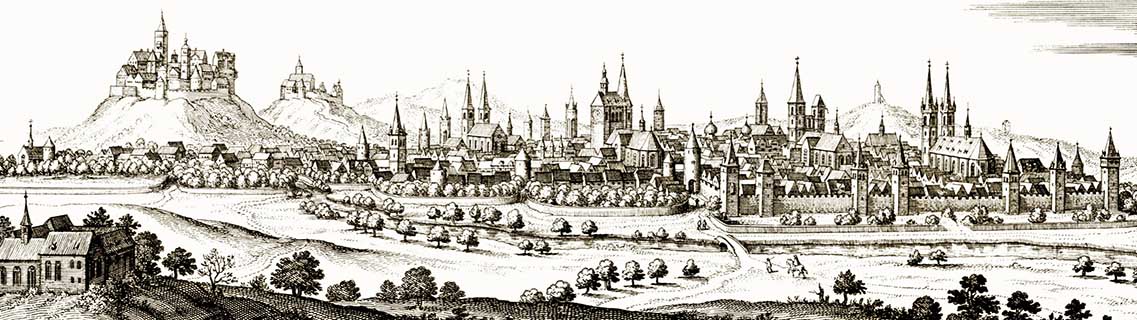
Quedlinburg by Merian, 1647.
Regarding the Frankish-Thuringian War,
the Annals localize at least three battles
between the rivers Weser and Unstrut. The places Maerstem and Arhen,
modernly
identified with e.g. ‘Marstem at Hanover’ and ‘Ohrum on the Oker’, are
also mentioned in the accounts about the Saxon campaigns of
Charlemagne. The texts written at Quedlinburg do not relate the
battle between Thiadric and Irminfrid on location
called Runibergun by Widukind – either Ronnenberg at Hanover,
region of Marstem or, less likely, Ronneberge
at Nebra. It should be further annotated that Widukind’s urbe
quae dicitur Scithingi does re-appear in the Annals as
the
important place of siege and conquest ( Schidinga).
However, its contextual fortification
cannot be proved as a contemporary venue for
archaeo-chronological reasons if equated with the castle’s ground area
of the
pre-Carolingian foundation at Burgscheidungen on
the Unstrut; notably M. Springer (op.
cit.) quoting Erika Schmidt-Thielbeer, Burgscheidungen,
in: Handbuch der historischen Stätten Deutschlands vol.
II,
Stuttgart 1987, p. 62. The Quedlinburg author
connects this obvious place with
|
| |
|
Irminfridus
autem cum uxore
et filiis, et
uno milite Iringo nomine, capta a Saxonibus noctu civitate Schidinga
qua se concluserat, vix evasit.
(loc. cit. p. 32)
|
|
|
Thus, the
decisive battle, now with Saxons aiding the Franks, has been situated
somewhere on the Unstrut.
|
|
4.1
The Annals ' Second Source
The Quedlinburg chronicler seems to
provide an amalgamation of obvious divergent spatiotemporal traditions
about
figures representing or equated with ‘Ermanricus’, ‘Attila’,
‘Theodericus’ and
‘Odoacrus’.
|
| |
|
This author(ess) reports that
|
| |
| 1. |
between 450 and
457 Ermanricus (...) let kill his only son
Fridericus, and then let hang his relatives Embrica and Fritla ‹
who are mentioned as ‘Emerca’ and
‘Fritla’ by the Widsith ›. Likewise,
at the instigation of his
kinsman Odoacer, he expelled his kinsman Theoderic from Bern and forced
him to go into exile to ‘Attila’, |
|
|
|
‹ whose regnal right of disposal obviously
includes
the northern Húnaland
with eastern regions of the Harz, since › |
|
|
| 2. |
between 491 and
518, (...) ‘Theoderic’ was returned to the kingdom of
the Goths by the support of ‘Attila’, overthrew his relative Odoacer at
‘Ravenna’, and – after leaving him alive at the
intercession of Attila –
sent him into exile to a few estates he donated him at the confluence
of the rivers Elbe and Saale; |
|
|
| 3. |
also in this period (...) Ermanricus, king of
the Goths, was chopped off his hands and feet and thus
deservedly slain by the brothers Hemidus and Serila and Adaccarus,
whose father he had killed. |
These interrelated passages read as follows [cf. MGH SS
3, p. 31 ]: |
| |
| 1. |
Eo
tempore Ermanricus super omnes Gothos regnavit, astutior in dolo,
largior in dono; qui post mortem
Friderici unici filii sui, sua perpetrata voluntate, patrueles suos
Embricam et Fritlam (=
‘Herlungos’?) patibulo suspendit.
Theodericum
similiter, patruelum suum, instimulante Odoacro
patruele suo, de Verona pulsum apud Attilam
exulare coegit. |
| 2. |
(...) Theodoricus
Attilae regis auxilio in regnum Gothorum reductus, suum
patruelem Odoacrum in Ravenna civitate expugnatum
interveniente Attila, ne occideretur, exilio deputatum, paucis
villis iuxta confluentiam Albiae et Salae fluminum donavit.
|
| 3. |
Ermanrici regis
Gothorum, а fratribus Hemido et Serila et Adaccaro, quorum patrem
interfecerat, amputatis manibus et et pedibus turpiter, uti dignus
erat, occisio. (...) Theodoricus
Attilae regis auxilio in regnum... [→
2.]
|
|
|
Excerpt (1.)
on
Ermanricus, right before the mention of Aëtius, who defeated
Attila’s
campaign of terror in Gaul amid 5 th century,
is partially
identifiable with some contexts provided by the Thidrekssaga,
cf. Mb 278, Mb 282. This excerpt
refers to
the reign of East Roman Emperor Marcianus, misspelled as Martianus
(‘cum Valentiniano’) in the
Annals.
As regards excerpt (2.),
the Quedlinburg chronicler assigned its contents to the period of
Emperor Anastasius I Dicorus (491–518), in
which the
chronicler mentions also Ermanricus ' death.
However,
both the date and cause of his violent death cannot refer to the end
of the Greuthungian Gothic king who died in 375. The slaying
of Ermanricus has obviously to do with the ‘Svanhild-story’ that was
originally brought or made up
by Jordanes. His pretty legend has been estimated
less believable against the report by Ammianus Marcellinus on the cause
of death of the Greutungian ruler. Thus, according to
text critical research on both writers, Jordanes may have been confused
with another individual called or
nicknamed ‘Ermanaric’, who is said by the Annals to have
murdered the father of the revengers. Furthermore, it might be
interesting to read between the Annals '
lines that Theoderic got back his
kingdom after the removal of
Ermanric by Guðrún’s sons
(!), cf. ch. 4.3.
Theoderic’s ascription to an ‘exiled hostage’ in the period of
Marcianus (450–457), as provided by the Annals, was apparently
a further good argument for scholarly conclusion that Dietrich/Thidrek
should be taken for the heroized
Ostrogothic king. Historically, however, this Theoderic was never
expelled from the Italian Verona, rather he attacked Odoacer who
entrenched himself in Ravenna. Three decades earlier, based on
negotiation
and agreement, Theoderic
had left the Pannonian seat of his father. This was certainly not an escape
to the Byzantine Court of Marcianus '
successor Leo I at Theoderic’s age of
about eight in c. 459; cf. Jordanes who claims his stay there for ten
years. It is obvious that this context appears less connectable to
his escape myth 30/32. Both before Theoderic’s transfer and a
few years after his return, usually dated 469/470, it was not he but
his father
who led the kingdom which, however, became his own not before 474/475.
Thus, this Ostrogothic Theodoric cannot be considered
for the re-enthronement in his ancestral realm under the
period of Anastasius.
Moreover, due to the obvious massive
support given by Thidrek’s mighty patron to
reconquer his residence Bern, as accordingly chronologized
by Ritter, only the Húnalandish but not the more southeastern
Hun ‘Attila’ († 453) would match the period of Anastasius
(491–518). Compared to the Italian Battle
of Ravenna, Gransport (dated c. 515 by Ritter) appears not as a
defeat for Dietrich/Thidrek,
rather a considerable weakening
both for himself and his most eminent foe. In the course of the Battle
of Ravenna, the
trapped Odoacer failed with two attempts to break out and he was
therefore
ultimately dependent on peace negotiations. The historical dating of
Theoderic’s transfer to Byzantium deviates less than two years from the
chronology of the Annals, which seem to offer an interpretable stay of
at least 33 or 34 years
outside his father’s kingdom for southern Dietrich poetry, as
to calculate
from the end of Marcianus ' reign to the beginning of
Anastasius ' period.
In this context, besides, we can also refer not only to Ritter’s
conclusion on summer and winter
counting related to the life of Hildebrand.
Ermanaric’s age of death, as retold by Jordanes, is possibly/likely
based on
this
counting mode. In this respect, he and
Clovis would have reached roughly the same age. According to Gregory’s
half-decade time grid for dating almost all events, however, only an
approximate lifetime can be assumed for the latter; notably e.g.
Laurent
Theis, Clovis: de l’histoire au mythe (1996),
p. 52.
It may seem worthy to remark that Frankish king
Clovis died also in Anastasius ' reign!
Futhermore, it is worth mentioning that
Gregory of Tours knows of an explicit Saxon chieftain called Adovacrius,
Adovagrius (hist.
II,18), Odovacr(i)us (hist.
II,19), who had to do with Childeric in Gaul and fought with
him against the Alemanni in Gregory’s text.
The Liber Historiae Francorum provides
the form Adovagrius, cf. MGH SS rer.
Merov. 2
(ed. Bruno Krusch, Hanover 1888) p. 23828,
while the Annals know of an Odoacrus who was exiled by
Theuderic (see above). As remarked farther below, the 9 th-
century historiographer Rudolf of Fulda wrote that the Saxon commander H(*)adugoto
supported him against the Thuringians.
Thus, at hand of these
accounts, the scribe at Quedlinburg has apparently mixed Ostrogothic
with eastern Frankish and local history at first glance. However, (s)he
points out
that the northern ‘Odoacer’ was not killed by
‘Theoderic’ at ‘Ravenna’: ne occideretur. It is thus obvious
that the chronicler knows of another version, namely about the murder
of the Italian Odoacer by the Amalian Theoderic.
The Annals let us further know that an
obvious second ‘Attila’ successfully supported the re-enthronement of
this territorial ’Ostro-Gaulish’
Theoderic, as the latter then banished the former ‘Odoacer’ to an
estate
on the confluence of Elbe and Saale rivers (why? → ch. 4.4 with
proposed solution). This second
Attila, of an obvious other tradition, must not necessarily
be forwarded anachronistically by
the Ottonian scribe, nor this Theoderic have been the Ostrogothic king,
nor that 5 th-century ‘Ermanaric’ and the
Saxon
Odoacer have been uncontemporary.
Intertextually, as already considered above, it is now obvious
that the De
Origine Gentis Swevorum, 9 (op. cit. p. 160) does not
contradict the lifetime period of the second northern Attila
rex Hunorum on whom the Annals have noted his date of death
as a 6 th-century
contemporary of Theuderic I
and Thuringian king Irminfrid (see on both Gregory of Tours at hist.
III,7–8).
Apparently not attaching relevance to the chronicle
written at
Quedlinburg, Ritter recognized King Ata la’s
death
in the period of Justin (527–564/565) and localized the seat of the
mighty sister of that Húnalandish king in the region of the Harz
mountains by means of the Old
Norse +
Swedish manuscripts. |
|
4.2
Historiographical validations: Frankish and Saxon
history
Slashing Iring’s rôle
colported by Widukind, the Annals are forwarding a more brief
version of Widukind’s tradition on Amalberga’s
and Irminfrid’s incitement leading to Theuderic’s military expedition.
The core of this account knows even
the author of the De
Origine Gentis Swevorum. Regarding the
Frankish-Thuringian War, Matthias Springer reviews the competence of
the scribe or
‘scribess’ at Quedlinburg with this general assessment:
|
| |
|
Die
Arbeitsweise des Quedlinburger Verfassers
ähnelt durchaus der eines neuzeitlichen Historikers. Da er aus dem
„Buch der fränkischen Geschichte” wusste, wo Irminfrid den Tod
gefunden
hatte, wird er Widukind’s lange Erzählung von Iring für eine
„Sage” gehalten haben, zumal der Corveyer Mönch selber die
Schilderung als kaum glaubwürdig bezeichnet hatte. (Op.
cit.
p. 93.)
|
| |
|
[The
operating principle of the author at
Quedlinburg
might resemble well that of a modern historian. Since he knew from the
‘Book of
Frankish History’ where Irminfrid met his death, he might have
estimated the long story of Iring as a legend, the more so as the monk
of Corvey himself had been qualifying this account as barely
credible.]
|
|
|
Rudolf of Fulda (aforementioned),
who most likely represents an important source of Widukind,
writes on Frankish-Thuringian War that Thiotricus rex Francorum
could only overthrow the Thuringians with aid by obvious ‘Anglo-Saxons’
under their leader Hadugoto (cf. Translatio
Sancti
Alexandri, auctoribus Ruodolfo et Meginharto). Adam of
Bremen, another German historiographer of 11th
century, basically conveys Rudolf’s version (Gesta
Hammaburgensis ecclesiae pontificum, ch. III).
It seems
not unproblematic to except definitely any
involvement of Anglo-Saxon mercenaries and/or ‘true Saxons’ north or
northwest of the Thuringians in this war. The participation of
sailing forces Saxones ex gente
Anglorum, provided at first
by Rudolf and thereafter re-introduced by Widukind and the Annals, has
been challenged to
detect as fiction,
notably Richard Drögereit who finally concludes: «Rudolf
zeugte die Fabel, Widukind zog sie
mit Liebe groß». (Die
sächsische
Stammessage,
in: Niedersächsisches Jahrbuch für Landesgeschichte
26,
1954, see p. 197; id., Die „Sächsische Stammessage”.
Überlieferung, Benutzung und Entstehung, in: Stader
Jahrbuch
Ser. NF, vol. 63, 1973, pgs 7–58.)
|
|
|
Possibly serving for narrative motif
and solution in this apparently blurry context, Martin Lintzel
remembers Procopius (History
of the
Wars, Gothic Wars, VIII, xx,6
[English
edition]) who
knows of Anglo-Saxons (people of ‘Brittia’ =
‘Angili,
Frissones, Brittones’)
emigrating
back to ‘less populated’ territory of the Franks and to the Varni
(M. Lintzel, Zur Enstehungsgeschichte
des sächsischen Stammes, in: Sachsen und Anhalt 3,
1927, pgs
1–46, see fn. 132). With further connotation
basically agreeing: Reinhard
Wenskus, Sachsen –
Angelsachsen – Thüringer, in: Walther Lammers (Ed.), Entstehung
und Verfassung des
Sachsenstammes, Darmstadt 1967, pgs 483–545, see p. 520f.
|
|
|
Richard Drögereit and Matthias
Springer (op. cit. pgs 75–89) strongly reject a
believable ‘migration-and-origin tradition’ of the Saxons
which is somewhat echoed by the eldest trio of Rudolf of Fulda,
Widukind of
Corvey and the Annals. While Drögereit does basically follow
Sigurd Graf von Pfeil, Die Sachsensage bei
Widukind von Corvey, Göttingen 1968, p. 46,
Hilkert Weddige seems to resume the disparate scholarly
opinions with this compromise (Heldensage
und Stammessage. Iring und der Untergang des Thüringerreiches in
Historiographie und heroischer Dichtung [Tübingen 1989]
p. 39):
|
| |
|
Hathagat
und die mit ihm verbundenen
kultischen Elemente werden wohl autochthon-altsächsischer
Überlieferung entstammen, während das Eingreifen der Sachsen
in den Thüringerkrieg auf Grund eines fränkischen
Hilfegesuchs sowohl auf einem realhistorischen Faktum als auch auf
einem literarischem Schema beruhen kann.
|
| |
|
[Hathagat
and the cultic elements being
connected with him might be derived from an autochthonous Old Saxon
tradition, while the
intervention of the Saxons into the Thuringian war on Frankish request
of help can be based on an actual historical fact as well as a literary
scheme.]
4.3 Guðrún’s
sons vs Ermanric by the Second Source
Already proceeding from the Annals and
Nordic traditions, we can follow close spatial relations between this
Ermanric, the Franks, and their neighbouring peoples for both
geostrategical and historical contexts, cf. i.a. William J. Pfaff on
Ermenrik in the Thidrekssaga (ch. 10.1). This narrative
environment can also be solidified with the Guðrúnarhvǫt,
the Hamðismál, and
the historical potential and interpretation of Clovis '
takeover of King
Sigibert’s realm (cf. Gregory of Tours, see ch. 9). This Rhenish king can
be paralleled with that Sigurð whom Frankish king Clovis let slay
on a hunting trip somewhere east of the Rhine – where
Sigibert/Sigurð
had a secret treasure hoard. Thus, interliterarily,
Jǫrmunrek r ( = Ermanric → ‘Clovis’)
appears accessible
to Sigurð’s and Guðrún’s daughter Svanhild. This
approach seems plausible since the kingdom of her murdered
father was obviously adjacent or pertaining to the Rhenish realm of Dietrich/Theuderic
with their seats Verona–Bonn
and Tolbiacum/ Tulbiacum–Zülpich by Thidrekssaga
and Gregory of Tours.
Further, basically supplementing the Annals, we know from the Ragnars
drápa loðbrókar,
the eldest surviving Skaldic poetry of the 9 th
century, that Guðrún’s
sons Sǫrli and Hamðir are said to have fought in Jǫrmunrek r’s
hall. Since the revenge motif of Kriemhild
has long been propagated by the Nibelungenlied, the Nordic
Grímild r or Guðrún or both could have
been aware also
of the
complicity of Jǫrmunrek r/Ermanric in Sigurð’s death
and thus
motivated Sǫrli and Hamðir for taking revenge on the real mighty
ruler who hired and/or allowed the Niflungs to slay Sigurð (with
involvement of his deceived son). This seems actually to be the most
probable second motive which the authoress of the
Annals might have submitted by omitting deliberately the name of the
father of
Serila, Hemidus, Addacarus, whom the Guðrúnarhvǫt
claims as Guðrún’s third spouse Jónak r.
However, in Germanic heroic legend he is nowhere connected with any
heroic or
other noteworthy account. Thus, if the Annals '
chronicler had suspected
him of being a narrative duplication of Guðrún’s first
husband Sigurð, she may
have done well not to give any further thought to the paternal side of
Hemidus/Hamðir and Serila/Sǫrli for her account. Furthermore,
considering Guðrún’s
traditionally rooted desire for revenge, it is by no means excluded
that – rather by primal tradition – her daughter Svanhild, (step)sister
of Sǫrli and Hamðir, had already fallen victim
to a failed plan of revenge against her spouse Jǫrmunrek r/Ermanric,
who has been seen responsible for the slaying of her father Sigurð.
At hand of all these transmissions, however, neither their origin nor
all their figures can be made probable in southeastern Europe, cf. the
textual criticism on Jordanes ' pretty legend of
‘Ermanaric’ already by high mediaeval chroniclers. So we may certainly
estimate that the Annals are of special value for (historical)
interpretations of chronicles, sagas and legends. Since we know
that the latter genre of transmission does not necessarily have to be
interested in the real political background of an event, its focus
can rather be on figurative heroic rendering and effect, which may be
thus subject to ‘transformation’ through the use of even external
motif patterns.
4.4 Second ‘Attila’
and Second ‘Odoacer’ by the Second Source
It is obvious that both the Amalian
Theoderic
and the first Frankish Theuderic could never meet
an Ermanaric as their most influential antagonist in an Ostrogothic
sphere, but the first Frankish Theoderic be the historical contemporary
and successor of that ‘Ermanaric’ whom the Quedlinburg
Annals chronologize as a contemporary of an obvious Saxon Odoacrus
between 491 and 518. Since we find
him in this chronicle actually just ‘overthrown’ (expugnatum
but not occideretur) at Ravenna, which is now to be
localized,
he did not necessarily have to have been killed there.
The Thidrekssaga
may shed light on this context and, implicitly, the Saxon one of
obviously two interwoven Odoacers:
|
| |
Since the 9 th-century
version of the Hildebrandslied
provides an ‘Odoacer’ as the individual who expelled Dietrich,
it may be apt to hypothesize the parallel that
Gregory’s Gallo-Saxon ‘Odovacarius’ (the Liber’s
Adovagrius) banned the Frankish Theodericus on behalf of Clovis
(counselled by Aurelian) or an ‘Ermenrik’ advised by Sifka:
When appearing as Thidrek’s former enemy in the Rabenschlacht
on the Moselle, (*)
accordingly either TRAVENNE (see above ch. 3.1)
or RAVENTHAL at GRANSPORT
dated 515 by Ritter,
the Saxon warlord would have been as an ambitious commander on
Ermenrik’s side and –
hence – deserved thereafter to be banned
by Thidrek =
Theuderic. Furthermore, according to the Old
Norse + Swedish
texts and
Gallo-Roman sources, either Ermenrik or his historical placeholder was
responsible for the political
desolation and isolation of Roma II = Trier in 5 th
and 6 th
century, as this political status has been clearly connoted also by
Late Antique clerics, e.g. Avitus of Vienne, and attentive historians,
cf. e.g. Hans Hubert Anton, Eugen Ewig.
—————————
* This
area around the Confluentes
up to the Pellenz (cf. Puli in the Old Norse
manuscripts), derived from Latin Palatia, was of remarkable
economic importance and thus
densely populated in early times. For example, the General Directorate
for Cultural Heritage Rhineland-Palatinate (formerly: Landesamt
für
Denkmalpflege Rheinland-Pfalz) uncovered a huge burial ground at
Thür, western Pellenz, which encompassed more than 1100 graves.
These were mainly Frankish graves of Migration and Carolingian Period,
but there were also Roman and Celtic among them. Typical ground plans
of Celtic houses built as early as in 5th century B.C. were also found
there. This region may appear of same literary place value
as Dietrich’s Bern,
cf. Vernica at
Zülpich near Verona
= Bonn on the Rhine, cf. Bernkastel-Kues on the Moselle as a possible
memorial
of a Bern castle. The Chronica regia
Coloniensis dates to the year 1197 that a Theodoricum
Bernensem, ‘who appeared as a mirage on a black horse on the
Moselle, is said to have announced that various misfortunes and
miseries would befall the Roman Empire’. 
|
|
| 5.
How reliable is Gregory of Tours east of the Rhine ? |
|
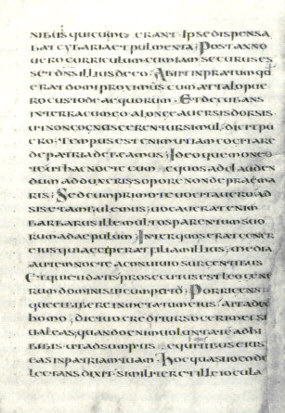 A page of a mediaeval transcription
of a vellum
A page of a mediaeval transcription
of a vellum
written by Gregory.
|
Gregory apparently put forward
unsatisfactory information about Theuderic’s descent and vita. On the
one hand, he considers him well as pre-eminent son of Clovis,
but on the other, he would not satisfyingly recite a supporting
scale of examples. The more we closely follow Gregory to Clovis and
Theuderic, the more queries we get. Nonetheless, it seems plausible
that the mightiest Frankish king kept an eye on the young designated
king of an important eastern kingdom between the Meuse and the Rhine.
Yet, Gregory actually appears credible in this case if he calls Clovis
at
least the
political foster-father of Theuderic.
In general, there is sound criticism
of Gregory’s attitude of rendering history by
ignoring or misrepresenting history among scholars who have been
contributing to the prevailing scholarly opinion; see, for instance,
Ian N. Wood, Walter A. Goffart, Matthias Springer, Georg Scheibelreiter.
|
|
|
The historiographical dilemma
of 5th
to 6th
century naturally encompasses the family of Chlodio, head
of a Frankish dynasty in the very dark shadow of
Gregory’s brightly shining early Merovingians. An old tradition,
written
as a chronicle to be titled as Geographia
et Historia Montis, refers Chlodio’s
most influential son ‘Alberon of Mons’. John Mack Gregory translated
this account on him and his residential location:
|
| |
This town was at
first founded by Alberon, a Prince of France, son to Clodion the Hairy,
King of France, and grandson to Pharamond the Great, first King
thereof; who, in the year of our lord 449, being left, by his father’s
death, to the guardianship of his kinsman Merovec, and his guardian
having deprived him of his inheritance, and usurped his crown to
himself, went thereupon into Germany, to sollicit assistance to recover
his right, and was assisted by the Germans ‹ the
Alemanni according to Jean-Baptiste Gramaye on François de Rosières
› so powerfully, as
that, in
progress of time, he recovered all the lower Austrasia, and a good part
of Belgium, as far a Tournay and Cambray; and, in the year 481, he came
hither into that country, where now Mons is...
(The Geography and
History of Mons, in: THE HARLEIAN MISCELLANY
XI, p. 90.)
http://books.google.de/books?id=Qh0wAAAAYAAJ
(retrieved Oct. 2010).
|
|
|
According to Jacques de Guyse, Annales
Historiae illustrium Principum
Hannoniae, and the editions of Jean-Baptiste Gramaye on
this region (see Antiqq.
Brabantiae, ed. François de Rosières),
Chlodio
ruled together with Merovech during the period of Aegidius. Chlodio is
said to have appointed Merovech as a guardian of his sons in case of
his death, but, according to these sources, he had appropriated their
royal heritage
unlawfully. The authors of these texts convey three sons of Chlodio:
Albero of Mons,
Reginald
(‘Chlodebald’),
Ranicar (or Raginar). When Albero died in 491, he left at least two
sons,
Walbert I and Ragnachar (Ragnicar) of Cambrai,
who was
later slain by Clovis in Cambrai. Furthermore, these sources maintain
that
Chlodio’s son Albero, who certainly was not Childeric, was married with
a
sister of the Italian Theoderic.
|
|
Regarding the position of the Frankish
Theuderic I
in the Thidrekssaga and Merovingian history, the author
remarks at endnote 22 of
his article Wadhincúsan,
monasterium Ludewici, catalogued at the National German
Library
DNB (urn:nbn:de:
0233-2009033115, updated version at
https://www.badenhausen.net/harz/svava/MonasteriumLudewici.pdf
): |
| |
|
Zumindest
finden wir im Reallexikon
der Germanischen Altertumskunde, vol. 30 (2005), unter Theuderich
I. (S. 459–463) die völlig zurecht formulierte
Quellenkritik, dass Gregor von Tours behauptet, T.s Mutter sei nur
eine Beischläferin (concubina) Chlodwigs I.
gewesen (S. 460). Dort heißt es weiter über
diesen Theuderich (S. 459), dass er vor 484 geboren sein soll
und die erste Tat aus T.s. Leben, von der wir wissen sein nach 507
im Auftrag Chlodwigs I. unternommener
südgallischer Feldzug war (S. 461). Nachdem Theuderichs Sohn
Theudebert eine „Däneninvasion” im väterlichen Auftrag
zurückgeworfen haben soll, spätestens 520 – nach Chlodwigs
Tod –, dokumentiert Gregor von Tours erstmals die monarchische
Autorität Theuderichs aus der Kölner aula regia. Für die
Interpretation von Vertreibung, Exil und Rückeroberungsberichten
der
Thidrekssaga ist also keineswegs ausgeschlossen, dass deren
Protagonist Theuderich in einem Machtkonflikt unterlag, welcher
entweder Konsequenzen aus seinem südgallischen Zug von 507/508
nach
sich zog oder einen paternalen/maternalen und damit auch rheinische
Gebiete tangierenden Erbrecht-Streit betroffen haben konnte. So,
wie im subjektiv-subtilen Vorstellungskomplex ein scheinbar
verlässlicher fränkischer Historiograf die Mutter Theuderichs
bewusst verkannt haben mag, durfte dessen Vater von einem
nicht minder verzerrenden mediävalhistoriografischen Konzept
– das aus niederdeutschem Traditionspatriotismus nicht weniger
als die Tilgung des primus rex Francorum der Lex
Salica ausmachen konnte – mit einer in der Thidrekssaga
überlieferten Ersatzgestalt unkenntlich gemacht werden.
|
| |
|
[The
author of
the article Theuderich I. in the Reallexikon
der Germanischen Altertumskunde, RGA 30 (2005), pgs
459–463, rightly issued: Gregory
of Tours claims that the mother of T. was just a
concubine of Clovis I (p. 460).
Furthermore,
the
encyclopaedist states op. cit. p. 459 that Theuderic is supposed to
have been born before 484
and the first
deed of T. we know of was a campaign to South Gaul after 507 on
behalf of Clovis I (p. 461). After
Theuderic’s
son
Theodebert I repulsed a ‘Danish invasion’ by order of his
father, not after 520 but certainly after the death of Clovis,
Gregory of Tours begins to document the first appearance of
Theuderic as royal authority at the aula regia of Cologne. ‹
Rem.:
between 520 and 525 he was already aged at
least between 36 and 41! › Comparatively
regarding the
interpretation of humiliation, exile
and reconquests related by the Thidrekssaga, it is certainly
not out of the question that its protagonist Theuderic had to
bear consequences of either his South Gaulish campaign (507/508) or an
hereditary conflict with a kinsman of his paternal or
maternal line about territory even on the Rhine. When an
apparently reliable but nonetheless subjective and subtle Frankish
historiographer seems to have intentionally misjudged
Theuderic’s mother, the mediaeval historiographical concept of a
patriotic Low German
history could have faded out nothing less than the primus rex
Francorum
of the Lex Salica in order to make Theuderic’s father
unidentifiable with
a placeholder who could appear then in the Thidrekssaga.]
|
|
|
It may seem flashy that
Thidrek’s father is named after Gregory’s ‘first known’ rex
Francorum whom he provides as Theudomar (Theudomer), as
Eugen Ewig remarks well this ranking by disregarding Theudomer’s
father Richimer; see Gregory’s hist.
II,9
and Ostrogothic genealogy, cf. e.g. Trojamythos
und
fränkische
Frühgeschichte, RGA 19 (1998), p. 14.
The Guðrúnarkviða
III (in þriðja) calls Þioþrecr’s
father Þioþmar,
a correlation which has been so gushily regarded as an evidential
reflection of only an Ostrogothic pattern. As already annotated, the
name of Thidrek’s grandfather Samson does also appear
in
Merovingian genealogy, see Gregory’s hist. V,22.
The Thidrekssaga conveys in Mb 6 an obvious mighty ruler Þetmar
whom the
Icelandic MS A specifies as Thidrek’s
great-grandfather, whereas the scribes of both the eldest vellum
manuscript and MS B ascribe him to a
great-uncle of
Thidrek’s father; see recursively Mb 9. Since
Thidrek’s father Þetmar II
died apparently young, see chronologically Mb 12, Mb 131, we should not
discard the possibility that another close
and
mighty kinsman of him was historiographically supposed to be the father
of Thidrek. This alternative option, apart from nothing more
than a potential interpolation with either the
Ostrogothic Theodemir or, more likely, an early Frankish offspring
named after Gregory’s ‘first known’ rex
Francorum, may even appear as a rough literary
approximation related to the descendance both Thidrek –
Ermenrik and, finally
‘historically’, Theuderic – Clovis.
|
|
|
Regarding reliable genealogical
information about Frankish kings of times until the second half
of 5th century, we only
can say that Gregory left nothing more than assumption.
|
|
|
6. Interliterary
recognitions:
Chlodio and Hlǫðr in
northern Húnaland
More noteworthy onto the likelihood of
the northern
geographical environment of Eormenric the ‘Gaulish’ Gotan,
appearing as a candidate for the identification with Clovis I,
might be the
article by Reinhard Wenskus: Der
‘hunnische’
Siegfried, in: Heiko Uecker (Ed.) Studien zum Altgermanischen...,
RGA
Ergänzungsband 11 (1994), pgs 686–721.
|
|
|
First, Wenskus reviews briefly Otto
Höfler’s publication Siegfried, Arminius und
die
Symbolik (Heidelberg 1961, p. 13). The former
argues that
Sigurð’s geographic apposition hunskr, as provided by Sigurðarkviða
hin skamma (The Short Lay of Sigurð)
and the Atlamál
hin groenlenzku (The Greenlandish Lay of Atli),
would hardly ascribe the hero’s roots to Southeast Europe but rather
North German(ic) Húnaland. Second, Wenskus
recognizes an
eye-catching frequentness of Middle Rhenish location names with forms
related to ‘A(-)mal’, ‘-mal’,
‘-mael’,
‘-mall’. This observation was afterwards significantly substantiated by
Otto K. Schmich (op. cit. 1999,
p. 240),
who gives credit i.a. to J. M. Watterich, Die
Germanen des
Rheins… Leipzig 1872, p. 230. Schmich supplements
remarkably
with related names of hydronyms. Both authors discern these
outstandingly appearing names of locations and watercourses in the area
between the Middle + Lower Rhine and the Meuse,
as this
perception will be combined later.
Between Visigoths
and
Ostrogoths: the ‘Central Goths’:
|
| |
According to Wenskus '
approach we should not disregard
the potential literary confusion of this
‘Gaulish’ with ‘Gothic’ territory and, therefore,
not disrespect that in
the Migration Period (the narrative ‘horizon of event’) Nordic
tradition could
have
associated the latter with rather the Gaulish kingdom of Clovis I
and his predecessors than the Italian or southeastern region on the
Tisza. Reinspecting under this
fundamental aspect the Hlǫðskviða (The
Battle of the Goths and Huns), Wenskus considers Árheimar
as the Arnhem of the later
Netherlands as one important location of the North Gaulish ‘Goths’.(10)
Furthermore, Wenskus takes critically account of
Helmut Humbach’s article on the geographical names in the Old Icelandic
‘Lay of the Battle of the Goths and Huns’: Die
geografischen
Namen des altisländischen Hunnenschlachtliedes, Germania
47, 1969, pgs 145–162.
As insinuated by Wenskus, the message of this discourse is of
altogether missing persuasiveness in so far as it proceeds from an
original southeastern core around the Black Sea but not Húnaland
around the later German Westphalia, as, for instance, explicitly
determined by the Thidrekssaga
and the Old Swedish manuscripts. Regarding a basic
interfigural recognition in this more authenic appearing area –
seemingly not far
from an ‘Amal-Gothic’ land even for dynastic ancestral reasons, as
apparently delineated by the Hervarar saga ok
Heiðreks
which includes the Hlǫðskviða –
Wenskus advisably collocates its eminent Hlǫðr
with C(h)lodio, one potential
progenitor
of the Salian
Franks who lays
an heritage based claim to a northeastern Gaulish region which appears
closely related with Húnaland.
Furthermore, it seems not inappropriate
to remember at this juncture that Isidore of Seville has
already combined this ethnic and etymologic relationship (Etymologiae
IX, II, 66): |
| |
|
Hugnos antea Hunnos
vocatos, postremo a rege suo Avares appellatos…
|
| |
|
[The
Hugni (apparently
more likely: Hugas),
previously called the Huns, thereafter called Avars according
to the name of their king…]
|
|
The Hugas
have been scholastically identified with the Chauci, since this tribe
seems partially connectable not only with ‘northern Húnaland’
but also
the ‘Origo gentis’ of the Franks, cf. on the latter RGA
22
(2003) p. 189f. [Translated version].
The Hlǫðskviða
begins with this statement: |
| |
|
Hlǫðr var
þar borinn í Húnalandi
|
| |
|
[Hlǫðr
was born there
in Húnaland.]
|
|
The Thidrekssaga (Mb
39→), the Old Swedish version (Sv
33→) and Suffridus Petrus (op. cit.)
seem to continue this heroic lay with Frisian counterattacks
against an old weakening Húnalandish king called Melias
by the
Old Norse + Swedish texts which relate that he
had no
son for heir. He
was possibly a relative of Humli or
someone of his successors. Incidentally, Wenskus proposes the last
Sugambric chief Maelo, who caused a heavy defeat to the Romans, as
eponymist of the Húnalandish Melias who should be taken
into
consideration as predecessor of an Eadgils–Adgils–Athils;
see farther below. Melias' obvious residence Susat
was finally conquered by the Frisian prince Atala,
as localized
by the Old Norse + Swedish texts and dated
between 450 and 470 by Ritter, while Suffridus mentions a Frisiorum
dux Odilbaldus; see below Ferdinand Holthausen and
Willi Eggers. His his potential short name
‘Odilo’ might comply
with an etymological consideration by Wenskus who, in an independent
context, regards closely related name forms ‘Otilo, Uatalo’ even by
Upper
German texts of 7th–8th
century (op. cit. p. 708).
|
|
7.
Theuderic I
or Thidrek of Bern: «King of Bonn»
Theuderic might have known parts of
regions called later Ripuaria and Austrasia
already before the death of King Clovis I.
Although
Gregory of Tours is remarkably focussing on Clovis'
vita, the
appearance of this king was reported hardly ever on territory between
the Meuse and the Rhine. Thus, we further may imagine that Theuderic,
not only in mission for Clovis, kept an eye on the largest
metropolis on the Rhine: the former Roman Colonia with
adjoining Bonn, the ecclesiastical based Low German Verona on the
Rhine.
|
|
After the death of King Sigibert,
ruler of eastern Franks with their obvious capital at Cologne, formerly
the largest Roman colonia on the Rhine, Gregory remarks
Theuderic c. 525 at the aula regia of
this metropolis, cf. Liber vitae Patrum
VI,2. Since there is a ‘rhyme-chronicler’s tradition’ of
13 th century that strongly connects Bern
with Bonn « by Bunna, dat heisz man dô Berne»,(11)
we should not repudiate that a further but lost historical source could
have mentioned Theuderic or Thidrek of Bern emphatically
appearing there. As regards Gregory’s report in the Liber
Vitae Patrum VI,2 and the ecclesiastical history of Low
German Verona–Bern, it would not seem inconsistent that the
region or city being called BABILONIA(12)
was the most important
location on the Rhine to launch formative conversion of the heathen.
Following Gregory’s demonstrative and believable words in this
connection, the first and very remarkable 6 th-century
Christian Mission was undertaken by Theuderic in a region which
Ritter called Berner Reich, the territory extending to BABILONIA.
|
|
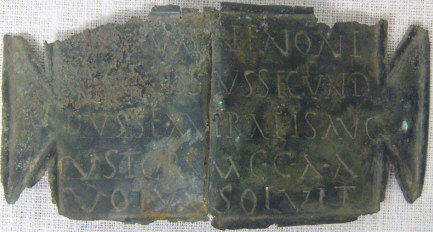
DEO
VARNENONI
M(ARCUS[?]) FUCISSIUS SECUND
DUS SEXVIRALIS AUG
USTORUM C(OLONIA) C(LAUDIA) A(RA) A(GRIPPINENSIUM)
VOTUM SOLVIT
Museum
Burg Frankenberg, Aachen. Cat. No. 27, formerly No. 188.
Photo by the author.
Interpretative
supplements put in brackets by W. M. Koch.
|
TABULA
ANSATA, found at archaeological explorations of VARNENUM
between 1907 and 1924, connotes well
the cultural and worshipping influence of this location on Roman
Cologne (C.C.A.A.), while VERONA appears to be
connected thereafter with adjacent Bonn in Christian times.
Inscription quoted from
Wilfried M. Koch,
Führer
zur
römischen Abteilung des Museums Burg Frankenberg, 1986,
p. 16.
Erich Gose,
Der
Tempelbezirk
von Cornelimünster in:
Bonner Jahrbücher
155-156, 1955-1956, p. 170. |
|
|
|
The special connectedness of ‘VARNE‘
with the C.C.A.A. has been estimated by Wilfried
M. Koch who explains the text on the above shown tabula as follows:
|
| |
Hier
hat M. Fucissius Secundus
aus dem Sechsmännerkolleg der Stadt Köln (Colonia Claudia Ara
Agrippinensium) sein Gelübde an Varneno mit Freude erfüllt.
Er gehört zu den Sevir Augustalis, die in der Stadt den Kaiserkult
vertreten. Er zählt damit zu den hohen Würdenträgern der
Stadt. Die Schenkung erhält damit eine größere
Bedeutung, ohne daß sie genauer bestimmt werden kann. Die Tabula
war früher zusammenklappbar, jetzt in der Mitte gebrochen.
(Op. cit. p. 16.)
[As shown here, M. Fucissius Secundus, of
the Six-Men-League of the City
of Cologne (Colonia Claudia Ara Agrippinensium), has fulfilled his oath
to Varneno with joy.
He belongs to the Sevir Augustalis who represent the imperial cult in
the city. He is thus one of the city’s high dignitaries. Hence, the
donation is of greater significance, albeit this cannot be determined
more precisely. The tabula, now broken in the middle, was originally
foldable.]
|
|
|
|
Furthermore, as regards an
exemplary relationship between the eminent place of worshipping ‘VARNE‘
and the C.C.A.A. in Roman times, Wilfried M. Koch quotes i.a.
recursively from the review of previous explorations written by
the archaeologist Erich Gose (op. cit. p. 171).
In
context
with the tabula ansata shown above, the aforesaid dignitary seems
to re-appear on another bronze plate which was also found in the temple
site of Varnenum. The inscription on this plate read by W. M. Koch
is
(DE)AE SUNUXSAL
VO (?) CISSONIS
V(OTUM) S(OLVlT) L(IBENS) M(ERITO)
[Interpretative
supplements put in brackets by W. M. Koch.]
|
| |
|
Von der
hier angesprochenen
Göttin Sunuxsal (oder Sunuxal) wird angenommen, daß sie die
Stammgottheit der SUNUCI war, deren Hauptsitz daher im Aachener Gebiet
vermutet wird. Von den SUNUCI ist bisher wenig bekannt, sie
dürften als befriedeter gallischer Stamm im Gebiet zwischen Aachen
und Tolbiacum/ Zülpich gewohnt haben. Die schwer
verständliche Lesung kann ggf. dahin ergänzt werden,
daß hier ein Familienmitglied der auf der Inschrift Kat. Nr. 27
genannten Familie Fucissius (= CISSONIS) aus Köln sein
Gelübde an die Göttin Sunuxsal (= DEAE SUNUXSAL) mit Freude
erfüllte (= VOTUM SOLVIT LIBENS MERITO).
|
| |
|
(W.
M. Koch, op. cit. p. 16.)
|
| |
|
[The goddess Sunuxsal
(or Sunuxal), as mentioned here, is assumed to be the main
deity of the SUNUCI (Sunici), whose seat thus may be presumed
in the Aachen region. So far as little is known about the SUNUCI, they
may have lived as a pacified Gallic tribe in the area between Aachen
and Tolbiacum/Tulbiacum/Zülpich. It seems possible to
supplement the
difficult reading with the meaning that a relative of the family
Fucissius (= CISSONIS)
of Cologne,
mentioned on the inscription cat. No. 27, may have joyfully fulfilled
his oath (= VOTUM SOLVIT LIBENS MERITO) to the goddess Sunuxsal (= DEAE
SUNUXSAL).]
|
|
|
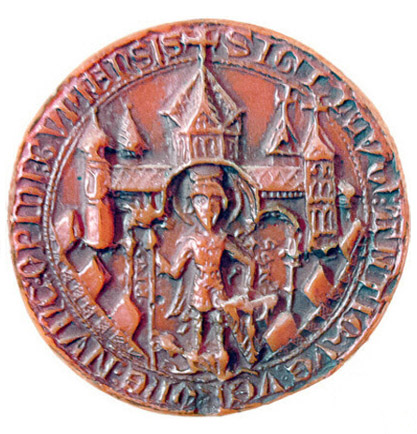 |
 |
SIGILLVM ANTIQVE VERONE NVNC
OPIDI BVNNENSIS
Seal of Bonn, 13th century.
Inventory pieces shown on the left & below:
Stadtarchiv und Wissenschaftliche Stadtbibliothek Bonn.
|
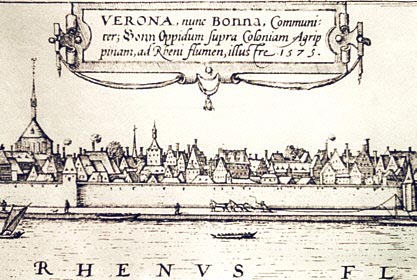 |
VERONA,
nunc Bonna, Communiter;
Bonn Oppidum Supra Coloniam Agrippinam,
ad Rheni flumen…
Detail from copper engraving by Georg Braun & Frans
Hogenberg: Civitates Orbis Terrarum, 1575. |
| |
|
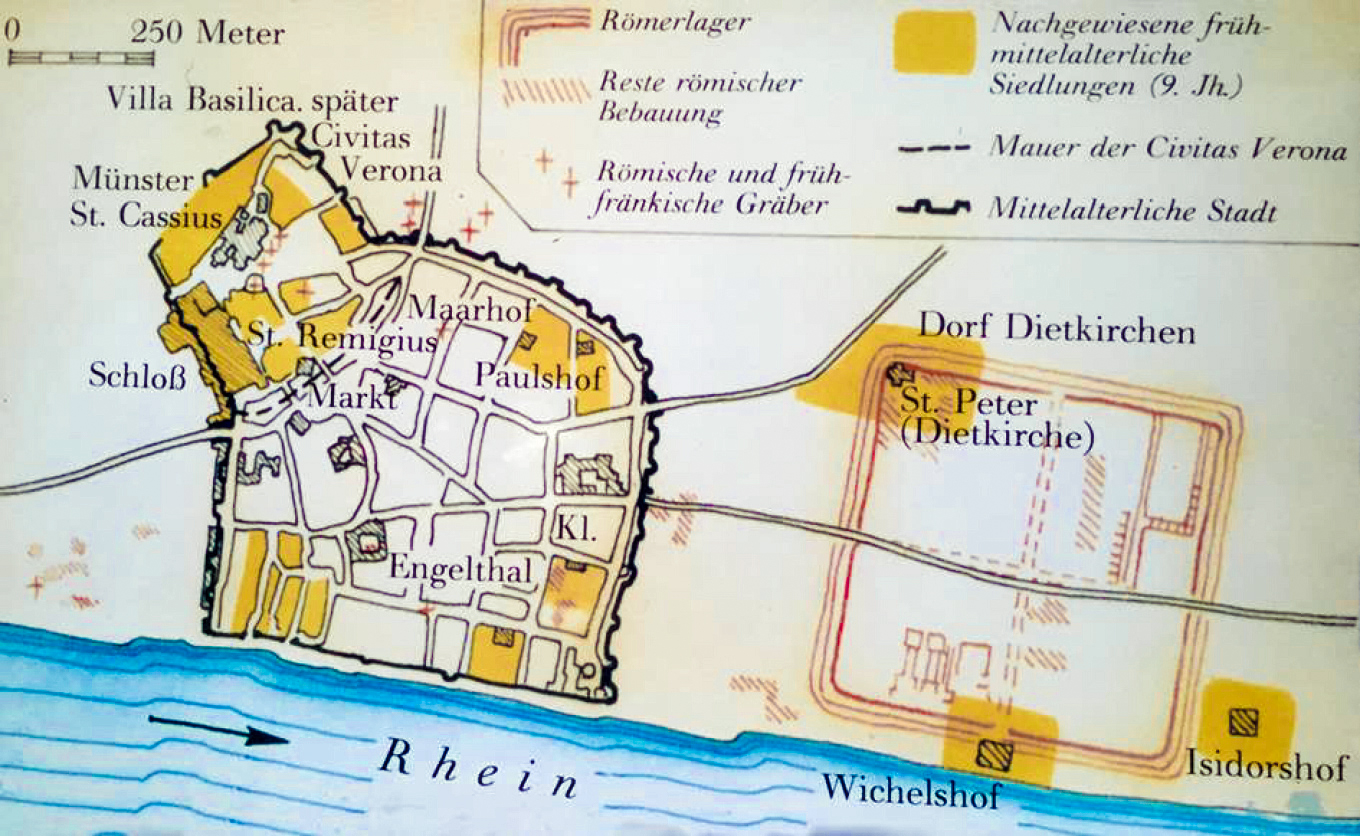 |
VERONA cisalpina according
to a mediaeval plan with the
Roman base CASTRA BONNENSIS on the right.
Source:
Stadtmuseum Bonn, published in DER BERNER 90, p. 57. Photo by
Reinhard Haase.
|
|
Verona
– Bern: contemporary
popular and literary transmissions obviously
outlasting the Roman Period:
Despite of the place and/or
region that the
Old Norse + Swedish scribes have forwarded as BABILONIA,
the spatio-historical
relationship of the C.C.A.A. with ‘VARNE’ is
substantiated by the geostrategical mapping which is obtainable from
the accounts
by Old Norse + Swedish manuscripts.
Other sources, in particular mediaeval local transmissions, may
qualify the Franco-Rhenish but at least Old German profile of Dietrich
von Bern in an interpretative connection with both locations.
Although Ritter has only focused Verona
nunc Bonna as the residential place of Thidrek af Bern
instead of a ‘regional border term’,
in so far not regarding the catchment and commuting area between Aachen
and the Rhine with its eminent cultural and economic significance since
Roman times, he was apparently not committing a real faux pas of
interpretation. Thus, with respect to the narrative dimension of
Thidrek’s or Theuderic’s large kingdom and action
spaces, the literary difference or the scaled distance between this
Verona and Varne(num) may appear rather infinitesimal.
With a view to the economic ranking of the Roman region of Aachen,
Heinz
Cüppers (op. cit. p. 12, fn. 46 ref. to H.
Petrikovits)
rates that the former existence of a remarkable sigillata pottery,
district
Schönforst, points to great economic importance as a significant
manufacturing and trading place. He underlines his estimations also
with large
calamine deposits found at
Breinig and Gressenich which suggest further processing and sales
facilities.
|
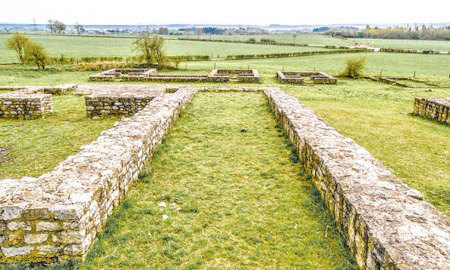 |
A
partial view of Varnenum.
Photo
by the author. |
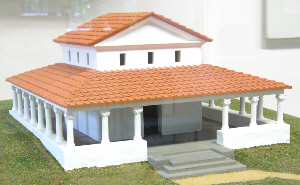 A
reconstruction model of a Varnenum main temple.
A
reconstruction model of a Varnenum main temple.
Museum
Burg Frankenberg.
Photo
by the author.
The
graphic renders an ecological exploration of the temple site basing on
phosphate
analysis of its soil.
The archaeological
research of this area has been not completed.
Source:
Thomas
Krüger,
Im
Labor sichtbar gemacht: Die Grundfläche des
RömischenTempelbezirks
Varnenum
in:
Archäologie
im Rheinland 1987,
Landschaftsverband
Rheinland, Rheinisches Amt für Bodendenkmalpflege.
Image: VarnenumVicus.png
at https://de.wikipedia.org/wiki/Varnenum
|
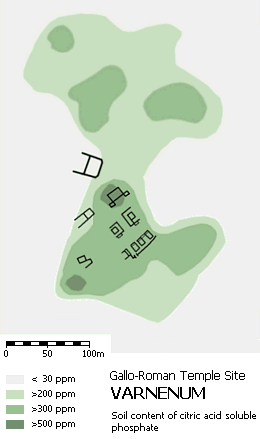 |
|
|
The Varnenum cult site close to
Breinig was presumably supplemented or replaced with another
place of worshipping in the very centre of Aachen. Such ‘central
change’ has been suggested and chronologized
between 2nd and 3rd
century by archaeological indications which have been considered by
Wilfried M. Koch, Heinz Cüppers and other authors referring
to the research of German LVR organization and elder explorations. This
cult site, between today’s
Aachen cathedral and the Büchel or Imperial Baths, was built up
at the beginning of the 3rd
century and supplemented about a century later with porticoes, as the
excavations brought to light this kind of an impressive arcaded
colonnade architecture. Although the presence of the Sevir
augustalis has been ascribed to also this location, the
archaeologists found in its centre dedicatory inscriptions to only Mercurius
Susurrion and Fortuna.
Regarding settlement activities from 5th
to 8th century, which are basing on
present excavations, however, there was neither considerable nor
continuous occupation after massive destructions by Gaulish insurgents
in 3rd
and presumably even in 4th
century; see Heinz Cüppers, Beiträge
zur Geschichte des römischen Kur- und Badeortes
Aachen, in: Aquae
Granni, Beiträge zur
Archäologie von Aachen, of edition series Rheinische
Ausgrabungen No. 22,
Köln/Bonn 1982, see p. 14. Generally: RGA 1 (1973) pgs
1–3, see p. 1.
|
|
|
The Roman
Aquae Granni: Archaeological plan of its centre
with the position of the later build cathedral. (Translated version.)
Names of modern places put in brackets.
Buildings on temple site supplemented with
H. Cüppers (op. cit., see Tafel 1).
Source file retrieved 2017-07-15.
|
|
The Key of
Varnenum, cat. No. 29, Museum Burg Frankenberg:
«Der
Griff des Schlüssels ist in Form eines Löwen
gearbeitet.»
(W. M. Koch,
op. cit. p. 16.)
The lion corresponds with the heraldic animal of Dietrich von Bern.
Photo by the author.
|
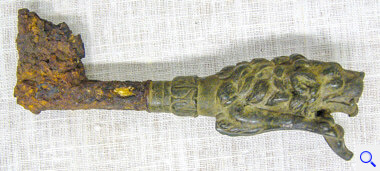
|
|
The Old Norse manuscripts relate that
the aged Thidrek took a bath on a location which is known as
‘Thidrek’s Bath’ (Mb 438), while the
Old
Swedish redactor
additionally writes (Sv 382) that the king had
to ride
to this place
which, however, has been never mentioned before as an urban or
residential
location. Thus, it seems less likely that this bath belongs to his last
known seat at Roma II =
Trier on the Moselle, cf. ch. General
conformity of contemporary residential regions. As regards
the authorship of an early source on Thidrek, we may rather
think now of Aachen, i.a. known as AQUIS VILLA,
to which the equestrian statue of the Italian king Theoderic was
shipped
on behalf of Charlemage.
Andreas Agnellus of Ravenna, where this sculpture was confiscated,
noted well its ‘deportation’ to Aquisgranis, cf. also
Walafridus Strabo scathing this ‘nude imperator on horseback’ in front
of Charlemagne’s residence, hence near or at his thermal bath.
Concludingly it may appear now as the best narrative place where the
primordial
author of saga’s texts, inspired from a
fantastical horse emerging in the garden of the bath and throwing a
deep black shadow from the setting sun
of the Frankish protagonist, could think out his allusively transformed
epilogue with a hart whose precious crown represents the kingship
uncatchable vanishing from the dying king.
Joachim Heinzle concludes on Dietrich’s
Hellride [transl.]:
|
| |
|
The tradition of the
Hellride could be related to transmissions in which Dietrich apparently
appears as a savage hunter or a leader of the Wild Hunt (of the Army of
the Dead), but the evaluation of the manuscripts remains difficult. It
is also unclear whether demonic traits, which Dietrich carries in many
traditions – he is supposed to be a sprout of the devil and capable of
spitting fire – belong to the complex of legends about
Theoderic’s/Dietrich’s End.
It must remain open whether the traditions about
Theoderic’s/Dietrich’s End, serving for demonizing the king of the
Goths, were developed in the first instance from an
ecclesiastical point of view, or whether they were negatively affected
by the deliberate perversion of an older Theoderic apotheosis.
|
| |
|
[Mit der
Höllenritt-Tradition könnten Überlieferungen
zusammenhängen, in denen Dietrich anscheinend als Wilder
Jäger oder als Führer der Wilden Jagd (des Totenheeres)
auftritt, doch bleibt die Beurteilung der Zeugnisse schwierig. Unklar
ist auch, ob dämonische Züge, die Dietrich in manchen
Überlieferungen trägt – er soll ein Sproß des Teufels
sein und ist in der Lage, Feuer zu speien – in den Sagenkomplex von
Theoderichs/Dietrichs Ende gehören.
Offenbleiben muß, ob die Überlieferungen
von Theoderichs/ Dietrichs Ende zur Verteufelung des Gotenkönigs
allererst aus kirchlich-katholischer Sicht entwickelt wurden oder ob es
sich um die gezielte Verkehrung einer älteren Theoderich-Apotheose
ins Negative handelt.
Op. cit.
p. 9.]
|
|
|
Otto K. Schmich (op.
cit. 1999),
Hanswilhelm Haefs
(2004) and the author (2005) have been voting for Varnenum as
either Thidrek’s place of residence or the name donor of his
kingdom, whereas the author has been
considering recently the latter option with rather another localization
being introduced farther
below as an important temporal seat in the Berner Reich of
Thidrek.
|
8.
Which
are the dynasties of the eastern Franks of 5th
century ?
The records about local Hannonian
history cited by Emil Rückert interestingly allow to be seen that
the Merovingian kings Meroveus and, subsequently, Childeric have
tolerated Chlodio’s descendants to administrate obviously no other
regions than partially those of today’s Netherlands and Belgium, and
some Eifel land between the Meuse and the Rhine. Early in the 6th
century, however, the political status of Franco-Rhenish territory was
insidiously challenged by Merovingian King Clovis who once had the
right time to look over the lands beyond the Meuse and to engage the
murderer(s) of King Sigibert of Cologne. Thereafter, as Gregory of
Tours narrates, this region
of unquestionable strategic importance was forwarded to a son of ‘any
heathen concubine’ but not to any of King Clovis'
legal
sons!
|
|
|
Could a splendid planning
Theuderic or Thidrek, oath-breaker against Sigurð in a
case of
honour, take later revenge on his kinsman Ermenrik
(see the 8th
item above) without using an army of his own folk? Did one of them
pretend beyond the Rhine to be still an expelled king, since
one of them could not motivate Franks to fight against Franks?
The Old Norse + Swedish scribes report on
Thidrek’s attack
against Ermenrik at a place called Gransport to which
he came with an army from King Atala.
|
|
Samson, the grandfather
of Thidrek as well as the German-Nordic spelled Salian
location
seem to be the key players. The records about the early
Frankish history of Brabant and Hannonia let also raise the question
whether Samson left ‘Salerni’ rather compulsorily as an
important pioneer of a kingdom in an area that Gregory’s
translator W. Giesebrecht and other historians have ascribed
to ‘Ripuaria’.(13)
|
|
|
|
Some authors raise the objection that
the narratives of the Thidrekssaga would not be related
mainly
to 5th
century and first third of the next for the most part, rather taking
dominating pattern from events of other periods. Regarding those
Thetmars in Samson’s line to this item, we actually can find an earlier
Frankish king who was spelled fairly identically with those Nordic
Thetmars: King Theudomer de Thérouanne († between 414 and 428).
Possibly semi-legendary, as some historian would judge him,
he was noted as spouse of Blésinde de Cologne. Theudomer, titled
magister militum in 383 and consul in 384, is mentioned by both
Gregory and Fredegar as an early Frankish king, the predecessor of
Chlodio by Gregory. The Chronicle of Fredegar mentions him as
the son of Theudomer who supposedly was congenial with Jovinus,
Roman counter-emperor from 411 till 413, when
he was captured and executed. Theudomer
is believed to have shared the same fate with this Jovinus.
|
|
|
8.1 A
spatiotemporal
interrelation with
Burgundians?
|
|
|
Olympiodorus of Thebes recounts the
Burgundian leader
Guntiarius (‘Gundahar’, ‘Gundicar’) and the Alan ruler Goar proclaiming
Jovinus counter-emperor on location
|
| |
|
εν Мουνδιακω της ετερας
Гερμανιας = in Mundiako
in the other Germania,
|
| |
|
thus Mundiacum
in the Germania inferior (= secunda).
However, some attentive
researchers would not equate this
geonym with Mogontiacum (Mainz, in the region of
legendary Burgundy with its ‘capital Worms’ by the Nibelungenlied, thus
in Germania superior),
rather identify the Mundiacum
as a possible or more likely location in Germania inferior
instead; cf. for instance:
|
| |
Julius R. Dieterich, Siegehard von
Lorsch •
Der Dichter des
Nibelungenlieds, Frankfurt / Darmstadt
1923.
Reiner Müller, Die Burgunden am
Niederrhein 410–443, Jülich 1924.
J. P. C. Kent, Roman Imperial Coinage
(RIC) X,
p. 152.
R. C. Blockley, The Fragmentary
Classicising Historians of the Later Roman Empire. Eunapius,
Olympiodorus, Priscus and Malchus.
II: Text, Translation and Historiographical Notes
(1983), p. 182, p. 216, ann. 46.
Harald von Petrikovits, Altertum.
In: (Franz
Petri, Georg
Droege, ed.), Rheinische
Geschichte 1,1, Schwann, Düsseldorf 1978, pgs 275f., 288f.,
348.
Franz- Josef Schweitzer, Die
ältesten
literarischen Quellen zum rheinischen Burgunderreich und das
MUNDIACUM-Problem.
In: Annalen des Historischen Vereins für den Niederrhein
(AnnHVNdrh) Nr. 203 (2000), pgs 7–22.
Sandra Seibel, Typologische
Untersuchungen
zu den
Usurpationen der Spätantike. Doctoral thesis, University of
Duisburg-Essen 2004, p. 165. |
|
|
This chronical, literary and
geographical relationship was reviewed by the historian and
history didactician Hans Georg Kirchhoff (University
of Dortmund, em., † 2021). Following
Harald von Petrikovits (op. cit.
above) he summarizes that [transl.:]
|
| |
|
the Burgundians were
indeed temporarily in the Jülich area has
long been discussed and has been widely accepted in recent research16
[→Petrikovits]. The equation Mundiacum =
Mündt provides a concrete place name for this.
|
| |
|
Dass sich Burgunder
tatsächlich vorübergehend im Jülicher Raum aufgehalten
haben, wird seit langem diskutiert und
hat sich in der jüngeren Forschung weitgehend durchgesetzt16.
Die Gleichung Mundiacum = Mündt liefert dafür
einen konkreten Ortsnamen.
|
| |
|
H. G.
Kirchhoff, Die Rätsel von Mündt. Mundiacum 411 und das
niederrheinische Burgunderreich. In: Neue
Beiträge zur Jülicher
Geschichte, Band XIV, Jülich 2003, pgs 7–30.
|
|
|
The historian Reinhold
Kaiser rejects a Burgundian settlement in the Germania inferior,
but does confirm Guntiarius' participation at Mundiacum
in this Roman province
for proclaiming Jovinus counter-emperor; cf. Die
Burgunder, Kohlhammer,
Stuttgart 2004, p. 27f. Kaiser makes this plea [transl. pgs
28–30]:
|
| |
|
In the
‘Waltharius’ Worms is indeed mentioned as the royal seat of the
however Frankish Gunthar, the son of Gibicha, while the Nibelungenlied
situates the court of the Burgundian country at Worms, where the three
sons of Dankrat (instead of Gibicha), Gunther, Gernot, Giselher, and
their sister Kriemhild lived. The Edda lays mention more often
the Rhine as the place of action. Since the list of kings of the Lex
Burgundionum mentions Gibica, Gundomar, Gislahar and Gundahar as
predecessors of king Gundobad, which were taken up in the sagas, partly
with other or modified names, such a localization seemed to be
justified. Therefore, the imperial elevation of Jovinus was generally
transferred to Mainz, into the domain of the Burgundians – vice versa,
it was concluded from this place to the Middle Rhine as domain of the
Burgundians.
This traditional interpretation was fundamentally questioned when
Julius R. Dieterich in 1923 rightly returned to the original reading of
the Olympiodoros text and thus claimed as the place of elevation of
Jovinus Mundiacum in the Germania II. Because of the linkage of the two
events, elevation of the usurper and settlement of the Burgundians, he
also moved the realm of the Burgundians to the Lower Rhine. In 1928
Ernst Stein tried to support this thesis by referring to the list of
troops of the dux Moguntiacensis
in the Notitia dignitatum, which he dated to about 430. According to
this list, the Roman limitant troops would have been stationed in the
Upper Germanic places between Selz and Andernach, i.e. also in Mainz
and Worms, still in the first third of the 5th
century, which is why a
simultaneous settlement of federates in this area can be excluded. The
Belgian historian Henri Grégoire went one step further, he
identified Mundiacum with the place Montzen (north of the Belgian
Limburg, besides other Rhenish places come into consideration like
Monzen, Mindt, Münz or Mündt). With this he linked different
names of the Nibelungen saga with toponyms of the East Belgian area,
the former civitas Tongeren, which belonged to the Germania II: Thus
the
Nibelungs were the people of Nivelles, thus the Pippins, Hagen of
Tronje was Hagen of Tongeren. Contextually, only after a
‘saga shift’ the
Nibelungen saga would have been connected with Worms. However,
Grégoire‘s combinations have been massively contradicted from a
linguistic and historical point of view. [...]
The two events of 411 and
413 are to be separated absolutely: The
elevation of Jovinus in the Germania II at Mundiacum does not prejudice
the settlement of the Burgundians there, this is valid both for the
Alans and the Burgundians. Burgundiones
as well as Alani participated in the same year 411 in the campaign of
Jovinus against the usurper Constantin III to southern Gaul. The Alans
apparently remained there and operated in southwestern Gaul (Bazas) in
414. The Burgundians were then, after the fall of Jovinus (413),
settled by general Constantius at the Middle Rhine or confirmed in
their seats taken there after 406/7 (so Hoffmann), where the mediaeval
legend tradition and archaeological findings locate them according to
the thesis of Stroheker and Wackwitz. This plausible and
contradiction-free explanation has been widely accepted in recent
research, which would ultimately confirm the traditional view based on
incorrect source interpretation in the result: The first Burgundian
Empire on Roman soil was most probably located at the Middle Rhine
(near Worms). [...]
A renewed examination of
the Notitia dignitatum and its collation with
the archaeological findings of the late antique stronghold of Alzey,
located in the hinterland of the Rhine line, has been undertaken by the
archaeologist Jürgen Oldenstein. He thereby comes to an important
modification of the Middle Rhine thesis. Accordingly, the Mainz Ducat
was not abolished in 406/7, but on the contrary was formed after 406/7,
in connection with the reorganization of Gaul, especially of the Rhine
defense under Constantine III or general Constantius: In this new
defense system, the Burgundians, as federates, took over the tasks of
the Comitatensian elite troops in the hinterland of the border. In the
front line this was formed by the right Rhine ship lands and burgi, on the Rhine by the Rhine
fleet and directly at the border line by the Limitan units (listed for
the dux Moguntiacensis in the
Notitia dignitatum between Selz and Andernach). The second phase of
construction and use of the Alzey stronghold with characteristic
organically roofed half-timbered buildings is that of the Burgundian
federates. It ends with the defeat of the Burgundians in 436; the fort
was rendered useless and only after the withdrawal of the Burgundians
to the Sapaudia (443) was it restored to a defensible condition, until
it was finally abandoned after the middle of the 5th
century. Modified with regard to the interpretation of the Notitia
dignitatum, the Middle Rhine thesis is not only adopted here, but
supported by new insights into the organization of the border defense
and the role of the Burgundian federates in it, as well as by the
archaeological evidence.
Nothing more precise can be said about the nature and extent of the
settlement of the Burgundians.
|
| |
|
Im ‚Waltharius‘ wird in
der Tat Worms als Königssitz des
allerdings fränkischen Gunthar, des Sohnes Gibichas, genannt,
während das Nibelungenlied in Worms den Hof des Burgunderlandes
situiert, wo die drei Söhne Dankrats (statt Gibichas), Gunther,
Gernot, Giselher, und deren Schwester Kriemhild lebten; die Edda-Lieder
erwähnen öfter den Rhein als Ort des Geschehens. Da in der
Königsliste der Lex Burgundionum als Vorgänger König
Gundobads Gibica, Gundomar‚ Gislahar und Gundahar genannt werden, die
in die Sagen (z.T. mit anderen bzw. abgewandelten Namen) aufgenommen
worden waren, schien eine solche Lokalisierung gerechtfertigt, und
deswegen wurde generell die Kaisererhebung des Jovinus nach Mainz, in
den Herrschaftsbereich der Burgunder verlegt und umgekehrt von diesem
Ort auf den Mittelrhein als Herrschaftsgebiet der Burgunder geschlossen.
Diese traditionelle Deutung wurde grundsätzlich in Frage gestellt,
als Julius R. Dieterich 1923 mit Recht zu der ursprünglichen
Lesart des Olympiodoros-Textes zurückkehrte und damit als
Erhebungsort des Jovinus Mundiacum in der Germania II reklamierte.
Wegen der Verknüpfung der beiden Vorgänge, Erhebung des
Usurpators und Ansiedlung der Burgunder, verlegte er auch das Reich der
Burgunder an den Niederrhein. Diese These suchte 1928 Ernst Stein mit
dem Hinweis auf die Truppenliste des dux
Moguntiacensis in der Notitia dignitatum, die er auf ca. 430
datierte, zu stützen; danach wären in den obergermanischen
Orten zwischen Selz und Andernach, also auch in Mainz und Worms noch im
ersten Drittel des 5. Jhs. die römischen Limitantruppen
stationiert gewesen, weshalb eine gleichzeitige Ansiedlung von
Foederaten in diesem Raum auszuschließen sei. Der belgische
Historiker Henri Grégoire ging noch einen Schritt weiter, er
identifizierte Mundiacum mit dem Ort Montzen (nördlich des
belgischen Limburg, daneben kommen noch andere rheinische Orte in
Betracht wie Monzen, Mindt, Münz oder Mündt) und
verknüpfte verschiedene Namen der Nibelungensage mit Toponymen des
ostbelgischen Raumes, der ehemaligen civitas Tongern, die zur Germania
II gehörte: so seien die Nibelungen die Leute von Nivelles, mithin
die Pippiniden, Hagen von Tronje sei Hagen von Tongern erst nach einer
„Sagenverschiebung“ wäre die Nibelungensage mit Worms verbunden
werden. Doch ist den Kombinationen Grégoires aus
sprachwissenschaftlicher und historischer Sicht massiv widersprechen
worden. [...]
Die beiden Ereignisse
von 411 und 413 sind unbedingt zu trennen, die
Erhebung des Jovinus in der Germania II bei Mundiacum präjudiziert
nicht die Ansiedlung der Burgunder ebenda, das gilt für die Alanen
wie für die Burgunder. Beide,Burgundiones wie Alani,
nahmen im gleichen Jahr 411 am Zuge des Jovinus gegen den
Usurpator Constantin III. nach Südgallien teil. Die Alanen blieben
anscheinend dort und operierten 414 in Südwestgallien (Bazas). Die
Burgunder seien dann nach dem Sturz des Jovinus (413) von dem
Heermeister Constantius am Mittelrhein angesiedelt oder in ihren dort
nach 406/7 eingenommenen Sitzen bestätigt worden (so Hoffmann), wo
die mittelalterliche Sagenüberlieferung und archäologische
Befunde sie lokalisieren, so die These von Stroheker und Wackwitz.
Diese einleuchtende und widerspruchsfreie Erklärung ist in der
neueren Forschung weitgehend akzeptiert worden, womit letztlich die auf
falscher Quelleninterpretation beruhende traditionelle Sicht im
Ergebnis bestätigt würde: Das erste burgundische Reich auf
römischem Boden lag höchstwahrscheinlich am Mittelrhein (bei
Worms). [...]
Eine erneute Untersuchung der Notitia dignitatum und ihre Konfrontation
mit dem archäologischen Befund des im Hinterland der Rheinlinie
gelegenen spätantiken Kastells Alzey hat der Archäologe
Jürgen Oldenstein vorgenommen, und er kommt dadurch zu einer
wichtigen Modifizierung der Mittelrhein-These. Danach ist der Mainzer
Dukat 406/7 nicht aufgehoben, sondern ganz im Gegenteil erst nach 406/7
gebildet worden, und zwar im Zusammenhang mit der Reorganisation
Galliens insbesondere der Rheinverteidigung unter Constantin III. oder
dem Heermeister Constantius: Die Burgunder übernahmen in diesem
neuen Verteidigungssystem als Foederaten die Aufgaben der
comitatensischen Elitetruppen im Hinterland der Grenze. In vorderster
Linie wurde diese durch die rechtsrheinischen Schiffsländen und
burgi, auf dem Rhein durch die
Rheinflotte und direkt an der Grenzlinie durch die Limitaneinheiten
(aufgelistet für den dux Moguntiacensis in der Notitia
dignitatum zwischen Selz und
Andernach) gebildet. Die zweite Bebauungs- und Benutzungsphase des
Kastells Alzey mit charakteristischen organisch gedeckten
Fachwerkbauten ist die der burgundischen Foederaten. Sie endet mit der
Niederlage der Burgunder 436; das Kastell wurde unbrauchbar gemacht und
erst nach dem Abzug der Burgunder in die Sapaudia (443) wieder in
verteidigungsbereiten Zustand versetzt, bis es dann nach der Mitte des
5. Jhs. endgültig aufgegeben wurde. Modifiziert im Hinblick auf
die Interpretation der Notitia dignitatum, wird hier die
Mittelrhein-These nicht nur übernommen, sondern durch neue
Einsichten über die Organisation der Grenzverteidigung und die
Rolle der burgundischen Foederaten darin sowie durch den
archäologischen Befund gestützt.
Über die Art und die Ausdehnung der Ansiedlung der Burgunder
lässt sich nichts Genaueres sagen.
Franz-Josef Schweitzer (medievalist
and linguist at the Katholische Universität
Eichstätt-Ingolstadt) considers this
estimation by Kaiser, who on the basis of the provincial Roman
archaeologist Jürgen Oldenstein cites only a single 'reliable'
Burgundian finding at the former Roman stronghold Alzey near Worms,
apart from an obvious 5th-century Burgundian
beltbuckle found in Worms-Abenheim, not
convincing for the exclusion
of the Germania inferior as [also the other] Roman province of
a
partial Burgundian settlement west of the Rhine.
(F.-J.
Schweizer, Ist die
Niederrheinthese noch zu halten?
In: DER BERNER 51 (2012) pgs.
40–47. Besides, Oldenstein titled his study of 1995 with question
marks: Les Burgondes à
Alzey? Une question ouverte? In: Les Burgondes. Apports
de
l’archéologie, Dijon 1995, pgs 87–93. )
Kaiser himself writes (op. cit. p. 31) that the Greek
church historian Socrates of Constantinople reports about Huns under
their leader Octar ('Optar' or 'Uptar', an uncle of Attila), who
massively threatened and plundered Burgundians beyond the
Rhine. (Ecclesiastica Historia [II] 7,30: Gens
est barbara, trans flumen Rhenum sedes habens, eorum qui Burgundiones
vocantur. But Kaiser understands them to be those
Burgundians on the right bank of the Rhine, i.e. on the east bank of
the Rhine, who defeated the invading Huns after the death
of Octar in 430.)
In any case, we may regard well that an
obvious appearance of Burgundians in Germania I, presumably
even on the eastern bank of the Rhine, is no proof that they
could not have settled, at least partially, in Germania II. On
this account Schweitzer further underlines in his review on
Kaiser that Heinz Günter Horn (provincial
Roman archaeologist, formerly vice director of the LVR
Rheinisches Landesmuseum Bonn,
director of the LVR-Office Bodendenkmalpflege im
Rheinland) rather argues for the possibility drawn by
Petrikovits. Thus, Horn does not exclude that a certain
part of Guntiarius' Burgundian people could have settled in the area
between ‘the Lower Rhine, the
northern Middle Rhine and the Eifel’, cf. Die
Römer in Nordrhein-Westfalen,
Theiss, Stuttgart 1987, p. 107f.
The RGA 22 (2003) states
on the ‘Origo gentis’ of the gens Burgundionum, p.
195:
|
| |
|
Im Unterschied zu
anderen gentes
der VWZ sind die → Burgunden in den Qu. schon im 1. Jh. n.
Chr. durch → Plinius bezeugt (44, 4,14; 171, 49. 231), wo sie zu den →
Wandalen gerechnet werden. Ebenso werden sie von → Ptolemaeus (48, II,
11,8) erwähnt, der sie zw. Oder und Weichsel lokalisiert. Woher
sie urspr. kamen, ist unklar. Eine skand. Herkunft der gens spielt
erst in späteren Traditionen eine Rolle und konnte auch
arch. nicht nachgewiesen werden (→ Bornholm S. 312).
Aus
schriftlichen Qu. sind uns weder eine frühe OG noch andere
Herkunftsmythen überliefert, die als burg. Traditionen gesehen
werden könnten. Wie in einigen anderen Punkten unterscheiden sich
die Burg. auch hier vom Großteil der germ. gentes der
VWZ. Die einzige Überlieferung zur burg. Gesch., die uns aus dem
burg. Kgr. selbst noch erhalten ist, ist eine Aufzählung burg. Kg.
im Liber constitutionum (→ Lex Burgundionum) aus dem J. 517. In diesem
Abschnitt (31, 3) verfolgt der Gesetzgeber, wohl Kg. → Gundobad, die
Gesch. der manumissio bis zurück in die Zeiten Gibichas,
Godomars, Gislahars und → Gundahars (→ Gibichungen § 2). Diese
Liste der vier kgl. Vorfahren Gundobads kann durchaus als Kg.sliste
betrachtet werden und läßt sich vielleicht mit der
später verfaßten, umfangreicheren im Edictum Rothari (→
Leges Langobardorum) vergleichen. Doch im Unterschied zum langob. Kg. →
Rothari verbindet Gundobad die burg. Kg.sliste nicht mit einer
Herkunftsgesch.
Der letzte Name der Liste, Gundahar, ist
auch aus anderen schriftlichen Qu. bekannt. Olympiodor (38, fr. 17)
zählt ihn zur Partei des Usurpators Jovinus. Prosper berichtet,
daß unter seiner Herrschaft das Burgunderreich am Rhein durch die
mit → Aetius → verbündeten → Hunnen vernichtet wurde (435). Diese
dramatischen Ereignisse wurden bekanntlich der Kern späterer
Erzählungen, v.a. des → Nibelungenliedes. Doch gibt es keinen
Hinweis darauf, daß diese Geschichten burg. Traditionen
widerspiegeln, die nach der Niederlage der Burg. 435 und nach ihrer
Ansiedlung in der → Sapaudia in ihrem Kgr. an Rhône und
Saône entstanden. Es ist allerdings möglich, daß die
Tradierung dieser Geschichten auf Burg. zurückgeht, die sich nicht
an Rhône und Saône ansiedelten. Auch gibt es keine Version
dieser Erzählungen, die die weitere Gesch. der Burg. behandelt –
weder das Weiterbestehen der gens noch ihre Ansiedlung in der
Sapaudia.
Außerdem wird in karol. Qu. zur burg. Ethnogenese, in der Passio
Sigismundi (42, c.1) und in der Vita Faronis des Hildegar von Meaux
(23, c. 2), die Katastrophe von 435 überhaupt nicht erwähnt.
(…)
[In
contrast to other gentes of the Migration Period,
the → Burgunden
are already attested in sources of 1st
century A.D. by → Pliny (44, 4,14; 171, 49, 231), which ascribe them to
the → Wandalen [Vandals].
Likewise, they are mentioned by → Ptolemaeus [Ptolemy] (48, II,
11.8),
who localizes them between the rivers Oder and Vistula. It is
unclear where they originally came from. A Scandinavian origin of
the gens plays a rôle only in later traditions, but could
not be proved archaeologically (→ Bornholm, p. 312).
Written transmissions provide neither an early Origio
gentis nor any other origin myth which could
be seen as Burgundian tradition. As regards some other item, the
Burgundians differ from the main stem of the Germanic gentes of the
Migration
Period. The only extant account about Burgundian history, preserved in
the Burgundian kingdom itself, is a list of Burgundian kings in the
Liber constitutionum (→ Lex Burgundionum) of 517. In this list, section
(31, 3), the likely legislature → Gundobad traces the history of the manumissio
back to the times of Gibica, Godomar,
Gislahar and →
Gundahar (→ Gibichungen § 2). This list of the four royal
ancestors of Gundobad can be regarded at least as a line of kings and
may
perhaps be compared with the later written and more comprehensive
Edictum Rothari (→ Leges Langobardorum). However, in contrast to the
Langobardian king → Rothari, Gundobad does not connect the Burgundian
list of kings with a history of origin.
The last name of the list, Gundahar, appears
also in other written transmissions. Olympiodorus (38, fr 17) ascribes
him to the party of the usurper Jovinus. Prosper reports that, under
his rule, the Burgundian kingdom on the Rhine was destroyed by the →
Hunnen [Huns], allied with → Aetius in 435. As popularly known
these
dramatic events make the core of later narratives, especially the →
Nibelungenlied ‹ Rem.: this
claim is not provable to the Thidrekssaga ›.
However, there is no indication that these stories reflect
Burgundian traditions which were following after the defeat of the
Burgundians in
435 and then in their settlement in the → Sapaudia in their kingdom on
the Rhône and Saône. However, it is
possible
that the tradition of these stories goes back to Burgundians who did
not settle on the Rhône and Saône. Futhermore, there is no
version of these narratives which deals with a continuation of
Burgundian history – neither with the continuation of the gens
nor with their settlement in the Sapaudia. Moreover, neither
Carolingian sources related to Burgundian
ethnogenesis nor the Passio Sigismundi (42, c.1) and the Vita Faroni of
Hildegar of Meaux (23, c.2) mention the catastrophe of 435.
(…) ]
Sources
(23) Hildegar von Meaux, Vita Faronis, hrsg. von J.
Mabillon, Acta Sanctorum Ordinis
sancti Benedicti, Nachdr. 1936, 606–625.
(31) Liber Constitutionum, hrsg. von L. R. de Salis, MGH LL 2/1, 1892,
Nachhdr. 1973, 29–116.
(38) Olympiodorus, hrsg. von J. C. Blockley, The fragmentary
classicising historians
of the Later Roman Empire, 1981.
(42) Passio Sigismundi, hrsg. von B. Krusch, MGH SS rer. Mer. 2, 1888,
Nachdr. 1984, 329–340.
(44) Plinius der Ältere, Historia naturalis libri XXXVII, hrsg.
von H. Rackham, 9 Bde., 1949–1952, oder; hrsg. von G. Winkler, R.
König, 1988.
(48) Ptol., Geographia, hrsg. von C. Müller, 1883, oder: hrsg. von
C. F. A. Nobbe, 1843–45, Nachdr. 1966.
(171) Wenskus, Stammesbildung.
|
|
Cf. esp. Ian N. Wood, Gentes, Kings
and Kingdoms — The Emerge of States: The Kingdom of the Gibichungs,
in: Regna and Gentes, Brill NV, Leiden 2003, pgs
243–269.
|
The records on authentic history
of Burgundian kingdoms do not provide
contemporary leaders who are corresponding with Gunnar and Hǫgni.
Hence,
both the ‘Didriks chronicle’, apart form its fictitious younger
supplements serving for the final but contradicting chapters (Sv
383–386), and the Thidrekssaga nowhere mention
spelling
forms somehow related to ‘Burgundia’ or ‘Burgundy’.
Ingo Runde, an author of the RGA,
resumes shortly [transl.]
‘a legendary destruction of the Wormsian kingdom of the
Burgundians’ (op. cit. endnote 13; see p. 84).
The Genealogy of Piat-Herrero
provides the bloodline of Theudomer, son of King Richimer de
Thérouanne, to a remarkable extent. The former was also
captured and executed with his spouse by the Romans.
That data notes Theudomer’s son and successor ‘Clogio’ (‘Clodio’)
as ‘Le Cheveulu’ (‘the Longhaired’). Since his lifetime is
roughly estimated from 400 to 450, he appears as one of the
contemporaries
of Samson by Ritter’s
timeline. C(h)lodio is chiefly
known
as conqueror of
some western lands
on the Somme and of Cambrai. However, there are no sources which
disallow his
further
appearance in more (north)eastern Gaulish regions. Would
Chlodio’s
environment thus be of interest in order to detect Samson on
the subject of Piat-Herrero’s and other sources
comprehensiveness and reliability? Nonetheless, the political
failure of both Jovinus and Theudomer of Thérouanne corresponds
with
the basic historical recognition that the Romans would not have
tolerated those
vast and manifested conquests up to that point of time when
Aëtius, the great Roman Magister militum, could destroy
Burgundy in Germania superior – more likely: overwhelmingly the
inferior – finally with Hunnic warriors.
|
|
|
A view to the time ‘post Aëtius’
nevertheless allows to detect the Roman Eagle being bled white
on the Upper and Middle Rhine. Thus, at the beginning of the second
half of 5th century, the first
Franks in the area of the later defined ‘Ripuaria’ could seize
the opportunity to self-govern and enlarge their territory
by expeditions we can easily encounter in some early chapters
of the Old Norse + Swedish manuscripts.
|
|
9. King
Sigibert of Cologne = King
Sigurð the Nibelung ?
Gregory of Tours let us know that
Clovis
supported his cousin Sigibert of Cologne against an Alemannic raid
which has been localized in the region
of Zülpich, a seat of Theuderic I. The Old Norse +
Swedish scribes inform us that Franco-Rhenish king (‘Sigurðr
Sveinn’) was brother-in-law and, obviously, the new
neighbour
of King Gunnar, ruler of the Niflungs, at the same place and time.
|
|
|
Helmut de Boor
rather shortly
considers a possible historical connection of this Sigibert on the
Lower Rhine with ‘Siegfried the Hero’; Hat
Siegfried gelebt?
PBB 63, p. 254, ISSN 1865-9373 (Walter de Gruyter).
Alfred Carl Groeger, another contemporary German philologist, considers
correspondingly in the epilogue of his booklet Nibelungensage:
|
| |
|
Nicht ausgeschlossen
ist es
auch, dass historische Vorgänge um Chlodwig den Sagenstoff
beeinflusst haben: Dieser ließ seinen Vetter, den
niederrheinischen Frankenfürsten Sigibert
(Siegfried?) im Jahre 508 auf der Jagd ermorden (…) Möglich,
dass auch von hier aus Einflüsse zu suchen sind.
|
| |
|
[Further, it is not to
exclude
that historical events around Clovis had influenced the legend, since
he let murder his cousin, Sigibert (Siegfried?), ruler on the
Lower Rhine, on the hunt in the year 508 (…) Possibly, influences
must be sought by starting from this context.]
|
| |
|
(Publisher:
Hamburger Lesehefte Verlag, Heft Nr.
137; ISBN 3-87291-136-8.)
|
|
|
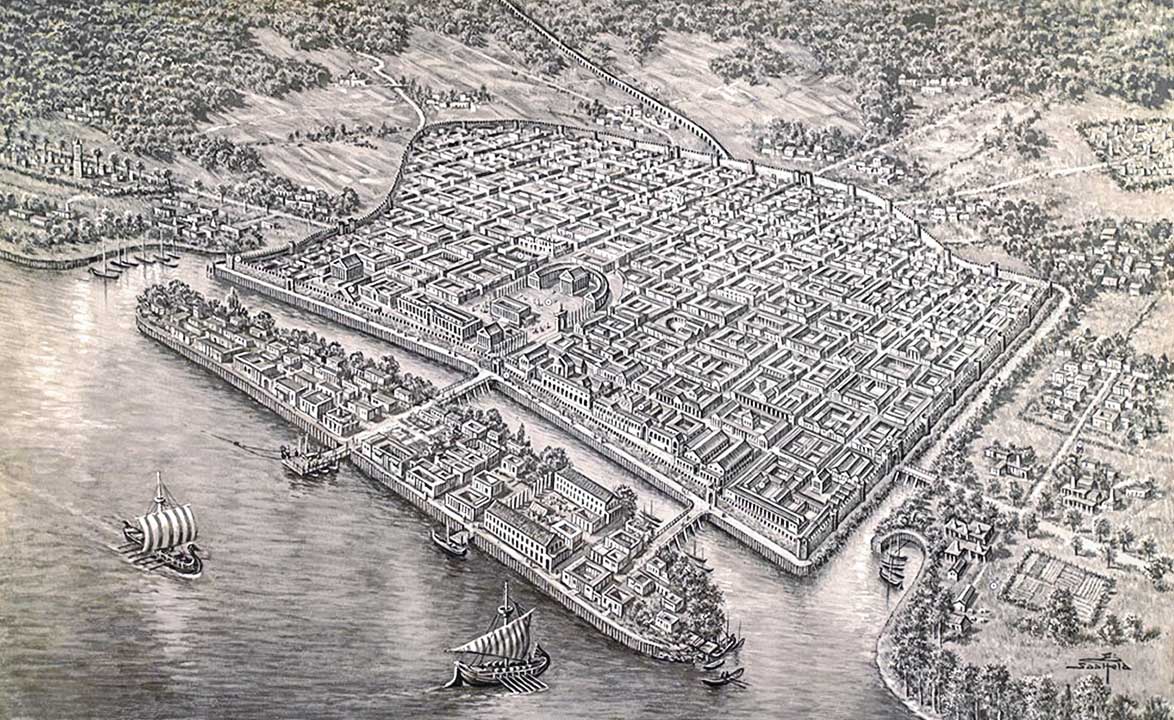 CCAA of 3rd
century CCAA of 3rd
century
Painting by Ernst von Saalfeld
|
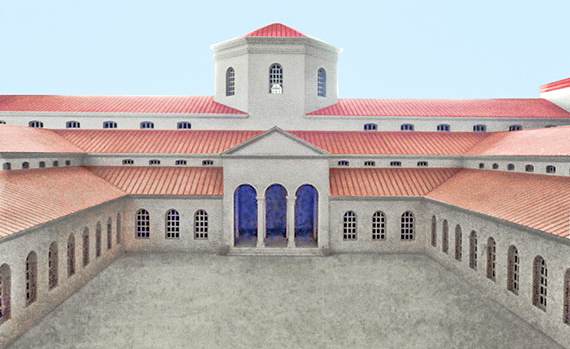
CCAA: Praetorium – a view to the inner courtyard.
Reconstruction model in the ‘Archäologische Zone’,
Cologne City Hall, Basement Floor.
|
|
| This passage deals with King Sigibert of Cologne
from Gregory’s hist. II,40: |
| |
|
When
King Clovis was dwelling at Paris
he sent secretly to the son of Sigibert saying: ‘Behold your father
has become an old man and limps in his weak foot. If he should
die,’ said he, ‘Of due right his kingdom would be yours
together with our friendship.’ Led on by greed the son plotted to
kill his father. And when his father went out from the city of
Cologne and crossed the Rhine and was intending to journey through
the wood Buchaw ‹ Buconiam
silvam ›, as he slept at
midday in his
tent his son sent
assassins in against him, and killed him there, in the idea that
he would get his kingdom. But by God’s judgment he walked into the
pit that he had cruelly dug for his father. He sent messengers to
king Clovis to tell about his father’s death, and to say: ‘My father is
dead, and I have his treasures in my possession,
and also his kingdom. Send men to me, and I shall gladly transmit to
you from his treasures whatever pleases you.’ And Clovis replied: ‘I
thank you for your good will, and I ask that you show the treasures
to my men who come, and after that you shall possess all yourself.’
When they came, he showed his father’s treasures. And when they were
looking at the different things he said: ‘It was in this little
chest that my father used to put his gold coins.’ ‘Thrust in your
hand,’ said they, ‘to the bottom, and uncover the whole.’ When he
did so, and was much bent over, one of them lifted his hand and
dashed his battleax against his head, and so in a shameful manner
he incurred the death which he had brought on his father. Clovis
heard that Sigibert and his son had been slain, and came to
the place and summoned all the people, saying: ‘Hear what has
happened. When I,’ said he, ‘was sailing down the river Scheldt,
Cloderic, son of my kinsman, was in pursuit of his own father
asserting that I wished him killed. And when his father
was fleeing through the forest of Buchaw, he set highwaymen upon
him, and gave him over to death, and slew him. And when he was
opening the treasures, he was slain himself by some one or other.
Now I know nothing at all of these matters. For I cannot shed the
blood of my own kinsmen, which it is a crime to do. But since this
has happened, I give you my advice, if it seems acceptable; turn to
me, that you may be under my protection.’ They listened to this,
and giving applause with both shields and voices, they raised him
on a shield, and made him king over them. He received Sigibert’s
kingdom with his treasures, and placed the people, too, under
his rule. For God was laying his enemies low every day under his
hand, and was increasing his kingdom, because he walked with an
upright heart before him, and did what was pleasing in his
eyes. (English version by Earnest Brehaut.)
|
|
|
The Old Norse and Swedish
transmissions seem to complete Gregory’s report on Clovis and Sigibert.
These
are the most important narrative items considering the view of the Old
Norse +
Swedish scribes:
|
|
| 1. |
Sigurð as well as Sigibert
were contemporary kings of rather smallest area between Cologne
and Zülpich.
|
| 2. |
Sigurð had also a treasure
hidden somewhere in the woodlands.
|
| 3. |
Sigurð had also to cross
the Rhine to go there.
|
| 4. |
Sigurð, victim of a family
plot,
was also slain while on a trip into the ‘Lyr(a)’ or ‘Lur(u)’ woodlands
on
eastern side of the Rhine. Buc(h)onia can be
regarded as
less specific Frankish expression being used rather for any hilly
woodland beyond the Rhine, cf. Fr. bûcheron: woodcutter.
The Guðrúnarkviða II, 7
likes to
confirm
that Sigurð was slain somewhere on the other side of
the river, as Guðrún (in Thidrekssaga
‘Grimhild’)
remembers this
detail:
Gunnar hung his head,
but Hǫgni told me
of Sigurð’s cruel death.
"Beyond the river
slaughtered lies
Guthorm’s murderer,
and to the wolves given…
Intertextual exploration of
Thidrekssaga, Vǫlsunga saga and the
Nibelungenlied allows to conclude that ‘Guthorm’, slaughterer of
Sigurð, was replaced with ‘Gernoz’
(the Upper German ‘Gernot’) for epic
insertion and amplification of Hǫgni. Regarding his
performance toward
Sigurð, however, we should contemplate the Nibelungenlied,
Thidrekssaga and ‘Didriks chronicle’ taking pattern from
manslaughter’s part of Gui and Bove in the poem
of Daurel et Beton, obviously written
in first half of 13th
century. This literary work has been ascribed to the
‘Cycle of Charlemagne’. (The author of the Vǫlsunga
saga
could have taken the Sigurðarkviða II
to transfer the place of murder to the hall of residence.)
|
| 5. |
Sigurð died also at the
place of his treasure, as
these circumstances seem to provide evidence:
|
| |
|
| |
Hǫgni must have known
exactly its position because the mother of his son Aldrian
could successfully forward the key and the route to
that place to the boy. Hǫgni, who already had told Brynhild
(‘Brynilda’) that
Sigurð’s power would be stronger than his own, could
only get the key to the lockable cave from Sigurð’s dead
body by choosing that safest as well as lethal way.
|
|
|
|
Thus, the dead Cloderic seems
to be Gregory’s and Clovis' subject, since the
former
retells us that the latter needs him for the folk to give them
fallacious reasoning of the murderous plot, whereas the dead Sigurð
appears as remaining subject to the assassins and the Old
Norse + Swedish texts which relate that the
murderers
need his dead body to shock Grimhild with performed revenge.
|
|
|
Following Ritter’s comprehensive
interpretations of the manuscripts, the source provider of the Old Norse
+ Swedish texts has connected Babilonia
with the large region between Cologne and the Lower Rhine, as
this geographical recognition seems to be closely related also to
Sigurð and his realm on narrative occasion of the Niflungs'
fatal march to their sister
Grimhild: When their rearguard, commanded by King Gunnar
and Hǫgni, was approaching the opposite bank of the Rhine at Duna
Crossing, only a few miles north of Cologne,
Hǫgni slew the ferryman on board and apologetically said to his
protesting half-brother Gunnar:
|
| |
|
He shall not tell
where we are going to.
|
|
|
A short time later Hǫgni met a
guardian on the eastern banks of the Rhine, and that
man called ‘Eckivard’ warned him with these words:
|
| |
I
am wondering how you’ve come along here,
because you are Hǫgni, King Aldrian’s son, who has killed my
lord, Young-lord Sigurð. As long as you are in Húnaland (14):
Look out! Many people are
keeping here hostility against you.
|
| |
|
(Mb
367 replacing missing
chapter in the Old Swedish texts.)
|
|
|
Regarding the murderous plot on
Sigurð and Sigibert, Gregory does not explicitly narrate the
same circumstances of death as the Old Norse +
Swedish
manuscripts,
however.
|
|
9.1
Sigibert ‘and’ Sigurð: How far can we follow Gregory and the saga?
Following intertextually Clovis '
control of power, he certainly would not have nominated the Niflungs
for King Sigibert’s or Sigurð’s successor if they had been already
rewarded with the administration of Thidrek’s realm after his
expulsion from Bern. If Zülpich, that Gregory obviously calls
‘Tulbiacum’, had been remarkably destroyed in Alemannic-Frankish war,
the Niflungs could have been forced to take a new place of residence
nearby. Vernica or the younger spelling Verminza, as
the manuscripts provide the name of this seat, is only a few miles far
from Zülpich.
The Old Norse + Swedish
manuscripts note brightest full moon night when the Niflungs met the
Rhine at Duna Crossing: Since important campaigns were usually planned
to start at full moon in Late Antiquity as well as (prae-)mediaeval
times, the Niflungs with polished armour underneath their garments
could have moved only c. 30 mi. (c. 48 km) from their capital place.
Both kings Sigurð ‘and’ Sigibert
were surely popular in large regions on both sides of the Rhine.
The place of Sigurð’s hoard, his ‘treasure cave’ as mentioned
in the Old Norse + Swedish manuscripts, is
geographically related to
the Lurvald, largest woodland region of the later Westphalia.
J.
Baptiste Gramaye, chronicler of Antiquitates
Brabantiae; Nivella, p. 3 n. 9, notes ‘Sigibertus
et Moringus in vita S(anta) Wiberti’. Nevertheless, both
Sigurð
and Sigibert seem of Merovingian descent and thus kinsmen of Clovis who
proclaimed the same to the folk in the region of Cologne.
The Old Norse scribes correspondingly convey Sigurð’s
mother as daughter of King ‘Nidung’ who ruled the Hesbaye
(Mb 152–156, Sv 148–152), a former Salian area that nowadays
belongs to Belgium. As the author remarks by means of Emil
Rückert’s
research into Frankish onomastics of the Merovings,(15)
the position of King ‘Nidung’, Old Nordic name for ‘hater’, seems
to be reserved for King Meroveus (‘Moroveus’, ‘Morung’, ‘Morvung’),
the father of ‘ORTVANGERIS’, as this spelling
can
express a son of ‘(M)OR.VANGER.
Emil Rückert points up his conviction that Childeric, son of
Meroveus,
appears also as Jutlandic Hjalprek in both Vǫlsunga
saga and heroic lays of the Elder Edda. These traditions
relate
him as an
obvious mighty leader who cares for Sigurð after the death
of his father Sigmund. A ‘Cheldric’ does also appear as ‘Saxon’ chief
in the Historia Regum Britanniae! |
|
|
The Thidrekssaga provides an
interesting geographical detail
by chapter Mb 62:
|
| |
|
A king named
Nidung was ruling Jutland,
that part which is called Thiodi…,
while the Old Swedish chronicler notes well on Weland/Velent in chapter
59: |
| |
|
He was finally
washed ashore Jutland; a king named Nidung was there…
|
|
Has the first Merovingian already been
ruling some territory outside of Salia, particularly Frisian
coastland up to the northwestern cap of Jutland? Fredegar,
protagonist of unbelievable Greek descent of the Franks,
nevertheless can provide an interesting unvoluntary metonymy.
The founder of the Merovingian dynasty, as he writes about the origo
of the Franks, was a bizarre individual that came
across the sea to have a son with the spouse of Frankish King
Chlodio: the mythical Minotaur (‘Neptuni Quinotauri’) as the
very best
creature for the impressing horns on a furry alien helmet of a
fierce or unfathomed Nordic chief, but not, as he suggests,
that figure of Greek origin?(16)
Thus, we should focus further interest also on that part of
Jutland which the Old Norse scribes remarked as King
Nidung’s territory, see attachment Merovingian
Origin Location.
A concerted effort to synchronize some apparently analogous or
completing pattern from Frankish historias or chronicles, Hannonian
records
of local history, and ‘Didriks chronicle’ plus Thidrekssaga,
may result in the following chart of early Merovingian and
Frankish genealogy. As already mentioned above, its predicate is
endorsed i.a. by
Mb 9: |
| |
|
King
Samson further fathered with his
concubine another son who was named Thetmar after his ‹ Samson’s ›
father-brother…
|
|
|
The above remembered
Theudomer, ascribed to Samson’s father by the scribe of MS
A
in Mb 6, seems to meet the demand on corresponding historical,
chronological and genealogical environment in so far.
|
|
10.
Preliminary
Filiations
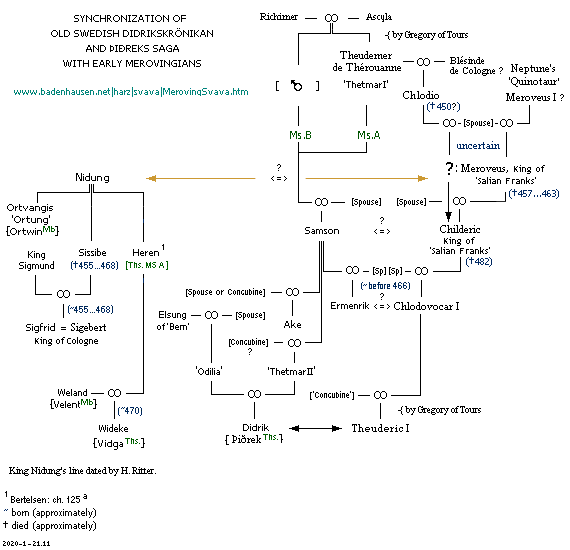 |
|
|
|
|
The texts
provide the first
appearance of three sons of Ermenrik not soon (!) after the
conquest of ROMA = Trier on the Moselle, as Ritter estimates
their removals A.D. 493; see Dietrich
von
Bern, Munich 1982,
p. 282.
|
| |
|
|
The genealogical inspections
of the Old Norse + Swedish texts and Gregory of
Tours
may not
suggest to identify Thidrek as Theuderic I
at the first go. Eugen Ewig and the RGA
estimate his mother descended from a family of Cologne (Eugen Ewig, Francia 18/1 (1991) p. 49).
The first named manuscripts provide a Jarl Elsung the Younger,
obviously a close relative of Elsung the Elder who formerly was
slain by Samson. ‘The Younger’ is known as ruler of Babilonia,
‘the Elder’ as father of Odilia who possibly was introduced as
Franco-Rhenish ‘Evochildis’ at the court of
Theuderic’s/Thidrek’s
father.
|
|
|
The pseudonymous Fredegar notes
that
|
| |
|
the
Franks were diligently seeking a long
haired king from themselves as they had before … created
Theudomer king, the son of Richemer, who was killed by the Romans
in that battle which I mentioned above. His son Chlodio, the most
suitable man in his tribe, took his place in the
kingdom.
|
|
|
However, the ‘Chronicle of
Frankish Kings’, known as the Liber historiae
Francorum or the Gesta
regnum Francorum of 726/727, ascribes Chlodio to son
of Faramond, son of Marchomir to whom the liber’s writer(s)
draw(s) on certain Trojan narrative from the
Priam and
Antenor
Legend.
|
|
|
Christian Settipani, of
Augustan Society Inc., genealogist of Charlemagne’s
Ancestry (Les Ancestres de Charlemagne;
Editions Christian, Paris 1989), orders these Frankish
accounts in this way:
|
| |
|
Nowadays,
it is pointless, I hope, to say
anything about the legend of the Trojan origins denounced by good
scholars since 14th century as an absurd
fable and which is only a
literary creation […] It is self-evident that Fredegaire had
interpolated Gregory at this place, but he could have done so
with good evidence or according to the oral tradition. So,
if we had absolutely to choose between Fredegaire’s and the
Liber’s version, we would prefer that of Fredegaire…
(From Christian Settipani’s addenda of 1990
at http://www.rootsweb.com/~medieval/addcharlENG.pdf
retrieved Aug. 2005.)
As modern research has been trying to
point out, there might be some circumstantial evidence that Frankish
historiographers of second half of
6th to first half of
7th
century were premeditatedly replacing
basic facts about early Frankish history by an ‘absurd core of
Trojan legends’, cf. Eugen Ewig, Trojamythos
und
fränkische Frühgeschichte 1996, 1998; Troja und die
Franken 2009.
|
|
|
Ermenrik
The earliest known mention of an Ermanaric
can
be found in the so-called Getica written by
Jordanes, who introduces him as the murder of a Sunilda, (step)sister
of her
revengers Ammius and Sarus, cf. correspondingly Svanhild, Hamðir
and Sǫrli by heroic tradition of the Elder Edda. Regarding the
apparent Ostrogothic episodic originality, Roswitha Wisniewski
succinctly notes that [transl.]:
|
| |
|
Jordanes includes the
Swanhild saga in his History of the Goths without the slightest
indication that he doubts the account’s truth.
|
| |
|
[Original
text:]
|
| |
|
Jordanes nimmt die
Swanhild-Sage in seine Geschichte der Goten auf, übrigens ohne den
geringsten Hinweis darauf, daß er an
der Wahrheit des Berichteten zweifelt.
|
| |
|
(Roswitha
Wisniewski, Die
Darstellung des Niflungenunterganges in der Thidrekssaga,
postdoctoral thesis, Tübingen 1961, p. 233.)
William J. Pfaff (op.
cit. p. 85) proceeds from
the battle of Gransport and conjects that such a
localization is consistent with the ascription to Ermanaric
of holdings north of the western Alps elsewhere in
Þíðriks saga (see Trelinn-borg).
Pfaff refers to this ‘Trellinborg’ as the seat of the Harlungen on the
Rhine, whose capture and geostrategic plausibility points to an
Frankish but not Ostrogothic Ermanaric.
The
Thidrekssaga ascribes Ermenrik’s death to a failed
fat-lifting procedure, cf. Mb 401. So we cannot exclude
that the saga’s scriptor knew of some detail in
the HISTORIA CHRONIKE
(ΙΣΤΟΡΙ ΧΡΟΝΙΚΗ)
written by John of Antioch. Thus, that scriptor could have
concluded from his account an obesity of Odoacer
and transferred it to the northern Ermenrik. As the Byzantine
chronicler relates, Theoderic the Great
is said to have killed Odoacer with one sword stroke
from collarbone to hip, and afterwards mockingly testified
that ‘not a bone had been in that villain’. [John
of
Antioch cited by Hans-Ulrich Wiemer, Theoderich
der Große: König der Goten (2018) p. 15.]
Hermann Schneider, incidentally most cited by William J. Pfaff,
strongly warns against underestimating the Low German narrative milieu
about Ermanaric and his death [transl.]:
|
| |
|
The abuse committed with
the term of
Low German epic poetry, the fantastic systems that have been elaborated
from it, must not be allowed to mislead us about the actual existence
of
an extensive and, in many respects, original Low German literature of
lore in the field of heroic saga. In this we have to classify the poem
on Ermanaric’s death.
|
| |
|
[Original
text:]
|
| |
|
Der Missbrauch, der mit
dem Begriff der niederdeutschen Epik getrieben worden ist, die
phantastischen
Systeme die man von ihr entworfen hat, dürfen nicht an der
tatsächlich anzunehmenden Existenz einer umfangreichen und in
vielem originalen niederdeutscher Liedliteratur aus dem Gebiet der
Heldensage irremachen. In diese haben wir das Gedicht auf Ermanarichs
Tod einzureihen.
|
| |
|
(Hermann
Schneider,
Studien zur Heldensage in: Zeitschrift für deutsches
Altertum und deutsche
Litteratur 54
(1913) pgs 339–369, cf. p. 352.)
Walter Benary argued for the
originality of the Ermanaric saga in Frankish heroic poetry, cf. Die
germanische Ermanarichsage und die französische Heldendichtung,
vol. 40
in the series: Beihefte zur Zeitschrift für romanische
Philologie
(De Gruyter Reprint 2020).
Although Hermann Schneider is extremely reserved about the
relationship between the Frankish tale of Aymon’s four Sons
and the Harlungen in the Dietrich epics, as handled by Benary,
he nevertheless follows him onto the plausible reception of Ermanaric
with
Sibich/Sifka from the Carolingian saga milieu: [transl.]:
|
| |
|
Thus, there is much worth
noting in Benary’s account of French elements in the Harlungen
narrative. According to his explanations, I also believe that the
revenging figure of Sibich is strongly interspersed with French
influences. The typical activity of the evil council of the murders of
the emperor’s
son related as an envoy, the way of death of hanging for disliked
vassals, the king’s lust for their treasures, all this looks very
French
after all.
|
| |
|
[Original
text:]
|
| |
|
So ist doch vieles
beachtenswert,
was Benary an französischen Elementen in der
Harlungenerzählung aufweist. Ich glaube nach seinen Darlegungen
auch, dass die jetzt vorliegende Gestalt von
Sibichs Rachetaten stark von französischen Einflüssen
durchsetzt ist. Die typische Tätigkeit des bösen Rates der
Morde an dem als Gesandten verwandten Kaisersohn, die Todesart des
Erhängens für missliebige Vasallen, die Lüsternheit des
Königs nach deren Schätzen, all das sieht doch
sehr französisch aus.
|
| |
|
(Hermann
Schneider,
Studien zur Heldensage in: Zeitschrift für deutsches
Altertum und deutsche
Litteratur 54
(1913) pgs 339–369, cf. p. 348. See also the review on Benary by
Wolfgang Golther in: Zeitschrift für französische Sprache
und Literatur,
vol. 41
(1913) pgs. 179–180.)
Thus, we may supplement Schneider with geonymic
frequencies based on *Ermen‹ and *Armen‹.
Searching place names with these prefixes in a continental area between
the Atlantic coast,
North Sea and the Rhine may provide following matches: |
| |
An
Ermenonville is located about 40 km northeast of Paris, known to be
the last seat of Clovis. Other places of the same former prefix can
be found in other French départements, including the Auvergne.
An Ermenonville-la-Grande
and an Ermenonville-la-Petite
belong to the
Eure-et-Loir department which is located southwest of Paris. In
Normandy, département Seine-Maritime, lies the commune Ermenouville.
Finally, we can summarize that in the northern European area *Ermen(...)
places
are very conspicuous, especially in France. The
same applies to the prefix *Armen‹,
see there Armentières-en-Brie, Armentières-sur-Avre,
Armentières-sur-Ourcq.
Referring also to *Arment‹ with the Low German tradition of Koninc
Ermenrîkes
Dôt, the ballad of Dirick van dem Bërne
dealing with his foe King of Armentriken, we can find in a
Belgian
region, just
between Antwerp and Ghent, an Armentruijenbeek
– the rivulet of Armentruijen.
The Beowulf,
which/whom we can hardly
ascribe to an Italian or Ostrogothic milieu of primal tradition,
provides an important narrative pattern that already reflects the
hostility
between Heimir (‘Hama’, the Old Swedish Heẏm) and Erminrikr
of the
Thidrekssaga with this
action of Thidrek’s loyal follower (lines
1198–1204):
|
|
hordmádmum
hæleþa
syþðan Háma ætwæg
tó herebyrhtan byrig Brósinga mene
sigle ond sincfæt· searoníðas fealh
Eormenríces ·
gecéas écne raéd ·
þone hring hæfde Higelác Géata
nefa Swertinges nýhstan síðe
…
|
A hoard-gem of
heroes,
since Hama bore
to his bright-built burg the Brisings' necklace,
jewel and gem casket. — Jealousy fled he,
Eormenric’s hate: chose help eternal.
Hygelac Geat, grandson of Swerting,
on the last of his raids this ring bore with him
… |
|
(English
translation by Francis B. Gummere.)
Do these lines deal with an ‘Ermenrik’
as king of the Ostrogoths or rather the Gøtar, Gauts or Geats
north of the Alps? The author of the Beowulf
assigns him apparently younger, but at least not much older than Higelác
Géata.
Historians who critically review the Beowulf
and
compare cautiously other Nordic traditions with Frankish historiography
equate the latter with the Nordic chieftain ‘Chlochilaichus’. Following
historical estimation, he
was killed on
the retreat from his invasion into Theuderic’s paygo Attoarios
roughly about 521; see Liber historiae Francorum,
19; Gregory’s hist. III,3 (without geographical
information); → Hygelac in RGA 15 (2000), pgs
298–300.
Since the narrative intentions of the Beowulf
are not turning to an Ostrogothic or Upper German milieu, it may be
noteworthy to remark
that Karl Simrock, Beowulf,
1859, p. 64,
translated Brósinga into Breisach
which, however, can be
localized as rather the northern Brisiacum,
the name of the Roman settlement or stronghold at (Bad) Breisig on the
Rhine. Thus, Heimir’s
place of action appears intertextually related to the Middle Rhine
region of Amelunga
and Ørlunga, where Ritter has
independently identified both the battle of Gransport and
Heimir’s
raids of revenge
thereafter against the undefeated Erminrikr.
Regarding his own historiographical and intertextual research, Ritter
has compared ‘Gaulish Ermenrik’ with Frankish king Clovis I,
and he correspondingly places at the disposal [transl.]:
|
| |
|
The
figure to be historically allocated with preference, however, is King
Ermenrik of Rom/Trier. He is constantly governing there more than 50
years by the Ths. This is
also the period of Clovis about which we know hardly more than
passably (…) One may also question the existence of rather another
historical individual behind «Ermenrik»; and yet there is
to encounter a similarity typified by the murder of male
relatives committed by both Ermenrik and Clovis. Nonetheless, this may
be based on imitation. The main source about this period, though not
contemporarily written, is the work of Gregory of Tours. He is utterly
affected by West Frankish topics. His sight onto the centre area
stretching out to the Rhine, apart from some clear view, is apparently
foggy.
|
| |
|
[Original
text:]
|
| |
|
Die
Gestalt aber,
welche vor allem geschichtlich eingeordnet werden müßte, ist
König Ermenrik in Rom/Trier. Er herrscht hier nach der Ths ohne
Unterbrechung mehr als 50 Jahre. Dies ist aber auch die Zeit Chlodwigs,
welche wir leidlich gut zu kennen meinen (…) Man kann auch fragen, ob
sich unter dem Namen »Ermenrik« etwa eine andere
geschichtliche Persönlichkeit verbirgt, und man wird die
Ähnlichkeit bemerken, wie Ermenrik alle seine männlichen
Verwandten umbringt und wie ganz entsprechend Chlodwig das gleiche tut.
Aber hier kann auch einer den andern nachgeahmt haben. Die Hauptquelle
über jene Zeit, von ihr aber zeitlich schon weit entfernt, ist
Gregor von Tours. Er ist ganz westfränkisch eingestellt. Den
mittleren Bereich bis an den Rhein heran scheint er nur wie durch einen
Nebel zu sehen, mit einzelnen Erhellungen.
|
| |
|
(Ritter, Dietrich
von Bern, Munich 1982,
pgs
285–286.)
Regarding this statement we may assume
that Ritter was aware of the genealogical outline of the early Frankish
kings drawn by Gregory of Tours and some Roman historiographer.
Interpreting the
Ermenrik of the Þidreks saga and the younger Old Swedish texts
as the reflecting character of
Clovis I, which implicates his king- and
kinship related to his eminent successor Theuderic I
in so far, Ritter seems to have emended his obvious opposite view being
published previously in 1981, Die
Nibelungen zogen nordwärts, see p. 247, en. 27. Thus,
this important re-evaluation does not basically contradict the
interliterary
research on the determination of the real spatiotemporal prototype of Dietrich
von Bern which has been made or reviewed already
by L. Lersch, H. Lorenz, K. Malone, F. J. Mone,
K. Müllenhoff, K. Simrock, H. Vitt and other scholars.
|
|
|
Clovis'
advisor and treasurer:
|
|
|
It is obvious that the
scribes of the Þidreks saga and Old Swedish manuscripts have
connected almost all momentous decisions in the reigning period of King
Ermenrik with his advisor who, however, might have been nicknamed in
the lineage of both oral and clerical transmissions. Thus, it seems
indicated to demand additionally that King Clovis must have had also an
advisor whose nature ought to correspond generally with Ermenrik’s
confident and, finally, whom even has been set at least one pictorial
monument in the French history of arts.
Richard A.
Gerberding’s critical study
of the Liber Historiae
Francorum might allow to conclude
the cunning and loyalty of Clovis'
influential
advisor who played a very significant rôle in regnal affairs
conveyed by the author(s) of this
book of
Frankish history. Gerberding points out
this
appearance of the Frankish king’s
counsellor (op. cit. p. 69):
|
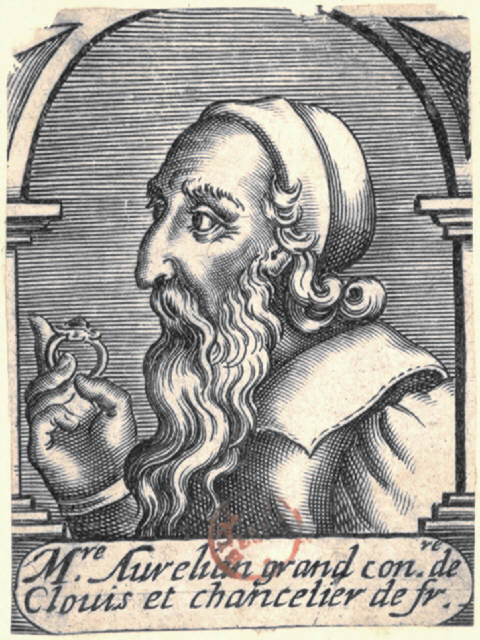 A stamp by an anonymous artist,
Bibliothèque nationale de France.
|
|
| |
|
In LHF-11,
-12, and -13 the author
gives us another royal counsellor whom Gregory does not mention. This
is Clovis’ advisor, Aurelian, who is the hero in the LHF’s long
story
of Clovis’ courtship of Clothild. Gregory simply says that the
Burgundian king, Gundobad, was afraid to refuse Clovis’ request for his
niece and so he handed her over (Hist., 11-28). The LHF
on the other
hand dedicates the greater part of three chapters to laying out the
cunning and loyalty of Aurelian in obtaining the Burgundian princess.
Doubt has been expressed about Aurelian’s authenticity,1
but, since
he is also mentioned by Fredegar in the same connection2
and since
we know there to have been a number of men by that name3
who could
have been an advisor to Clovis, there seems little reason to doubt that
he did exist. (…) In LHF-15 it is again Aurelian who
suggests that
Clovis turns to the Christian God in order to secure his victory over
the Alamanni. In Gregory’s account (Hist., 11-30) of his
conversion,
the king turns to Christ on his own.
|
|
__________________
|
| |
|
1.
"… wohl eine unhistorische
Gestalt…"
(Zöllner, Geschichte der Franken, p. 56).
2. Fredegar, III-18, in: SSRM, II, pp. 99-100.
3. Karl Stroheker, Der
senatorische Adel im spätantiken Gallien, Tübingen, 1948,
lists four men who were Clovis’ contemporaries. His number 46 on page
150 seems the most likely candidate.
|
|
| Furthermore, Gerberding remarks this on the avaricious
side of
Clovis' advisor under the headline II.
Emphasis on
Treasure and Booty (see p. 71): |
| |
|
With the
exception of its last
sentence, the whole of LHF-13 is an addition to Gregory’s
Historia.
The
chapter is the story of the successful attempt of Aurelianus to claim
Clothild’s treasure from her uncle, King Gundobad of Burgundy.
|
|
|
Martin Heinzelmann lists Aurelianus
4 as
the legatarius ‘Aurilianus’ in service of King Clovis I,
see Gallische
Prosopographie 260–527. Francia 10 (1982), p. 564.
The Old Norse scribes relate that Sifka serves his king not
only as counsellor but also ‘fiarhirdi’ (treasurer), see Mb 127, Johan
Peringskiöld: ch. 103. Henrik Bertelsen (op. cit.
p. 411)
registered him likewise as Ermenriks skatmester.
|
|
|
Morphological
connections and prospects:
|
| |
Linguistically and semantically, the
Latin names Chlodovechus (‘ Chlodovocar’) of
King Clovis may appear as an adjective+verb
compound derived from claudus
+ vocare in the
meaning of having an
unsteady or defective mind or,
physically, of lame, limping or
crippled appearance. But this interpretation, which
apparently does not refer to Clovis ' original
name, is
uncertain. Thus, we may wonder if he had received his
bibliographical Christian name at a certain point of
time in his political career – presumably after his baptism? This
momentous event could certainly draw attention to the milieu of
clerics, mediaeval writers and narrators who apparently
transformed his name for mentioning him in e.g. the Wǫlundarkviða
and Guðrúnarkviða II. Hlǫðvér,
the Nordic name of Clovis, appears to be based on *Hluda + *wīgaz,
respectively Proto-Germanic *hlūdaz (loud, famous) + *wīgą (fighter). On the other hand, it
seems
unlikely
that Clovis were named with either the Latin compound Chlodovechus/Chlodovocar
or that Germanic remembrance ‘famous fighter’ immediately after his
birth in an obvious syncretic or still unchristian
environment. In any case, a
transformation of his name for his typical character
trait (‘nicknaming’) would not seem inconsistent in
an intertextual literary context, regarding even spelling forms
related with that ‘Ermenrik’ of the Thidrekssaga when
consulting
J. de Vries: OE. yrman,
ME. (i)ermen: to grieve sb., cf. ON. erma.
It is worth mentioning here that there may be some Franco-Gothic
(re)naming of an historical individual which finally might result in
misinterpretation. A good example represents the alternation from Bruna,
Visigothic king Athanagild’s daughter, to Brunichildis. This
renaming has been serving for questionable scholarly interpretation as
the narrative spouse of both Sigibert I and the
literary Sigurð
(Siegfried),
and, in so far, the German-Nordic Brunhilda–Brynhild, who
popularly stands for a female warrior for wearing a Brynne–Brünne
= ring armour or byrnie.
However,
the retransformation of this
interpretation back to a synonymic Visigothic origin, which is
apparently based on nothing more than a female form of Franco-Gothic brun
(‘bright’, ‘brown’, cf. ‘brunette’) can not be performed satisfyingly.
For another example, as regards an apparently same contextual and
figural identity
with however different names, we may note well Gunnar’s sister provided
by
the Thidrekssaga and the Elder Edda, cf. Grímhildr
= the Eddaic Guðrún.
In
the Guðrúnarkviða
II (in ǫnnur) her mother appears as ‘a grim Hilde’ = Grímildr, resolutely
asking her sons who would pay for her killed son-in-law. It seems
conclusive that the author of the common source of the
Thidrekssaga and Nibelungenlied transferred her name and the
basic motif of revenge to her daughter.
Contemplating these and further aspects, we may alternatively reckon
with an
epithet as the idiosyncratic
name of a figure appearing especially in ancient historiography. Thus,
Ritter did not disregard the Húnalandish king ‘Ata -la’
(the Eddaic ‘At -li’),
who
is portrayed
rather in a defensive rôle, especially by the author of the
Nibelungenlied. It should
be further annotated that
even Gregory of Tours provides a name
of a quite similarly spelled historical individual.
Regarding Gregory’s
6 th-century accounts, he knows of an Attalus,
a nephew of
bishop Gregory of Langres, as
hostage at the court of Theuderic I. The
article Who
is King Atala? recalls some
historical person of 6 th–8 th
century being closely related to this name.
Eormenric’s
geographic environment by the
Old English Widsith
Alfred Anscombe made an interesting
approach to reintroduce
an obvious Gaulish Eormenric by means of the Widsith,
the Venerable Bede and some other sources, i.a. the Origo
Gentis Langobardorum.
Although the route of the Lombards from Scandinavia to Vurgundáib
(Burgundy) with
stopovers in Anþáib (presumably at the tribal
‘Antes’ on the lower Danube) and Báináib
(OE.
‘Bãning…’, likely Bohemia) under the
4th–5th-century
Agilmund and his successor Laiamicho (see dating by the RGA
13 [1999] p. 181) has been scholastically suggested
‘legendary’, Anscombe combines the Gaulish Eormenric on
territory somewhat close to the later German Westphalia, i.e. the
region which Ritter has contextually specified.
Regarding Anscombe’s structural based geographical and ethnographical
analyses of the Old English ‘Catalogue of Kings and Rulers’ by its
obvious continental author
and, among other material, the work of Bede and the Origo,
it may seem redundant to remark that Anscombe reviews R. W. Chambers'
work on the Widsith (1912) with this
general
statement:
|
| |
|
Nevertheless,
Mr. Chambers has treated the
matter as a student of legend – and I for one feel that this method is
apt to present princes and peoples in distorted attitudes and in
dislocated and discrepant environment.
|
| |
|
(The
Historical Side of the old English Poem of ‘Widsith’.
Transactions of the Royal Historical Society [III. Series] Vol. IX, pgs
123–165, see p. 125.)
|
|
|
Interestingly, in the matter of
Ritter’s basic reinspections of the Old Norse +
Swedish
manuscripts, it may
seem not superfluous to note that Anscombe points out an ancient
connection, based on either story or history, of tribesmen called
‘Greeks’ with the Treveri:
|
| |
|
‘Igitur omnipotens
Deus tres plagas maxime
gladium venire permisit super regnum christianorum et super civitatem
Trevirorum tribus vicibus: prima autem plaga Grecorum sub imperatore
Constante filio Constantini [† 350] secunda Wandali et Alemanni [A.D.
406] tertia Hunorum [A.D. 451].’ Vide ‘Codices S. Mathiæ
et S. Gisleni’ in Hillar’s Vindicatio Historiæ
Treverorum, pp. 57, 159. Also cp. ‘Post quem [sc. post S.
Paulinum Treverensem episcopum († 358)] Bonosius; deinde Brittonius
(…)
Horum temporibus Greci cum magna manu Treberim invasere et
cædibus et rapinis et incendiis graviter attrivere’; Gesta
Treverorum ed. G. Waitz, ‘M.G.H.’, ‘SS.’ tom. VIII. (1848),
p. 154.
|
| |
|
(Transactions…
op. cit. p. 148, fn. 2)
|
|
|
As far as our context is concerned, it
seems less relevant that such ‘Greek’ reflection, either the ‘Chroici’
of
the Alemannian leader Chrocus based on the Epitome
de
Caesaribus or another elder Chrocus related by Gregory of Tours and
the ‘Creacas’
by the Widsith, could have been potentially inspiring or
misleading the Old
Norse and Swedish scribes, cf. Anscombe (above) p. 145f.
|
|
|
Furthermore, Alfred Anscombe has
localized the ‘northern neighbours of the Treveri as ‘Gōtas’ by
geographical inspection of mainly the Widsith
and Origo Gentis Langobardorum. This
seems intertextually very interesting but, standing on its own without
further circumstancial indications, not forming a solid historical
evidence. Anscombe also combines that ‘Jarmeric’s uncle Budli
recalls
the Frankish name of Bodilo (Notes
and Queries, s. 11, XI, pgs 143–145, cf. p. 145) who,
moreover, may be
identified with an original Frisian ruler BODIL
(see farther below on ‘ODILbaldus’).
Following Anscombe’s intertextual identifcations of related persons in
so far, the kinship between ‘Eormenric’, Franco-Rhenish Theoderic and
Ætla (→ Atala)
may project
the mother of the latter as a daughter of Thidrek’s
grandfather or Thidrek’s mother as a sister of Atala’s
father. However, we must also take into consideration that Anscombe
may win little favour by identifying Saxo Grammaticus'
Danish ruler ‘Jarmeric’ with ‘Eormenric’ without further material. It
seems noteworthy that the scribes of the Old Norse +
Swedish manuscripts do not convey any consanguinity
between Thidrek and Atala, but
do
forward the common basic interests of both kings.
|
|
|
Who is Hermenricus
mentioned by Fulk of Reims?
Ritter has expressively considered
the libri Teutonici of certain connotation, see
Dietrich
von Bern, Munich 1982, pgs 304–305, en. 122. An author
referring to this edition is Flodoard (894–966),
historiographer and archivist at the cathedral of Reims
for the most time of his life. He is known as creditable
writer, especially by means of his ecclesiastical chronicle
of Reims. Flodoard left a passage taken from a letter that
archbishop Fulk of Reims wrote in 893 under political strain
between Charles the ‘Simple-minded’, whom Fulk called out by unction
for making him counter-king against Odo, king of Western Francia, and
Arnulf of Carinthia, king of Eastern Francia. With this paper Fulk
forwards some warning arguments to Arnulf, regarding this example about
the history of – apparently more likely – the Frankish
kingdom:
|
| |
|
…
subjicit etiam ex libris Teutonicis de
rege quodam Hermenrico nomine, qui omnem progeniem suam morti
destinaverit impiis consiliis cuiusqam consiliarii sui…
Source: Flodoardi
Historia Remensis ecclesiae, IV, 5, in: MGH
SS 36.
Edition of 1998 by Martina Stratmann, Flodoard von Reims. Die
Geschichte der Reimser Kirche, see p. 383.
|
| |
|
… he
(Fulk)
subjects to
further item from the Teutonic books a certain king named Hermenric,
who destined all his progeny to die by
impious counsel from one of his counsellors…
|
|
|
See also this survey on the historical
and literary
outlines of ‘Emanaric’ and Clovis by the author:
|
| |
Rolf Badenhausen, Zur
Historizität der Thidrekssaga – Teil III: Zur interliterarischen
Identität von Ermanarich: III-1 in DER BERNER 83
(2020) pgs 34–50,
III-2: vol. 85 (2021) pgs
41–60, III-3: vol. 86 (2021),
pgs 36–52.
|
|
Samson
Friedrich Panzer has aptly encountered
at least 50 ‘Samsons’ – Samsun, Sanses, Sanson – in the heroic
Old French Chansons de geste, cf. Italische
Normannen in deutscher Heldensage (1925) on the basis of
Ernest
Langlois, Table des noms propres de toute nature
compris
dans les chansons de geste imprimées (Paris 1904), cf. p.
599f.
The heroic figure Samson commemorates the Old Scandinavian bibliography
with at least 38 manuscripts of the Samsons saga
fagra.
This court epic saga, written in 14th–15th
century, calls its protagonist a son of King
Arthur, who also ruled over England, and renders him acting as a bride
deliverer mainly in ‘Britannia’, the French Brittany. Further, apart
from the
appearances of a Samson in the Karlamagnús
saga,
in the Blómstrvalla saga i.a.
referring
to Thidrek’s lineage, and in the Faroese lore of Ismal,
his deeds are also spread in two Old Danish manuscripts. In these
ballads, which also reached Old Sweden, Samson’s abduction of a king’s
daughter and his flight and pursuit are at the centre – thus in
accordance with the abduction and flight motif in the Thidrekssaga.
The Old Norse Thidrekssaga and the Old Swedish
‘Didrikskrönikan’,
which can be traced back to a common Low German or Saxon main source,
introduce Samson not only with a narrative scheme of abduction and
escape, but also as a conqueror whose total vivid portrait points well
to the Frankish 5th century. We may therefore
consider that the eminent bibliography about Samson as an exceptionally
perceived hero bases on an historical archetype which has been serving
for all these reflector figures.
Nevertheless, Panzer and some 19th-century
analysts have claimed historical and thus also figurative parallels to
the Norman conquest of southern Italy in the Samson account of the
Thidrekssaga, cf. e.g. Wilhelm Müller, Mythologie
der deutschen Heldensage. (1886) p. 152f. Other analysts,
e.g. Richard Heinzel, Otto L. Jiriczek
and Waldemar Haupt, assume Samson from an archaic tradition
with Saxon and French features, which is said to have been adopted in
Danish heroic lore (Kämpeviser). However, Haupt also
concedes a sufficient potential for identifications by means of the
Italian-Norman history of Emperor Lothair III
against Roger II of
Sicily (Rodgeir af Salerni); cf. Zur
niederdeutschen
Dietrichsage (1914) p. 164f. Hermann Schneider accepts
certain figural transfers from Roger to Samson, but rejects both a
primal Saxon tradition and uncritical copying from events of the 12th-century
emperorship [transl.]:
|
| |
|
Apart from the similarity
of names, there is hardly anything that captivates about this theory.
Despite Müller and Haupt, Panzer found an almost uncultivated
field when he set out to explore the Samson fable for Norman
reminiscences with a thorough exploitation of the historical source
material. (...) But the distance between the fable and history remains
so great that it cannot be bridged by the catchword «poetic
stylization». The equation has nothing compelling and so the
proof is also not provided that the Norman history had supplied the
building blocks for the prologue of the Thidrekssaga.
|
| |
|
[Original
text:]
|
| |
|
Außer der
Namensgleichheit
besticht kaum etwas an dieser Theorie. Panzer fand trotz Müller
und Haupt
fast unbebautes Feld, als er sich daran machte, mit gründlicher
Ausnützung des historischen Quellenmaterials die Samsonfabel auf
normannische Geschichtsreminiszenzen zu durchforschen. (...) Aber
der Abstand zwischen Fabel und Geschichte bleibt so groß, dass er
mit dem Schlagwort „poetische Stilisierung“ längst
nicht überbrückt werden kann. Die Gleichsetzung hat nichts
Zwingendes und so ist auch der Beweis nicht erbracht, daß die
Normannengeschichte die Bausteine zu dem Prolog der Ths. geliefert habe.
|
| |
|
(Hermann
Schneider, Germanische Heldensage. I. Vol., I. Book
(1928–1934, 1962) pgs 285–286.)
Thus, we may follow Schneider even
insofar as the warlord Samson – Rodger’s enemy – can only
be religated to a miscast for the rôle of Lothair III.
The name Samson was given to an early died
Samson of Merovingian dynasty.
Another more or less significant buttress appears as
ancestral name forwarding by an interesting nexus between
Theudomer’s father RICHEMER
and Samson’s son Ermenrik through
simple half-word interchange: EMER-RICH ( ch =
k).
According to the manuscripts Samson met his kinsman King Thetmar,
mentioned as his uncle in the Icelandic B-manuscript, after the slaying
of the noblemen ‘Brunstein’ and
‘Rodger’. Both have been detected as noncontemporary placeholder by
Karl
Droege, Zur Geschichte der
Nibelungendichtung und der Thidrekssaga, in: ZfdA 58
(1921), see p. 25f. on ‘Brunstein’.
King Thetmar, bearing a golden lion on his red
shield (Sv 4, Mb 6), had apparently come to aid
his
close relative on
this account, presumably against the Romans. In any
case, however, Samson would have had good reason to
remember him with name forwarding to one of his sons.
The scribe of the A-manuscript provides King Thetmar as Samson’s
father, as both writers may intend to point out his Frankish lineage
with the mention of Theudomer (‘Theodemir’) de
Thérouanne, † before 414. It seems noteworthy to remark
that
Samson’s interliterary father does not correspond
with that prototype of King Arthur whom the Samson
saga fagra loves to expose to some light of Lancelot
romance. Furthermore, it seems difficult to equate the famous King
Arthur with a king provided as Arkimannus
( Icelandic MS A, see Mb 245) whose surviving but
expelled two sons received new properties
from King Ata la.
Summarizing Samson’s narrative outline presented by
the Old Norse and Swedish manuscripts, his ethnical environment seems
rather Frankish than Roman based. As
regards Samson’s literary-historical epicentres, his
conquests with his prominent sons are geostrategically plausible only
between rather the Salian Hesbaye, the Eifel down to the Middle-Rhine,
where the Germania inferior meets the superior at the Roman Brisiacum,
and, as the texts provide, the previously Roman-ruled Moselle with its
eminent metropolis, where his outstanding son Ermenrik was acting
afterwards as its mighty and cruel ruler.
It seems less likely that Chilperic I had
named
his son
Samson after a Roman fort at Namêche on the southern banks
of the Meuse. Rather, Ernst F. Jung (op. cit., see
endnote 9,
pgs 101–102) quotes the assessment by
Helmut G. Vitt (op. cit. pgs 134–138) who
underlined the corresponding basic profiles of
Samson and Childeric I for literary
recognition.
However, Jung rejects the equation of Clovis I
with Thidrek’s father Þetmar.
As already pointed out farther above, see Some
historical and literary analogues, 1
with endnote 7,
and so far, both Samson and Ermenrik seem
worthy of synchronizing them with the Merovingian leaders Childeric and
his son Clovis I.
Childeric’s campaigns
according to Roman and Frankish sources.
See also these more comprehensive
explorations of Samson’s literary
identity by the author’s articles: |
| |
Rolf Badenhausen, Zur
Historizität der Thidrekssaga – Teil I:
Frühmerowingische
Herrscher und „Samson“; in: DER BERNER 80 (2020), pgs 24–38.
Rolf Badenhauen, Gallorömische
Warlords: ›Samson‹ – Childerich – Odoaker. Zur dynastischen
Kontinuitätsfrage der Thidrekssaga; in: DER BERNER 87
(2021), pgs 29–53.
|
|
|
Weland
He is mentioned in the appendix or
‘addendum’ of the German Heldenbuch
editions. Earlier remarks and renditions on Weland provide e.g. The
Lament of Deor, an 8th-century
elegy, the heroic
poem Waldere,
the Wǫlundarkviða
of the Elder Edda.
The Beowulf connects best armour with
Weland’s work. The Old Norse scribes of the Thidrekssaga use
the form Velent, while their
younger colleagues of the Old Swedish transmissions spell him Weland,
Velland(h), Wellandh.
Weland’s father Vaðe, a ‘risi a siolande’ as appositioned
by the Old Norse manuscripts of the Thidrekssaga, is
mentioned in The Widsith, a ‘poetry’
that has
been generally
regarded as a survey of European individuals, kings and heroes:
|
| |
|
Witta weold Swæfum,
Wada Hælsingum
The identical form Wada
(or Wade)
is preferred by the Old
Swedish scribes. Kemp Malone (1962, p. 207)
remarks on
the quoted
line (22) that
|
| |
|
the thulaman thinks
of
Wada, not as a mythological figure of any kind but rather as a Germanic
king, ruler of a tribe apparently historical. The theory that Wada "was
originally a sea-giant, dreaded and honored by the coast tribes of the
North Sea and the Baltic" (Chambers 95), seems therefore unlikely. On
the later (largely mythological) versions of the tale of Wade, see
Chambers 95 ff.
|
|
Referring to the Venerable Bede,
Malone does not equate Weland’s son called Widgawith with the
North-Suebian Witta who has been identified with Wid ning
and Wiht gils, assumed to be the grandfather(s) of Hengist
and
Horsa. The Widsith
introduces Weland’s son Wudga at line 124 and line 130 with
Heimir = Hãma ( see
Beowulf
line
1198). As already remarked above, Dietrich’s
contemporary Widga must
not necessarily come from the other side of the Alps.
H. Ritter and the author estimate the ‘historical horizon’ of the
Weland
parts of the ‘Didriks chronicle’ and Thidrekssaga between
440 and 470 (see Ritter’s
timeline). After his apprenticeship Weland was in service of King
Nidung who was ruling not only his Jutlandic kingdom but also the
Salian territory called Hesbaye (‘Hesbania’).
The manuscripts refer to his daughter called ‘Heren’ (see Icelandic MS
A, intertextually to be identified with ‘Beaduhild’) and three
of his sons. Weland, being cited also in Geoffrey of
Monmouth’s Vita
Merlini as Pocula que
sculpsit Guielandus in
urbe Sigeni, fled across Weser river and the North
Sea to Jutland with a specially prepared trunk that serves him well as
a
watercraft. In order to save his life, he had slain his outstandingly
skilled masters for his father’s unwillingly broken oath at ‘Ballova
Smithy’, which is about 30 mi. (c. 48 km) far from Siegen town.
Geoffrey of Monmouth never mentions Ballova
in his
literary work, whereas the Thidrekssaga and the Old Swedish
texts never Siegen. Although
Geoffrey’s Sigeni
has been alternatively surmised as Segontium or Sigontium
as the
Old
Welsh Kaer Sigont, we nevertheless may wonder how
Geoffrey had acquired the interesting information about Weland.
The Waltharius remarks Weland
shortly with these words at the lines 965 &
966: |
| |
|
Et nisi
duratis Wielandia fabrica giris
Obstaret, spisso penetraverit ilia ligno.
Weland, grandson of King Vilkinus, was
recorded as superb working smith and artist of his time, certainly
appearing as an early predecessor of Leonardo da Vinci.
However, Weland became victim of intrigues from some man of King
Nidung, and so he secretly took murderous revenge on his two
youngest but innocent sons for laming him by order of that
probably unsuspecting big ruler. Thereafter Weland made his daughter
pregnant at his forge and finally left the king with an aircraft
that corresponds well with a simple modern windsurfing glider, as
Ritter has explanatorily interjected, see Der
Schmied Weland, Hildesheim 1999, which
includes also a
nautical expert’s opinion of Weland’s passage.
We naturally would remember at this point Daedalus of Greek
mythology, the extraordinary inventor and master craftsman who
devised the Cretan Labyrinth for the fierce Minotaur: King
Mino, to whom Daedalus fled after he had committed murder, would not
allow him to leave the Minotaur’s special dwelling from which
he could escape by artificial wings nevertheless. We thus may
wonder whether there were any better literary innuendo for Weland’s
literary biographer to confirm and analogize
Fredegar’s Minotaur with King Nidung. Maurus Servius Honoratus,
late 4th-century grammarian,
left the interesting commentary on Virgil that the crippled Vulcan,
metal-smith of the gods, attempted to use violence on
goddess Minerva when she met him for forging service.
If the scribe of Weland’s vita had transformed this anecdote,
the manuscripts certainly would be basing on scholarly mediaeval
background!
|
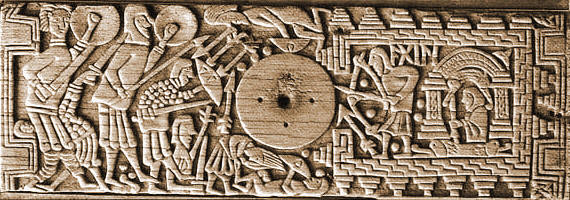
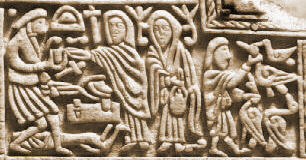 |
The
whalebone made Franks Casket,
Anglo-Saxon, first half of 8th century.
Regarding the divided
scenes on its front panel (smaller picture),’…
the left is
derived from the Germanic legend of Weland the Smith…’
as The British Museum points out briefly. Surprisingly, the front
panel’s right half shows historical adoration
of the Magi. Carved scenes of quite similar style from the
Thidrekssaga and related Nordic narratives were also adorning the
former
church of Hyl(l)estad, Norway. The photo on the left, imaging the
scene in the left half of the front panel, documents also Weland
getting and feeding geese, as this action will clearly mark the
most important first step for the
|
|
Creation
of
the Mimung (Sv 64, Mb 67).i
The
larger scene shown by this smaller photo refers to Weland working at
his smithy. He might be depicted at that time when he had slain the two
youngest sons of King Nidung,
seemingly illustrated with one small human body laying on the
ground behind Weland (Sv 73, Mb 74). This scene corresponds well
with the appearance of King Nidung’s daughter and a supernatural
maiden serving Weland with a bottle of liquid to make her obedient.
Thus, the artist seems to consider mythological tradition. The
first panoramic image of the casket’s
lid ‘…
shows another Germanic story about a hero named Ægili who is
shown defending his home from armed raiders.’(Comment by
The British
Museum). Ritter regards this scene ‘The Return of Odysseus’,
however.
|
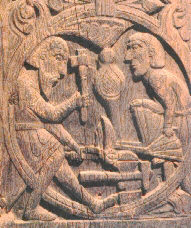
Two carvings
of Hylestad
Stave Church.
|
|
|
The
redrawn scene above remembers well also Weland slaying
Amelias, Master Smith of King Nidung.
|
|
|
|
i
A method of refining iron by digestion of birds is believed to be
traditionally kept as a secret in China and Tibet. Ritter
remarks that the usage of bird excretion for making
nitriding steel of astonishing high quality was scientifically
verified by
|
| Dr
Karl Daeves, Technical Engineer, |
|
Rundschau
deutscher Technik, Nr.26 20.Jg. Germany 1940;
|
| Dr
J. Heddaeus, Technical Engineer, |
|
Das
Werk, Heft 9, Jg. 1936, published by Vereinigte Stahlwerke
AG, Germany.
|
| See appended document |
The
Steel of Weland the Smith –
Summaries
of Scientific Analyses. |
|
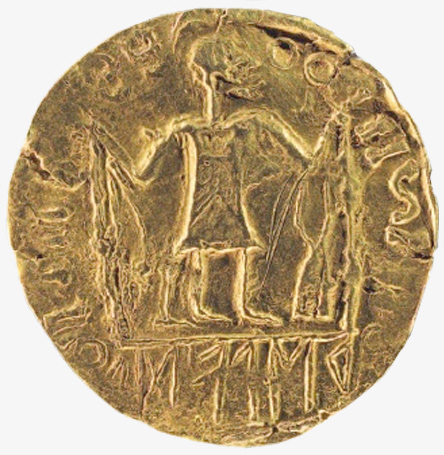
The Velad or
Welad Solidus.
 |
|
Ritter
provides on Weland another discovery being evaluated of
6th–7th century
(!), thus of elder creation than the
Franks Casket: the Gold Solidus of Frisian Schweindorf
with its obverse estimated as a facsimile of a typical Late
Antiquity solidus. The reverse shows the
likeness of a person and runic symbols of enlarged
Anglo-Saxon set of characters.
Jantina
H. Looijenga, authoress of the doctoral thesis Runes
around
the North Sea and on
the Continent A.D. 150–700,
classifies this piece as:
«… a cast gold solidus, found
in
Schweindorf near Aurich in 1948. Now in the Ostfriesisches
Landesmuseum, Emden. Date 575–625. |
Runes
run left: weladu
or þeladu.
|

|
| The
initial rune has a large loop, from the top of the headstaff to
the bottom, so either w
or þ may be read. As þeladu
does not render something meaningful, generally the reading wela[n]du
is preferred. This is a personal name Wēla(n)du, cf.
Old English Wēland, Old Norse-Icelandic Vølundr,
New
German Wieland |
| < *wēla-handuz,
nominative singular maskuline: u-stem, ‘trickster’
(Düwel/Tempel 1968/70; Beck 1981:69ff. with references).
The first part of the compound is *wēl- ‘trick, ruse’ cf.
Old Nordic vél ‘artifice,
craft, device’ followed by the suffix -and <
Germanic *handuz. |
The name might refer to the well-known legendary smith Weland...»
Tineke Looijenga, authoress of Texts and Contexts of the
Oldest Runic Inscriptions, Leiden & Boston 2003, corrected this
reading of the solidus to welad.
Thus, we would adhere to consideration that coincident ‘Low Saxon
minting’ referring to mythological persons might be unprecedented.
The Ardre VIII image stone of Gotland (8th
century) and the
Cross-shafts of Leeds (c. 11th century)
provide other pictorial
traditions of Weland the Smith.
Weland of old
tradition. Painting by E. Nowack.
|
|
|
|
Widga
The Waldere
provides the eldest known father-son-connection of Wēland with Widia
(Old Norse: Viðga)
and represents the earliest tradition we have on the relationship of
the latter to Ðēoderīc,
whereas the Widsith does
obviously disregard the father of Wudga. He appears remarkably
as Widrick
in Old Danish heroic epics(17) and
became
also a significant subject of receptive MHG poetry ( Wittich, Witige).
As concerns his original ancestry and homeland in particular, Gunnar
Olof Hyltén-Cavallius
and other philologists identify Weland’s son Widga ( Widerich)
with a ‘Widerick’ Widrik Willandsson
or Werlandsson by sources
related to the former ‘Willands’ härad, now
Villands härad, as this region of Skåne seems to correspond
with the name of Widga’s father (Hyltén-Cavallius,
op.
cit. pgs XXIIf.). Some local historians of this administrative
district have suggested a naming from rather a pretty lake called Wæ tli
thereabout which, however,
seems to point to a derivation which does reflect an early or final
property of Widga’s
grandfather Vaðe,
Vaði, Wadi (cf. the forms
by Icel. MS A; see
https://sv.wikipedia.org/wiki/Villands_h%C3%A4rad#Namnet
[retrieved March 2016]).
 The
19 th-century copyist and reviewer of the Old Swedish
manuscripts quotes i.a. from sources which situate the final resting
place of Widrik in the same ‘härad’ of South Sweden, district of
Bromölla-Valje-Sölvesborg. The current coat of
arms of the superior administrative district has been designed with
hues which are corresponding with Sweden’s national colours. The Royal
Library of
Denmark preserves at least one elder version of this coat of arms which
is adorned with a centre-placed carbuncle-stone.
Hyltén-Cavallius mentions that in the aforementioned region the
grave of Widrik, in the south of today’s Vidriksberg farmstead by other
sources,(18)
was documented for the archives of Scandinavian king Christian IV
by Rev. Jens Svendssøn in 1624. Referring to this localization,
Nils H. Sjöborg’s Samlingar
för nordens fornälskare, innehållende Inskryfter,
Figurer… II (Stockholm 1824) ascribes Widrik’s
grave to c. 500.
Combining this context with Viðga’s
literary vita provided by the Old
Norse manuscripts, he finally could have been returned from Gransport
(or his northern German family and property) to the defining or last
residential place of his father and/or grandfather which, however,
may be less likely Fimber, Isle of Fehmarn in the Baltic Sea,
but more likely another northern location as being placed above at the
disposal. Considering
the interliterary
spelling variations of Widga the Hero (cf. e.g.
Roswitha
Wisniewski, Mittelalterliche Dietrichdichtung, Heidelberg 1986,
p. 276), especially the Old Swedish name forms Wideke
and Wideki
can generally echo a result of shortening derivation from Old German Widechinstein,
a former name related to the Sayn-Wittgenstein dynasty.
The Latin manuscript of Thidrekssaga, ch. CLVI
published by
Johan Peringskiöld, provides these insignias of Widga: |
| |
|
…
Galeam
gestabat candidi coloris,
scutum, ephippium, axillaris tunica, vexillum, scutum rubro colore
interstinctum malleum forcipemque
exhibebant, quorum in medio tres elucebant carbunculi lapides,
gentilitia paterni stemmatis insignia, quæ fabrilium
operum magistrum eum prorsus excellentem præfigurabant;
maternum genus per lapides ternos
indigitabatur…
|
|
|
The English translator Edward R.
Haymes reads the corresponding passage of Mb 175 as follows:
|
| |
|
Vidga
the strong had all of his
equipment white in color, shield, saddle, surcoat, banner and
helmet-cover. His shield was marked with red paint in the shape of a
hammer and tongs. There are three carbuncle-stones in his shield. The
mark is a sign of the origin of his
father. He is a smith and the most skilled of
all men in the world. The three gemstones signify his mother.
|
|
| |
|
There is no proof of evidence that
name-giving of this South Swedish region, apparently related to father
and son Weland and Widga, is based on rather fictitious figural
background.
|
| |
|
10.3 Atala of
Susat
and a
perspective survey
|
|
Ferdinand
Holthausen,
a 19th-century
researcher of Thidrekssaga and Dietrich epics, wrote
in
1884:
|
| |
Ich denke mir, dass die
Erzählung der friesischen Chronik
im wesentlichen eine alte Soester Localsage widergibt, und zwar in der
ursprünglichen Fassung, ehe sie mit der Attilasage verschmolzen
war. Attila war schon früh in der niederdeutschen Heldensage in
Soest localisiert, wie Heimi in Wedinghausen und die Rabenschlacht an
der Mosel, allmählich flossen
die Sagen von ihm und von den Friesen im Bewusstsein der Soester
zusammen, und zu der Zeit, als die Männer von Soest, Bremen und
Münster dem Sagaschreiber ihre Sagen
und Lieder vortrugen, muss diese Verbindung schon eine ganz feste
gewesen sein.
Der Bericht der Th. S. gibt das Resultat dieser Sagenvermischung; so
erscheint der grosse Hunnenkönig als friesischer Prinz und
Gründer von Soest.
(F. Holthausen, Studien zur Thidrekssaga in: Beiträge
zur Geschichte der deutschen Sprache und Literatur, PBB, Band 9,
Heft 3;
pgs 451–503, see p. 456.)
[I think that the account of Suffrid’s
Frisian chronicle principally reproduces an old local saga of
Soest, which is the original
version before it was amalgated with the saga of Attila. Attila has
been early localized in Low German heroic saga, also Heimi
at Wedinghausen and the Rabenschlacht on the Moselle;
and so the sagas of the former and the Frisii were gradually fusing in
the mind of the people of Soest; and at that time
when the men of Soest, Bremen and Münster were reciting their
sagas and lays to the saga writer, this compound must have been a very
solid one. The report of Thidreks saga represents the result of this
saga
amalgamation, so the great king of the Huns appears as Frisian prince
and founder of Soest.]
|
|
|
Why did Holthausen
stumble upon the Frisian
chronicle
written by Suffridus
Petrus in 1590? This is the very passage Holthausen encountered in
Suffrid’s De
Frisiorum antiquitate et origine libri tres II, 15:
|
| |
|
Vesvalii
igitur ab eo tempore, quo
terram istam occupassent, una cum confoederatis Angrivarijsii
vicinam Frisiam diversis incursionibus infestarunt, &
tandem anno
Christi
344. qui Odilbaldi, Frisiorum ducis, nonus fuit, terram Gruninganamiii
ex improviso invaserunt, & antequam Frisij
in armis
esse possent,
omnia
flammis ac rapinis vastaverunt usque ad fluvium Lavicamiv,
qui eam terram ab Occidentali Frisia separat. Odilbaldus autem,
contractis quantocius copijs, hostes fugientes non modo praeda exuit,
set & domum usque insecutus, castris
aliquot ac
munitionibus
occupatis privavit; nec porro destitit, donec Angrivariam totam, &
maxima quoque ex parte Vesvaliam suae ditioni subjugasset, relicto
illic praesidiario duce, cui nomen erat Yglo Lascon. Ille hisce populis
in officio continendis praefuit annis integris sexaginta quinque, &
ad securitatem domini sui aedificavit arces tres, primam in Angria,
quae postea Vitekindi fuit; alteram Susati, quae postea in civitatem
per Dagobertum Clotarii filium sublimata, &
tandem
S. Cuniberto
Coloniensi Episcopo donata est, quod nostris scriptoribus referentibus,
attestantur Chronica civitatis Lippiae &
Coloniensis; tertiam
Iburgi, quod nunc Driburgum dicitur, de quibus infra plura.
________________________
i
Westfalians
ii Engern: name of a tribe on
Weser
river
iii Groningen
(Netherlands)
iv frequently mentioned
in
local histories
but today difficult to prove as watercourse that possibly had some
closer relation to Dutch ‘Lauwers zee’
|
|
Regarding the history of Soest’s
formation, Holthausen additionally quotes from Johann S. Seibertz’ Urkundenbuch
zur Landes- und
Rechtsgeschichte des Herzogthums Westfalen (book of
certifications on the country and legal history of the Duchy of
Westphalia, vol. I), as certified on Soest in 1120:
|
| |
|
Preterea iuris
advocati est. hereditatem accipere frisonum et gallorum.
|
| |
|
(Holthausen,
op. cit.
p. 455. Quotation: Seibertz op. cit. p. 50.)
Suffridus Petrus,
of Christian name Sjoerd
Pietersz,
was Professor of Jurisprudence, Canon at St. Apostles
Church of Cologne, and appointed ‘First Historiographer’ of
West-Frisian
corporative system in 1590. Although his obvious patriotic disposition
has been
indicated
for some uncertain historical reprojection, we nonetheless should keep
an
eye
on the following text from his
Frisian chronicle:
|
| |
|
Supradictus
autem Frisiorum dux
Odilbaldus filium habuit, cui nomen erat Udolphus Haron, quem
Gymnasticis certaminibus egregie domi exercitatum anno Christi 357. in
Angriam misit, ut eum Yglo Lascon veris praelijs cum hoste subeundis
expoliret, apud quem paulo plus biennio uno fuit.
Habitabat ea tempestate prope Hamburgum
praecipuae nobilitatis satrapa Vergistus, qui filios duos Hengistum &
Horsum, & filiam unam nomine Svanam
habebat. Filij
in Albis mortui sunt. Udolphus dum visendorum amicorum gratia Saxoniam
ingressus, ad Vergistum divertit, amore Svanae correptus est, quam &
cum parentum utrinque consensu uxorem
duxit.
|
| |
|
(Suffridus
Petrus, op. cit.)
|
According to the Frisia,
seu, de viris rebusque Frisiae illustribus libri duo,
written by Martinus
Hamconius, a king called Odilbaldus was succeeding his father
in 435. The ‘hypothetical Frisian historiography’, as the writings
by both Frisian scholars are recalled by some scholars, provides from
its more or less fragmentary accounts at least seven reges,
principes, duces, potestati with a name or second name based on *Adel.
It seems more than likely that this form does basically correspond with
*Odil.
Both Suffridus and Martinus nowhere indicate to have any intertextual
relation to the Thidrekssaga, but, according to their
writings, we are apparently
confrontated with Frisian leaders Adel,
Adils, Aðils, Athils chronologized from 2nd
to 5th century. As further maintained by
these accounts, an Adgill(us)
rules later in the 6th, another one in
the 8th century. A pre-Carolingian Frisian AUDWULF
FRISIA stamped on coins, an AVDVLFVS
FRISIA or
VICTORIA AVDVLFO minted on other coins found in the
Netherlands and, regarding the former one, in England, and the accounts
on a Frisian leader called Aldgisl
appear historically verifiable; cf. Herrius Halbertsma, Frieslands
oudheid, Thesis, University of
Groningen 1982; see p. 792 on the latter and p. 68 on
the former in Halbertsma’s new edition of 2000. Although not a few
details in the vitae of the early Frisian leaders seem apocryphally
constructed, there is no
proof of evidence that all representatives of this regnal clan, even
those of Migration Period as listed by Suffridus Petrus, Martinus
Hamconius and other authors, are purely fictitious.
Since we can not clearly distinguish between Frisian-born and Saxon
rulers in this spatiotemporal matter of historical or historiographical
recognition, and,
against Suffrid’s and Martinus' accounts,
neither verify
nor disprove
the political connectivity of Soest with the Frisian kingdom in
Merovingian and even later times, we should not disregard that
mediaeval historiography could have related a former 4th-
or 6th-century ruler of a
southern region to
the Odil–Adel–Adgill dynasty
and call or byname any of their successors
likewise an Athil (see farther below).
Besides, it may be worth to compare the obvious common stems of Adil–Odil
with the forms of the Eddaic rulers Atli and Budli,
where the initial consonant of Atli’s ancestor seems to emphasize *Udli / *Odli.
The ending forms -li and -il appear certainly
interchangeable for
interliterary usage, see At-li – Att-il-a
as
most
prominent example. Moreover, it should be recognized in an
ethno-geographical context that the Icelandic and Swedish manuscripts
introduce not only an Odilia – presumably indicating a daughter
of an offspring or good-son Elsung
of an Odil – as Thidrek’s mother, but
also, as forwarded as well by the Old Norse texts, an equally named
woman
as spouse of Ermenrik’s advisor Sifka. All this cannot reflect a basic
narrative milieu of the Ostrogothic Theoderic.
Holthausen’s perception, in view of considerable
literary detraction of ‘Attila the Balkan Hun’, is based on an early
passage in the Thidrekssaga that relates the Frisian invasion and
conquest of King
Melias' Húnaland.
Johan Peringskiöld
provides this text of the Latin script which appears closely
related to the Stockholm folio of Thidrekssaga:
|
| |
LXII.
(Mb 39) |
Inclaruit ea
tempestate rex
Osides, qui Frislandiæ regno potiebatur, opum atque
regionum amplitudine præstans. Duo ipsi nati erant filii,
Ortnitus atque Attila. Quorum minorennis alter a primis pueritiæ
annis roboris & fortitudinis egregia dedit
specimina. Equestria
exercitia probe edoctus, liberalem habebat animum, sapientæ
etiam donis instructum. Cætera alienarum etiam rerum
appetens erat, in prosequendo proposito suo maximopere persistens.
Hunc duodecimum ætatis annum cum ageret, præfectum
prætorio constituit Osides. Attila crebas cum copiis suis
in regnum Meliæ excursiones fecit. Quod vero annis iam
gravis esset Melias, nec filium haberet, cui tutandam regni finium
curam committere posset, multum detrimenti ab Attila ipsi allatum fuit,
subjugatis urbibus eius plurimis. Circa idem tempus in morbum incidens
Milias, militiæ duces atque præfectos ad se
convocari iussit, ut rerum secreta cum ipsis communicaret. Doluit
autem vehementer, nullum sibi esse filium hæredem cui
regni gubernacula committere posset; quippe filiam in Vilkinalandiæ
boreali regione marito nuptam, generumque suum Osantrigem moderando
regno proprio intentum esse. Interea multo cum successu per Hunalandiam
grassari Attilam Osidis filium; unde conjectura haud fallaci prævidere
se, ex stirpis suæ progenie propediem ablatum iri
Hunalandiæ
regimen. Hanc ob causam regnum Osantrigi committendum voluit, ut
adversus Attilam tutaretur. His agitatus curis, simulque morbi
ægritudine
labefactatus, tandem exspiravit Melias. Mortuum magno luctu
prosequebantur Hunalandiæ cives, propter pacis quæ
coluerat studia, opumque erogandarum liberalitatem, inque legibus
servandis exactitudinem. |
(Mb 40)
|
Huius
morte cognita, Attila solennem populi
conventum indixit, advocatisque familiaribus suis, prolixo verborum
sermone exposuit, quanto hactenus successu res in Hunalandia prospere
ab ipso gestæ, urbesque expugnatæ fuerant :
Iuramento insuper se adstrinxit, non prius avitum regnum repetiturum
se, donec universa Hunalandia sub suam potestatem redacta sit. Ipso
hunc in modum loquuto, ingens adstantium in multum diem concitatus est
clamor, collaudantibus aliis insignem regis virtutem atque
fortitudinem, divitiarumque copiam, qua priores sua familia satos longe
superavit. |
LXIII.
(Mb 41) |
Melias
Vilkinaburgum
primariam regni sui sedem habuit. Redacto autem in suam potestatem
universo regno, sedem hanc Susatum promovit, quam &
diutius deinde
tenuit. Huius nimirum urbis ipse prima fundamenta posuerat, permanetque
hodiernum in diem celebris eius gloria, &
opulentiæ
fama. Attila solenni pompa Hunalandiæ rex creatus est.
Quam dignitatem sibi præreptam cum cognovit Osantrix,
admodum id ægre
tulit utpote iure hæreditario Odæ uxoris suæ
Meliæ filiæ sibi
debitam. Hinc dissidiorum origo inter utrosque reges, prælia
cruenta
cædesque. Occupatum nihilominus regnum Meliæ
gladio sibi vindicavit
Attila, addito prætextu illo, Osidis in Frislandia regnum
exiguis
limitibus circumscriptum, patri suo vix in vita suffecturum esse ; quin
& ægre
laturum
fratrem
Ortnitum, si
defuncto patre, regnum cum ipso dividere velit. Quapropter regno multis
cum molestiis occupato, se nequaquam cessurum, sed ultima potius
experiri paratum. Interjecto tempore aliquo ê vivis excessit
Osides Attilæ pater, post quem regnum Frislandiæ
occupavit filius
eius maior natu Ortnides. Ipsi filius natus est Osides, optimæ
atque
præclaræ indolis, egregiisque corporis
exercitiis imbutus. Ad adultam
cum pervenisset ætatem, patruum suum Attilam Hunalandiæ
regem adire
gestiebat. Advenientem multo honore excepit Attila, præfectum
legionis
equitum eum constituens. Hoc in statu diuturno tempore res perstiterunt.
|
LXIV.
(Mb 42) |
Attila
vocato ad se nepote Oside, eum sui causa in Wilkinalandiam ad
Osantrigem ablegandum dixit, pro sollicitandis filiæ
regiæ nuptiis.
Magno mox apparatu iter instructum, adjunctis ei in societatem viginti
præstantissimis viris è nobilium cohorte… |
|
|
Edward R. Haymes translated these accounts from
Bertelsen’s transcriptions:
|
| |
| Mb 39 |
There
was a king named Osid. He
ruled a country called Frisia. He was a powerful chieftain and rich
both in lands and in movable goods. He had two sons. The elder was
named Ortnid and the younger Attila. Attila was large and strong very
early in his life, a good knight on horseback, generous with money,
wise and ambitious. He was the greatest fighter in all respects. When
he was twelve years old, King Osid set him as chief over all of his
chieftains. King Attila often rode out with his army into the domain of
King Milias, who was feeble with age and who did not have a son to
protect him. Attila did much damage in his kingdom and took many cities
in his land.
At this time King Milias fell seriously ill. He
summoned his chieftains and conferred with them secretly. He greatly
regretted that he had no son to rule after him and that his daughter
was married off in the north in Vilkinaland, and that his son in law,
King Osantrix, was too far away to take care of his kingdom. But Sir
Attila, the son of King Osid, was often in his kingdom, and thus he
thought that the kingdom might pass out of his family, even though he
wished that King Osantrix would rule over it and protect it from
Attila.
Because of these concerns and because he was very
sick, King Milias died. He was greatly mourned in Hunland, because he
was peaceful and generous with money and because he had kept the law
while he had ruled Hunland. |
| Mb 40 |
When
Attila, the son of King
Osid, heard that King Milias was dead, he summoned an assembly of the
multitude and had his friends come. He gave a long speech about how
well his harrying expeditions into Hunland had gone and how many cities
he had taken in the domain of King Milias. He then swore that he would
not return to the kingdom of his father until he had won all of
Hunland. His speech produced great applause and for a long time
everyone praised him for his generosity, his valor, and for the fact
that he had become much more powerful than his kinsmen had been. |
| Mb 41 |
Attila
was accepted as king over
the army and the retainers gave him the title of king. He swore to them
justice and law in return, and another time he promised them that he
would never return to the kingdom of his father until he had won all of
Hunland with his sword along with all of the territory King Milias had
owned. King Milias had had his capital in Valterborg, but King Attila
set up his city at Susa. It is now called Soest. He became the richest
of kings. For a long time there was enmity with the Vilkinamen, because
King Osantrix thought that King Attila had taken by force the kingdom
that belonged to his queen Oda and had belonged earlier to her father,
King Milias. But King Attila kept all of the kingdom that belonged to
Hunland so that King Osantrix received no tribute from it.
Now King Osid died, the father of King Attila, and
his kingdom was taken by his elder son, Ortnid, and he was now king in
Frisia. He had one son, named Osid. He sent him to King Attila to be
raised. Osid was the bravest and most gallant of men. King Attila
placed him as chieftain in his army over many of his knights. The
kingdom remained thus a long time. |
| Mb 42 |
It
happened onetime
that King Attila called his kinsman Osid to him and said that he wished
to send him north into Vilkinaland to meet King Osantrix. His task was
to ask for the hand of Erka, his daughter, in marriage. King Attila
also chose a second chieftain to go on this journey. His name was
Rodolf and he was a duke over many knights in Attila’s army. He
selected twenty knights on the basis of their courtesy and good manners
to accompany them, and each had two well-accoutered squires. Thus was
this journey splendidly planned in all details… |
|
|
| The Old Swedish manuscripts render this brief
version (Ortnitus ↔ Herding): |
| |
|
33.
|
In
Frisia was a king called
Osid. He had two sons; one was called Herding, the other Aktilia. He
had in mind to make war
anytime, and he gained some land and glorious victories. Once he was
warring against Melias king. When Aktilia invaded Melia’s land, he
said: ‘I will never
return unless and until I have won this land!’ He won many battles
against Melias king. Melias withdrew to an urban location called
Wilcina. Aktilius won
all his land and subjected it by his rules. And he settled at a place
called Susat, and he let build it up preciously. Tribute was paid to
Aktilius as king of
allHúnaland that Melias had had before him. Osanttrix king heard
of
it, and it seemed
to him ashamed that the father of his spouse had been expelled in such
way. Now a big war began between Osanttrix and Aktilius king, and they
had many battles against each other. However, Aktilius king did not
lose anything
of the realm that he had won. He said that nobody shall get anything
of it as long as he was living: ‘My brother Herding shall have Frisia
after the death of our father.’ |
|
34.
|
Then
Osid, king of Frisia, died. Herdink took over the
realm. A son called Osid was born to him. He became a strong man. As he
was grown up, he rode to his father-brother Aktilius king, and he was
always the commander of his folk when they were warring. Aktilius sent
out his nephew Osid
and with him xx knights to Osanttrix king, submitting that Aktilius
wants to have his daughter Ercha.
|
|
|
A comparison of these passages with Suffrid’s
report
results in these general relations, see Willi Eggers (op.
cit.
p. 84f.):
|
| Thidreks
saga & ‘Didriks chronicle’ |
Suffridus
Petrus |
| The warriors
of Osid, king of Frisia, invade Húnaland
under Atala’s’s command. |
The warriors
of Odilbald, king of Frisia, are acting
in response of attacking southern and southeastern tribes ‘Vesfali’
and ‘Angrivari’ and invade regions of the later Westphalia under Yglo
Lascon’s
command. |
| Atala
takes
Susat as residence and builds it up. |
Yglo Lascon
stays in conquered Westphalian land. He builds
up three fortressed settlements. The most important one is Soest. |
| Osid, son of
Herding and grandson of Osid the Elder,
kings of Frisia, moves to Atala. |
Udolph Haron,
son of Odilbald, moves to Yglo Lascon for
education. |
| Osid the
Younger goes to Osantrix (‘Osangtrix’), king of the Wilzians.
As representative of Atala he makes a
proposal
for Osantrix’ daughter. |
Udolph Haron
goes to the region
of the later Hamburg for courting Svana, daughter of Vergist
whom Suffrid quotes as
an influential ruler on the Lower Elbe, territory of the later Hamburg. |
Eggers quotes so far from
Holthausen. The latter considers this synopsis as follows:
|
| |
|
Die
Übereinstimmungen zwischen der Mitteilung der friesischen
Chronik und den Worten der Th. S. sind so schlagend, dass wir daraus
getrost einen alten Zusammenhang erschliessen dürfen. Ein
friesischer König erobert Westfalen-Húnaland,
Soest-Súsat wird dort als Burg gegründet, resp. zur
Landeshauptstadt erhoben und ummauert — dem Odilbald entspricht
Osið, dem Yglo Lascon der Königssohn Attila, dem Udolph Haron
der jüngere Osið, der zu seiner weiteren Ausbildung nach Soest
geht. Anstelle der Heirat zwischen Udolph Haron und Svana in Hamburg —
in der Nähe des Landes der Wilzen — hat die Th. S. entsprechend
die Brautwerbung Osiðs im Wilzenlande für seinen Herrn und
Oheim Attila. Svana und Erka, Vergistus und Osantrix stehen ganz und
gar auf gleicher Linie. Die Menge der Übereinstimmungen schliesst
trotz mancher Verschiedenheiten im einzelnen die Annahme von Zufall aus
— dies müssen gemeinsamer Quelle entstammende, alte
Überlieferungen sein.
(Holthausen, op. cit.
pgs 455–456.)
[The correspondences between the narrative detail by the Frisian
chronicle
and the words of the Th.S. are so striking
that we can confidently conjecture an old
context. A Frisian king conquers Westfalen-Húnaland,
Soest-Súsat is founded there as a castle, resp. raised to the
capital of the country and walled – Odilbald corresponds with Osið,
Yglo Lascon with Attila as the king’s son, Udolph Haron with Osið
the
Younger, who goes to his further education to Soest. Instead of the
marriage between Udolph Haron and Svana in Hamburg – near the land of
Wilzians – the Th. S. accordingly relates Osið’s courtship at
the Wilzians for his lord and uncle Attila. Svana and Erka, Vergistus
and Osantrix are all in line. The set of correspondences excludes,
despite of many differences in detail, the assumption of coincidence –
these must be common source-derived, ancient traditions.]
Of course, there are some different
narrative details
in these courting stories. For instance, Suffridus or his source does
not mention a
kinship between Odilbald and Yglo Lascon, and there is no ‘rule keeping
escort’ for Udolph’s special mission, whilst
the Old Norse + Swedish texts relate that Margrave
Rodingeir/Rodger, an accompanying but obviously interpolative
nobelman based in Húnaland,
finally takes the chance to court the Wilzian princess Berta.
Nevertheless, we may wonder whether this literary comparison can be
based on
an believable historical event.
(The Helgakviða Hjǫrvarðssonar
from the herioc lays of the Elder Edda offers an
interesting
allusion where King Hjǫrward
sends out Atli to Svavaland for courting King Svafnir’s
daughter.)
Comparing the geohistorical pattern of the Osantrix+Oda
and Atala+Erka wooing stories with both
Ritter’s timeline and
Suffrid’s history of Frisia, these episodes seem to have occurred
in 4th
and/or 5th
century. As regards Suffrid’s date tandem anno Christi 344, we
have to reconsider historical incursions of ‘Northern Saxons’ into
regions of today’s North Rhine-Westphalia and southern parts of Low
Saxony by means of
some independent ethno-archaeological research. For instance, Peter
Berghaus contextually agrees with the archaeological and
numismatical research by Jan W. de Boone:
|
| |
|
Den
nördlichen Teil
dieses Schatzfundgebietes, den Raum zwischen Wiehengebirge und
Teutoburger Wald, hat J. W. de Boone sehr überzeugend mit dem
Vorstoß einer sächsischen Gruppe etwa um 370 in Verbindung
gebracht.17) Diese Deutung wird durch die
Fundumstände
des Ellerbecker Fundes unterstrichen; er stammt aus einer Siedlung des
3. bis 5. Jahrhunderts, die bei dem sächsischen Vorstoß
überrannt und verwüstet worden sein dürfte. Man
möchte fast glauben, daß sich ein erneuter Vorstoß
dann fünfzig Jahre später weiter nach Süden, bis in das
Hellweggebiet gerichtet hat. Seine Spuren hat er in den dortigen
Schätzen aus dem Anfang des 5. Jahrhunderts hinterlassen.
[J. W. de Boone has very convincingly
connected the northern part of this treasure-finding-region, the area
between the Wiehengebirge and the Teutoburger Wald, to a group of
Saxons pushing forward about A.D. 370.17)
This interpretation is underlined
by the characteristic circumstances of the Ellerbecker finding. It
belongs to a 3rd–5th-century
settlement which must have been
overrun and devastated by this Saxon advance. One would almost believe
that a further advance was launched fifty years later farther to the
south, just into the Hellweg area. This incursion has left its traces
in
the local treasures dated into the beginning of 5th
century.]
__________________
17) J. W. de Boone: De Franken
van hun eerste optreden tot de dood van Childerik, Diss. Groningen
1954, S. 109.
See also Peter Berghaus, Der
römische
Goldmünzenfund von
Ellerbeck, Lkr. Osnabrück, in: Die Kunde. Neue Folge
7, 1956, Heft 1–2, pgs 30–40, cf. p. 37.
Wilhelm Winkelmann reassesses the
conjected opinion of Berghaus as historical 4th–5th-century
incursions of northern people into the Hellweg region which
includes the urban district of Soest. Winkelmann,
formerly archaeological director
of German LWL organization, connects
the treasure trove discoveries and other archaeological finds
with these ethnographical conclusions:
|
| |
|
Aber
warum sind
diese Schätze vergraben worden? Bei dem einen oder anderen Schatz,
die mit großen Steinen abgedeckt waren, Ellerbeck und
Letmathe-Oestrich, kann es sich um Opfergaben handeln. Aber ihre dichte
Verbreitung im Norden und Osten des altfränkischen Gebietes weist
auf wiederholte, vom Norden erfolgende kriegerische
Vorstöße, die sich zwischen 365 und 450 ereigneten. Hier
wird schon seit der ersten zusammenfassenden Veröffentlichung
dieser Funde durch Sture Bolin im Jahre 1926 und später auch durch
de Boone und P. Berghaus auf wiederholte sächsische
Vorstöße verwiesen, die über den Hellweg bis zum Rhein
führten. In diesen unsicheren Kriegsjahren sind zweifellos die
Schätze vergraben worden, um sie vor dem Feind zu verbergen und
später wieder zu heben. Aber dazu kam es nicht mehr. Denn schon
begannen aus den nördlicher liegenden sächsischen Gebieten an
der Weser erste Vorstöße nach Süden. Ein erster Zug der
Jahre 365 bis 370 durchbrach das Wiehengebirge, das Weserbergland und
gewann das Gebiet bis zur oberen Ems und oberen Lippe. Ein weiterer
Zug der Jahre 425 bis 450 traf auch das Hellweggebiet bis zum
Rhein.
[But why have these treasures been
buried? Some of the treasures, covered with large stones at Ellerbeck
and Letmathe-Oestrich, can be sacrificial offerings. But their dense
spreading in the north and east of the old Frankish region points to
warlike advances made repeatedly from the north between 365 and
450. The first summarizing publication on these findings by Sture Bolin
in 1926, other later by de Boone and P. Berghaus, does already refer to
repeated Saxon advances across the Hellweg to the Rhine. In these
uncertain years of war the treasures have undoubtedly been buried in
order to conceal them from the enemy, and to raise them again later.
However, this did not happen, since new advances from northern Saxon
regions on the Weser begun southward. A first movement between 365 and
370 broke through the Wiehengebirge, the Weserbergland and took
the region up to the upper Ems and upper Lippe rivers. A further
movement from 425 to 450 also affected the Hellweg area to the
Rhine.]
|
|
|
Winkelmann remarks also opposite
pushing migrations in the same period. Thus, these movements seem
consistent with Suffridus' version about those
eastern
tribes
(somewhere on the rivers Hunte and Weser) who invaded
regions on the Lower Rhine, Drente, and other areas of Frisia:
|
| |
|
In
den gleichen
Jahren sind aber aus den elbgermanisch-sächsischen Gebieten
zwischen Weser und Hunte auch nach Westen gehende Vorstöße
festzustellen. Sie erreichen die Drente, Friesland und weite Gebiete
des Niederrheins, wie die zahlreichen einander verwandten
sächsischen Gefäße des 5. Jahrhunderts erkennen
lassen.
[In the same years, however, advances even to
western regions can be determined from Saxon regions on the Elbe,
between
Weser and Hunte rivers. They reach Drente river, Frisia, and wide areas
on the Lower Rhine, as this is shown by many corresponding Saxon
vessels of 5th century.]
|
| |
|
(Wilhelm
Winkelmann, Frühgeschichte
und Frühmittelalter, in: Wilhelm Kohl (Ed.), Westfälische
Geschichte 1, Düsseldorf 1983, pgs 187–230. Both
quotations p. 194;
includingly referring to Sture Bolin, Fynden av Romerska mynt i det
fria
Germanien. Doctoral thesis, Lund 1926.)
|
|
Albert Genrich, Die
Altsachsen, Hildesheim 1981,
does also estimate these forcible movements of ‘Northern Saxons’
in 4th
and 5th century (pgs
25–27):
|
| |
|
Im
westlichen Randgebiet
Niedersachsens, dem an Westfalen angrenzenden
Osnabrücker Raum, läßt sich eine gewaltsame Ausdehnung
der Sachsen durch einige Münzfunde deutlich machen. Innerhalb
einer germanischen Siedlung bei Ellerbeck, Kr. Osnabrück, wurde
eine anscheinend in Notzeiten vergrabene Bronzedose mit 25
römischen Goldmünzen, sogenannten Solidi, gefunden (…) Die
jüngste Münze ist um 367 geprägt worden. Dieser
Münzschatz steht nicht allein. Andere Funde gleicher Art und
ähnlicher Datierung sowie eine Anzahl von einzeln gefundenen
Goldmünzen derselben Zeit finden sich in demselben Gebiet und im
benachbarten Westfalen. Der letzte Bearbeiter dieses Fundkomplexes,
Peter Berghaus, vermutet, daß die Münzen den Sold
germanischer Krieger in römischen Diensten darstellen. In die Erde
gelangten sie, weil sie anläßlich eines sächsischen
Vorstoßes nach Süden – am Ende des 4. Jahrhunderts –
vergraben wurden, der das Wiehengebirge betraf. Gleichartige Funde aus
dem Hellweggebiet in Westfalen sind an das Ende des 5. Jahrhunderts zu
datieren. Sie kennzeichnen damit den Fortgang einer hier gewaltsamen
Ausdehnung des sächsischen Machtbereiches.
[In a western fringe of Low Saxony,
the area of Osnabrück adjoining Westphalia, a violent expansion of
Saxons can be made clear by a few coins. In a Germanic settlement
near Ellerbeck, district of Osnabrück, a box of bronze containing
25 Roman gold coins, the so-called Solidi, was found being buried in
distress (…) The youngest of them was coined about 367. This
coin treasure stands not alone. Other finds of the same kind and
similar dating, as well as a number of individually found gold coins of
the same period, are found in the same region and the neighbouring
Westphalia. Peter Berghaus, the last editor of this fund complex,
assumes that the coins represent the pay of Germanic warriors in Roman
service. They were buried because of a Saxon advance to the south at
the end of 4th century, which did affect the
Wiehengebirge. Similar
finds from the Hellweg area in Westphalia can be dated into the end of
5th century. They thus characterize the
progress of a violent
expansion of the Saxon sphere of power.]
|
|
|
Both Berghaus and Winkelmann date
the 5th-century invasion of northern folk(s)
into the region
between of Osnabrück and the Hellweg rather
not after 450.
|
| |
| Other sources of contextual research: |
| |
| Werner Best, Ostwestfalen im 4. und
5.
Jahrhundert nach Christus. Gedanken zur ethnischen Veränderung
einer Landschaft während der Völkerwanderungszeit, in: Ravensberger
Blätter Heft 1, 1996, pgs 29–38. |
| |
An ordinarily quoted collection of
elder studies
on the emergence, constitution, political and ethnosocial
structures of the Saxons provides Walther Lammers (Ed.), Entstehung
und Verfassung des
Sachsenstammes, Darmstadt 1967.
|
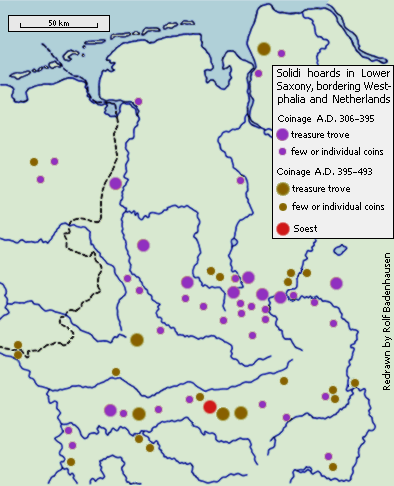 |
Albert
Genrich (op.
cit.)
quotes this mapped survey provided by Peter Berghaus,
op. cit. p. 38.
|
|
|
|
Frisian, Saxon and
Northern
rulerships
Suffridus Petrus, who implicates the
coastland between the rivers Ems and Elbe as Frisian territory,
provides two Yglos
ruling Soest in 4th and 7th
century: Lascon in 2nd half of 4th
century, Galama in in 7th
century.
Although there is no further reliable source for verifying, the elder
Dutch bibliography comprehends one or both of these Yglos (Iglos)
as historical
person(s), apart from Suffridus Petrus and Martinus Hamconius notably
Abrahm
J. van der Aa, Daam Fockema, Christianus
Schotanus, Waling Dykstra. Since Soest must have had its local ruler
also in first third of 6th
century, a contemporary of Theuderic I in
so
far, the former could have been an agnate of
the 7th-century Yglo. One the
other
hand, however, the dynastical
names and bynames Adel, Adil, then Odil, appear
strikingly in Frisian historiography. Furthermore, an Adil is
conveyed by the Ynglinga
saga, an Eadgils
by the Old English/Anglo-Saxon Widsith
and Beowulf, an Aðil
by Old Norse Hrólfs saga kraka,
an Athislus
by Saxo’s Gesta Danorum, a northern 5th–6th-century
Attila
by both the Annales
Quedlinburgenses and De Origine Gentis
Swevorum, an Athisl by the Annales
Lundenses
which include the Chronicon Lethrense.
These name forms may indicate at least the
general possibility of a correspondingly named ruler even on a
Migration Period location which nowadays borders or pertains to
northern Germany.
Since we can tentatively combine the spelling forms Odil
with Adil and Eadgils with both Agils and Athislus,
the latter likely the form by a high mediaeval author,
we should pay attention to Widsith
who relates an Eadgils, ruler of the Saxon Myrgings
(cf. Raymond W. Chambers and Kemp Malone ), at lines 93–96.
We may assume that he overthrew or became successor of Meaca
Myrgingum, line 23, who is possibly/likely King Melias of
Thidrekssaga (see below). However, it seems conclusive that
Kemp Malone
does not agree with an evident Swedish identity of an Eadgils,
who
is depicted – likely detracted and distorted – by Saxo Grammaticus
because (1962, p. 137)
|
| |
|
(1) Saxo connects the
story of
Athislus with that of Offa, and since Offa certainly fought the
Myrgings the sons of Frowinus
presumably fought them too, and Athislus can be identified with the
King Eadgils of the Myrgings who figures in Widsith;
(2) the
Myrgings
were a branch of the Swaefe, and tradition may have turned their king
into a Swede through an easy confusion of Swaefe with the Swedish name,
(3) though Saxo makes Athislus a Swede, his slayers are from Sleswick
and the episode may reflect prehistoric wars…
|
|
| Kemp Malone on Swaefe = Suebi, (1962,
p.
202): |
| |
|
The Saxons, not the
Suebi, held
the south bank of the Eider, and the Myrgings are best taken for a
branch of the widespread Saxon confederacy of tribes, a branch later
known as Nordalbings.
Although the name of this tribe suits
very well the watery
region between
Elbe and Eider where the seats of the Myrgings were presumably to be
found (Malone 1962, p. 186), their
territory
should be recognized not only on these rivers. Consulting Jan de Vries (op.
cit.)
on ON. mýrr, the characteristic
toponymic environment of this tribe appears to
be based on En. mire, myry
(adj.),
OE. mór, cf. also German moor and Old Frisian mor.
Hence, we cannot exclude even adjacent Frisian regions.
The slayers in the vita of
Athislus, as claimed by Saxo, may be not automatically transferred to
the killers of Eadgils
given by the Widsith.
Besides, his lines 41–44 are without any participation of this
protagonist. Raymond W. Chambers (Widsith, op.
cit. p. 260)
does also reject a Swedish identity of this Eadgils
‘remade by Saxo’ and understands him ON. Athils.
Regarding his temporal appearance as king of the Myrgings, Chambers
argues (p.
94, fn. 2):
|
| |
|
But
Widsith equally represents him as
a contemporary of Alboin (died c. 573) and on his ground Eadgils
used to be placed with equal confidence in the sixth century.
Neither the place of birth nor
ancestral homeland of this Athils is known to the author of
the Widsith. As regards the unknown real
dimension of his kingdom enclosing or bordering the alleged river Elbe,
Malone has already requoted the Vita Meinwerci
episcopi
Patherbrunnensis for the more or less critical
consideration of a regiam curtem
Moranga dictam
even more to the west; see above ch. Some interliterary_receptions.
If combining
this context with the transmissions
by the Old Norse + Swedish scribes in
connection with
the ethno-archaeological history of Westphalia’s Migration Period,
the appearance of a Frisian-born Ata la,
whom
Ritter and other
analysts assign to a 5 th-
and 6 th-century Saxon or ‘Húnalandish’
contemporary of
Thidrek–Theuderic beyond the Rhine, can be collocated or bynamed
by the scribes with a conspicuous intertextual Athil.
Although historical research on late mediaeval transmissions about the
earliest and early Frisian dynasties has relegated these traditions
more or less to pure fiction, they stubbornly stick to the appearance
of leaders called *Odil and *Adel/Adil. As
already regarded farther above, it seems obvious however that we can
not clearly distinguish between Frisian-born and Saxon rulers in this
spatiotemporal matter of historical recognition and, against the regnal
accounts by Suffridus Petrus and Martinus Hamconius, neither verify nor
disprove the political connectivity of Soest with the Frisian kingdom
in Migration Period and even later times. Thus, we may take into the
basic consideration that a mediaeval historiographer could
relate not only a former 4 th
or 6 th-century
ruler of a southern region to the Frisian Odil–Adil dynasty and
call one of his successors likewise an Athil. Martinus Hamconius
forwards with Suffridus Petrus a 6 th-century Adgillus,
ruler of
a larger territory east of the Rhine – understood as Adgilla or
Attila? –
as a contemporary of a Frankish king Chlotar II. Martinus '
elder
colleague Suffridus recalls this Frankish king moving martially
eastward with his son Dagobert who might be seen as a more or less
decisive Frankish conqueror of Soest. But on the other
hand, apart from the contextual northern ‘Attila’ environment noted by
the Annales
Quedlinburgenses and De Origine Gentis
Swevorum, the line
of all those Odils–Adils by Frisian tradition, the Athils
recognized by Chambers plus the northern Ata la
finally identified
by Ritter seem to solidify the existence of a likewise called Saxon
ruler who, as an apparent contemporary of the Thuringian War in the
early 6 th century,
could withstand an advance of Franks moving
from a region west of the Rhine.
Drawing a preliminary conclusion from these observations, the accounts
of the Thidrekssaga, which connect an early advance of the
Niflungs with this location, can be regarded at least as an
interpolated compilation based on the transmission by an earlier author
who wrote mainly as an historiographer. Furthermore, as shown above for
the narrative background, we must reckon with
the very high probability of hostile incursion and political upheaval
at the aforementioned geoethnographical
timestamps being related to 4 th, 5 th
and 6 th century.
|
|
|
10.4 Some
literary-historical
perspectives
A maternal line in the synchronizing
chart related to the early Merovings seems to indicate an
important political relationship between the emerging Franks
and their eastern neighbours, as their common Germanic ancestors
were severely subjugated by the Romans not long ago. As the Old Norse +
Swedish texts provide, such ‘association’ was hereditarily sealed
in the Hesbaye in the middle of 5 th
century between King Nidung’s daughter and King Sigmund, see Mb 152 and
Sv 148 as already mentioned above.
After an epic insertion dealing with the birth
and vanishing of their son Sigurð, seemingly based on a pattern
of Franko-German Saint Genevieve Legend which has been enriched with
motives of the birth of Moses and the saga of Romulus and Remus, the
third writer of the eldest extant manuscript relates the
hero’s youth at Mime the Smith. Within this period Sigurð fell
in love with Queen Brynhild ‘the Virgin’ on location which has been
connected
with ‘Svava’: The Harz, certainly most attracting Low
German region.(19)
On recommendation of Brynhild, Sigurð moved to King Isung and
his gorgeous sons which the Old Nordic scribes know as strongest
fighters. It seems obvious that these Isungs were living in an
important political and economic region, since the area
between the Harz and the mouth of Elbe river, the latter nowadays
pertaining to Hamburg, was bordering the lands of
martial Baltic tribes (see the accounts on the ‘Wiltsians’ or Wilzians)
on the one
side. On the other, the position of this kingdom might have been
guaranteeing enormous toll and tax profits for Scandinavian trade
routes.
Thidrek’s ‘Grand Banquet’, convened for a trip to a big fighting
event at King Isung (Sv 177–209, Mb 190–226), may appear inter
alia as a tricky
political campaign for making Sigurð
submissive to think about his father’s connection
with the family of an obvious Salian ruler: If the Niflungs
were endeavouring to expand their territory toward the northern Meuse
or a northern Rhine region, then Thidrek – a good or the best
friend
of King Ata la by the texts – could have
been
compelled
to install providently an extraordinary trustee for holding them in
check.
Besides, Sigurð’s name can express his peculiar
skin. Theophanis the Confessor, eminent Byzantine co-author of
a world chronicle from 284 to 813, knew of a characteristic hereditary
mark going with the Merovings: an obvious ichthyosis
hystrix, a striking form of skin disease. Thus,
Theophanis ' exceptional remark allows to
punchline ‘bristles of swine growing on Merovingian
spine’; cf. the translation by C. Mango and R. Scott. Edward G.
Fichtner quotes Theophanis ' entry for the year(s)
723–724 with these
words: |
| |
|
The
descendants of that line ‹
the Merovingian line › were called
Kristatai, which means ‘hairy backs’
[trichorachatai]: for, like pigs, they had bristles sprouting
from their back.
|
| |
|
(Edward
G. Fichtner, Sigfrid’s Merovingian Origins,
2004, p. 335.)
Jan de Vries, editor of Old Nordic etymological
dictionary (Altnordisches etymologisches
Wörterbuch, ed 2000), seems to enlighten us on
Sigurð’s name and nature: |
| |
|
sigg
= bacon
rind (from primal
Nordic ‘segja’)
sigg (Modern Norse) = rind
sigg (Shetlandic) = hard skin
segg (Modern English dialectical)
=
skin with gristles
Thus, the German affix -fried
or -frid
seems to accomplish best nicknaming, since it is old suffix for strong
male nature or property, cf. ‘Burgfried’ for biggest tower of a castle
or fortress.
|
|
| 11.
Early
activities in Baltic lands and Western Russia |
|
|
The history of the ‘Wiltsians’ is
connected with Thidrek’s and Atala’s
eastern
operations and the political interests of the latter holding Hildigund
(Hildigunnð) hostage, daughter of Ilias af Gercekia (Grec(i)a,
Greka). Hans-Jürgen Hube
(op. cit.) remarks Adam of Bremen (a.
m.) who provides Graecus and Graecen as general
expressions for a Slav, the Slavs resp. While the Old Norse +
Swedish
texts report on several campaigns of Thidrek and Atala
in regions between Pomerania and some western part of Russia, Procopius
of Caesarea transmits an interesting account related to the marriage of
a sister of Theodibert
and, in so far, most likely a daughter of Theuderic I.
This episode, titled as the Story of
Radigis by some reviewers, does not appear
unbelievable as a whole, notably H. M. Chadwick who sees no
ground
for disputing that it has a
historical basis, see The
Heroic Age, Cambridge 1912, pgs
97–99.
Thus, it seems traceable that the eastern Franks under either
Theuderic I or his son Theudebert could
have been engaged in political relations with a region which J.
Peringskiöld called ‘Vilkina’ land. This spelling form is also
mentioned in H.
Bertelsen’s ÞIÐRIKS SAGA AF BERN, p.
XXIX.
Procopius relates that a daughter of Theuderic became spouse of
Hermegis (‘Hermegisclus’), king of the Varni,
and, afterwards, his son Radigis. The area of this tribe (cf. Germ.
‘Warnen’) has been narratively identified with a seashore-region north
of Thuringia, in so
far Mecklenburgian locations Warnemünde and Warnow,
likewise Warnow river. After the death of Hermegis, as
Procopius continues his narrative (History of the
Wars,
VIII, xx),
his son Radigis
cancelled intended marriage with
a princess of
‘Brittia’ in order to marry the widow of his father due to the
political intention of the late king.
Procopius completes that the ‘Brittian’ princess thereupon
confronted Radigis martially with her fleet and finally made him to
keep his former promise. Following the descriptions of Procopius, the
‘island’ called ‘Brittia’ may be
not necessarily identical with ‘Britannia’ (Great Britain). The former
bewildering geonym has been scholastically interpreted as (a part of)
the Jutlandic area; notably by Ernst Stein (Histoire
du Bas-Empire, II, Paris 1949, p. 718 f.) and Procopius'
translator H. B. Dewing who opts for a probable ‘Denmark’. However,
these proposals apparently found insufficient support and have been
replaced
by Edward A. Thompson, Procopius
on Brittia and Britannia, in: The Classical Quarterly 30,
No. 2 (1980), pgs 498-507. He identifies Procopius'
Britian
as Brittany (= Armorica)
and Brittia as Britain. Nonetheless,
Thompson had also to concede that this localizations may be based on
some significant ‘source emendation’. Hence, Irine Bavuso declares
these conclusions questionable, at least insofar as in
Procopius' Histories Βρεττανία
is clearly the Roman island of Britannia
(e.g. De Bellis III.2.31
Βρεττανία δὲ ἡ νῆσος ‘the island of Britannia’): note that in our
passage (De Bellis VIII.20.6)
the historian refers his reader back to his previous description of
Thule and Britannia (De Bellis VI.15.4ff.); see Bavuso op.
cit. p. 287.
As regards the geographical and political position of the Varni,
Malone
states (Widsith, 1962, p. 208) that
|
| |
|
there is good
evidence, ably summarized by Chambers 244 f. ‹ rem.: Widsith, 1912
›, that in the sixth and
succeeding centuries a settlement
of Varni existed
between Elbe and Saale, and the political relations between these Varni
and the Saxons may have been such that Procopius was not without
justification for putting both tribes under the one name Varni. That
the Varni were politically powerful in the early years of the sixth
century seems evident from the letter which Theodoric the Great wrote
to their king (and to the kings of the Eruli and Thuringi), urging upon
him an alliance against Clovis. This letter, which has come down to us
in the Variae of Cassiodorus (iii. 3), was addressed to three monarchs
of Middle Europe, kings too far from the Frankish border to be cowed by
Clovis but too near to feel safe from attack, faced as they seemed to
be by a new Alexander, whose armies had crossed frontier after frontier
and whose ambition had known no limits.
|
|
11.1 Remarks on
‘Historicity’ of
‘Vilkinaland’ and other Baltic lands
The Venerable Bede mentions a Frisian Wiltaburg,
a very obvious historical relict quoted
as oppidum Wiltorum, in connection with other events related to
6th–7th
century; see Historia ecclesiastica gentis Anglorum
V, XI. Thus, we cannot exclude the tribal existence of
the Wilti, a form provided by Widukind
of Corvey, on northern German territories in Roman Times and/or
Migration Period. Einhard, 9th-century
author
of the Vita Karoli Magni, situates the Welataben,
apparently identical with the ethnic group he calls Wilzi, as
an historical tribe dwelling along a certain shore of the Baltic Sea.
Otto K. Schmich (urn:nbn:de:1111-200602020 at http://d-nb.info/978424182/)
has contemplated the Quielprannii,
southern neighbours of the Chamavi
by means of the Roman based TABULA PEUTINGERIANA,
to
identify with the Wilzians.
Although some scholarly state of research likes to situate the settling
area of the 8th–9th-century
Wilzians mainly in the northeast of
today’s Mecklenburg, omitting or rejecting strictly compatible
spatiotemporal perspectives of ‘less reliable’ or ‘legendary’
bibliography, we may not ignore the possibility that ancient and
mediaeval scribes have been referring to
a collective term which includes related spelling forms of
tribes basing on different native understanding. Jordanes, the 6th-century
Roman bureaucrat and later
historiographer, provides this ethnic description of Scandinavia with
an early tribe he calls ‘Vinovilith’, a form appearing closely
related with Vino-Velethi–Veleti:
|
| |
|
Now in the island of
Scandza (…) there dwell many and diverse
nations, though Ptolemaeus mentions the names of but seven of them.
(…) In the northern part of the island the race of the Adogit live,
who are said to have continual light in midsummer for forty days and
nights, and who likewise have no clear light in the winter season for
the same number of days and nights. (…) But still another race dwells
there, the Suehans, who, like the Thuringians, have splendid horses.
(…) Then comes a throng of various nations (…) All their
habitations are in one level and fertile region. Wherefore they are
disturbed there by the attacks of other tribes. (…) All these live
like wild animals in rocks hewn out like castles. And there are beyond
these the Ostrogoths, Raumarici, Aeragnaricii, and the most gentle
Finns, milder than all the inhabitants of Scandza. Like them are the
Vinovilith also. The Suetidi are of this stock and excel the rest in
stature. However, the Dani, who trace their origin to the same stock,
drove from their homes the Heruli, who lay claim to
preëminence among all the nations of Scandza for their tallness.
|
| |
|
Jordanes about the
“Island Scandza” (= Scandinavia), partly referring
back to Ptolemaeus. Getica (History of the Goths), ch. III. 551/552.
|
| |
|
(S.
Holst, L. Jørgensen, E. Wamers, Odin, Thor und
Fryja. Scandinavian Cult Sites of the 1st Millennium AD and
the Frankish Realm, Regensburg 2017, p. 23.)
|
|
|
However, the scribes of the Old Norse
and, in particular, the Swedish texts have been charged with
ascribing ‘Vilkinaland’ to ‘Swedish lands’, as this might be
interpreted also as an historiographical attempt to render an origo
gentes. The Latin script published by Johan Peringskiöld
accomplishes correspondingly:
|
| |
|
|
|
|
Wilkinus rex fama atque
victoriis, adhæc etiam fortitudinis
gloria celebris, alta fruebatur pace in regno suo. Armis sibi subegerat
regionem, quæ tunc temporis Wilkinalandia nuncupabatur,
hodierno die Sveonia & Gautalandia ; cuius ambitu complectebatur
Scania, Sælandia, Jutlandia, Winlandia ; quæque
his
adjuntæ sunt provinciæ omnes, regis Wilkini
parebant
imperio, ex cuius etaim nomine vocari sveverunt. Et vero in tradenda
historia is ordo observatus est, ut nimirum ex summi præfecti
nomine nuncupata sit regio populusque. Itaque & regio hæc
Wilkinalandia vocata, a regis Wilkini nomine: itidemque incolæ
regionis cuncti Wilkinenses dicti, servato nomine hocce, donec novum ab
illo sit impositum, in cuius potestatem gens illa postea transierat
(…)
(Johan
Peringskiöld,
Latin script 1715, cap. XLV.)
|
| |
|
Mb
21: Villcinus het konungr. hann var agetr af sigrsælld.
oc rœysti. hann æignaz með rikinu oc hernaði
þat land er
kallað var villcina land. en þat heitir nu suiðioð oc
gautland
oc allt sviakonungs uelldi skanœy sealand ivtland vinland.
oc oll þau riki er þar til hallda. sua viða stoð
riki villcinus
konungs sem land er við kentt oc þat er hattr fra sagnar
iþessaRi sogu at af
heiti ens
fyrsta hofðingia tekr hans riki
nafn. oc su þioð er hann stiornar. sua er þetta riki
kallað
villcinaland af nafni villcinus konungs. oc villcina menn su
þioð er þar byGir.
allt
þar til er œnnur þioð kemr til rikiss
ivir þetta land. oc skiptaz þa af nyiv nœfn (…)
(H. Bertelsen op.
cit. I, p.
44.)
|
| |
|
There was king named Vilkinus.
He was always victorious and valorous. He conquered by
strength and harrying the country that was later called Vilkinaland and
that is now called Sweden and Gautland, along with all the empire of
the Swedish kings: Skaney, Sjaland, Jutland, Vindland, and all the
territory that belongs to them. The power of King Vilkinus was so
extensive that
the country was known by his name, and as is the manner of telling in
this saga that the land and the people take their name from the name of
the first chieftain
that ruled over them. So this country was called Vilkinaland after the
name of King Vilkinus and the people who lived there were called
Vilkinamen. This was the case until another people came to rule over
the country and gave it their name (…)
[Translation
by Edward R.
Haymes]
|
| |
| Sv
17: A king was called Wilkinus. He was
a gorgeous man. He won Wilcina land by fighting for this land
that now
is called Sweden and ‘Got(h)land’ ‹
Gøtaland ›, Scania
and Zealand and Wendland and
all the realms there. These were called
Wilcina land, whose king
was called Wilkinus. There was tradition to name a land after
the name of its ruler (…) |
| |
|
Sv
297: Herding, king of Vilkinia land that
is now called Sweden, was a wealthy man and a mighty fighter. He had
a spouse who was called Ostancia; her father was Unne (‘wnne’),
king of
eastern realm (…)
Note: Herding → ’Hernid
’ → Old Norse Hertnið
|
|
|
|
Ritter recognizes Winland or Vinland
as German Wendland that must be separated from all forms related with
*Wil, *Vil and *Vel. The equation Vilkinaland that is now
called Sweden has been consigned from the Old Norse to the Swedish
manuscripts. However, their scribes have left that kind of chosen words
which may not necessarily refer to only archaic tradition. Thus,
in view of the ‘patriotical edits’ being quoted above, we are
apparently allowed to distinguish between at least two spatiotemporal
levels by different stages of knowledge and transmission. Since all
manuscripts can hardly provide more detailed ethnological and
geographical definitions of
‘Vilcina’, ‘Vilkina’, Wilzi, also equated with
‘Veleti’ and ‘Wiltsians’, we may understand
these ethnonyms, in common with the eminent scholar of Charlemagne, at
best
as general tribal allocation.
|
|
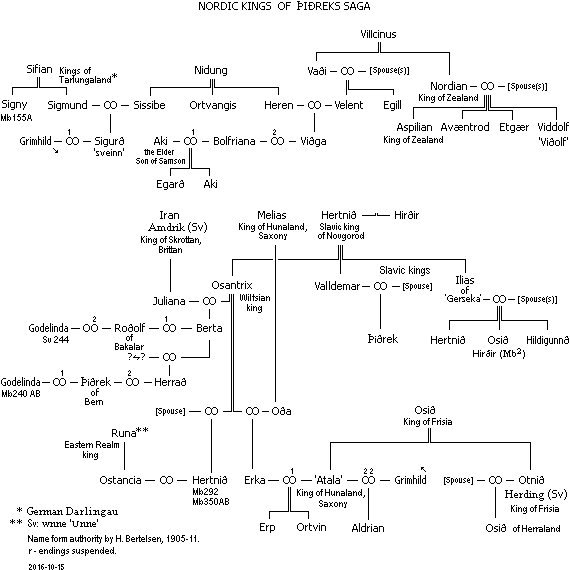 |
|
Genealogical chart of Nordic kings.
Some name appearing in Atala’s genealogy might be related to
southern
reception for the sake of just name harmonization; cf. e.g. ‘Erka’
whose vita cannot be transferred to the first known wife of Attila the
Southeastern Hun. |
| |
As already noted above, the Old Norse +
Swedish scribes may refer to
geopolitical events in Migration Period by using geonyms currently
known to high mediaeval readers and the audiences, as
placed at the disposal by Ritter, Dietrich
von Bern, Munich 1982, pgs 146–147. Contemplating this
context, we cannot make evident that these records do represent
‘compositions of different temporal layers of historical events’, as
this opinion has become a popular basic suggestion which, however, is
devoid of any convincing substance
against some conclusion provided already by elder scholarship; see, for
instance, the approaches of E.
Studer (op. cit., see below en. 28), W. Eggers (op.
cit., see below en. 21 i).
Since
the dynastical lines and vitae of the
4 th–6 th-century
Baltic & Slavic kings cannot be found
satisfyingly
in other surviving sources, Ritter regards the Wilzian and other
Slavic chieftains preferably as potential Migration Period kings ruling
Baltic territories which, as the high mediaeval texts postmodernly
provide, include ‘Poland and Russia’. Ipso facto, he would not relegate
their accounts just perforce to unhistorical, inconstistent or
unauthentic traditions. Considering both the Frankish politics of
Theuderic I, explicitly rather his daughter and
son
Theudebert as shortly remarked by Procopius, and the accounts provided
by the Old Norse + Swedish manuscripts, it
seems
inappropriate to relocalize the Baltic regions, as geographically
recognized well by both elder and modern scholarship, to more or less
anachronistic venues pertaining to pretty tribes situated in
today’s southern Dutch and northern Belgian regions.
William J. Pfaff remarks i.a. the conquest of the obvious large Húnaland
by the Frisian prince ‘Attila’ with regard to the ‘chronicled material’
released by Suffridus Petrus in 1590 (Pfaff op. cit
1959 p. 102
considering F. Holthausen’s reasonable suggestion), while
Willi Eggers (op. cit.) has antecedently
underlined the
potential relationship
between Osantrix and his eminent son-in-law by referring to Suffrid’s
historiography. Regarding
this interliterary context, his sources may be not disregarded for the
identification of Osantrix with a southern Jutlandic
ruler called Vergistus, qui filios duos
Hengistum et
Horsum et filiam unam nomine Svanam habebat.
As noted above, Suffridus recites this genealogical connection, but
claims that Udolphus
Haron is the natural father of Hengist
and Horsa.(20) Vergistus
or Vetgistus,
appositely ‘the Jute’, is
Bede’s Victgilsus ‹ cuius
pater Vitta by Nennius, or: cuius pater Vecta
›, while the so-called Anglo-Saxon
Chronicle (on A.D. 449–488) and
the Historia Brittonum spell him Wihtgils.
A potential intertextual Anglo-Saxon relationship of these familial
figures, albeit commonly judged at least ‘semi-legendary’, seems worth
to explore by means of Mb 28, as its author regards Osantrix’
father-in-law residing or ruling in/over Skrottan, Brittan.
As already mentioned, we apparently have to reckon with some nicknamed
or ‘renamed’
individual appearing in the Thidrekssaga and the Old Swedish
manuscripts. The ‘Eastern
lands ruler’
Osantrix may thus appear to some reader as shortened spelling form
of Old German ‘Os(t l)ant
rex’
who nonetheless seems to re-appear as Oserích
in MHG poetry. Incidentally, as to be remarked shortly at this
instance, there may be some examples for different
names of an historical individual in mediaeval German and Russian
dynasties, e.g. Adelaide or Eupraxia, daughter of
Vsevolod I, Prince of Kiev. At least one
example for
the only usage of an obvious epithet has been given above, see
Morphological
connections and prospects.
It should be briefly complemented the Latin quotations above
taken from the work of Suffridus Petrus. As he
forwards, a general of the Frisian
dynasty, who had invaded territory known later as Westphalia and
taken over Soest for his residence in Migration Period, was wooing
thereafter the daughter of an important ruler residing on the Lower
Elbe, territory of the later northern German metropolis. Although
there is no reliable source to prove or disprove Suffrid’s account, we
may not disregard at this spatiotemporal juncture that a Wilzian tribe,
or people historiographically equated with them under a collective
term, could
have been settling there. Furthermore, as regards Mb 55, the residence
of Osantrix appears
not far from the Falstrskógr, see its position provided
by Mb
109 and, plausibly, H. Bertelsen (op. cit. II, p. 403). |
|
|
11.2 Ostancia, queen
of
‘Vilkinaland’, Baltic Sea Region
|
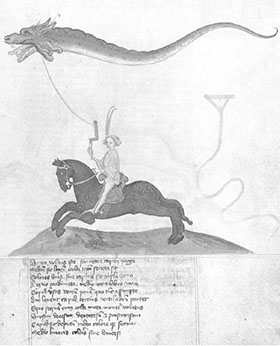
A mediaeval motif.
Source: Niedersächsische Staats- und
Universitätsbibliothek
Göttingen.
Cf. Heinz Ritter-Schaumburg, Dietrich
von Bern, Munich 1982,
pgs 241–245, Abb. 26. |
As
Ritter disenchants the magic arts of Osta(n)cia the
Sorceress, spouse of King Her(t)nid of ‘Vilkinaland’, she managed
the installation of special kites to shock the warriors
of King Isung, see HISTORIA
WILKINENSIUM, THEODERICI VERONENSIS…, CCCXXVIII (Sv 299, Mb 352):
… Isthæc vero
secretas per artes convocavit in
medium feras omnimodas, utpote leones, ursos atque dracones horrendæ
magnitudinis, quos voci suæ obsequentes hostium agmini
propulsando
obmisit…
Gregory of Tours also considers this
obvious 6th-century warfare
method for confusing the enemy [hist. IV,29]:
Chuni vero iterum in Gallias venire conabantur
(…)
Cumque confligere deberent, isti magicis artibus
instructi, diversas eis fantasias ostendunt et eos valde superant…
[The Huns were again endeavoring to make an entrance into the Gauls
(…) And when they were about to fight, the Huns, who were versed in
magic arts, caused false appearances of various sorts to come before
them and defeated them decisively… (English version by E.
Brehaut.)] |
|
|
12. Résumé
As regards Old Norse bibliography and
mediaeval historiography,
the Thidrekssaga appears
as being
based on a chronicle or historia rendering an eulogy of most important
‘Austrasian’ king Theuderic. Nevertheless, Thidrek’s biography
has to be regarded fragmentary: Just at that time when he
was celebrated King of Roma II, Sv 356
and
Mb 414, his curriculum vitae provided by the Old Norse +
Swedish texts is drawing to an end. The remaining last parts
of the Old Norse manuscripts relate Aldrian’s Revenge
and two epic implantations. The first deals
with Bergara (Sv: Brugara) which could be an innuendo
onto Bergen,
place of translation by the Old Norse scribes who were editing or
knowing of continental heroic epics and adding here their own geonymic
imprint
with a central motif of the Wolfdietrich-Ortnit.
The second is Heimir’s episode at Wadhincusan
monastery which Roswitha Wisniewski recognizes as the literary
signature of the Low German author Ludewicus, a
provable 13 th-century
scriptor and copyist of a precious bible at Wedinghausen monastery.(21)
|
|
|
Gregory relates Theuderic’s first
appearance not before 507/508. Next, about 524/525 (see
Edward James [1986:23 n.9] following Ian N. Wood [1983:38 n.8]),
our Frankish scriptor mentions him on a campaign against the Auvergne –
counselled there by his dux Hilpingus (= ‘Hildingus’ ?).
At
nearly the same time Theuderic appeared at the Moselle’s Roma
for restoring this metropolis, then crossing the Rhineland
for warring in Thuringia (c. 531/532).
Thereafter he removed a challenging Gaulish chief called Mundericus
(532/533) and his kinsman Sigivald who likely had served him as
viceroy in Clermont. Considering Theuderic’s biographical gap between
507/508 and c. 524 plus his following actions, the vita of this
Frankish king appears rather completed by the
Old Norse and Swedish manuscripts.
Thus, to further substantiate these recognitions, we have to compare
the
basic accounts of the Thidrekssaga with the western
Frankish period from 5th to 6th
century in the following and to draw further conclusions on the
literary genre of the Old Norse and Swedish transmissions (→ ch. 12.3).
|
|
12.1 General
conformity of
contemporary residential regions
Trier
= Roma II on the
Moselle – the dark decades in the reign of Clovis I
Regarding the exposition of
Thidrek’s
exile, we obviously have to consider the ethical side of his
humiliation that might have been lasting as long as he was unable to
compensate his expulsion. Although
he could not regain his kingship from his kinsman Ermenrik (dated 1st
quarter of 6th century by Ritter), he could
have been able to make or join a campaign somewhere else. This context
might also comprehend Gregory’s suppression of contemporary history of Roma
II, the metropolis of the Treveri,
and some area between the Meuse and
the Rhine – as he actually did for his very fragmentary
reports on both Theuderic and, especially, the significant region
of Belgica I. As to another item
raising from
this spatiotemporal context, now of further interest, Gregory’s readers
may be made to believe that Theuderic was crowned in no time after
Clovis'
death, thereafter presumably residing also on locations called Remi
and Mettae – though Gregory does not say a word about the date
and place of Theuderic’s coronation. According to archaeological
research, however, Roma II
with its former imperial seat was the most significant urban location
and base of river logistics for the southern Franks when Theuderic had
reconquered (inter alia) the
Auvergne and
ascended the throne of the eastern Franks. Furthermore, as regards the
basic regnal and
political principles of Late Antiquity and Migration Period, it seems
too problematic to substantiate rather Metz and/or Reims as the only or
most important place(s) of
Theuderic’s residence(s),
notably
e.g. Roger Collins (1983) referring to the early Merovingians and
Theuderic’s son Theudebert.
It is obvious that Gregory of Tours provides Trier as Theuderic’s
residence while reporting on a noble individual called Attalus,
who was sent between 531 and 533 as an hostage
to his court [hist. III,15], where
his son Theudebert was educated by Nicetius, head of the Church of
Trier and likely also the governor of this metropolis. Since the
begin of
Theuderic’s restoration and Christian reconsolidation of
Trier has been dated between 525 and 527, cf. Gregory’s contextual
remarks in his Liber
vitae patrum VI,2–3, this metropolis appears as Theuderic’s
eminent seat after the
episcopal election of Nicetius.
As far as we know Clovis never turned toward the former Belgica I
with its eminent metropolis for enlarging his kingdom. Why? First
of all, H. G. Vitt (op. cit.) and other
analysts
reasonably suppose Childeric already acting ahead in the political
interest of his son Clovis in the last two decades of his life; notably
Eugen Ewig, Die Merowinger und das Frankenreich
(2001)
p. 20;
Guy Halsall, Barbarian Migrations and the Roman
West 376-568
(2007) p. 269f; Ulrich Nonn, Die Franken
(2010)
pgs
99–100. Thus, it seems hard to
accept that Childeric – or his obvious interliterary parallel
‘Samson’ – were not appreciating or preparing to the Frankish conquest
of that location known only a
short time before as largest colonia on the north side of the Alps.
Considering the Old Norse + Swedish texts and
the Latin
manuscript by
Peringskiöld, the latter providing Samson Salernitana urbis
imperium regiumque titulum
adeptus est (ch. VIII), as chronologized
between c. 460 and 470 (at this time also the final Frankish conquest
of Cologne and occupations of
its surrounding regions), all sources allow to detect no other
contemporary Franco-Rhenish or Gaulish leader mightier than Childeric
or Samson. If the former had played actually a leading rôle for
the conquest of the Treveri metropolis, his successor thereby
had an adequate resource even
for his hefty campaigns.
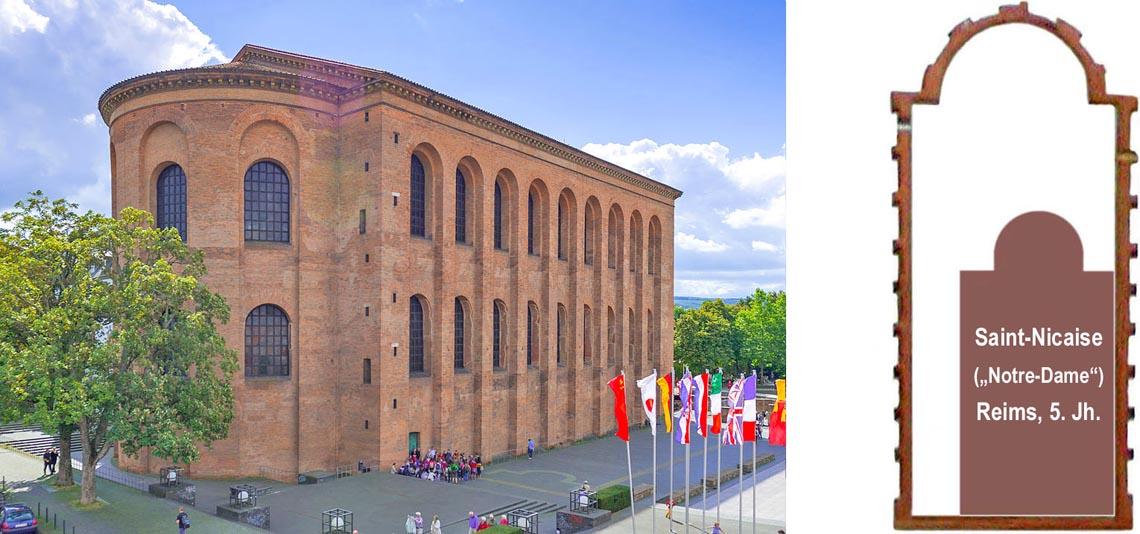
|
Dimensions:
The Aula
Palatina of Trier (photo by Heinz L. Boerder) vs the Church of Reims,
5th century.
Cf. Élie Lambert, La
cathédrale de Reims et les cathédrales qui l’ont
précédée sur le même emplacement
in: Comptes-rendus
des séances de l’Academie des Inscriptions et Belles-Lettres
(1959) vol. 103, no. 2, p. 241f.
|
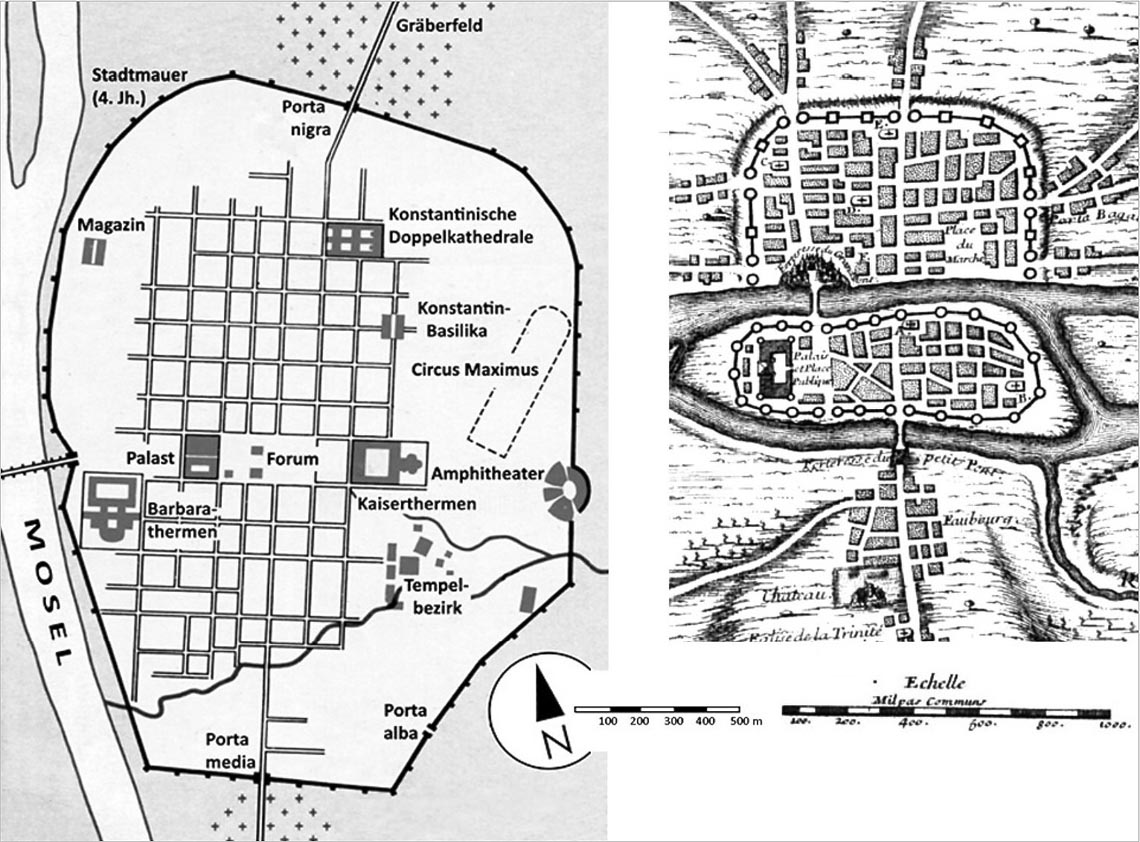
|
Imperial
Trier
compared to scale with Paris of 5th to 6th
century,
the latter provided by the
topographer Antoine Coquart (1668-1707).
Plangraph of Trier based on publications by Heinz Cüppers and
Josef Niessen, e.g. PUTZGER
Historischer Weltatlas;
Leonardo
Benevolo, Die Stadt in der
europäischen Geschichte
(1998),
cf. p. 27 referring to the Enciclopedia
dell’Arte Antica.
|
We may wonder whether this assumption
matches with Trier’s
blank sheet of history perfectly covering the reigning period of Clovis
‘&’
Ermenrik, alternatively prolongated up to Theuderic’s ‘&’
Thidrek’s first appearance and reconstitution of
this metropolis. Or asked another way: For
what reason should Clovis have renounced
a geopolitical status symbol not less than a former imperial Roman
seat? There may be a sublime
circumstantial evidence for his seat on the Moselle at
least at the end of 5th century, although
Gregory writes about De baptismo
Chlodovechi that the
queen arcessire
clam sanctum Remedium Remensis urbis episcopum iubet [hist.
II, 31]:
|
| |
First, however, we
therewith cannot make evident both Clovis'
residence and
his baptism at Reims, albeit Fredegar
– but not the Liber Historiae
Francorum – claims Clodwigs seat at Reims.
The 13th-century
monks of Saint-Denis, compilers of the so-called Grandes
Chroniques de France, follow Fredegar’s
localization. Gregory claims later an important
place of Clovis even at Tours, place of the king’s and scribe’s ‘so
beloved Basilica of St. Martin’, which – if we
can believe this at all apart from the well documented Martin’s cult –
may point to nothing more than another place amongst possible places
of secondary residence.
|
| |
Second, as regards a
likely concealed
historical parallel at the baptism of Clovis, only some words later
Gregory apparently makes a flashy local allusion with the phrase that
Clovis procedit novos Constantinus
ad lavacrum. Thus, by means of Gregory’s and our sources, we
should not disregard that Constantine I has
been
affiliated to ‘first baptized Roman emperor’.
If forwarding this parallel, as this seems more than likely, Gregory
might have provided a covert local indication
related to Constantine’s western seat, making in this way the
locality’s name expressis verbis superfluous. Since Remidius
(‘Remigius’) sometime congratulates Clovis on taking over Belgica II [Epistolae Austrasiacae 2],
we neither have material nor any plausible reason contradicting
the authority of Childeric’s successor over the superior
adjacent
province. As Gregory remarks twice later [hist.
II,38 &
40], Clovis chose Paris for his new seat
during or shortly after his more than hazardous South Gaulish campaign.
Ian N. Wood reasonably remarks that
|
| |
|
Clovis ceases to
appear in the Italian
records at this time; it may be significant that it is the
period to which Gregory assigned the extermination of his
hero’s northern rivals.117 (op.
cit. 1985, p.264)
_________________
117 Gregory,
Liber Historiarum II, 40-2. For arguments in favour of
the late dating of these events, Wood, Kings, kingdom and
consent, p. 28.
|
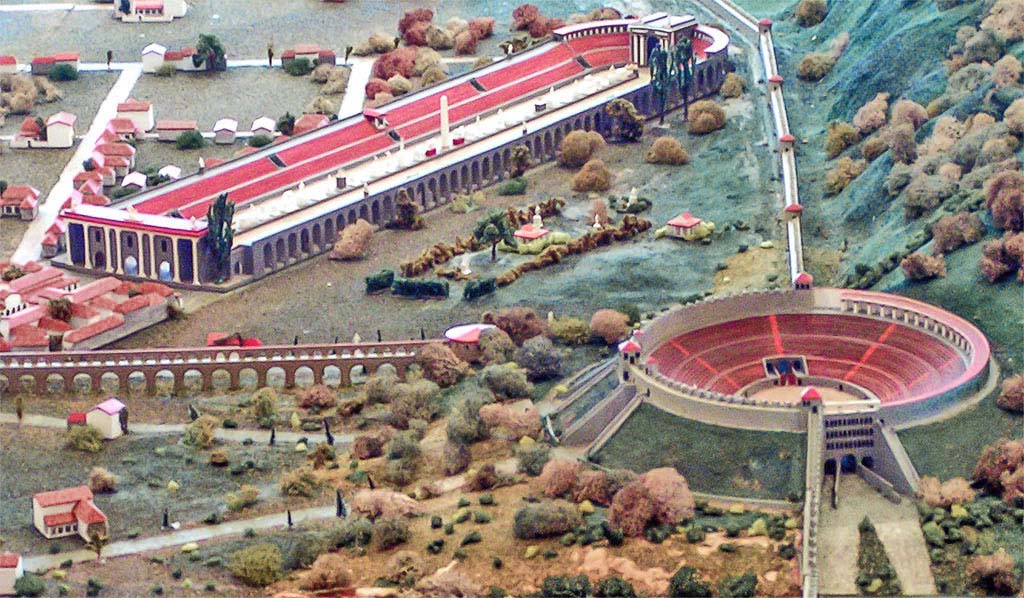
|
The ‘event
quarter’ of the Imperial Roma II: Circus Maximus and Amphitheatre.
Reconstruction model at the Landesmuseum
Trier. Photo by Stefan Kühn.
|
|
In consideration of
Clovis' inexorable ascent – he climbed up the
ladder of military success and regnal power when
the Franks took Trier – and Dietrich’s dynastical
plus geopolitical background by the Old Norse +
Swedish
manuscripts, the consequences of such potential context taken as
authentic would preliminarily concern
nothing more than a renewed nickname identification of Dietrich’s
close relative Ermenrik,
appearing at least as the best ‘placeholder’ whom the Old Norse writers
could interpret for their distinctive
exposition of ‘parallelism’ in history. However, as regards the
fragmentary Frankish history about Clovis and Theuderic that emerges
now from this context, there are at least three burning questions we
are left with:
|
| |
| 1. |
Which Frankish ruler was
responsible for the exceptionally recorded politico-religio-cultural
‘irregularities’ in the metropolis Roma II
of the former Belgica prima, «historically
and interpretatively appearing as an isolation based on politically
troubled times», as these were contemporarily
known since the mid of 2nd half of
5th
century and lasting even for more than one decade after Clovis'
uncertain death in 511? (See more details and
quotations farther
below.)
|
| |
|
|
|
Thus, we may further ask
in this context: Why did Gregory of Tours not
say a word about the cause or background of the very striking
clustering of Episcopalian
dismissals in the city of the Treveri?
|
| 2. |
Why has Theuderic
restored this eminent urban location not
earlier than c. 524/525?
|
| 3. |
Why could Theuderic not
appear in person in available Frankish history between 508 and c. 524?
|
| |
|
|
|
The military break-in of
a
Nordic leader called ‘Chlochilaichus’ within this period,
apparently along some northern Rhine territory, was beaten back by
Theuderic’s son Theudebert. Gregory’s previous memo about
Theuderic, who allegedly «followed Clovis to his new seat at
Paris«
more or less immediately after the South Gaulish campaign, which had
caused the forceful
intervention of the Italian Theoderic, does not seem convincing with
regard to the implicit long lasting passivity
of the Frankish namesake.
|
| |
|
|
|
Did Theuderic
have at that time more urgent matters to deal with than to beat off the
Nordic break-in? Or was he staying rather in a foreign sphere, thereby
out of sight of Frankish and Roman writers?
|
|
|
Regarding the Frankish campaign
against the Visigoths of 507/508, it seems less plausible that
the Clovis had no idea of the risks and consequences of
Theuderic’s military operation, particularly after
the intervention of the undefeated Ostrogothic protector.
According to Gregory’s version [hist.
II,37], Clovis moved to Bordeaux, gave the order to bring him
Alaric’s treasure from Toulouse and then retreated to Angoulême.
Rather, Theuderic moved southward to Albi and Rodez, then northward to
the Auvergne. However, as the military-political effects were soon to
show, Clovis was well advised not to stand in front of the Ostrogothic
lion’s den for long. But, in case of this mission being blocked, he
then could exert his influence on the inheritance part of the most
powerful Frankish prince who could have been ruling it almost
independently.
Theuderic had – apparently impudently – violated the ‘Pax Gothica’ of
Theoderic the Great.
And in fact, after 16 summers and 16 winters
Theuderic successfully reconquered the Auvergne
– at that time the fading vigour in the very last year(s)
of the Ostrogothic Theoderic being in religious conflict with his Roman
subjects and Emperor Justin I; cf.
e.g.
Ian N. Wood, The Ecclesiastical
Politics of Merovingian Clermont, in: P. Wormald (Ed.), Ideal
and Reality in Frankish and
Anglo-Saxon Society, 1983:38;
Wood op. cit. 1994:51–54; Edward James, Gregory
of Tours: Life of the Fathers,
1985/1991:23–24, fn. 9; RGA 30
(2005) Theuderich I, p. 462
with further sources; https://www.badenhausen.net/rolf-badenhausen/Theuderich_I.pdf.
This major military operation appears certainly in close spatiotemporal
connection with Theuderic’s constitutive consolidation of Trier. Since
he did not appear in the
aforementioned repulse of Chlochilaichus '
troops,
presumably a large-scale offensive of northern forces, this
second Auvergnat expedition is Theuderic’s next known ‘Frankish
campaign’ after 507/508(22)
– with or after his stopovers at Cologne (with Gallus)
and Roma II !
The preceding absence or isolation of Theuderic, designated king at
least
of the eastern Franks, might have meant
a challenging situation for Clovis ' campaign against the
Visigoths and, finally, Theoderic the Great. Thereby Clovis could take
the chance to
remove Sigibert, the leader of the Rhenish Franks, in order to expand
his
empire immediately to the northeast instead after his rather failing
campaign in southern Gaul – and in so far without any involvement of
Theuderic if we confer to Gregory’s reports. Ian N. Wood,
op.
cit.
1985, p. 264,
estimates that blocked
in the
south after 508, Clovis
may have turned his mind toward enhancing his prestige in the
Rhineland and perhaps across the English Channel.
Gregory, implying more indirectly this point of view,
if at all, makes Clovis responsible for the elimination
of King Sigibert of Cologne between 507 and 509 [hist.
II,40].
Although Gregory does not really indicate any conflict between
Clovis and Theuderic, it seems not certain that Clovis ever
intended to protect Theuderic. Presumably, either immediately or a
short
time after the death of Clovis, Theuderic’s son Theudebert could have
conducted the
kingdom of his father for a certain period, as the military extent of
Chlochilaichus ' invasion seems to point to this
reasonable case. Besides, this Nordic chief invaded the paygo
Attoarios
by the account of the Liber historiae Francorum,
19,
a former ‘Chattuari’ region which has been scholastically estimated at
that time (c.515–c.523) on the Lower Rhine, but not in an obvious
identical region of Burgundy called terram Chatuariorum by
Carolingian historiographers; see Richard A. Gerberding, A
Critical Study of the Liber Historiae
Francorum. Doctoral thesis, Oxford 1982, p. 84f. As regards
the moment of this northern attack, we may wonder whether the death of
Clovis, possibly rather some years after 511 (!), and an absence of his
eastern successor Theuderic had caused the impression of a weak and
vulnerable phase of (a part of) the Frankish kingdom.
Following both
Ritter’s timeline related to the Old Norse and Swedish
texts and historical upheavals on the other
side of this river, it may be further contemplated his estimation that,
between Clovis ' campaign to South Gaul and the
Thuringian invasion by Theuderic’s forces, the
Niflungs – or Frankish intruders – could
have crossed the large stream for the conquest of the obvious
wealthy region of Susat– Soest.(23)
All these significant contexts are not corrupting historiographical
interpretations of Thidrek’s interliterary parallel
Theuderic. Rather, we must state again
an incredibly shrinking area for two different Theoderics
when turning once more toward the
vitae of Thidrek and Theuderic.
This is encyclopaedic quotation referring to Clovis '
eastern successor
Theuderic I
who in the third decade of
6 th century restored and Christianly
reconsolidated
Trier = Roma II
after its
period of obvious destructive arbitrary rule: |
| |
|
It
was while abbot that King Theoderic I
(511–534) learned to know and esteem him, Nicetius
often remonstrating with him on account of his wrong-doing
without, however, any loss of favour. After the death of
Aprunculus of Trier, an embassy of the clergy and citizens
of Trier came to the kingly court to elect a new bishop.
They desired Gallus, but the King refused his consent.
They then selected Abbot Nicetius set out as the new
bishop for Trier, accompanied by an escort sent by the king,
and while on the journey had opportunity to make known his
firmness in the administration of his office. Trier
had suffered terribly during the disorders of the
Migrations.
http://en.wikipedia.org/wiki/Saint_Nicetius
(retrieved March 2009)
|
|
|
Hans Hubert Anton, an author of the RGA
and expert in ecclesiastical Gallo-Roman and Frankish history,
constates [transl.]:
|
| |
|
The
accumulation of names
in the Episcopal Registry of Trier at the end of 5th
and
beginning of 6th century (Emerus, Marus,
Volusianus, Miletus, Modestus,
Maximianus, Fibicius, Abrunculus, Rusticus) suggests a period of
politically troubled times, the weak testimonies of the
aforenamed allow to conclude an (undoubtedly
politically based) isolation.
|
| |
|
[Die
Häufung der Namen in der Trierer
Bischofsliste am Ende des 5. und zu Beginn des 6. Jahrhunderts (Emerus,
Marus, Volusianus, Miletus, Modestus, Maximianus, Fibicius, Abrunculus,
Rusticus)
deutet auf politisch unruhige Zeiten, die schwache Bezeugung der
Aufgeführten läßt dabei auf eine (zweifellos politisch
bedingte) Isolierung
schließen.]
|
| |
|
(Hans
Hubert Anton, Die Trierer Kirche und das nördliche
Gallien in
spätrömischer und fränkischer Zeit,
in: Beihefte der Francia 16,2 [1989], p. 61.)
See also Nancy Gauthier, L’évangélisation des
pays
de la
Moselle. La province
romaine de Première Belgique entre Antiquité et Moyen-Age
(IIIe-VIIIe siècles), Paris 1980, p. 135.
|
|
|
Eugen Ewig counts up six episcopal
dignitaries being affected by supersessions between 479 and 502/3 (op.
cit. 1954, p. 88; i.e. Emerus, … , Maximianus), and he
contextually quotes from a letter of
recommendation written by Avitus of Vienne on request of bishop
Maximianus of Trier (op. cit. p. 60):
|
| |
|
Quamquam
nec
illa vobis regionis
suae subversio tamquam incognita exaggerari debeat, cum pietatem
vestram quaerentem ubique misericordiae aditus, non lateat, ubi est
misericordiae locus.
|
|
|
Starting from the 470ies,
the episcopal records related to Trier
itemize ten predecessors of Nicetius, episcopal dignitary until c. 525:
Jamlychus, Emerus, Marus, Volusianus, Miletus, Modestus, Maximianus,
Fibicius, Abrunculus or Aprunculus, Rusticus, the latter
ignored
by Gregory of Tours, see Vitae
Patrum VI,3.
It seems too hard to accept that Gregory had no idea of the causality
of this matter whose basic historical background should have been
perceptible to him. So we are obviously urged to constate:
|
|
|
After the reigning
period of Clovis I, plus a portion
of time after his more uncertain than certain date of death (notably
Ian N. Wood, see above), the amassing of names in the
Episcopal Registry of this Roma cisalpina ended with
Theuderic’s appearance – in the
period of his reconquering Auvergne campaign – on this
eminent metropolis of the Treveri, which he tremendously
remodeled.
Regarding King
Thidrek’s arrival on
this location, within a difference of only c. 2 years by means of
Ritter’s spatiotemporal identification of Roma II
as Trier, Thidrek
liberated this metropolis from Ermenrik’s
successor ‘Sevekin’, the nicknamed Old Nordic ‘Sifka’(24). |
|
|
Since Ritter localized the Harlungen
seat Fritila some miles south of
Bonn, which may be slightly emended with the Roman stronghold Brisiacum
(Breisig on the Rhine, in
the region of the Ahrgau), the manuscripts already specify in Mb 281
its northeastern position from Roma
II
which hence complies
with Trier:
nu
er vestan veðr oc
sunan oc fagrt skin oc heitt. oc stundvm smatt
regn oc fagrt austan oc norðan huat kemr þaðan nema enn
ungi egarð oc hans brodir aki?
|
| |
|
(Henrik
Bertelsen, ÞIÐRIKS
SAGA AF BERN II p. 165.)
|
| |
We now have wind from
the
west and the south and warm weather and sometimes a little rain and it
is fair from the north and the east. What comes from there but the
young Egard and his brother Aki?
[Translation
by
Edward R. Haymes]
This is nothing less than a
further compelling parallel that points
out another very important political event in the vita of
Thidrek–Theuderic. The Old Norse +
Swedish
manuscripts
annotate King Thidrek’s conversion into Christianity,
undoubtedly in narrative context and spatiotemporal coherence with Roma
II
=
Trier, in accordance with that moment when Bishop Nicetius talked
seriously with Theuderic I at the metropolis of
the Treveri.
Cologne
– Bonn – Verona –
Zülpich:
Since the prime author of the
manuscripts
has already determined the seat of Thidrek’s follower Heimir in the
region
of the (northern) Suebi,
Fasold’s homeland in the Osning
(a part of Teutoburg Forest, cf. ‘Osnabrück’),
Widga’s on Zealand, Þettleifr’s in
Scania and Vildifer’s in the Eifel region on the Amel, the
geographical allocations in Mb 225–226
and Sv 209 point to rather a small common area of the seats
of both Thidrek and the Niflungs. Relating the return of
Thidrek’s
champions from King Isung’s Bertanga, these chapters supplement
the mappings of the
remaining heroes as follows:
|
| |
|
Mb 225:
Now that King Thidrek and all of his men had
proven themselves so that no man in the world would dare to bear a
shield against them in battle, they wished to set their lands in order
and put great chieftains over castles to rule
them. Earl Hornbogi went home to Vindland along with his son Amlung and
his wife Fallborg, and they ruled over their land for a long time with
honor and respect. Sistram went east to Fenidi and became duke there
and the most famous of men, just as his kinsmen had been before.
Herbrand went home to his country where he was the most powerful duke.
Mb 226:
Then Thidrek rode home with King Gunnar to Niflungaland
along with all
those [as the heroes are Hildebrand, Sigurð and Hǫgni] who
were later to be his knights…
[Translation
by
Edward R. Haymes]
|
|
|
Sv 209:
King Didrik and his men had then tested themselves in so
many battles that no-one dared to offer his shield against them. Then
each one went home to his realm. Hornboge Jarl went home to Winland,
and Almung with him, and his wife. Sintram went to Venedi and became
the hertig there. Brand Widfarling also went home to his
realm and also became a mighty hertig. King Didrik and the warriors who
were left rode to Nyfflingaland with King Gunnar. To Sigurd Sven they
gave King Gunnar and Hǫgni’s sister Crimilla, and half of Nyfflingaland
with her, and they celebrated the wedding for 5 days with much praise.
[Translation
by Ian Cumpstey]
|
|
|
Paying attention to the chronology of
events provided by the Thidrekssaga, the Old Swedish texts
and Gregory of Tours, inasmuch as these sources are relating important
historical or historiographical accounts in Low and
Central Germany, Thidrek was crossing the Rhine homeward to
the Eifel region at that time
when Theuderic
|
| |
|
indeed had
returned to his property
and sent for Herminfrid…
|
| |
|
(Idem
vero
regressus ad propria,
Hermenefredum ad se data fidem securum praecipit venire, quem et
honorificis ditavit muneribus. Factum est autem, dum
quadam die per murum civitatis Tulbiacensis confabularentur,
a nescio quo inpulsus, de altitudine muri ad terram corruit
ibique spiritum exalavit. Sed qui eum exinde deiecerit,
ignoramus; multi tamen adserunt, Theudorici in hoc dolum
manifestissime patuisse.)
|
| |
|
and (…) one day,
as they were standing on the
walls
of Tulbiacum (Zülpich, in common
Roman
spelling Tolbiacum)
and
talking… [hist. III,8]
|
|
|
– a fatally shrinking space for the
homeland of two different Frankish individuals within this
spatiotemporal span to be dated after c. 524 and before 534.
|
|
|
At this contextual instance we should
further recall the eldest ‘Stockholm
manuscript’ which determines the residence of the Niflungs on a
location called Vernica or Verniza, see H. Bertelsen’s
transcriptions (op. cit. II, p. 414). Johan
Peringskiöld’s Latin
script conclusively conveys ‘Vernicam,
Vernicum, Vernixia’, as this place has been identified with
Virnich at Zülpich, Schwerfen district. Comparing these spellings
by both
transmissions in particular, it is obvious that these
geonymic forms are directly corresponding with each other: VERNICA—BERN.ICA,
even though
this may or could be a literal coincidence that disallows any further
interpretation. Since the texts obviously distinguish between the
residences of Thidrek and the Niflungs, however,
we rather should suggest the seat of the former at another position
nearby. Thus, we may assume him, at least temporarily, in the
centre of Zülpich. Fragments of a thermal bath at a Late Roman
fortification, whose stone walls are connecting i.a. a
round stone tower (c. 8 meters in diameter) with a rectangular stone
tower at a length of 30 m (meters),
thus supporting well Gregory’s
localization, have been excavated and published by Ursula
Heimberg, Michael Gechter, Peter Pahlen: Grabungen
in Zülpich. Das
Rheinische Landesmuseum, in: Rheinische Ausgrabungen ’78,
Köln/Bonn
1979, pgs 85–90.
|
 |
Fortified wall with two towers of the Roman castra
Zülpich.
(Partial view of excavation plan; op. cit. 1979, p. 88, see
Fig. 74.)
|
|
|
Zülpich’s geostrategical
importance from Roman to Merovingian times has been persuasively
underlined by Eugen Ewig, Rheinische Geschichte vol. 1,2, p.
15. This Tolbiacum
was junction place of important Roman short and long-distance
routes to the following locations:
|
| |
|
•
Bonn, Castra Bonnensia, via Euskirchen-Billig, Belgica Vicus
• Cologne, Oppidum Ubiorum - Colonia
Claudia Ara Agrippinensium
• Jülich, Iuliacum Vicus
• Reims, Durocortorum Remorum
• Trier, Augusta Treverorum =
Roma II
• Xanten, Colonia Ulpia Traiana,
via Neuss, Novaesium
In his accounts on the revolt of the
Batavi, the Roman historian
Tacitus mentions this Tolbiacum in finibus Agrippinensium.
The Frankish castle of Zülpich, which was erected later close to
the Roman fortification,
has been ascribed to
a ‘Königspfalz’, i.e. a royal palace serving as temporal or
secondary seat for Frankish authorities. We may state therefore the
excellent position of this location in a territory which is known in
Frankish history as Ripuaria. It mainly extended from a
northern region west of
the Rhine, at least from the southern border area of the former (C)HATTUARIA
(identified with the source region of Niers river), to the Lower
Moselle.
The solid built stronghold of Zülpich was erected in Roman times
with
a thermal bath. Thus, according to the manuscripts, this reputable
place meets the requirements for the location of Dietrich’s Bath,
cf. Mb 438 and Sv 382. The scribe of the Icelandic B-manuscript, but
neither his colleagues of the elder Stockholm folio nor of the
Icelandic A-version (nor of the Old Swedish transmission),
imagines Bern
in Mb 414 as Thidrek’s other place of residence
– embellished with a copper-made likeness of him on a
tower – on an unnamed river crossed by a bridge ‘north
of Rome’. Per contra, the scribe of the A-version localizes
only an unnamed northern borginne with this stone
bridge and memorial. But his Old Swedish colleague knows
of no other location except rom which, as
all texts provide, was for a long time in possession of a memorial of
him and his horse Falka, both made in copper, so
apparently created as an equestrian statue (cf. Sv 356). Regarding the
passage in Mb 414, the scribe of the B-manuscript seems to have thought
of Verona on the Etsch as
Thidrek’s northern place of residence. However, if all these
writers had meant Theoderic’s statue in ‘Ravenna’, whose naming has
been equated with Gransport and/or Ran( a), the
confusion of the latter place with the Italian Rome would be unlikely.
Regarding Ritter’s basic identifications at least for the contemporary
dimension of Thidrek’s ‘and’ Theuderic’s
realm, we may assume supporting cultural and name-giving indications
which are far-reaching into the past. Thus, the regnal conception of
the region of Cologne since Roman times, in its city obviously the aula
regia of Theuderic I according to a report
of
Gregory, seems to have left historical
imprints not only on its suburban location Bonn– Verona in
Old German bibliography (see
ch. Theuderic
I or Thidrek of Bern «King of Bonn»),
but also, as we may further supplement with even Gregory’s and
Tacitus '
accounts, on an important because very
conveniently located Tolbiacum in finibus Agrippinensium.
Although the Old Norse and Swedish transmissions distinguish
contextually
between the rulers of Babilonia and Bern, both terms
appear geographically closely
related. With regard to the problem of identifying a sole residence of
even an early Merovingian ruler, it seems obvious that the basic ruling
structure with exercise of power of both Theuderic ‘and’
Thidrek belongs to rather itinerant kingship. As concerns an
objection related to the basic attitude by the texts onto the latter,
we may then contemplate the opinion of the mediaeval clerical
scholars of Cologne who
equate Thidrek’s residence Bern with either Bonn– Verona
or/(‘and’) its closer surrounding region with the area of Cologne.
Since these places on the Rhine are located only a few dozen miles or
32
to 36 km (north)east of Zülpich, this Tolbiacum
might represent the other most likely option. Furthermore, the Old Norse
+ Swedish texts leave no doubt that Thidrek slew the
ruler
of Babiblonia and thus could have taken over his residence at
approximately that time when Theuderic appeared at the aula regia
of Cologne.
Conclusively, there seems to be little doubt by means of these sources
that the place of Theuderic’s ‘and’ Thidrek’s Rhinelandish
seat must have been somewhere in finibus Agrippinensium. |
SYNOPSIS
VITAE :
Theodericus Veronensis vs. Theuderic I.
|
|
Theodericus Veronensis
Thidreks
saga
by
Heinz Ritter-Schaumburg(1)
and Quedlinburg Annals
|
Theuderic I
by Gregory of Tours,
Gallo-Roman sources
Quedlinburg Annals
|
|
|
|
| 470 |
Birth of Theoderic.
Hildebrand moves to Bern and becomes tutor of
Theoderic.
|
|
| 480 |
Theoderic appointed ruler of Bern. Heime
and other
first followers join him. Widga, son of Velant the Smith, comes to Bern
and pits his strength against Theoderic who accepts him as a
follower. Theoderic’s adventurous trip to the Osning woodlands.
Heime banished. Thetleif joins Theoderic. The ‘Danish’ fighter
meets him at his stopover Fritila, the Harlungen residence on
the Rhine
with its ruler Ake the Elder, step-brother of Ermenrik. |
|
|
|
Theoderic attends ‘First Imperial
Diet’, a
colloquium
of many chiefs at King Ermenrik’s Roma (= Roma secunda:
Trier
on the Moselle). |
↔ {Clovis I has just taken over rulership of
the Franks from Childeric I (†
481/2).} |
|
|
Wildewer joins Theoderic.
Theoderic and King Atala warring against Vilkinaland.(2)
|
|
|
|
Theoderic aids successfully his kinsman
Ermenrik against
Rimstein (‘Runsten’) on obvious Alemannian territory Germersheim
[Mb 147]. |
↔ {Ritter: First invasion
of
Alemannians?} |
|
|
Grand Banquet of Theoderic with his
twelve noble
followers at Bern
where they decide to go out to King Isung. |
↔ {Preponed parabola on Theuderic’s campaign to Thuringia
with his twelve noblest followers → Quedlinburg Annals.}(3)
|
| 490 |
Theoderic attends ‘Second
Imperial Diet’ at
King Ermenrik’s Roma.
Sigurd is ruling Rhine-Frankish territory
between the Eiffel
and the Rhine by appointment of Theoderic. Widga quits Theoderic and
becomes follower of
Ermenrik.
|
|
|
507
|
[Ritter: 495 → Note 4]:
Ermenrik eliminates the Harlungen
and sends an army to Bern
in
order to demand
subjugation from Theoderic who goes into exile granted by King Atala.
|
Theuderic, in service for Clovis I, invades the southern
Gaul
and
Visigothic territories of the Albigeois, Rouergue and
Auvergne. From 508 to
about 510 successful counteractions against the Franks and their
Burgundian
allies
in adjacent Mediterranean Septimania and the Provence by general Ibba
serving Theoderic the Great. |
| 510
|
|
|
| 515
|
With King Atala’s military support
Theoderic goes out
to meet martially King Ermenrik. Theoderic’s
messengers finally find him
at Roma (= Trier on the Moselle) where Ermenrik
prepares the counter-attack. Theoderic takes high losses at Gransport
on the Moselle’s mouth for the fall of two sons of King Atala, good
friends
of Theoderic. Wildewer kills Walter of Waskenstein, banner-bearer of
King Ermenrik.
{Theoderic’s re-enthronement with Attila’s
support → Quedlinburg Annals.} |
Theuderic’s
son Theudebert repels a raid of ‘Danish’ King Chlochilaich who in the
retreat is killed by Theudebert.
According to Gregory of Tours, Theuderic is said to have aided
victoriously
Thuringian king Hermanfrid against his brother Baderic. But Theuderic
was prevented from taking the half of Baderic’s realm as promised for
reward
by Hermanfrid.
|
| 520
|
|
|
| 525
|
[Ritter c.
526]:
The Niflungs start an expedition to Susat (Soest).
All Niflungs fall but the king of Susat has to take heavy
losses. Ermenrik remarked ‘already dead’. Theoderic kills the ruler of Babylonia
(territory of Cologne) on his way back to Bern. |
Theuderich at the aula regia of Cologne, where he
calms down a crowd of angry protesters: His companion Gallus, the later
bishop of the Auvergne, burnt down a popular Pagan temple of them
→ Gregory Liber vitae Patrum,VI,2.
Theuderic conquers the Auvergne. |
|
Thereafter
Theoderic prepares in
the Eiffel a campaign to overthrew Sifka (‘Sibich’, ‘Sevekin’) at Roma
II, formerly advisor
of the late Ermenrik. Theoderic defeats him at the Graechenborg
on the
Moselle.(5) |
During this time he cares for
comprehensive restoration of Trier.
Theuderic’s dux Hilpingus
(the form Hildingus in
Carolingian texts) mentioned as his important
intimate advisor during the Auvergnat conquests. |
|
527
|
Theoderic
now king of Roma II = Trier.
(↔)
|
Theuderic
thereafter allocated as ruler of the aera of Trier → Gregory hist.
III,15. |
| 530 |
Hildebrand dies.
{Hermanfrid = Irminfridus flees to ‘Attila’.
→ De Origine Gentis Swevorum, 9.}(6)
(↔)
{If Hermanfrid’s emissary Iring had come as
Irung
to Atala’s seat Susat,
where he was slain by Hǫgni [Mb 387], then the Niflungs-Battle could
have ended c. 531. → Note 6.1}
|
Theuderic invades and takes possession of Thuringia, where he failed
with an attempt on Chlotar’s life. Then Theuderic lures Hermanfrid
to his residence Tulbiacum (Zülpich with Vernica
nearby)
and succeeded in an attempt to assassinate him.
Theuderic overthrows Munderic, claimaint to the
Frankish throne. Theuderic delegates his son Theudebert to reconquer
regions which the Franks invaded in 507–508, but were then expelled by
the Visigoths and Romans under Theoderic the Great with his general
Ibba. Theuderic kills his relative
(parens)
Sigivald. |
535 |
Between 534 and 536
Theoderic passes away at his residence
with a thermal bath.(7)
(↔)
|
Theuderic dies end of 533; both Gregory and Cassiodorus
annotate his
death without violence.
|
|
Aldiran’s revenge, death of
‘Attila’ c. 539.
(↔)
|
{Death of ‘Attila’ between 527 and
565.
→ Quedlinburg Annals.} |
|
Notes Synopsis Vitae |
|
1
Dietrich
von Bern (1982) p. 282 (op. cit.); Der Schmied Weland, p.
163, 165, 169.
2 The historicity of
Didrik’s/Thidrek’s and At(t)ala’s campaigns
against Vilkinaland and ‘Russia’ must remain open at present.
3 Cf. Ulrich
Steffens, Hugo Theodoricus und Thideric de Berne. In: DER
BERNER 67, p. 21f., cf. p. 31.  4 The beginning of
Dietrich’s and Hildebrand’s exile has been recalculated according to
‘Hildebrand’s calendar’, i.e. the enumeration of his years; cf.
4 The beginning of
Dietrich’s and Hildebrand’s exile has been recalculated according to
‘Hildebrand’s calendar’, i.e. the enumeration of his years; cf.
Ritter, Dietrich von Bern (1982) p. 205f., 267;
Hans Jürgen Hube, Thidreks Saga
(2009) p. 354, ann. 1 (op. cit.);
Edo W. Oostebrink, Die Anfänge
der Merowingerherrschaft am Niederrhein (2017) p. 88 (op. cit.);
Hans Friese, Thidrekssaga und
Dietrichepos (1914) p. 33 (op. cit.).
Thus, the exile’s begin can
be postponed from the year 495 to c. 510.
Cf. on Dietrich’s
Flight the
proven vacuum of transmission about Theuderich, who on the basis of all
available sources did not appear on
Frankish territory from 508 to c. 525, i.e. after the South Gaul
campaign of Clovis I:
Rolf
Badenhausen, Der
gallisch-fränkische Wiedereroberungszug von Theuderich I.
als
„Thidrek von Bern“
In: DER BERNER 82 (2020), pgs 42-51;
id.:Theuderich I. – der historische
Thidrek! In: DER BERNER 81 (2020), pgs 3–29.
5 Presumably the
Gallo-Roman temple site
at Graach on the Moselle:
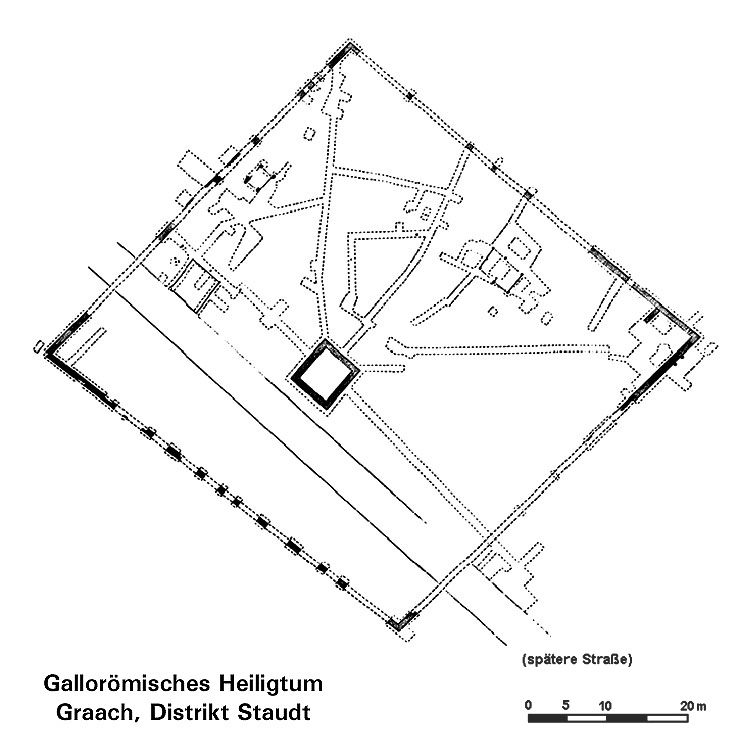
(Caption by the author.)
Sources: Trierer Zeitschrift für Geschichte und
Kunst des Trierer Landes und seiner Nachbargebiete. Jahresbericht
1978-1980,
p. 370. Artur Weber, Suche nach den Ursprüngen des Weinortes
Graach. In: Heimatjahrbuch Bernkastel-Wittlich (1993) p.
172.
6 At illi
confederationes
regum metuentes, ne vel Theoderici sponsionum fraudarentur vel regum
conspiratione ex provintia propellerentur, decreverunt noctu vadum per
Gozholdum monstratum transire ao Thuringiorum castra ex inproviso
irrumpere. Quo peracto tantam stragem de hostibus dederunt, ut vix
quingenti cum Irminfrido evaderent, qui etiam commigravere ad Hunorum
regem Attilam.
(MGH SS rer. Germ.
60, p. 160.)
[Transl.]: But they ‹ the
Swevi, people of North Suavia supporting Theuderic ›
got so worried because
of the pact between the kings ‹ Theuderic
and Irminfrid › that they feared either to be
cheated of Theuderic’s
promise, or else be chased out of the country by the allied kings. And
so they decided to cross the ford shown by Gozhold during the night and
to break rapidly into the fortress of the Thuringians. So it happened
and they made such a bloodbath among their enemies that not even 500
escaped with Irminfrid, and they moved to Attila, king of the Huns.
6.1 According
to the Origine Gentis Swevorum Irminfrid’s
intermediate stay in Attila’s Susat cannot be excluded, cf.
Hilkert Weddige (op. cit. p. 66) at least on Iring/Irung. Ritter
assumes him
as a kinsman of King Irian, cf. Die Nibelungen zogen
nordwärts
(1981) pgs 163–164.
7 The later
Old Swedish supplement Sv 383–385 of MS E 9013 disregarded.
See rather Mb 414, Mb 438 of the elder manuscripts referring to
Thidrek’s bath. The Roman built thermae
of Zülpich belong to a residential
place of Frankish king Theuderic I (see above).
|
|
|
|
Parallels with
Wolfdietrich
The emphasized rôle of the
faithful
and wise Ber(c)htung in comparison
with Thidrek’s loyal companion Hildebrand does not need to be
pointed out further.
As for Theuderic’s royal residence mentioned just before, there is an
obvious significant
parallel with the Wolfdietrich epics,
whose protagonist reconquered his
father’s seat ‘Constantinople’ after he had been cheated out of
his inheritance and expelled from his father’s kingdom.
Annotating to Theuderic’s and Dietrich’s vita, the Frankish but
not Greek residential location in these epics (written after c. 1230)
can be interpreted now more contextually as an allusion to rather ‘Emperor
Constantine’s seat’ known as Augusta
Treverorum = Trier on the Moselle:
Under the lemma Franken→Wolfdietrich
the RGA 9 (1995, p. 384f.)
states about an even further Old French epic that (as
already translated above)
|
| |
|
in the ‘Floovant’
(Chlodovinc, son of Clovis) the father of the protagonist is called
Constantine. Gregory of Tours does also call Clovis a new
Constantine
(II, 31) in the description of his baptism. The fact that his residence
was then called Constantinople
in the poem appears reasonable, but has
nothing to do with the city on the Bosporus.
|
As quoted above, Gregory of Tours
referred
to Clovis as the new Constantine, sparing the name of the
eminent location where Bishop Remigius of Reims had blessed him.
Regarding further
narrative details in the Wolfdietrich
epics, it is irrelevant whether he was born as an older or younger
kingly son, because we do not know which of all his brothers ultimately
survived for the division of the father’s kingdom. But we know from
Frankish history that no representative of Theuderic’s later
territories in the Frankish
kingdom was present at the First Council of Orléans
in the widely accepted year 511 of King Clovis' death.
Wolfdietrich’s expulsion according to the A-B-versions
results
from the dispute with his brothers about the inheritance share of
the paternal kingdom, in version A Sabene
represents the driving force.
Both Wolfdietrich and Theuderic are maligned as ‘Kebsenkind’ (a
concubine’s child).
According to Widukind of Corvey, 10th
century, and the Origine
gentis Swevorum,
dated between 1100 and 1210, Theuderic’s ‘sister’ harps on
his illegitimate descent that should disallow him to take over his
father’s realm.
Gregory of Tours, who makes Clovis I the father
of Theuderic still in chronological context with oral tradition,
also connects the latter’s origin from a concubine relationship
which he could have already taken from Theoderic’s Ostrogothic
biography, see above ch. 3.3.
The comparison of Wolfdietrich with
the Thidrekssaga provides a surprising amount of
identifications which may underline their extraordinary
intertextual relationship. Thus, it is not necessary to mention
that both feature a lion in the shield and fight against
dragons. Further, in Wolfdietrich A the
protagonist
inherits the steed Valke from his father, while
Thidrek takes
over the stallion Falka from Heimir, see citation
Heinzle ch. 3.5. Moreover, Thidrek
takes also the sword Eckisax together with the highly praised
armour
from Ecke (cf. adventurous Osning trip and also the Eckenlied
centered on territory belonging to Cologne), which Wolfdietrich
once appropriated from Ortnit who
had been killed by a dragon. According to the younger Dietrich
epics his enemy Ecke is said to
have received sword and armour
from Queen Seeburg of Jochgrimm, which she had acquired from Tischcâl
monastery, see Miklautsch op. cit. p. 85.
According to the Thidrekssaga, cf. Mb 157 on a war
campaign of Sigurð’s father Sigmund, his advisor Hartwin
(‘Artwin’, ‘Arthur’) desires the queen, who, however,
refuses him. Analogously the parallel in the A-version
of Wolfdietrich:
Before his birth, the king also embarks
on a military expedition, leaving the queen to administer
the realm under the unfaithful Duke Saben. He,
too, desires the queen, who likewise vigorously rejects
him. This common motif, ostentatiously connected to the birth
of these eminent heroic figures, cannot be mere coincidence. More
likely is an extraordinarily close spatiotemporal
relationship between the history of transmission and authorship
that may be solidified with further exploring.
Wolfdietrich B, in
striking parallel to the Samson account of the
Thidrekssaga, relates Hugdietrich’s adventurous
courtship of Hiltburg, the daughter of a king Walgunt of
Salneke. After he forbade their marriage and therefore
locked her in a tower, Hugdietrich appears as ‘Hildegunt’
in female disguise and thus is admitted
to Walgunt’s
court – just
compare the courtship of Apollonius for King Samson’s daughter.
According to the B-version Wolfdietrich
defeats the greedy Ortnit in a duel, but together with him he
frees his
bride Sigeminne on a castle Altenfelse (version D)
from the giant Drasian. So here we have two cross-textual
synonyms being related with Thidrek’s Osning trip.
In consideration with the dating relations to the
younger Dietrich epics these overwhelming parallels can be
explained hardly with an Ostrogothic, but rather original Frankish
provenance of the source material.
Roswitha Wisniewski, who nonetheless shares with an obvious minority of
analysts (cf. Miklautsch op. cit. p. 84) a
rather shortsighted identification of Wolfdietrich with the
Italian Theoderic, unrebuttedly concludes (op.
cit. p. 162;
highlighted passage by the quoting author)
|
| |
|
that in the saga of Wolfdietrich a very old
version of the Dietrichsage seems present, which had to
give way to the
younger saga versions of the Middle High German epics, and
that for their preservation the transposition of the saga
on another hero took place, perhaps at the same time with
new designation as Wolf her Dietrich and a new genealogy,
according to which Wolfdietrich is an ancestor of Dietrich.
|
| |
|
[Original
text:]
|
| |
|
Es hat den Anschein,
daß in der Wolfdietrichsage eine sehr
alte Version der Dietrichsage vorliegt, die den jüngeren
Sagenversionen der mittelhochdeutschen Epen weichen mußte,
und daß zu ihrer Bewahrung die Transponierung der Sage auf
einen anderen Helden erfolgte, vielleicht zugleich mit neuer
Benennung als Wolf her Dietrich und einer neuen Genealogie,
nach der Wolfdietrich ein Vorfahre Dietrichs ist.
12.2 Common
geostrategical ambitions
The narrative return of Theuderic–Thidrek is typified by
corresponding pattern. Both Gregory of Tours (c. 524/525
→)
and the Old Norse + Swedish texts (Mb 413, Sv
355) provide the king’s re-appearance with
reconquering Gaulish territories west of the Rhine and the
Lower Moselle.
|
|
|
According to predominant scholarly
datings, Gregory of Tours relates King
Theuderic I at the aula regia of
Cologne about 525 (see table above).
Regarding Ritter’s basic
spatiotemporal identification of the
historical Dietrich von Bern in so far, it seems absurd to
place and interpret another king Thidrek on the side of
the Frankish Theuderic, who, in the same period being involved, became
authority over a territory even southeast of Húnaland,
exempli gratia a North Thuringian area after c. 531.
Furthermore, as regards the Old Norse and Swedish transmissions, we may
proceed from an attempt of an eastern Frankish tribe to take over the
wealthy region of Soest within a period between Clovis'
campaign to
South Gaul and Theuderic’s one to Thuringia. Such further 6th-century
campaign of Franks to that remarkable
location in the area of the later Westphalia, undertaken likely in the
first half of 6th century, may or can be the
historical defeat and downfall of the Niflungs in rather the Second
Northern Húnaland,
which actually might have caused big losses in warriors on both sides.
In any case, this campaign does not contradict the Merovingian
expansionism related to eastern regions beyond the Rhine already in the
6th century! An
account about this military expedition, dealing with unquestionable
historiographical testifying, is expressed in both Mb 393–394 and these
distinguished words by
Peringskiöld’s Latin manuscript, ch.
CCCLXVII:
|
| |
|
Enimvero
Thiotiscis carminibus (ON.
‘Thydeskir menn’) memoriæ
prodita est, celebris gloria
pugnæ istius, etiam apud antiquos memorandæ.
Magnam utique cladem illam summorumque virorum jacturam, superstitis
Attilæ Regis temporibus in Hunalandia neutiquam
resarciri potuisse (…) Et sane lectu digna sunt Thiotisca carmina (‘Thydeskra
manna’) illa, quibus
exponuntur Susatensium
civium
effata, eorum præcipue qui urbe adhuc incolumi vitam
vixerant (…) Quin & alii apud
Bremensis atque Monasterienses præclara in existimatione
viri, antedictarum
luculentam notitiam nobis dederunt, nulla tamen cum prioribus habita
communicatione rerum, mito consensu iisdem ferme circumstantiis
descriptarum. Visa nimirum his popularium traditionum indubia veritas,
quam carminibus Thiotisco idiomate
in illustrium virorum factis describendis solenni studio proponere
moris erat.
|
| |
|
Indeed,
there is
memorial confirmed by German lays, celebrating such glory of the battle
which
also remember the old ones. This defeat caused such highest loss in men
that it could not be compensated with survivors in the time of Attila’s
reign (…)
And, indeed, German lays have been lectured dignifyingly, exposing the
fate of the
citizenship of Susat, of those
who were living previously at this undisturbed urban place (…)
Other men of even Bremen and Münster confirmed this by means of
the aforesaid illustrious notice; though
they had no knowledge about this from the first said inhabitants, there
was
consensus regarding almost all
circumstantial descriptions.
And this is certainly to be seen in accordance with the indubitable
truth rendered by popular traditions, described in German lays made by
reputable men, as these have been meanwhile performed.
|
|
| This passage then completed with the Icelandic
manuscripts, see
Bertelsen ch. 429a (Mb 428): |
| |
|
Epter
davþa Attila kongs tok
Þidrek af
Bern allt Hunalannd [ad rade margra vina sinna er vered høfdu
med
Attala konge þa er Þidrek kongur var j Húnalande.
Þidrek kongur ried sijnu rijke til elle, og ecke er nu fra
þvi ad seigia, ad hofdingiar hafe barest i móte honum, so
eru nu
aller hrædder
fyrer honum, ad eingenn þorer ad hefnast a honum, þott
eirnsaman
rijde hann med sijnumm vopnumm.
|
| |
|
[Transl. Mb
428:] After
the death of King ‘Attila’,
Þidrek of Bern took over all of Húnaland, supported by
many of his friends who were at King Attila’s court when he was in
Húnaland.
From now on King Þidrek was reigning his whole realm until old
age, and there is nothing to say
about chieftains rebelling or anybody daring an attack against him,
even when he was lonely riding with his weapons.
|
|
These accounts relate
that Thidrek became authority over a certain part of Saxony
( = Húnaland)
which included the eastern region
of the
later Westphalia with its obvious centre Susat, as the Old Norse
+ Swedish
texts seem to credit this moderately to the tragical disappearance of
its ruler.
After the takeover of the kingdom of Cologne by Clovis I,
the eastern advance of the Franks was significantly expedited by
Theuderic I,
who moved martially to North Thuringia with its Harz region and who
presumably
tolerated or appointed local individuals as loyal
chieftains also in Saxon regions beyond the Rhine. An impactive
Merovingian movement to the lands of the later Westphalia, a
retaliatory military action against the Saxons, who attacked eastern
Franks in 623, has been
ascribed to Chlotar II
and his son Dagobert, therewith forcefully occupying or gaining some
regions at least west on Weser river about 625/626. Later on, this
Frankish invasion of Saxony, as provided by the Liber
historiae Francorum, 41,
was massively reinforced by Charlemagne.
According to the letter of Theuderic’s son Theudebert, who
informed Emperor Justinian I about territorial
heritage
of Austrasian kingdom only a few month after the death of his father,
its status
quo is … cum
saxonibus (,)? Euciis, qui se
nobis voluntate propria tradiderunt [MGH: Epistolae Merowingici
et Karolini aevi I, p. 133 (III. Epistolae Austrasiacae 20)];
cf. in chronological and interpretative contexts Franz Beyerle, Süddeutschland
in der politischen Konzeption Theoderichs d. Gr., Grundfragen der
alemannischen Geschichte, Vorträge und Forschungen,
1, 1955, p. 77f.
On the one
hand, Beyerle apparently concludes that the geographical placement of
‘Saxon Jutes’ ( saxonibus Euciis) would cover perforce all
southern
Saxon people. Thus, he transcribes ‘ cum saxonibus et Euciis’.
On the other hand, however, ‘Saxon Jutes’ could have been chosen by
Theudebert or his
scribe in order to distinguish them clearly from the Anglo-Saxons.
Notably disagreeing
with Beyerle is Richard Drögereit who ambiguously localizes (a
part of) saxonibus
Euciis rather in Pannonia: Fragen der
Sachsenforschung
in historischer Sicht, in: Niedersächsisches Jahrbuch
für Landesgeschichte 31, 1959, pgs 38–76, see p.
50f.
Theudebert’s letter
to Justinian does not contradict the political relationship between the
‘Húnalandish’ or ‘Saxon’ Ata la and
Thidrek.
As regards the timeline of events provided by the Thidrekssaga (cf. Ritter
and the author), both had overthrown a tribe equated with the
Wilzians in
the early 6 th century. |
|
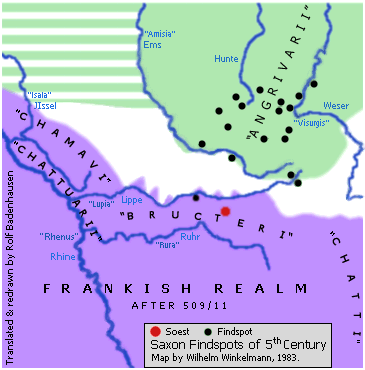 |
This map,
originally
titled ‘Sächsische Fundstellen im 5. Jahrhundert’ by Wilhelm
Winkelmann (op. cit. p. 195), navigates with ancient
tribal (re-)localizations. The ‘demarcation of
Saxon and
Frankish territory’ is primarily basing on archaeological research.
The ‘Liber historiae Francorum’, XIX, seems to equate the
‘(C)hattuarii’ with the ‘Attoarii’ of 6th–8th
(!) century.
Gregory of Tours does only refer to some
ethnonyms provided by Tacitus
for narrative related to the end of 4th
century, while Bede and other
authors still use them for their descriptions of later events up to
7th–8th century.
However, neither Widukind of Corvey nor the Annales
Quedlinburgenses mention the specified Roman based tribal names in
their 5th–7th
-century accounts,
albeit Widukind remarks once ‘Angarios’ in his ‘Res gestae Saxonicae’
I,
14, just before his introduction of Charlemagne. Both Gregory and the
Annals
refer to ‘Sicambria’, perhaps the tribal region of the ‘Gambrivii’, in
their
5th -century reports.
More realistically, the region between Lippe river and the
former ‘Chatti’ should be regarded as a more or less occupied area.
Thus, this ethnographical outline does not allow an inference on the
stability of the
6th–9th-century
Franco-Westphalian territory. |
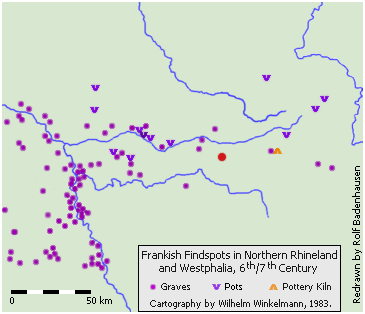 |
Furthermore, W. Winkelmann provides
these findspots for estimating the peripheral
Frankish borderline crossing the Westphalian region in 6th/7th
century
(op. cit. pgs 198–199).
The kiln was excavated at Geseke, c. 17 km southwest of Paderborn.
Winkelmann further remarks that some revealing finds of Westick,
location of
Kamen, have been dated to 5th century; for
instance a small Francisca
of lead, elaborately profiled needles, pots of glass and goblets.
He also estimates some of these finds burned in kilns on the Rhine.
Referring to the map above, Winkelmann additionally ascribes
‘Hamaland’
, a small region
east to northeast of the ‘Chamav’, to Frankish territory of 6th–7th
century. |
|
|
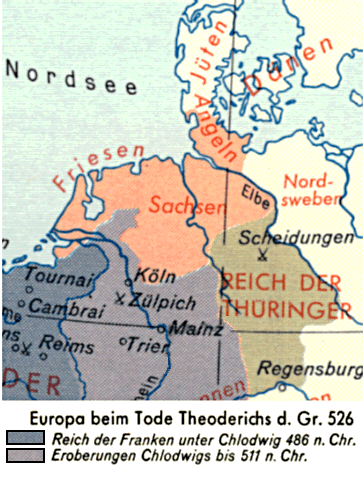 |
An elder
scholarship’s
version of borderlines related to 6th
century, cf. the ‘Saxon notion’
not only by
Gregory of Tours. This partial view is an excerpt from a
map of Europe designed by German prehistorian Kurt
Tackenberg; cf. e.g. Putzger, 88th ed. 1965,
p. 39.
Gregory’s contemporary Venantius Fortunatus knows of Saxons, Danes and
Jutes warring against
Chlotar I and his son Chilperic (carmina IX, 1, 73f.). He further
relates a dux Lupus successfully fighting against Saxons and
Danes (carmina VII, 7, 50f.), as contexually annotated by Walther
Lammers, Die Stammesbildung
bei den Sachsen, in: Westfälische Forschungen X,
Münster
1957, pgs 25–57.
Id. (Ed.), Die Eingliederung der Sachsen in das
Frankenreich, Darmstadt 1970; the latter mainly focussing on
7th–9th century.
Albert Genrich (op. cit. p. 6f.) attempts to project the view of
‘Saxon(y)’ as a
likely collective tribal body already before the Merovingian
period by means of ethno-archaeological studies whose related
cartography (i.a. by Hans Jürgen Eggers) points to «a
homogeneous
economic area with a typical burial cult extending from the Lower Elbe
to the Middle Weser and the Teutoburg Forest after A.D. 200.»
Therewith he infers [transl.]: ‘It is not improbable that
the
borders of this archaeological sphere are coextensive with those of a
political group.’
[‘Es ist
nicht unwahrscheinlich, daß die Grenzen dieses
archäologischen Kreises mit denen einer politischen
Gruppierung zusammenfallen.’] |
|
|
In 2005 Christoph Grünewald,
archaeologist at German LWL organization, resumed the
archaeo-ethnological research on Westphalian 6th
century with this statement:
|
| |
|
Im 6.
Jahrhundert müssen wir uns voll und ganz auf die Analyse von
Gräberfeldern stützen, denn eindeutig und gut
interpretierbare Siedlungen dieser Zeit mit Befunden sind selten. Ein
Blick auf die Karte (…) weist insgesamt 15 Gräberfelder auf.
Fast alle liegen ganz eng in der Lippe-Hellweg-Zone. Alle peripheren
Regionen wie das nördliche
Münsterland, Südwestfalen und auch
die Zone, in der wir im 5. Jahrhundert
noch an der Weser viele Fundpunkte hatten, bleiben ausgeklammert.
Dies kann als ein weiterer Beleg
dafür gesehen werden, dass die
„sächsische Südausbreitung” des 5. Jahrhunderts keinen
Bestand hatte und jetzt eher westliche Einflüsse dominieren.
Etwas differenziert gesehen werden müssen die
Grab- und Beigabensitten. Sie variieren
sowohl von Friedhof zu Friedhof wie innerhalb eines Gräberfeldes
stark (…)
Fasst man zusammen, so zeigen die
Grabfunde ein eindeutig linksrheinisches, also
fränkisches Gepräge, während die Grab-Befunde dies nur
teilweise bestätigen, sich in anderen Teilen aber deutlich hiervon
absetzen. Versuchen wir hier jetzt den Abgleich mit Schriftquellen,
sind die Grenzen schnell erreicht. Zwar sind für das 5. und
6. Jahrhundert vielfach Kriegszüge
der Sachsen – allein oder mit anderen
Stämmen zusammen – erwähnt und dass 557 ein fränkisches
Kastell in Deutz von Sachsen gestürmt wurde, über
Territorien, Machtgebiete oder dauerhaft besiedelte Länder sagt
dies aber nichts aus.
[Ab 7. Jahrundert:]
In den Jahrzehnten um und nach 600 ist kurzfristig
eine besondere Entwicklung zu
spüren: An mehreren Stellen sind gut bis sehr gut ausgestattete
Gräber zu finden,
die teilweise sogar als „Adelsgräber” – den Begriff mit aller
Vorsicht genutzt – bezeichnet werden können. Am bekanntesten ist
sicher der Fürst von Beckum
(…) mit seiner kompletten Bewaffnung, Geschirr und goldenen
Taschenbeschlägen (Winkelmann 1974). Ihm zur Seite gestellt werden
können Kriegergräber aus Fürstenberg (… Melzer
1991) oder Warburg-Ossendorf (Siegmund 1999a), die schon als
fränkische
Statthalter im eroberten Westfalen gehandelt wurden. Sozusagen ihr
weibliches
Pendant – als Adelige, nicht als Statthalterinnen
– bilden Gräber aus Soest mit reichem Goldschmuck (Melzer 1999).
Auch hier ist wieder die Herkunft der Gegenstände sicher im
linksrheinischen
Gebiet zu suchen.
(C. Grünewald, Archäologie
des
frühen
Mittelalters vom 5. bis zum 9. Jahrhundert in Westfalen – ein
Überblick – in: Archäologie in
Ostwestfalen 9 [ISBN 3-89534-569-5],
Saerbeck 2005, pgs 71–86, see pgs 73–75.)
|
| |
|
[Regarding
6th century, we must entirely
draw upon the analysis of burial grounds, because settlements
with findings for clear and good interpretation are infrequent. The map
(…) shows altogether 15 burial grounds, almost all their positions
very
close to the Lippe-Hellweg
zone. All peripheral regions such as the northern region of
Münster, South Westphalia and also the area of many 5th-century
findspots on the Weser are excluded. This can be taken for evidential
conclusion that the ‘southern expansion of the Saxons‘
is no more
relevant in 5th century, whilst western
influences are now dominating.
The burial and piece adding customs must be regarded
more differentiated. They vary much both from cemetery to cemetery and
also within a burial ground (…)
Summarizing, the finds of these graves show
unequivocal
dispositions from the left side of the Rhine, thus being Frankish.
Nonetheless, the findings about these graves are proving this only
partially, although significantly diverging even in parts. Now trying
to weigh this against bibliographical sources, we will be soon
stretched to the limits. There are frequently mentioned martial
campaigns of Saxons – or in common with other tribes – in 5th
and 6th century, e.g.
a Frankish fort at Deutz raided by Saxons in 557. However, these
expeditions are not relevant for an inference on territories, orbits of
power or permanently settled
lands.
|
| |
|
Up
to
this point in Grünewald’s summary, which contextually includes the
burial
grounds of Soest on the Hellweg, he does not differentiate
between first and second half of 6th century.
Now around
and after 7th century:
|
| |
A special short-time-development must be noted for
the centuries about and after 600: There are several locations of well
and very well endowed graves which partially can be called
– with utmost care – ‘Noble
Graves‘. The best known of them is certainly the grave
of the ‘Ruler of Beckum‘ (…) with his complete armament, equipment
(harness) and golden bag fittings (Winkelmann 1974). We can put on his
side the warrior graves of Fürstenberg (… Melzer 1991) or
Warburg-Ossendorf (Siegmund 1999a) which have been already discussed as
graves of Frankish governors in conquered Westphalia. So to say that
the graves of Soest represent their female pendants – as noblewomen but
not governors – with wealthy gold jewellery (Melzer 1999). Right here
the origin of the found pieces has to be researched certainly in the
area left of the Rhine.]
|
| |
|
Regarding again the
Frankish-Thuringian War,
the above-mentioned manuscript De Origine Gentis
Swevorum, 9, relates that
Irminfridus,
overthrown opponent and, finally, tributary armistice partner of
Frankish king Theodericus, moved with ‘merely five hundred’
to an ‘Attila’ after a lost battle:
|
| |
|
At illi
confederationes regum metuentes, ne
vel Theoderici sponsionum fraudarentur vel regum conspiratione ex
provintia propellerentur, decreverunt noctu vadum per Gozholdum
monstratum transire ac Thuringiorum castra ex inproviso irrumpere.
Quo peracto tantam stragem de hostibus dederunt, ut vix quingenti cum
Irminfrido evaderent, qui etiam commigravere ad Hunorum regem Attilam.
|
| |
|
(Codex
Palatinus
No. 1357, fol. 152v–153v,
Vatican Library. Codex No. 4895 A, fol. 123–124, Bibliothèque
nationale
de France. M. H. Goldast, Scriptores rerum Suevicarum (Franco
f.
1605, 8°), pgs 15–20.
MGH Latin text: cf. MGH SS rer. Germ. 60 (Ed.
Waitz/Hirsch,
Hanover 1935), see p. 160 for c. 9.)
In common with the Annals of
Quedlinburg this message seems to substantiate a Low Germanic Atala
of 5th/6th century
whose date of death estimates Ritter only a short time before that one
of
Thidrek. Furthermore, as contextually indicated, the notice
quoted
above
from the De Origine Gentis
Swevorum does not contradict the Saxon-Thuringian ‘notions
of
history’, from wherever adapted by ‘homeland historiographers’. Hilkert
Weddige (op. cit. p. 88f.) points
out that the author of De Origine Gentis
Swevorum must have known the Chronica written by
Frutolf von Michelsberg, i.e. esp. its part De
Origine Saxonum.
|
| |
|
When Thidrek returned
home from a disastrous Susat to his residence in the outer
Eifel, he knew that some region of the later
Westphalia and Low Saxony was too weak to repulse any
further attack coming from the
other side of the Rhine. When Theuderic was back on home location in
the outer Eifel, as Gregory remarks events after 531/532, he
apparently gaver order to remove the deprived last king of Thuringia.
This
is conceivable political strategy of Frankish expansion
appearing in first half of 6th
century.
|
|
12.3
Dénouements on
literary milieu
As already recognized by attentive elder scholarship (notably e.g.
Gunnar O.
Hyltén-Cavallius, Henrik Bertelsen, Bengt Henning), the scribes
of the Old Swedish texts left the literary form
of a chronicle or historia at least;
neither one of those fornaldarsögur,
sagas written before Iceland’s ethnological
starting point, nor one of those riddarasögur,
chivalric tales written thereafter by Old Norse ‘fabulatores’
apparently for amusement at mediaeval
courts. Roswitha Wisniewski, whose postdoctoral work about the downfall
of the Nibelungen by Thidrekssaga has been either attacked
unconvincingly or ignored enormously by her colleagues, does not follow
inappropriate methodological principles of elder and some newer
scholarship
for classifying the predominant
literary gender of the Thidrekssaga. Although Wisniewski
unpersuasively regards e.g. ‘the Italian conqueror Samson’ as a
brainchild
(‘Erfindung’) of Thidrekssaga, she justifiably points out (op.
cit. 1961, op. cit. 1986) that its
obvious comprehensive Low German source is based on dominating
narrational
identities which are unquestionably belonging to the genre of the
mediaeval chronicle and historiography [transl.]:
|
| |
|
The
literary design of Thidrekssaga
is characterized by natures known from chronicles, historiographies
and gestae (Droege, Wisniewski). The title
‹Dietrichschronik› for the
Swedish version thus might be chosen not by chance. In contrast to
heroic lays and epics, as they are personalizing and depolitizising
sagas, politicizing is especially typical for chronicles and related
literary forms.
|
| |
|
[Für
die Gestaltungsweise
der Thidrekssaga sind Eigenheiten kennzeichnend, die aus Chroniken,
Historien und Gesten bekannt sind (Droege, Wisniewski). Die Bezeichnung
›Dietrichschronik‹ für die schwedische Fassung
dürfte nicht von ungefähr kommen. Im Gegensatz zu
Heldenliedern und Heldenepen, die Sagen personalisieren und
entpolitisieren,
ist für Chroniken und verwandte Formen gerade die Politisierung
typisch.]
|
| |
|
(Roswitha
Wisniewski, op. cit. 1986, p.
79; cf. also p. 35 on ‘Samson’.)
|
|
Hans-Jürgen Hube (Humboldt
Universität Berlin, Nordeuropa-Institut, em.)
correspondingly estimates the manuscripts being based on a
historia or chronicle written in
12 th–13 th century,
and he reasonably detects some basic point of view provided by
Susanne Kramarz-Bein, who has been not convincingly focussing on
nothing else than riddarasögur and fornaldarsögur
as the obvious possibilities or mixture for the literary gender of the
Thidrekssaga, as spitzfindig.(25) |
|
|
As regards the life of Theoderic the
Great, his vita is more in detail than the biographical
material we have on
the Frankish Theuderic and his intimate advisor dux
Hilpingus,
as shortly annnotated in Gregory’s wartime records, cf. the name form Hilprant
as the best companion of Dietrich von Bern in the keenly
compiled ‘World Chronicle’ by Heinrich von München.
Astonishingly, however, the Ostrogothic Theoderic had no confident
or follower roughly named alike for an eminent relationship that
has been already compared with King David and Jonathan by the
ecclesiastical scribe of Mb 15 – as we urgently have to expect this for
the
incontrovertible literary connection. However, Widukind of Corvey
does already know of this Frankish king’s reliable and familiar advisor
who, albeit his name put aside and equated with an obvious
‘highest-ranked servant’, was appearing in Thuringian War:
|
| |
|
Erat
autem
Thiadrico servus satis
ingeniosus, cuis consilium expertus est saepius probum, eique
propterea quadam familiaritate coniunctus.
|
| |
|
(Res
gestae
Saxonicae I, 9.)
|
|
|
Furthermore, the Annales
Quedlinburgenses do already provide the twelve noblest
companions of
the Frankish Theoderic; and there is no solid literary
evidence imaginable that the Old Norse scribes had endeavoured to
create all those stories about their twelve heroes for the sake of the
Annales' mention
of the number of the Frankish king’s followers.
Roswitha Wisniewski quite rightly
queries the missing scholarly consistency onto the cardinal questions
and answers on the historical starting point of Dietrich von Bern
saga tradition and the mental process for/of converting an historical
Italian conqueror so emphatically into an Italian refugee!
Referring to the prevailing scholarly opinion, she cognizes the
conquest of
Italy by Theoderic the Great and the assassination of Odoacer, but
she cannot provide a good reason why Dietrichdichtung,
categorized ‘of southern origin’, transforms such basic biographical
context into extensive fabulous exile tradition (op.
cit. pgs
44–45). Joachim Heinzle cluelessly wonders [transl.]:
|
| |
|
Nonetheless
puzzling is what matters most: how
did come the conversion of Italy’s historical conquest by
Theoderic into Dietrich’s expulsion from Italy into being?
|
| |
|
[Rätselhaft
bleibt indes die Hauptsache:
wie es zur Verwandlung der historischen Eroberung Italiens
durch Theoderich in die Vertreibung Dietrichs aus Italien
kommen konnte.
Op. cit.
p. 6.]
|
|
|
The Ambraser
Heldenbuch
already includes the eminent verse form poetry Dietrichs
Flucht and Rabenschlacht,
its literary gender misleadingly established as HISTORISCHE
DIETRICHEPIK by elder scholarship.
Comparing the basic source context of the prose version known as
‘Anhang zum Heldenbuch’ (AHB), provided as either prologue or, more
commonly, addendum in the ‘Books of Heroes’ released by Diebolt
von Hanowe and some other editors, Joachim Heinzle concludes [transl.]:
|
| |
|
It is
out of the question that the author of the
‘Heldenbuch prose’ had an access to the ‘Thidreks saga’: saga
and prose must, independently of each other, have selected eclectically
from the same old narrative tradition.
|
| |
|
[Es
ist ausgeschlossen, dass der Verfasser
der ‘Heldenbuch-Prosa’ Zugang zur ‘Thidrekssaga’ hatte: Saga und Prosa
müssen unabhängig voneinander aus der gleichen, alten
Erzähltradition geschöpft haben.
Op. cit. pgs 79–80.]
This statement implies significant
divergences for intermediate and/or final edits basing on
‘the same old narrative tradition’.
|
|
|
Alpharts Tod,
seemingly the
‘trilogical’ or at least further outstanding rhyme epic dealing with Dietrich’s
explusion and his attempt to regain his
kingship, conveys a
Franco-Rhenish paper manuscript of 15th
century, while the text itself seems to be generated in
13th/14th
century. Joachim Heinzle does not follow estimations pleading for an
author
based in Upper Germany [transl.]:
|
| |
|
It
seems hopeless to determine the native
location of the text. The circumstantial evidences brought forward for
the Bavarian and, lately, Alemannic space as linguistic area are all
through unusable.
|
| |
|
[Hoffnungslos
scheint es, die Heimat des
Textes bestimmen zu wollen. Die Indizien, die man für den
bairischen und –
zuletzt – für den alemannischen Sprachraum beigebracht hat, sind
durchweg unbrauchbar.
Op. cit. p. 90.]
|
|
|
However, accordingly to the majority
of scholarly validations of the Middle High German Dietrich
epics, with venues obviously keyed to Italy and Upper Germany,
endemic authors and their recipients are said to have deemed a
necessity for
heroizing the pragmatic appearance and political
success story of the correspondingly named
Ostrogothic politician – thus glorifying and mystifying him by (e.g.)
replacing his grandfather with nothing more than an
alluding surrogate Amelunc generated from an 550 years living HugeDietrîch who, noteworthy enough, is
mentioned at first in Saxon transmissions written in 9th/10th
century.
Taking this and other approaches into consideration, scholarly
authorities as Kemp Malone and other researchers in mediaeval Dietrich
transmissions
inclusively regard the literary North-South mainstream, Malone at
least for Dietrich von Bern transmissions, notably already
Simrock et al. even for Heldenbuch contexts. However, both do
prefer the
Frankish king and/or his best companion as the prototype(s) serving for
some southern based heroic lay or epic work on the Italian Theoderic,
cf. also Joachim Heinzle and the RGA on Wolfdietrich.
|
|
|
Since the vita and death of
Thidrek’s
foe Ermenrik do widely differ from the historical accounts on Odoacer
and Ermanaric (d. 376), we may contemplate Heinzle’s axiomatic
conclusion related to the poetical and spatiotemporal
bandwidth of particular Upper German Dietrich von Bern
traditions [transl.]:
|
| |
|
The
synchronisation of events and persons of
different times is aiming at the construction of an exclusive world of
heroes, where everthing is connected with all and everyone has to do
with everybody.
|
| |
|
[Die
Synchronisierung von Ereignissen und
Personen, die verschiedenen Zeiten angehören, zielt auf die
Konstruktion einer geschlossenen Heldenwelt, in der alles mit allem
zusammenhängt und jeder mit jedem zu tun hat.
Op. cit.
p. 5.]
However, we may wonder whether this
easily seen good conjecture meets final illation in the light of
further distinctive explorations. For instance, it is obvious that some
non-negligible contexts related to the epic vitae of not
only Dietrich von Bern but also his most eminent foe are
significantly at variance. In view of the complexity of mediaeval Dietrich
epics, the conclusive disposition brought
by Heinzle may point
to hardly more than an allocation of heroic and/or historical names to
the variables of poetical or unbelievable narration. Consequently, if
we have to explore some
narrative interrelation with obvious equally named figures provided
by different environments of transmission and, implicitly in so far,
unequal literary milieus (!), we rather have to care warily for some
further interpretative step of dénouement and exposition.
It is obvious that the twinship of Dietrich’s Flight and Exile
represents the very core of the most trenchant traditions about him.
However, Joachim Heinzle does concede with regard to the basic
narrative identification and connection of Dietrich’s
Fluchtsage
with an heroically but unreliably suggested Theoderic the Great [transl.]:
|
| |
|
In the end, however, all
attempts at explanation remain non-committal, and one can only
basically state that the reformulation of the historical event
to the Flight Legend was oriented to a ‘situation schema’ that –
fitted out with a more or less solid stock of motifs –
was commonly known from elder narrative tradition.
|
| |
|
[Letztlich bleiben
aber alle Erklärungsversuche unverbindlich, und man kann nur
grundsätzlich feststellen, daß sich die Umformulierung des
historischen Geschehens zur Fluchtsage an einem ‚Situationsschema’
orientierte, das – mit einem mehr oder weniger festen Motivinventar
ausgestattet – aus älterer Erzähltradition geläufig war.
Op. cit.
p. 6.]
|
|
The identification of Theoderic the
Great as the heroic representative of Dietrich von Bern, for
instance by means of nothing more than an unclear surrogate called
‘situation schema’ by Heinzle, lacks of
convincing reasoning even for that non-referenced elder
narrative tradition. In his publication of 1999, predominantly
surveying southern based mittelhochdeutsche Dietrichepik,
we are missing reliable estimations about the
connective degrees of dependencies between these Upper
German epics and the Thidrekssaga; see e.g. pgs
58–83
with his approach basing on an obvious ‘elder tradition’ as the common
source of the latter and ,Dietrichs
Flucht’ und ,Rabenschlacht’ (pgs 79–80), which he
estimates in the light of unclear literary-historical relationship.
Following unbiasedly Ritter’s interpretation of the Old Norse and
Swedish manuscripts, these texts cannot provide the conditional
framework to relegate them convincingly to any Ostrogothic saga on the
life of Theoderic the
Great. Since there is actually no evidence to the contrary,
it now seems clear that acknowledged historical plus historiographical
contexts of Migration Period in eastern Frankish, North German and
Baltic regions cannot disprove both the basic political contents of
these manuscripts and Ritter’s basic conclusions. According to his
estimations, advanced explorations of these texts do not necessitate
polemic argumentation by de facto obsolete research which, for
instance, has been suggesting an oral based
‘process operative’ called ‘localization’ for
‘transmitted events’, therewith arguing in favour of a special
kind of ‘pseudo-localization’ for ‘pseudo-history’. However, such
dubious hermeneutical approach and solidification pays no attention
to any further provision of evidence, but implying rather
smartly an overestimation
of the exactness of history as
preserved in oral traditions instead — pretty statements
of reviewers emending themselves to another, more believable scholarly
level of mediaeval German-Norse transmission of historiography.(26) |
|
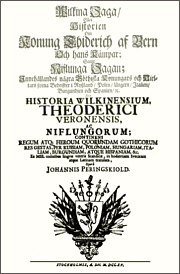 |
Johan Peringskiöld clearly
distinguished in 1715 between Old Norse literary category SAGA
and the script he provided under the title
HISTORIA
WILKINENSIUM, THEODERICI VERONENSIS, AC NIFLUNGORUM.
Ritter has indicated the fundamental literary
problem of the Thidreks SAGA by
questioning
the relevance of its title, arguing finally that we have no sufficient
evidence to ascribe its manuscripts to current
oral transmission about any Ostrogothic milieu.
Rather, it seems more likely that the immediate source of all extant
manuscripts was referring to a German based ‘Großwerk’,
notably Roswitha Wisniewski (op. cit.)(27)
and Hermann Reichert (see the author’s review of Heldensage
und Rekonstruktion; Vienna, 1992: Zur
Transmission der Thidrekssaga und altschwedischen ‘Didrikskrönikan’)
who points out an unlikely
relationship for immediate oral transmission. |
|
< td>
|
Other scholars basically agree with a
‘Großwerk’
whose translation was written in Bergen, as these are e.g. Dietrich von
Kralik [Deutsche Heldendichtung, in: Das
Mittelalter in Einzeldarstellungen Leipzig 1930, pgs 168–193],
Karl Droege [Zur Thidrekssaga, in: ZfdA
66,
(1929), pgs 33–46], Heinrich Hempel [Sächsische
Nibelungendichtung und sächsischer Ursprung
der Thidrikssaga, in: Edda, Skalden, Saga; Festschrift für
Felix
Genzmer, Ed. Hermann Schneider, Heidelberg 1952, pgs 138–156; see
p. 140ff.], Heinrich Matthias Heinrichs [Sivrit
–
Gernot – Kriemhilt, in: ZfdA 86 (1955/56), pgs 279–290; see
p. 289], Helmut Voigt [Zur Rechtssymbolik
der
Schuhprobe in der
Þidriks saga (Viltina Þáttr), in: PBB 87
(1965), pgs 93–149], Theodore M. Andersson [An
interpretation of Thidrekssaga, in: Structure and
Meaning in Old Norse Literature, Ed. John Lindow &
other, Odense 1986, pgs 347–377; see p. 349ff.].
William J. Pfaff consents with a Latin chronicle, serving as
significant source of
the Old Norse and Icelandic writers, under these premises:
|
| |
I should agree that a
Latin chronicle played a role in the transmission of much
of the material in the Thidreks saga. In support of this thesis
one might add that some
names from sequences unrelated to the fall of the Nibelungs exhibit the
peculiarities and variation which were attributed to faulty use of
Latin orthographic symbols: for instance, Ruzcia-land and Villcina-land ,
although in the latter the variants with c, t, z and k are
further confused by the possibility that two Slavic words, one with a t ,
one with a k phoneme, are involved. If these errors are
traceable to the same Latin chronicle, a compilation embracing more
than the fall of the Nibelungen
was assembled in northern Germany in chronicle form.(28)
|
| |
|
(The
Journal of English and Germanic Philology, 61, 1962, pgs 948–952,
see p. 951.)
|
|
Striking a balance between Ritter, who
did not disregard narrational postmodernisms in the high mediaeval
manuscripts, and his antagonists, we have to concede that he plausibly
left a rational philological reconstruction of some very basic
account provided by Thidrekssaga. In contrast to him,
however, elder scholarship and some of its following modern
representatives have not been ready to follow the distinctions drawn by
Ritter.
Characteristically, the corresponding modus operandis of
these analysts amount to calling Upper German poetry plus
noncontemporary Ostrogothic contexts as reliable witnesses against more
realistic accounts of rather remarkable historiographical transmissions
indicating ‘at least’ basic congruences related to history of the 5 th–6 th-century
eastern Franks.
The apparently contradicting ‘two momentous passages’ on
Ermenrik’s conquests and mightiness in Mb 13 and 276 may be estimated
as a pretty reception of Jordanes ' Getica,
who
claims the Gothic Ermanaric ruling all the publics of Scythia
and Germania as these spheres were his own.
However, the postulated Low German source provider and/or the Old Norse
scribes could have also identified the geonyms of both passages as
legitimate southeastern markers in a monumental Franco-German
architecture. It is obvious that its pillars
were founded by Thidrek’s dynasty, then climaxing at
Charlemagne, and finalized as high mediaeval Sacrum Romanum Imperium
or
the Heiliges Römisches Reich deutscher Nation
by elder German scholarship.(29)
With respect to the historical identification of Dietrich von Bern
with
Thidrek of Bern, there are overwhelmingly more reliable
moments being geared for his synchronization with Frankish king
Theuderic I. Hence, regarding the most
important
details in the vita of Thidrek
of Bern, Ritter consequently asks in the epilogue of his book Dietrich
von Bern, Munich 1982, p. 279 [transl.]: |
| |
|
What is in agreement
with the life of Theoderic the Great?
Not the ancestors,
not the youth with the fights against the giants,
not the twelve loyal fellows,
not the decision-making fight against Sigurð,
not the life-long quarrel with his uncle,
not the long exile,
not the combats against the Northeast-peoples,
not the futile attempt to regain his homeland,
not the loss of the brother and the sons of the king ‹ Atala ›,
not the participation in the bloody downfall of the Niflungs,
not the lonely homecoming, the joyful reception in the homeland,
not the conquest of the empire of «Rome»/Trier in old age,
not the revenge on Wideke later on.
Nothing of this all
belongs to the life of Theoderic the Great.
|
| |
|
[Was stimmt
überein mit dem Leben Theoderichs des Großen?
Nicht die Vorfahren,
nicht die Jugend mit ihren Riesenkämpfen,
nicht die 12 vertrauten Gesellen,
nicht der Entscheidungskampf mit Sigfrid um den Vorrang,
nicht der lebenslange Streit mit seinem Oheim,
nicht die lange Exilzeit,
nicht die Kämpfe gegen die Nordost-Völker,
nicht der vergebliche Versuch, die Heimat zurückzugewinnen,
nicht der Verlust des Bruders und der Königssöhne,
nicht die Teilnahme am blutigen Untergang der Niflungen,
nicht die einsame Heimkehr, der freudige Empfang in der Heimat,
nicht die Eroberung des »Rom«/Trierer Reiches im Alter,
nicht die späte Rache an Wideke.
Gar nichts von diesem
allen gehört zum Leben Theoderichs des
Großen.]
|
|
|
Although it may seem less relevant
to connect the life of any Theoderic with a fight against a
‘gigantic creature’, an animal of
the kind called an elephant
(cf. Haymes), this list may be supplemented with more very
distinctive items which, however, finally do not meet reliable herioc
interpretation of the life of an Italian king. For example, Ritter did
not expressively state against phlegmatic or prejudicing scholarship
that Thidrek’s dynasty is nowhere connected with the ‘gens
Amalorum’ in the Old Norse and Swedish manuscripts. As regards the
political side of Thidrek’s accounts, we have to concede that
the Italian Theoderic supported no Hunnic ruler warring against more
northern or northeastern tribes. Indeed, we also have to
state that Thidrek led a campaign of revenge against a mighty
kinsman, who had exiled him already as a sovereign king; but in
contrast, the Italian Theoderic was transferred at the age of four or
five years for a maximum of about ten years as a hostage to Byzantium.
In the first time after his return, aged between 14 and 16 years,
substantially deviating from Thidrek’s return, Theoderic only
practiced some ruler functions still at the side of his father. Opposed
to the politically arranged return of the Italian Theoderic, however,
Thidrek returns to Bern
with a dramatic fight between his companion Hildebrand
and his son Alebrand. Moreover, with respect
to one of the most contradicting facts, the
Italian Theoderic personally killed his most
eminent rival Odoacer at the Imperial Palace ad Lauretum. But
Thidrek’s expeller and
archenemy died of obesity. His successor
– who was not killed by Thidrek
– fell in the area of ‘Rome’, where Thidrek is crowned again.
Thus, Ritter could further refer to the comprehensive study by H. J.
Zimmerman who explored heroic lore – saga and poetry – of Dietrich
von Bern in juxtaposition with the historical Theoderic the Great.
Zimmermann concludes that [transl.]:
|
| |
|
however, the tradition in
heroic
saga and heroic poetry moves so far away from the historical reality
that only
outlines are recognizable (...) For all strands of transmission it is
common
that they result in a Theoderic depiction that does not correspond to
the historical
reality.
|
| |
|
[Original
text:]
|
| |
|
Dagegen entfernt sich
die Überlieferung in
Heldensage und
Heldendichtung so weit von der historischen Wirklichkeit, daß nur
noch Umrisse zu erkennen sind (...) Für alle
Überlieferungsstränge ist gemeinsam, daß sie ein
Theoderich-Bild ergeben, das der historischen Wirklichkeit nicht
entspricht.
|
| |
|
(Heinrich
Joachim Zimmermann, Theoderich der Große – Dietrich von Bern.
Die geschichtlichen und sagenhaften
Quellen des Mittelalters. Doctoral Thesis, University of Bonn
1972, see p.
178. )
|
Ritter explains Zimmermann with this statement, cf. Dietrich
von Bern (1982) p. 14 [transl.]:
|
| |
|
The first sentence says
that in the heroic legend and heroic poetry only outlines of the
historical
reality are recognizable; in the second sentence also the recognizable
outlines
are renounced and, therefore, stated: The depiction of Dietrich von
Bern
of
the heroic legend and poetry does not correspond to the
historical
reality of Theoderic the Great. In spite of this clear statement the
possibility is not considered that in history and legend of two
different
personalities is spoken. How strong must be the general prejudice,
which hindered the decisive question in such an excellent study!
|
| |
|
[Original
text:]
|
| |
|
Der erste Satz sagt,
daß in der Heldensage und
-dichtung nur noch
Umrisse der historischen Wirklichkeit zu erkennen seien; im zweiten
Satz wird
auch auf die erkennbaren Umrisse Verzicht getan und festgestellt: Das
Bild Dietrichs von Bern der Heldensage und -dichtung entspricht der
historischen
Wirklichkeit Theoderichs des Großen nicht.
Trotz dieser klaren Aussage wird die Möglichkeit nicht erwogen,
daß in
Geschichte und Sage von zwei verschiedenen Persönlichkeiten die
Rede sei. Wie stark mußte das allgemeine Vorurteil sein, welches
in einer so vorzüglichen
Untersuchung die entscheidende Fragestellung verhinderte!
These striking contexts point out the
main unbridgeable differences between Theoderic the Great and Dietrich
von Bern
provided by the Thidrekssaga:
|
| |
|
As early as 375, the East Gothic king
Ermanaric lost the battle against the Huns. Moreover, Theoderic the
Great, born between 451 and 455, could not have met the Hunnic king
Attila, who died in 453. That Italian Theoderic was not
born in Verona on the Etsch, nor he spent his youth
on this location, but in Constantinople at the court of the Eastern
Roman Emperor Leo I the Thracian. The historic
Theoderic did not return to Italy as an expelled king; rather, he
conquered it with the initial consent from the Eastern Roman Emperor.
This Theoderic murdered Odoacer after he had defeated him in the Rabenschlacht.
The ‘Raven’, the questionable
geonymic interpretation of the
battle’s name, has been unreliably equated with the residential city
of Ravenna which was conquered by the Italian Theoderic. In contrast to
this campaign, however, Thidrek returned to the king of
‘Húnaland’ after the battle rather on the
Moselle’s Gransport at the Rauenthal,
which had caused big losses to both.
Thus, besides other unreliable observations, extrapolations
and conclusions pleading for an Amalian king as the heroic
representative of the Nordic Dietrich, non-existing climaxes in
the historical biographies of those Ostrogothic and Italian rulers have
been serving for itemizing the identification of
Thidrek with Theoderic the Great by both
elder and some current research. Regarding the
select circle of the latter individual, for instance, the essential
genealogy and vita of the Italian ruler Vitege cannot underline an
herioc environment of Thidrek’s companion and later foe Widga.
As the Old Norse + Swedish texts provide
further,
the genealogical and geographical root of Amlung, another follower of
Thidrek, cannot be taken for an eponymic hero who somewhat
reflects the Ostrogothic Amali dynasty. Furthermore, neither an Italian
Odoacer nor a Saxon commander Odovacrius, known as a contemporary
of Childeric I by Gregory of Tours,
appears in the Old Norse + Swedish manuscripts
of Thidrek of Bern.
Nonetheless, with regard to the
basic contradictory contexts in the
lives of the Italian Theoderic, ‘Ermanaric’ and Thidrek/Dietrich,
Joachim Heinzle likes to invoke the modus
operandi as of making
synchronous out of asynchronous by the authors of at least the
MHG Dietrich epics (see above). However, this
option basically presupposes only one Dietrich,
only one Odoacer/Ermanaric,
only one Attila. However, it
should be noted in principle that, to cite just one example, the
Quedlinburg Annals already hint at the ‘historical existence’ of
different ruler figures with the same or similar names, which therefore
do not necessarily have to be localized, combined and compiled in an
Ostrogothic-Italian milieu.
Moreover, it seems obvious that Theoderic the Great cannot be raised
easily as the epicized reflector figure
of Dietrich von Bern even by earlier traditions:
|
| |
|
The source contexts of the Elder
Edda’s heroic transmissions, referring to rather a
non-Italian sphere, are estimated considerably elder than the Middle
High German Dietrich
epics: In the Guðrúnarkviða
II Guðrún’s mother offers (a part of) Hlǫðvér’s
sali =
Clovis' kingdom to the brave one who avenges the death
of her
son-in-law, the Guðrúnarkviða
III then mentions Þioðrek =
Dietrich
von Bern at Atli’s court. This may point to rather a
Frankish-Saxon but not an Ostrogothic milieu
— it seems superfluous to underline again that the Guðrúnarkviða
I (fyrsta) and Oddrúnargrátr
allow to detect the territory of ‘Húnaland’ not far from
Denmark.
Besides, there is no evidence that the Eddaic writers had
transformed
an Italian Theoderic milieu to narrative domains between
the North Sea and Central Germany.
«Already Saxo
Grammaticus
speaks of a Saxon poet (cantor de genere Saxonum) who is said to have
warned Knut Laward in 1131 by a speciosissimum carmen which
dealt
with the notissimam Grimildae erga fratres perfidiam»,
|
| |
|
as Jan
de Vries constates on the fate of the Niflunga/Nibelungen in Altnordische Literaturgeschichte II
(1999) p. 129f.:
|
| |
|
Schon Saxo Grammaticus
spricht
von einem
sächsischen Dichter (cantor de
genere Saxonum), der 1131 Knut Laward gewarnt haben soll durch
ein speciosissimum carmen,
das die notissimam Grimildae erga
fratres perfidiam behandelte.
There is absolutely no evidence that
the Saxon cantor had been
receiving from original Upper German poetry. Thus Dietrich von Kralik
had to refer to nothing more than ‘a German minstrel transmission’ (cf.
de Vries op. cit. 129f.).
Further, it seems obvious that the 13th-century
authors of the Dietrich
epics do not introduce Thidrek’s loyal companion Hildebrand
for the
first time, whom Saxo calls Hildiger.
He transferred him from the source of the Ásmundar
saga
kappabana, which provides his sphere of action and his
‘Hunnic realm’ between Denmark, Saxony and the Rhine, where
this saga locates his death.
|
|
| |
|
Elisabeth Lienert notes that
|
| |
|
Heldenlieder, wie sie
in oralen oder semioralen Gesellschaften der Bewahrung der Memoria
großer Könige und Krieger dienen, sind prinzipiell durch
Jordanes' ‹Getica› (wohl 550/551)
auch für die Goten bezeugt, aber nicht für Theoderich.
|
| |
|
(Die
‹historische› Dietrichepik, Berlin/New York 2010, p. 27.)
|
| |
|
[Heroic lore, serving in
oral or semioral societies to preserve the memoria of
great kings and warriors, are in principle attested by Jordanes'
‹Getica› (probably 550/551) also for the Goths, but not for Theoderic.]
|
|
|
This observation seems
irrefutable. However, she generally claims (op.
cit.) that the inconsistencies between
Middle High German Dietrich epics and Theoderic allow
an equation of ‘transformation’ – to be based on
‘cognitive features’ from ‘collective memory’ – from
the latter to the former figure.
But this ‘transformation’ still represents an asynchronous modulating
with rather contradictory and/or inconsistent characteristic
features in the lives of
the historical Theoderic and his dominating poetry with not only an
anachronistic ‘Ermanaric’.
She states nevertheless:
|
| |
|
Insgesamt ist trotz
kategorialer Unterschiede zwischen heroisch- kollektiver Memoria und
klerikal-lateinischer Historiographie auffällig, wie wenig die
Fluchtepen (insbesondere die Vorgeschichte von ‹Dietrichs Flucht› und
‹Alpharts Tod›) die «geschichtliche Rückendeckung» der
Theoderich-Historie suchen. (Op. cit. p. 243.)
|
| |
|
[Summarizing, despite
categorical differences between heroic-‘collective memoria’ and
clerical-Latin historiography, it is striking, how little the Flight
epics (especially the prehistory of ‹Dietrichs Flucht› and
‹Alphart’s Death›) seek the «historical
backing» of Theoderic’s history.]
|
| |
|
|
She further predicates on the
‘transformation’ from Theoderic to Dietrich, ‘that of the
successful conqueror and ruler into Dietrich’s humiliating exile’, not
as a problem of the Middle
High German Dietrich traditions (op. cit.
231–232):
|
| |
|
Die diametrale
Umkehrung der historischen Tatsachen freilich, die Transformation des
erfolgreichen Eroberers und Herrschers Theoderich in den
glücklosen Exilanten (vgl. S. 29f.), ist auch in diesem Kontext
ein Extremfall. Die mittelhochdeutschen Texte allerdings betrifft
dieses Problem nicht mehr: Dietrich ist in seiner festen Rolle
etabliert; den Bezug zum Gotenkönig Theoderich belegen die
Chroniken; für die Dichtungen spielt er keine Rolle. Dem
kollektiven Gedächtnis geht es nicht um exakte politische
Konstellationen, sondern um eine Vergangenheit, die nicht
Faktengeschichte, sondern Vorgeschichte der
eigenen Gegenwart und Lebensform ist. (...)
Eine «formative» oder «normative» Funktion
«identitätssichernden» kollektiven Wissens ist in
diesem Fall nicht konkret festzumachen.
|
| |
|
[The diametrical
reversal of the historical facts, admittedly, the transformation
of the successful conqueror and ruler Theoderic into the
hapless exile (cf. p. 29f.), is
also an extreme case in this context. The Middle High German texts,
however, are no longer concerned with this problem: Dietrich is
established in his fixed rôle; the reference to the Gothic king
Theoderic is attested by the chronicles; for poetry he plays no
rôle. Collective memory is not concerned with exact political
constellations, but with a past that is not history of facts, but
prehistory of one’s own present and way of life. (...) A
«formative» or «normative» function of
«identity-securing» collective knowledge cannot be
concretely anchored in this case.]
|
| |
|
|
With these incongruous or
contradictory presuppositions about the historical and poetic
lives of Theoderic and Dietrich, Lienert’s
definition of ‘transformation’, as being connected with an historical
individual, appears rather unreliable due to insufficient identifying
features for
both. As she previously stated on historical truth and
credibility of heroic tradition, ‘believed historicity’
– if someone really wanted to defend this with a
‘collective memoria’ to be shaped by the Middle High German authorial
and recipient milieu – is not a reliable allocating criterion for
past facticity (op. cit. pgs 3–7, cf. p. 247).
However, the answer to Lienert’s criterion as a question whether the
Italian Theoderic as a diametrically projected and ‘plausible Dietrich
of heroic lore’ had rather to serve basically as a contradictory inspirational
figure would not evidently do justice to their
identification via ‘transformation’. Or to put it in another way: All
literary representations of Dietrich of Bern and his heroic
milieus are already so different and contradicting
among themselves that factual conclusion on Theoderic the Great as
his prototype is rather impossible than possible. Since Lienert
concedes at any case that
the reference to the Gothic king Theoderic does not play a rôle
for
the poetries, but that a collective knowledge – which is obviously
to be called neither ‘formative’ nor ‘normative’ – is concerned with a
past that is rather the prehistory of one’s
own present and way of life, she contradicts herself on the
admissibility of the starting figure for her pseudological
‘identification by transformation’.
Latin chroniclers of 13th century
actually recognized the glaring disproportions between the
climaxes in the lives of Theoderic and Dietrich von Bern
and, therefore, implicitly reacted with textcritical
rejections of the currently suggested ‘collective memoria’ that
‘implicitly is satisfying contemporary demands’ (cf.
Lienert op. cit. p. 247).
Already from such reception milieu Theoderic the Great emerges neither
untransformed nor transformed as a historically credible heroized Dietrich
figure. Anyway, evidence that the ‘collective memoria’
does refer to this Theoderic – and no one else – has
not been credibly provided anywhere; cf. Joachim Heinzle and esp.
the RGA
on the transmission and Frankish figurative character
of the Wolfdietrich; cf. Kemp Malone
arguing against an original southern historical Dietrich von Bern,
cf. Eddaic tradition, whose Þioðrek can be of
another
than Ostrogothic origin.
|
|
|
Nonetheless,
Professor Laurenz Lersch provided already in 19th century
this bibliographical
estimation:
|
| |
|
Es scheint
zwei Sagen gegeben zu haben, eine vom rex Theodoricus in Italien,
die andre vom deutschen Dietrich von Bern, die im Laufe der
Jahrhunderte, namentlich um die Zeit, als die Blicke der
deutschen Kaiser nach Italien gerichtet waren, zu einer einzigen
zusammenwuchsen und so in ewigem Doppelschatten das Auge des Forschers
necken.
|
| |
|
(Verona.
In: Jahrbücher des Vereins von Alterthumsfreunden im
Rheinlande. Bonn 1842, I, p. 34.)
|
| |
|
[There seem to
have been two legends, one about the rex Theodoricus in Italy,
the other on the German Dietrich von Bern, which in the course of
the centuries, definitely at the time when the German Emperors focused
their attention on Italy, conflated into one, thus teasing the
explorer’s eye with its everlasting double shadow.]
|
|
|
Karl Müllenhoff agrees basically
with Lersch and
puts spatiotemporal weight on both the Frankish protagonists Theuderic
and Theudebert of the Wolfdietrich epics
and Ecke’s Quest, considering on the
latter:
|
| |
|
Denn wer wird wohl den
Kampf des ostgotischen Dietrich von Bern, der durch das Verona-Bonn an
den Unterrhein gelangte, mit Ecke und Fasolt historisch deuten wollen?
Auch für die Vermutung, dass er hier an die Stelle des
austrasischen Dietrich getreten sei wird kein rechter Grund
aufzubringen sein. Jedoch bei einem solchen Zusammentreffen zweier
gleichnamiger Helden
auf einem und demselben Local wird man allerdings berechtigt sein, der
Sage des einen später wenigstens Berühmteren manches
abzuziehen und dem anderen wieder zuzuwenden. Gleich in Eckes Ausfahrt
sind mehrere Helden mit Dietrich von Bern in Verbindung gesetzt, die
nicht nur der rheinfränkischen Sage, sondern auch zum Teil selbst
der alten merowingischen beizuzählen sind.
|
| |
|
(Die
austrasische Dietrichsage, in: ZfdA 6 [1848], p. 459.
Original
text in common German.)
|
| |
|
[For whom actually wants
to interpret
historically the fight of the Ostrogothic Dietrich of Bern, who came
through Verona-Bonn to the Lower Rhine, with Ecke and Fasolt? There
will be no plausible reason to provide for the assumption that he has
taken the place of the Austrasian Dietrich here.
At such coincidence of two heroes of the same name on one and the same
location, however,
one will be justified to move some narrative items from the legend of
the one – later at least more famous – to the other. Yet, just in
Ecke’s
Quest several heroes are put in connection with Dietrich of Bern, which
are to be reckoned
to not only the Rhine-Frankish legend, but also partly even to the old
Merovingian.]
|
| |
|
Hermann Lorenz, proceeding
from the Quedlinburg Annals with his doctoral thesis Die
Annalen von Hersfeld (University of Leipzig
1885) and further chronistic and heroic transmissions, concurs
essentially with both scholars cited previously. He sums up:
|
| |
|
Wir müssen aus den
zuverlässigsten Zeugnissen schließen, daß bereits
im neunten Jahrhundert sowohl Theoderich d. Gr. als auch der
Frankenkönig Theoderich in den Liedern des Volkes
verherrlicht wurden. Den Franken finden wir in der späteren
Heldensage des dreizehnten Jahrhunderts wieder, ganz und gar
hineingezogen in den Kreis der gotischen Dietrichsage, darin
nur noch schwache Anklänge, die ihn hier als den historischen
Frankenkönig kennzeichnen. Die Sage selbst wird schon
früh der Verwechselung des gotischen mit dem
austrasischen Dietrich vorgebeugt haben, indem sie den letzteren durch
den Beinamen Hugo als Franken kennzeichnete.
|
| |
|
(Das
Zeugniss für die deutsche Heldensage in den Annalen von Quedlinburg,
in: GERMANIA
31 [19, 1886], p. 139.)
|
| |
|
[We must conclude from the
most reliable attestations that already in the ninth century both
Theoderic the Great and Frankish king Theoderic were glorified in the
people’s lores. We find the Frank again in the later heroic saga of the
thirteenth century, completely drawn into the circle of the Gothic
Dietrich saga, in it only faint echoes that denote him here as the
historical Frankish king. The legend itself will have prevented already
early the confusion of the Gothic with the Austrasian Dietrich, by
marking the latter by the epithet Hugo as a Frank.]
|
| |
The 20 th-century
historian
Josef Niessen has already reviewed these basic statements with the
non-contradictory conclusions of Karl Simrock on the emergence of the
Upper German Dietrich traditions, see endnote 11 ii, followed by its translation.
However, Middle High German scholars have much earlier contradicted
a believable inclusion of Ostrogothic history –
and insofar Theoderic the Great – for the historical and
literary prototype of Dietrich von Bern: |
| |
|
|
-
The chronicler Otto von Freising
(† 1158) concludes
the relations between the Greutungian ruler Ermanarich, the Southeast
European Attila and an obvious (Amalian) Theoderic, as to be conceived
as contemporaries by heroic lore, as lying tales.
|
-
The author of the KAISERCHRONIK,
written about 1140/1150, calls oral tradition about Dietrich
a lie and demands a liber for the allegation that Etzel
(Attila) should have been a contemporary of Dietrich:
«Swer nû welle bewaeren, das
Dieterîch Ezzelen saehe, der haize daz buoch vur tragen.»
Nevertheless, the author of this rhyming chronicle tried to bring this Dietrich
into a historical context and thought
up therefore his
grandfather as the ‘elder Dieterîch’, who should have
been the contemporary of the Hunnic king Ezzelen.
|
-
Regarding northern authors, the
sexton of the Middle Low German Benedictine Abbey of Deutz, (aedituus)
Theodericus, lists traditions ‹ plural! ›
about his namesake, Attila
and Ermanricus in his Chronicon universale brevissimum
(c. 1162) under historical events, but does not insert the
Flight Legend.
|
-
In
his Pantheon (1187–1190), the historian and poet Godfrey of
Viterbo transfers Theoderic the Great to Verona, thereby
ignoring the
fact that, according to credited chroniclers, this Theoderic never had
his seat in Verona, Italy. He writes: Leo imperator cum Ostrogothis
pacem componens, Teodericum, filium Teodemari, scilicet Veronensis, de
quo Teotonici sepissime miram narrant audatiam, obsidem recepit, cum
octo esset annorum. (Pantheon nr. 18, in:
MGH SS 22, p. 188.)
|
| |
|
Compared
to Otto of Freising’s chronistic competence, Godfrey obviously comes
off worse from today’s point of view, as already summarized by Hans
Werner Seiffert:
|
|
Zwar hatten beide ein
endzeitliches Bewusstsein, aber Gottfried
würde nie die strenge Wissenschaftlichkeit Ottos von Freising
erreichen.
|
| |
|
(Seiffert,
Otto von Freising und Gotfried von Viterbo, in: Philologus
vol. 115 [1971] pgs 292–301.)
|
| |
|
[Although both had an
eschatological consciousness, Godfrey would never achieve Otto of
Freising’s strict scientificity.]
|
The ‘collective memoria’ of
a Gothic Theoderic milieu that apparently serves without exception
for Dietrich
von Bern epics, as claimed by Elisabeth
Lienert et al., is certainly
in conflict with satisfying concurrence with an archaic
figure, who has been already distinguished from the great
Italian-Gothic king by these 12 th-century
scholars. Their
textual criticism implicitly encompasses heroic lore and/or pure
poetry. Hence, it is obvious that the Thidrekssaga allows deduction and
inference on a distinguishable narrative figure who rather may be
identifiable with a non-Italian ruler.(30)
The Old Norse and Swedish manuscripts can be estimated
as an imported
historiographical source.
A material of literary gender that King Hákon’s
scribes might have translated with same trustworthiness as,
for instance, the Trójumanna saga, Alexanders saga,
Rómverja saga, Gyðlinga saga, Veraldar saga. Friedrich
Heinrich von der Hagen, translator of an early German edition of
Thidrekssaga, mentions in his foreword a Latin
manuscript whose missing direct speech can be detected in the
prosaic text; see Johan Peringskiöld’s edition of
1715. Its source, not unlikely post-edited by a Scandinavian
Latin writer, is exposed to further discussion in the
author’s contribution Wadhincúsan,
monasterium Ludewici. Regarding this cleric
as the provider of the Old Norse +
Swedish renditions, he certainly could have either compared or reconfirmed
his manuscript with eminent German lays: seigia
þyðersk kvæ ði. (31) |
|
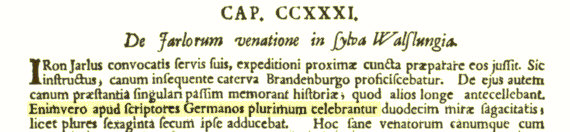
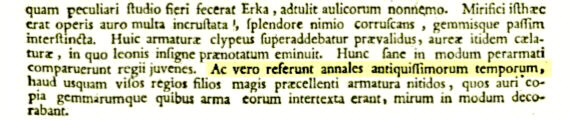
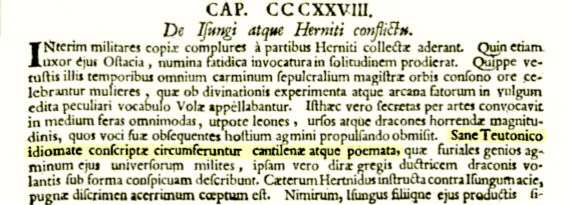
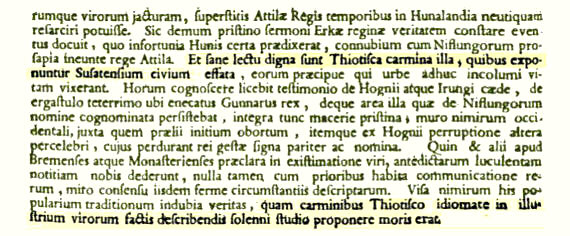
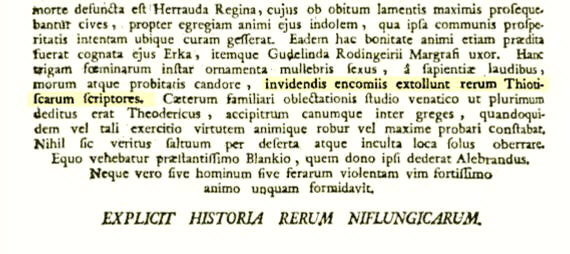
Clips
from the Latin version
provided with the Peringskiöld edition of 1715: passages referring
to German sources. Interestingly, the writers of the Old Norse
redactions notice Mænstrborg or Mynstrborg for
Westphalian Münster, recorded as one location of contemporary
witnesses, whereas the Latin scribe places at that very passage (2nd
clip from below) Monasterienses. This spelling
appears in mediaeval
German records on the civitates of Münster. Its locality is
based on the former Mimigernaford,
archaeologically estimated as a 6th-century settlement.
|
2 H.
Ritter detected the real topographical and
geographical accuracy (up to nearly 99% of all key-words)
of the Thidrekssaga manuscripts that subsequently seemed to
have
changed from a legend to a historia or chronicle.
Thereupon, finally aged 92, he recommended to draw
conclusions from the entire context of these
texts.
|
|
|
3
|
The small
cutting from Kurt Stade’s comprehensive Roman map of
Germanic territory has been published in various editions of
educational German history maps. Today’s current names of
former Roman locations are printed in blue, Roman routes in
red.
|
|
|
4
All source references ‘Mb’ are based on the Thidrekssaga’s
partition by Carl R. Unger. His re-organized chapter system includes
the Icelandic manuscripts and has been preferred by several modern
philologists and text translators. See a corresponding allocation table
for
H. Bertelsen’s transcriptions (1905–11) at A3.11
(redirected to the document).
|
| |
|
Typical ‘r’-endings of
names of
persons, as provided by the Old Norse manuscripts, may be frequently
suspended by the author.
|
| |
|
Regarding quotations from the manuscripts or their transcriptions, the
author equates ‘Old Norwegian + Old Icelandic’
with
‘Old
Norse’.
|
| |
All distances given in miles and kilometers are related to the linear
distance.
|
|
|
5
William J. Pfaff, The
Geographical and Ethnic Names in the
Þíðriks Saga, ’S-Gravenhage 1959, pgs 35–39.
|
| |
|
Pfaff concludes on Bertanga land
that
|
| |
|
the
form in Þíðriks saga is
probably influenced by
both Old French Bretaingne (Bertange)
and Bardengau (the name of an area along the lower
Elbe). The problems presented by this name can be adequately discussed
only in reference to the specific contexts in which it appears.
|
| |
|
|
|
|
6 i.
Nevertheless, we should not ignore the Studies in Heroic Legend
and in Current Speech
(1959) by Kemp Malone who argues decisively against modern
scholarship’s rash inscription
of Theoderic the Ostrogoth onto the Rök Runestone.
Malone’s discourse, first published in Acta Philologica Scandinavica,
ix (1934), pgs 76–84, casts also new light on northern high mediaeval Dietrich
von Bern
notions and their scholarly fixations. Malone quotes the inscription
and a translation based on Otto v. Friesen (Rökstenen,
1920) and Hugo Pipping (Rökstensinskriften, en rättsurkund,
1932) as follows:
|
| |
|
þat
sakum ąnart, huaR fur niu altum ąn
urþi fiaru miR Hraiþkutum auk tumi iR ąn ub
sakaR:
|
| |
|
raiþ
Þiaurikr hin þurmuþi, stiliR flutna,
strąntu
HraiþmaraR; sitiR nu karuR ą kuta sinum,
skialti ub fatlaþR, skati Marika.
|
| |
|
That I
say second, who nine generations ago
landed on the shore among the Hreiðgoths and he is spoken of
in a poem:
|
| |
|
Þiaurikr
the bold, the sea-king, rode (or ruled) on the strand
of the Hreiðmarr; now he sits ready on his horse,
his shield slung about him, the chieftain of the Mærings
|
| |
|
Malone
combines by means of acknowledged history that
|
| |
|
in
or about A.D.
520, the Gautish king Chochilaicus (Gregory of Tours) or Hygelac (Beowulf)
made a piratical inroad upon the Frankish kingdom, then ruled by
Theoderic, eldest son of Clovis. The forces of Theoderic, however (led
by the king’s son), inflicted a crushing defeat upon the Gauts, Hygelac
himself losing his life in the battle. The fall of King Hygelac was
still remembered in thirteenth-century Scandinavia, and the story of
his death is told by Snorri in the Ynglingasaga, where he
appears (cap. 22) as King of Sweden, while Saxo in Book IV of the
Gesta
Danorum gives him a Danish kingdom, in Book VI an Irish one. The
difficulty about his proper kingdom was occasioned, of course, by the
disappearance of the Gauts as a separate nation. But at the time when
the Rök inscription was made the old Gautish kingdom was doubtless
still remembered (among the Gauts at any rate), and we may with
confidence presume that the ninth-century Gautish runemaster of
Rök knew Hygelac (Hugleikr) as an ancient king of Gautland. If now
we look at Snorri’s account, we find that Hugleikr’s death is localized
not abroad but at home: the king is said to have fallen in battle with
Haki, a sea-king who invaded the country and usurped the throne.(…)
One may conjecture that the Rök inscription gives
us a stage intermediate between the historical course of events
(related by Gregory and the Beowulf poet) and the late
tradition recorded by Snorri: the opponent of Hugleikr still bears
his historical name, but he has been changed into a sea-king (i.e. an
exile) and his victory over Hugleikr has in consequence been
transferred from Frankish to Gaulish soil.
(Op. cit. 1959, pgs 117–118.)
|
| |
|
William
J. Pfaff remarks on Hraiþkutum = Reiðgotaland
in his book The
Geographical and Ethnic Names
in the Þíðriks Saga, 1959, p. 99:
|
| |
|
Húna-land
and
Sax-land (as in the Þetleifr sequence in
Þíðriks saga […] ) are
both placed
in northern Germany by implication:
‘Er þat sagt, at Reiðgotaland ok
Húnaland sé nú Þýðskaland
kallat’, the redactor comments ( […] cf.
Schneider, III, 96f;
de Vries, I, 36-38, 47f.)
__________________
(Hermann Schneider, Germanische
Heldensage III,
Berlin 1934; Jan de Vries, Altnordische Literaturgeschichte
I, Berlin 1941.)
|
| |
|
Contemplating
the potential geohistoriographical side of this context, the
‘raid-gauts’ of Hugleikr seem to have had tribesmen already
settling as Reiðgoths on a certain part of Frisian
coastland stretching out to the region of Groningen.
|
| |
|
As
regards the hero’s horse remembered by the Rök
inscription, allusively the equestrian statue of the Italian Theoderic,
then at the court (more precisely by Walafridus Strabo: apparently the
court’s bath area) of Charlemagne, Malone detects rather a Frankish but
not decisive Ostrogothic
environment of cognition and transmission:
|
| |
|
Presumably
the poet whom the runemaster is quoting had visited Aachen and,
naturally enough, had taken for a statue of Theoderic the Frank the
Theodoric statue which he saw in the Frankish capital. Moreover, if we
accept A.D. 835 as the approximate date of the inscription (cf.
Pipping, p. 109), and reckon back for nine generations as the
runemaster bids us, allotting to each generation 35 years (i.e. half
the traditional
life-span), we arrive at A.D. 520 as the date of Þiaurikr’s
attack upon the Gauts. Now it was about the year 520, as we have seen,
that the army of Theodoric the Frank attacked and destroyed the forces
of the Gauts.(…) It is noteworthy, besides, that the
historical records tell us of no other Theodoric who had dealings with
the Gauts. The obvious connexion for Þiaurikr, then, would seem
to be Theodoric the Frank, not
Theodoric the Ostrogoth nor yet the hypothetical Samlandish Theodoric of
(Rem: the 20th-century author Otto) v.
Friesen. (Op. cit. 1959, pgs 118–119.)
|
| |
|
Now
turning to ‘Theoderic’s time and place of misfortune’, Malone regards
receptions of the Mærings =
Marika
(the former mentioned in
the OE. poem Deor) as being transferred to the North Italian or
the
Istrian Meran by Upper German poetry (cf. Dietrichs Flucht,
König Rother, Kaiserchronik). He collocates these epics
aside the twelfth- or thirteen-century Regensburgian gloss ‘Gothi
Meranare’ plus
the notoriously quoted and widely uncritically interpreted prologue
provided with Notker’s Boethius:
|
| |
|
Odoagrum
Turcilingorum et Rugorum regem, qui et Herulos et Scyros secum habuit,
Romans et Italiam sibi subiugasse. Theodericum vero, regem Mergothorum
et Ostrogothorum, Pannoniam et Macedoniam occupasse.
|
| |
|
As a
matter of more historical priority, however, Malone contextually
discerns rather Theuderic’s campaign against the Visigoths in 507–508,
arguing (op. cit. 1959, p. 122)
|
| |
|
that
when Theodoric became an exile-and-return hero, the scene [sic! –
for further studies: reason]
of his exile was laid in Visigothic territory.
When in due course the Oberdeutschen learned the tale, they made it
their own by connecting the name Mæring
with the geographical term Meran, which occurs (1) as a
place-name: the Meran of the Tyrol, and (2) as a regional name, in the
sense ‘Illyria’, or, more narrowly, ‘Istria’. In other words, the
traditional name succumbed to a popular etymology. Since the Tyrolese
Meran, in the early Middle Ages, was a place out-of-the-way and
unimportant enough to serve admirably as a place of exile, it is not
unreasonable to conjecture that here we have the spot to which
Theodoric’s burg was shifted from the equally humble situation which it
had to start with. (Affixed footnote 14: The term
Mæringas,
as the Deor poet uses it, must obviously be taken in a
disparaging sense, while the burg which Ðeodric is
represented as owning (and occupying) was just as obviously thought of
as an out-of-the-way place of no importance. For the contemptuous
attitude of the Franks toward the Visigoths, see F. Jostes,
Sonnenwende
I (1926)
32.)
|
| |
|
Malone
seems to emend this special approach with an etymological explanation
which, if replaced with
an area somewhat east of early Frankish kingdom or the contents of the
Thidrekssaga, complies well with modern research by Ritter
and other analysts who have been connecting Dietrich’s place of
exile with a bordering folk right next to
the early 6th-century kingdom of the Franks.
|
| |
|
Malone
resumes on Mærings
or Mæringas (op. cit. 1959, p. 123):
|
| |
|
I
connect this name with NE mearing ‘boundary’ (cf. R. E.
Zachrisson, Studia Neophilologica VI 30), and take it to mean
‘borderers’ (…) The vocalism of the base agrees beautifully
with my etymology: the original ai is reflected in the
High German e (a Frankish loan), the English æ,
(i- umlaut of a) and the a of the Rök poet
(taken from the Frisians).
|
| |
|
Malone
did not mainly consider the Thidrekssaga for his discourse
which, however, does not appear disadvantageous to our context. He
suggests that the
‘sea-battle’, if at all most relevant for the
Frankish
retaliation, fought by Theuderic’s son, is in conjunction with the
king’s exile, and, as regards its ‘southern conception’, he rather
pleads for a
basic literary motif taken from the original Frankish Dietrich
von Bern (op. cit. 1959, p. 123):
|
| |
|
The
conception of him as a sea-king reflects, of course, the legendary
exile, tidings of which had evidently made their way to Scandinavia,
and this motif would be equally applicable to Wolfdietrich and to
Dietrich von Bern. The lordship of the Mærings, however,
belongs
properly to Wolfdietrich and, in spite of the Boethius prologuist, has
no place in the story of Dietrich von Bern. Þiaurikr, therefore,
is to be identified with Theodoric the Frank. His fame in Gautland
rested solidly on his great victory over the Gauts, and it is this
victory which the Gautish runemaster had in mind. He put the reference,
however, in terms of the new conception of Theodoric as an exile, a
conception imported from the south.
|
|
6
ii. Simrock, Malone an other analysts naturally could proceed
on the assumption that either Gregory or the Thidrekssaga or both
sources combine different genealogical
perception with the Franco-Rhenish protagonist. In
contrast to the Thidrekssaga that allows to detect its
definite geographical limitation, the Wolfdietrich
represents an example that fades over its obvious Frankish
based characters to the large area being connected
with the appearances of ‘Theoderic the Great’.
|
|
|
7 Cf. Old
Nordic ‘sámr’ = blackish, dark, dark grey. Although it may seem
not uncomplicated to identify Samson with Childeric I a prima vista, a
real named ‘Samson’ was son of Chilperic I, king of Soissons, and
Fredegund. Thus, we may wonder if their early died son should remember
a merited nicknamed ancestor of the early Merovings.
|
| |
|
Scholarly research into source material about Childeric I has
been producing controversial or at least divergent
redrawings of his remarkable fragmentary vita.
The sources about Childerich report only the last 18 or 19 years of his
life.
Thus, we cannot exclude his important
influence on the former Germania inferior –
on anti-Roman consolidations and final Franco-Rhenish
conquests.
|
| |
|
Referring to Childeric’s sexual profligacy, Gregory of Tours colports a
king called Bisinus as contemporary Thuringian king. As
noted well in scholarly discussions, this constellation appears
less authentic. Did Gregory rather mean the king of Tongres? A
corresponding emendation was already provided by a scribe
(copyist) of Gregory’s work, cf. Ian N. Wood 1994. Not less
interesting: Eugippius who equates the Thuringians
with Toringi [Commemoratorium 27,2 &
31,4],
cf. G. Scheibelreiter 2009. Gregory’s uncertain
genealogical horizon of 5th
century does also question the real dynastical identity of Clovis'
mother!
|
| |
|
Besides, the Blómstrvalla saga remembers some chapter
of Thidrekssaga when forwarding accounts related to the
heroes from the bloodline of Samson’s first son Duke Aki. The Samson
saga fagra, especially its first part, is based
on chivalrous French epics on Samson by Lancelot patterns,
while the Karlamagnús saga as well as Vilhjalms saga
mention ‘Samson’ rather shortly. Although Henry Goddard Leach regards
the Samson saga fagra originated in 13th
century, its
compilation seems to meet rather 14th-century
sagas, as Rudolf Simek
estimates. Nonetheless, this saga should not be left out for a glance
at Samson’s action space. Its last
chapter tries to give an historiographical outlook peculiarly
dominated by events in Westphalian and other Low German lands
(cf. ‘Vestfal’) exaggeratedly ascribed to Samson’s conquests: Valltari,
recited as a son of Samson, received from his father a Westphalian
realm, married ‘Gertrud’, daughter of a Duke of Brunswick
‘Brunsuik’, and finally became Duke of Holstein ‘Hollzsetu
landi’.
|
| |
|
There is a Salian ‘Salernian’ location called Samson,
as this Wallonian village can be found approximately
6 mi. (c. 10 km) east of Namur, Belgium. Its ruined Roman fort,
partially
restored to a castle with a surviving impressing limestone wall on the
rocks ‘Les rochers de plus de 80 mètres avec une formidable
muraille de calcaire’, is surrounded by Germanic
war graves of 2nd half of 4th
century.
|
| |
|
The scribe of the Icelandic
redaction MS A provides in Mb 3 a Salernis
borg, apparently conceived and forwarded as an urban location in
translatory contexts.
|
| |
|
Sauvenière
is today’s name of a location in a
region that covers the Wallonian place Samson.
Considering a potential relevance of
contemporary Sauvenière, a former Roman estate of 2nd
century has been proved on its Plateau d’Arlansart
at the highest spring of Orneau river. This place is mentioned
as «Salvenerias villa» in a copied deed certification of
Emperor Otto the Great, issued on September 20, 946. The Salernitana
urbis, as mentioned in the Latin script provided by
Peringskiöld,
might represent nothing more or less than a temporary place of
residence on Salian territory.
|
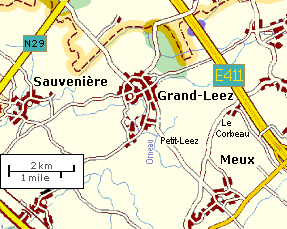
|
Ernst F. Jung, German
historian of Roman Era and Late Antiquity,
additionally remarks a sword-class with chape ferrules specified as „Samson-Typ”
which classifies
weapon foundlings of Childeric’s time in that
region of Namur, where Sambre river meets the Meuse. As regards this
sword type, Jung refers in his book Der Nibelungen Zug durchs
Bergische Land, Haider-Verlag,
Bergisch Gladbach 1987, to Wilfried Menghin who
notes in his book Kelten, Römer und Germanen,
Prestel-Verlag, Munich 1980, the corresponding
catalogue No. 16/17 of Time Group A, ‘the same to which the
Nordic Snartemo sword has been classified’.
[back
to ‘Samson’ (Preliminary Filiations)]
|
|
|
8 The
scribe of Mb 246 locates the Valslǫngu skógr at a
certain western border of Franka riki, cf. German
Thidrekssaga translation by F. H. von der Hagen. Ritter
identifies this forest as or in the Westerwald, a
woodland which,
as the MSS imply, belongs to the claim or
property
of this Salomon. This localization seems plausible if the
Franks had already taken
their first new lands on the Lower Lahn and Main
river (‘Frank-furt’).
|
| |
|
From second quarter to the middle of 6th
century, the Franks
invaded Thuringia on a Mid-German territory extending from the
upper Main to the upper Weser and the Elbe. Following Ritter’s
localization, the
mediaeval writer refers to an area known today as
‘(Unter-)Franken’ with regional inhabitants who are still called
‘Mainfranken’. The scribe of Mb 250 incidentally remarks that King Salomon
attended a colloquium of tribal leaders at King Ermenrik’s Roma
secunda. Ritter dated this
event at the end of 5th century. In so far
this Salomon, a palpable
nickname for a mighty Frankish chief seemingly related by a
sophisticated clerical author, appears connected with the first (or an
early) Frankish conqueror and new ruler of lower and mid Main regions.
The ford (‘furt’) of Main river on an obvious outstanding former
location related to the Franks – today the metropolis of a large
area – was an
important strategic passage presumably after the withdrawal of the
Romans and certainly after Migration Period.
|
| |
|
Thus, according to Ritter’s geographical interpretation, the position
of the Valslǫngu skógr – on this account in the
northwest of
Salomon’s realm extenting to the lower Lahn and the Rhine – appears
south of the adjacent Ungara skógr, conclusively the
region of Engers (the former Engersgau) on the Middle Rhine.
|
| |
|
Therefore, we
should not
ignore the geopolitical message of the expanding Franks provided
with the story of Apollonius and
King Salomon’s daughter Herborg. With
respect to the
primary receptional motifs of this episode, elder scholarship made some
interesting proposals. For instance, Fine Erichsen (op. cit. p. 36)
regards
the
MHG strophic epics Salman und Morolf as a possible
source. Accordingly, she imagines the original
love potion of the Celtic Isold transformed into a ring of
the same strong appeal, although the afore named tradition
may offer the motif of disguise performance to get an access to the
king’s court. Nonetheless, Notker
Labeo ‘Teutonicus’, eminent scholar at St. Gall monastery, made
known a grotesque part of Salomon dialogue tradition in
10th/11th
century. The
different Old English versions dealing with Solomon and Saturn
are estimated of nearly the same age.
|
| |
|
Regarding the prototype of Salomon
in the
Old Norse + Swedish texts, Richard Huß recognizes Duke Salomon of
Brittany, who ruled this land from 857 to 874 and was
venerated there after his death even as a saint and martyr; cf. Das
Landschaftliche und Ungarn in der
Thidrekssaga und die Entstehungsfrage von Nibelungenlied und Klage,
ZfdPh 57 (1932) pgs 105–140. Ritter remarks that the whole story of Apollonius
and
King Salomon’s daughter Herborg is rather later
minstrel
poetry with a geography that, generally, doesn’t seem to be clearly
clarified: Die ganze Erzählung ist aber
spätere Spielmannsdichtung und wohl überhaupt geografisch
nicht klar einzuordnen; see Die
Thidrekssaga. (Reprint of its translation by F. H. von der
Hagen, O. Reichl, St. Goar 1989, p. 765.) Thus, we may infer that the
author of this episode was apparently familiar with history and
traditions between Low Germany and the English Channel. Regarding the
narrative localizations in obvious Rhinelandish regions, it seems worth
mentioning that
Pfaff (op. cit. 1959 pgs 202–203) has already
considered the equation of Hungary with a German Engern
and suggested Apollonius' seat Tira
somewhere between the Moselle and the Rhine:
|
| |
|
If
Holthausen’s suggestion (478) that
Valsloengu-skógr refers to the Vosges is correct, then,
using Huss’s equation Hun = Engern = Ungarn again, the wooded
area south of the
Moselle known as Hunsrück might come in question (for the
common second element, meaning ‘forest’, see WFON, 146 under Reke).
The narrative
context suggests that these forests are nearer to Tira (‘near
the Rhine’) than to Iron’s home (II, 125-126, 134, 141). Perhaps
pertinent
in reference to the north-south directional terms used when
Þíðriks saga speaks of the forests is the ON
formula ‘south of the Rhine’ where we
would say “west of the Rhine” (cf. Völsunga saga, chapter
XXV; Eddaic Brot. 5b).
|
| |
|
Still
to be noted is Thier, which is located only two miles (c. 3 km)
south of
the Dhünn’s spring, the river that the Þíðriks
saga calls Duna. This village was mentioned as Tyre
in the 15th century. Farther north of this
location flows
the Anger (Angerbach), mentioned as Angero in
875. Place names especially along its lower course are based on its
name. Admittedly, it seems extremely unlikely that an Old Norse author
could have associated this Lower Rhenish region with the Engersgau
on the Middle Rhine, cf. Thür on the opposite bank in the
Rhineland-Palatinate.
|
| |
|
Furthermore,
considering interliterary reception, we
should not disregard that Geoffrey Ashe and Léon Fleuriot
identified King Arthur as the Britannic-Breton rex Riothamus,
who,
according to Jordanes' Getica
(XLV,237-238), was defeated by Euric about 470 and fled to the
Burgundians. According to this escape motive, the scribe of the
Thidrekssaga might have presupposed two sons of Arthur
who still migrated
to the Rhine (West Saxony). Thus, Isung in Mb 245 would be the
personified allusion to the Wisigoths (‘Wisung’ → ‘Isung’), and the
above mentioned Salomon of Brittany, as provided by the Annales
Bertiniani, might appear as
further narrative placeholder.
|
| |
The
Old Swedish manuscripts do not provide the story of Apollonius,
Iron,
Salomon and his daughter Herborg.
|
|
|
9
We may regard shortly in
this connection the dialogue between Grimhild and an isolated shown
Thidrek (Mb 376, Sv 319).
Not less interesting appears the Guðrúnarkviða
III (in þriðja),
where Guðrún exaggerates into worst situation of
‘Þioðrek’
and his champions at Atli’s court. The previous Guðrúnarkviða
II (in
ǫnnur), 25, appears of geographical importance, since
Guðrún’s
mother ‘Grimhild’ claims herself
being authorized to dispose (a part of) Hlǫðvér’s
sali = Clovis'
kingdom. Both the Guðrúnarkviða
I (fyrsta) and Oddrúnargrátr
allow to detect the territory of ‘Húnaland’ not far from Denmark.
|
| |
|
The
Vǫlsunga saga recounts that Brynhild titles Gunnar’s
brother-in-law as thrall of King Hjalprek whom literary
research has
been identifying or partially comparing with Clovis'
father Childeric.
Furthermore, as brought
out by this Nordic cycle of tradition,
an obvious mighty ruler called Hjalprek put Regin,
intertextually corresponding with Mime the Smith
to a certain extent, in charge of raising up Sigurðr sveinn.
It seems less important to annotate that the aforementioned
interfigural ruler may not be confused with a riddari
Hialprek known as a good kinsman of Thidrek, see Mb 321.
Likewise, the greive or jarl
Loðvigur (–Hlodver), see Mb 107 and Mb
403, may not
be confused with an equally named ruler of a kingdom.
|
| |
These examples,
basically belonging to an Elder Edda
source content, seem to reflect rather the original Frankish than the
late 5th- or early 6th-century
Burgundian
milieu of Þioðrek
and the Niflungs.
|
|
| 10 i. Reinhard
Wenskus
provides these arguments on the geographical appearance of Hlǫðr
in Nordic tradition (Der ‘hunnische’
Siegfried… pgs 717–719): |
| |
c) Hliþe:
in der Hervararsaga Hlǫðr. Auch
hier führt die Gleichsetzung zu lautlichen Schwierigkeiten.
Dennoch wird sie nicht im Ernst in Frage gestellt.209
Seit einem
Jahrhundert wird Hliþe
auch mit Lotherus, dem Sohn
des Humblus, des Saxo
Grammaticus identifiziert. Es ist merkwürdig, daß man nicht
auf die näher liegende Vermutung kam, daß hier der mythische
Ahn der Frankenkönige, Chlodio,
dem auch ein historischer König des 5. Jahrhunderts nachbenannt
wurde, vorzuziehen wäre. Das würde jedoch bedeuten, daß
das Húnaland,
über das Humli, wie der
Großvater des Hlǫðr
im Hunnenschlachtlied heißt, die Herrschaft ausübt, schon
lange vor der Thidrekssaga als "Hunnenland" verstanden worden wäre
und dieses Mißverständnis bereits in Gregors Vorstellung von
der Herkunft der Franken aus Pannonien vorausgesetzt werden sollte.
Das würde für die Entstehungsgeschichte des
Hunnenschlachtliedes bedeuten, daß über die bereits
bekannten Verlagerungen der Schauplätze hinaus, wie sie von H.
Humbach dargestellt wurden,210 noch ein
Ereignishorizont im
altfränkischen Bereich eingeschoben werden müßte. Dies
wird auch durch weitere Hinweise gestützt. Schon Humbach ist es
aufgefallen, daß im Hunnenschlachtlied die Himmelsrichtung, in
der das Land der Hunnen liegen soll, wechselt.211
Beim
Angriff auf die gotische Grenzburg kommen die Hunnen von Süden –
wie dies beim Kampf der Attila-Erben gegen die Goten in Pannonien ja
auch angenommen wird. Aber Hlǫðr
reitet von Osten her (Hlǫðr
reið austan) gegen Arheim, den Königssitz des Angantyr.
Dieses Árheimar bereitet schon
lange Kopfzerbrechen. Ch. Tolkien sieht es als Ableitung aus
ár-dagar
‘days of old’ =
"the ancient abode" für einen gotischen Königshof in
Südosteuropa, dessen eigentlicher Name vergessen war,212
während Humbach es in den nordischen Ereignishorizont verlagert
und an das dänische Aarhus denkt.213 Es
bietet sich aus
unserer Sicht aber eher das niederländische Arnheim an, dessen
Name in den Dialekten, die -n-lose Formen für die Bezeichnung des
Adlers kennen (ahd. aro, got. ara, anord. ari),
gerade im Norden eben Árheimar heißen
konnte. Wenn man an das westfälische Húnaland im
Osten bzw. im
Südosten davon denkt, ist die erwähnte neue Richtungsangabe
eher verständlich. Vielleicht bildete aber auch das in einem
Überlieferungsstrang als größere Raumeinheit gedachte
Árheimar/Arnheim eine wichtige Station beim
Vordringen der
Franken in das linksrheinische Gebiet. Schließlich ist sowohl der
Name Humlis wie der seiner
Tochter Sifka genau wie Hlǫðr als hunnischer Name
nur
verständlich, wenn man eine an sich sehr gut mögliche
volksetymologische Umdeutung annimmt. Im Gegensatz zur Darstellung des
Hunnenschlachtliedes wird der Name Humli
mit dem in der Amalerstammtafel bei Jordanes Getica 79 genannten
Hulmul
verglichen,214 der aber eben auch kein Hunne,
sondern ein
Sohn des Heros eponymos Gapt/Gaut
und damit Gote ist. K. Malone, der mit anderen die Lesart ‘Humal’
vorzieht, hat erwogen, ob Humli nur
"by virtue of the
phonetic pattern of his name" zum Hunnen geworden ist,215
was allein schon deshalb eine gewisse Wahrscheinlichkeit hat, weil die
Hun-Namen unserer Traditionsgemeinschaft vielfach Nebenformen mit -m-
aufweisen (so neben Hunfrid
auch Humfrid). Zieht man es
jedoch vor, den Namen Humli
mit der Bezeichnung der Hummel (anord. Humla), die auch
für andere
Bienenarten gebraucht wird, zu verbinden,216
dann fällt
einem sofort die Bienensymbolik des Childerichgrabes ein, ohne
daß wir dies hier weiter ausspinnen wollen. Es kann ja auch die
Bezeichnung für den Hopfen (anord. humla) dahinter stehen,
was jedoch
weniger wahrscheinlich ist.217
__________________ |
| |
209
K. MALONE (wie Anm. 206), S.
170 ff.
[206:
…
Widsith
(1962)…]
210 H. HUMBACH, Die
geografischen Namen des
altisländischen
Hunnenschlachtliedes, in: Germania 47 (1969) S. 145–162.
211 H. HUMBACH (wie Anm. 210) S. 151.
212 Ch. TOLKIEN, The Battle of the Goths and the
Huns, in:
Saga-Book of
the Viking Society 14 (1953/54) S. 158.
213 H. HUMBACH, (wie Anm. 210) S. 150 Anm. 20.
214 H. HUMBACH, (wie Anm. 210) S. 146 Anm. 7;
vgl. auch H.
WOLFRAM, Die
Goten (3. Aufl. 1990) S. 370: Hulmul-Humli
(sic!) ("Vater der Dänen") – wohl nach Saxos Konstruktion.
215 K. MALONE (wie Anm. 206), S. 171.
216 Vgl. etwa H. WOLFRAM, Geschichte der Goten
(1. Aufl.
1979)
Stammtafel a, Ende: Hulmul-Humli
"Hummelsommer".
217 Vgl. aber M. GYSSELING (wie Anm. 15) I S.
524 zu Humluncamp (Gem. St. George, arr.
Arras), der es als "Hopfenkamp" versteht.
[15:
…
Toponymisch
Woordenboek von
Belgie, Nederland, Luxemburg, Noord-Frankrijk en West-Duitsland
(vóór 1226) (1960)…]
|
| |
|
[Transl.:
c) Hliþe but in the Hervarar saga Hloðr.
Here, too, the
equation results in phonetic difficulties. Nevertheless, this is
not seriously questioned.209 Hliþe
has also been
identified with Lotherus, the son of Humblus by Saxo
Grammaticus, since a century. It is out of the ordinary that we did not
come to the more obvious assumption that the mythical ancestor of the
Frankish kings, Chlodio, serving for the naming of an
historical 5th-century king, seems
preferable. This would mean, however, that
the Húnaland, ruled by Humli, grandfather of Hloðr
in the Old Nordic Battle of the Goths and Huns,
could have been known as "Hun-land" long before
the
existence of the Thidrekssaga and
hence this misunderstanding should be premised already for Gregory’s
conception of the origin of the Franks in Pannonia.
Regarding the historical origin of the Battle of the
Goths and Huns in so far, an horizon of event has to be inserted in
the Old Frankish area
which goes beyond the known translocations of the battlefields, see the
presentation by H. Humbach.210 This is also
supported by further
clues. Humbach has already encountered that the cardinal point, at
which the land of the Huns is positioned, changes in the Battle of
the Goths and Huns.211 When the Huns
attack the Gothic border
fortification, they come from the south – as this is also assumed in
the battle of the Attila’s heirs against the Goths in Pannonia. But Hloðr
rides from the east (Hloðr reið austan)
against Arheim, the seat of King Angantyr. This Árheimar
causes quite a headache for a long time. Ch. Tolkien sees it as a
derivation from ár-dagar ‘days of old’ =
"the ancient abode"
for a Gothic court in Southeast Europe, whose real name was
forgotten,212 whereas Humbach shifts this
kingly seat into the northern horizon of event and thinks of the Danish
Aarhus.213 From our point of view, though,
the Dutch Arnhem could be called
Árheimar, whose name is known from the dialects as the name of
the eagle (Old High German aro, Gothic Ara, Old Nordic ari).
If we think of the Westphalian Húnaland
in the east or southeast, the new direction as
being mentioned is fairly understandable. The Árheimar/Arnheim,
conceived as a larger
unit of space in certain narrative context, presumably formed an
important stage in the advance of the Franks into the region left of
the Rhine. After all, the name Humli as well as that of his
daughter Sifka, just like that one of Hloðr, can be
clearly
understood as a Hunnic name if we assume an ethnic based
etymological re-interpretation. In contrast to the introduction by the Battle
of the
Goths and Huns, the name Humli is compared with the Hulmul
who is mentioned in the tribal chart of the Amals in Jordanes'
Getica
(79),214 who, however, is not a Hun
but a son of the hero eponymic Gapt/Gaut and thus a Goth.
Kemp Malone, who prefers ‘Humal‘
with others, has contemplated whether Humli became a Hun by
"virtue of
the phonetic pattern of his name",215 which
has a certain unique probability because the ‘Hun’ based names in the
community of traditions
often have secondary forms with -m- (such as Hunfrid, also Humfrid).
But if we prefer to combine the name of Humli with the name of
the ‘Hummel‘ bumble bee (Old Nordic Humla),216
also used for other species of bees, the ‘Beekeeper’s Symbolism’ [(quot.
rem.:) one of various interpretations] of
Childeric’s grave will be immediately apparent to us. We can also think
of hop (Old Nordic Humla) which, however, seems less likely.217 ]
__________________
|
| |
209
K. MALONE (op. cit. ann. 206), p.
170ff.
[206:
…
Widsith
(1962)…]
210 H. HUMBACH, Die
geografischen Namen des
altisländischen
Hunnenschlachtliedes, in: Germania 47 (1969) pgs 145–162.
211 H. HUMBACH (op. cit. ann. 210) p. 151.
212 Ch. TOLKIEN, The Battle of the Goths and the
Huns, in:
Saga-Book of
the Viking Society 14 (1953/54) p. 158.
213 H. HUMBACH, (op. cit. ann. 210) p. 150 ann.
20.
214 H. HUMBACH, (op. cit. ann. 210) p. 146 ann.
7; see also H.
WOLFRAM, Die
Goten (3. ed. 1990) p. 370: Hulmul-Humli
(sic!) ("Vater der Dänen") – likely following Saxo’s construction.
215 K. MALONE (op. cit. ann. 206) p. 171.
216 Cf. e.g. H. WOLFRAM, Geschichte der Goten
(1. ed. 1979) chart a (see end): Hulmul-Humli
"Hummelsommer".
217 But cf. M. GYSSELING (op. cit. ann. 15) I p.
524 as Humluncamp (Municipality of Saint-Georges,
L’arrondissement d’Arras), who understands it as "Hopfenkamp".
[15:
…
Toponymisch
Woordenboek von
Belgie, Nederland, Luxemburg, Noord-Frankrijk en West-Duitsland
(vóór 1226) (1960)…]
|
| |
|
10 ii.
Reinhard Wenskus has centered the cultural and geographical side of
early Merovingian history on its literary protogonist Chlodio with
these arguments:
|
| |
E.
Zöllner hat auf die Tatsache hingewiesen, daß
die aus einer Reihe von Inschriften in Niedergermanien (Birten bei
Xanten, Holtedorn bei Nymwegen, Monterberg bei Kalkar, Iversheim bei
Münstereifel) und Friesland (Beetgum bei Leeuwarden) bekannte
Göttin Hludana in ihrem Namen, der von Jan de Vries als ‚die
Ruhmvolle’ gedeutet wird 35, die
gleiche Stammsilbe aufweist wie
Chlodio. Doch hält er es für „unsicher, ob daraus
Schlüsse auf einen Hludanakult der
Franken gezogen werden dürfen” 36.
Es gibt jedoch einige Tatsachen, die diese Vermutung
stützen.
In Süd-Limburg, d. h. in einem Raum, der zu dem Bereich
gehört,
in dem die merowingische Reihengräberkultur entstand 37,
liegt Lanaken (Lodenaken 1106/11, Luthenachen
1141/57, das bis
1106/11
Krongut war38 ), dessen Name als
*Hludiniacas verstanden wird 39,
wobei
die Endung
auf eine frühmerowingische Namenschicht weist. Der Name
läßt
freilich nicht erkennen, ob hier die mythische Gestalt – also Hludana –
oder ein Frankenkönig gemeint ist, da seine Bedeutung
(„toebehorend
aan Hludo”) beides zuläßt.
________________________
| 35 |
JAN DE VRIES ‹
Altgermanische Religionsgeschichte: › II,
S. 322. Schon hier sei darauf hingewiesen,
daß auch der Name
der Pasiphae, der Gemahlin des Minos, die mit dem von Poseidon
gesandten
Meeresstier den Minotaurus zeugt, als Tochter des Helios ‚die
Allscheinende’
gedeutet wird. |
| 36 |
ERICH ZÖLLNER, Geschichte
der Franken
bis zur
Mitte des 6. Jahrhunderts, München 1970, S. 180. Zum Sprachlichen
vgl. PIERGUISEPPE SCARDIGLI, Sprache im Umkreis der
Matroneninschriften,
in: Germanische Rest- und Trümmersprachen, hg. von HEINRICH BECK
(Ergänzungsbände
zum Reallexikon der germanischen Altertumskunde, hg. von HEINRICH BECK
u.a. 3) Berlin – New York 1989, S. 146f. |
| 37 |
HORST WOLFGANG BÖHME, Die
Eingliederung des spätrömischen
Nordgalliens ins Frankenreich, in: 9. Kongreß der Union
internationale
des Sciences Pré- et Protohistoriques, Nice 1976, S. 71–87. |
| 38 |
GUIDO ROTTHOFF, Studien zur
Geschichte des
Reichsguts
in Niederlothringen und Friesland während der
sächsisch-salischen
Kaiserzeit (Rheinisches Archiv 44) Bonn 1953, S. 97f. |
| 39 |
MAURITS GYSSELING, Typonymisch
woordenboek
van België,
Nederland, Luxemburg, Noord-Frankrijk en West-Duitsland (voor 1226) I
(Bouwstoffen
en Studiën voor de geschiedenis en de lexicografie van het
Nederlands
6) Brussel 1960, S. 590. – Die Möglichkeit, den Namen in
zweifacher
Weise zu deuten, ergibt sich auch aus der Tatsache, daß in der
Gemarkung
von Lanaken ein Doesberg (in monte Dusenberg 1145; in monte Dulceberg –
lies Dusceberg – 1146) zu finden ist; vgl. ebd. S. 275; dies erlaubt
uns
die Annahme, daß es sich um das Dispargum castrum des
Gregor
von Tours (Hist. II,9) handelt, in dem Chlogio/Chlodio habitabat.
Diese Annahme ist jedenfalls wesentlich begründeter als die
Gleichsetzung
mit Duisburg südöstlich Brüssel, die noch ZÖLLNER
(wie
Anm. 36) S. 27f., mit Schmidt, Gilissen, Roosens u.a. als die
wahrscheinlichste
gilt (weitere Lit. bei HEINRICH TIEFENBACH, in: Reallex. d. germ.
Altertumsk. 21984, S.
497f.).
Jenes liegt in
einem
Ausbaugebiet und bereits im
Bistum Cambrai, d.h. nicht im Raum der Civitas Tungrorum, als das man
das in terminum Thoringorum Gregors doch wohl ansehen
muß, und
von wo aus erst Chlogio seinen Vormarsch auf das Gebiet von Cambrai
plante.
Dazu war Lanaken an der Römerstraße von Nijmegen –Tongern
der
viel bessere Ausgangspunkt.
Andererseits hat GYSSELING den Namen des Ortes
als dūsanda burg bzw. dutsanda burg d.h. ‚duizelige,
duttende,
d.i. sluimerende burg’ (?) gedeutet. Diese Deutung könnte auf eine
,Entrückung’ weisen, die mit gewissen Heilsvorstellungen verbunden
war. Das legen einige sprachliche ‚Überlebsel’ nahe: mnd.
dösich,
ae. dysig ‚betäubt’ (vgl. engl. dizzy ‚schwindlig, verwirrt’; dt.
dösig, dösen) und die mit dt. Dusel (aus nd. dusel
,Betäubung’)
zusammenhängenden Wendungen; wenn einem trotz seines Rausches in
schwieriger
Lage nichts passierte, sagte man: „er hat Dusel gehabt”. Dem
müßte
weiter nachgegangen werden.
Bemerkenswert ist die Verbreitung der damit
gebildeten
Ortsnamen. Außer den schon erwähnten können folgende
herangezogen
werden:
1) Doesburg an der Jjssel im Hamaland (d.h. im
Gebiet
der Chamaven); dort befand sich noch in ottonisch-frühsalischer
Zeit
– wenn auch nur geringes – Königsgut; vgl. GUIDO ROTTHOFF, Studien
zur Geschichte des Reichsguts in Niederlothringen während der
sächsisch-salischen
Kaiserzeit. Das Reichsgut in den heutigen Niederlanden, Belgien,
Luxemburg
und Nordfrankreich, Bonn 1953, S. 83.
2) Duisburg a. Rh. ursprünglich wohl im
Gebiet
der Chattuarier; der Ort war ein wichtiges Reichsgutzentrum.
3) Duisenburg Kr. Lingen/Ems im Gebiet der
Amsivarier.
4) Duisdorf (zu Bonn) war Dingstuhl für
eine
ganze Reihe umliegender Orte; auch Lanaken war mit Petersheim ein
Untergericht
des Vroenhofs Maastricht; vgl. MATTHIAS WERNER, Der Lütticher Raum
in frühkarolingischer Zeit, Göttingen 1980, S. 381, Anm. 64.
Der Befund ist deshalb bemerkenswert, weil
alle im
4. Jahrhundert als Franken bezeichneten Stämme mit je einem
solchen
Ort versehen sind; aber eben auch nur diese und keine anderen. Auch
hier
müssen eingehendere Untersuchungen feststellen, wieweit wir einem
Zufall zum Opfer fielen oder ob sich dahinter mehr verbirgt. Schon die
Lesart Dulceberg (s.o.) legt den Verdacht nahe, daß eine
romanische
Volksetymologie auch andernorts zu einer Umdeutung der Namen ehemaliger
Duisberge geführt hat. Das könnte bei einzelnen der nicht
ganz
seltenen Orte im nordfranzösischen Sprachgebiet, die Douchy-,
Douzy-
u.ä. Bestandteile haben und gewöhnlich als Dulciacum, d.h.
eine
gallorömische Ableitung vom lat. Personennamen Dulcius angesehen
wurden,
immerhin erwogen werden. Ähnliche Vorstellungen mögen auch
hinter
dem Ortsnamen Dutse (Geraardsbergen, Ostflandern, 866 Dulcia, 1213
Duche)
verborgen sein. Möglicherweise ist auch Ucimont in den Ardennen
von
Belgisch Luxemburg mit einer spätrömischen Befestigung so zu
verstehen, da sich 1 ½ km südwestlich davon ein ‚Mont de
Justice’,
also ein Malberg, befindet; vgl. J. E. BOGAERS – C. B. RÜGER
(Hgg.),
Der niedergermanische Limes. Materialien zu seiner Geschichte,
Köln
1974, S. 247. Romanische Umformung des Namens kann auch bei Dusemond
(seit
1925 Brauneberg) bei Veldenz an der Mosel vorliegen, das 575/88 von
Childbert
II. an Verdun geschenkt wurde (vgl. EUGEN EWIG, Trier im
Merowingerreich.
Civitas, Stadt, Bistum, Trier 1954, S. 174 und 244). Sollte jedoch das
zweite Namensglied (-mond) keinen Berg meinen, sondern die Mündung
eines Gewässers, ergeben sich vielfache Beziehungen zu
entsprechenden
Parallelen. So hat TIEFENBACH z.B. den religiösen Zentralort von
Toxandrien
Deuso (= Diessen 20 km westlich Eindhoven),
dessen
Hercules
Deusoniensis
selbst auf römischen Kaisermünzen erscheint, mit dem Namen
Dispargum
verbunden, während die bisherige Forschung ebenfalls an eine
Ableitung
von einem Flußnamen dachte. Dieser Anregung sollte genauer
nachgegangen
werden, da sich folgende – vorerst vage – Hypothese anbietet. Sollte
der
kultische Bezug des ersten Namensgliedes sich generell auf
Hercules/Donar
beziehen? Die Möglichkeit scheint sich für Dispargum dadurch
zu ergeben, daß Lanaken mit Petershe(i)m (s.o.)
eine Einheit
bildet
und St. Peter häufig Kultstätten Donars fortführt, wie
beim
Namenspaar Godesberg (in Guodenes monte 801/14; Wodenesberch
1140)/Petersberg
– wie Duisdorf im Umkreis von Bonn – vermutet wird. Diesem Petershem
bei
Lanaken entspricht in ähnlicher topographischer Anordnung
Goudsberg
östlich Maastricht an der Römerstraße nach Köln
mit
einer spätrömischen Befestigung; vgl. BOGAERS – RÜGER S.
177 Nr. 52. Wie es sich auch verhalten möge, daß bereits in
Toxandrien diese Vorstellungen bei den Salfranken vorauszusetzen sind,
dürfte u.a. der Ortsname Duizel (bei Eersel 13 km südwestlich
Eindhoven; 1219 Dusele) nahelegen, der einen Ort bezeichnet, der nur
4–5
km südöstlich Hoogeloon liegt, wo eine der in Toxandrien sehr
seltenen römischen villae festgestellt wurde. Da das -l des Namens
wohl nicht – wie beim dt. Wort Dusel – Suffixcharakter hat, sondern
wohl
ein Kompositum mit dem Bestandteil -sali (,Einraumhaus')
darstellt, hat
der Ort wohl nur lokale Bedeutung. |
|
| |
| (Reinhard Wenskus, Religion
arbâtardi. Materialien zum Synkretismus in der vorchristlichen
politischen Theologie der Franken
in: Iconologia Sacra, ed. Hagen Keller, Nikolaus Staubach, vol.
23, pgs 179–248, quot. pgs 184–186.) |
| |
|
[Transl.:
E. Zöllner pointed out the fact that
the
goddess Hludana, known
from a series of inscriptions in Low Germany (Birten near Xanten,
Holtedoorn
near Nijmegen, Monterberg near Kalkar, Iversheim near
Münstereifel)
and Frisia (Beetgum near Leeuwarden), who has been explicated by Jan de
Vries as
‘the glorious‘35, has in her
name the same
root
syllable
as Chlodio. But he considers it to be "uncertain whether
conclusions
can be drawn from Hludana-worshipping of the Franks." 36
However, there are some facts supporting this assumption.
In southern Limburg, pertaining to an area in which the Merovingian
culture of row grave cemeteries is originated37,
is to be found Lanaken (Lodenaken 1106/11, Luthenachen 1141/57
which
was regnal domain until 1106/1138).
Its
name is known as *Hludiniacas39
with the ending pointing to an early Merovingian name layer. This name,
however, does not reveal whether the mythical figure – i.e. Hludana –
or
a Frankish king is meant here, since its meaning (’belonging to Hludo’)
admits
both.
________________________
| 35 |
JAN DE VRIES ‹
Altgermanische Religionsgeschichte:
›
II, p. 322. It should be already remarked
here that Pasiphae’s name, the spouse of Minos who fathers the Minotaur
with the sea animal sent by Poseidon, is interpreted as the daughter of
Helios, the ‘All-Shining‘. |
| 36 |
ERICH ZÖLLNER, Geschichte
der Franken
bis zur Mitte
des 6. Jahrhunderts, München 1970, p. 180. On linguistic
matters see
PIERGUISEPPE SCARDIGLI, Sprache im
Umkreis der Matroneninschriften, in:
Germanische Rest- und Trümmersprachen, Ed. HEINRICH BECK
(Ergänzungsbände
zum Reallexikon der germanischen Altertumskunde, Ed. HEINRICH BECK u.a.
3) Berlin – New York 1989, p. 146f. |
| 37 |
HORST WOLFGANG BÖHME, Die
Eingliederung
des spätrömischen
Nordgalliens ins Frankenreich, in: 9. Kongreß der Union
internationale
des Sciences Pré- et Protohistoriques, Nice 1976, pp.
71–87. |
| 38 |
GUIDO ROTTHOFF, Studien zur
Geschichte des
Reichsguts
in Niederlothringen und Friesland während der
sächsisch-salischen
Kaiserzeit (Rheinisches Archiv 44) Bonn 1953, p. 97f. |
| 39 |
MAURITS GYSSELING, Typonymisch
woordenboek
van België,
Nederland, Luxemburg, Noord-Frankrijk en West-Duitsland (voor 1226) I
(Bouwstoffen
en Studiën voor de geschiedenis en de lexicografie van het
Nederlands
6) Brussels 1960, p. 590. – The possibility of explaining the
name in a
twofold manner also arises from the fact that a Doesberg is to be found
in the landmark of Lanaken (in monte Dusenberg 1145; in monte Dulceberg
– read ‘Dusceberg‘ – 1146); see op. cit. p. 275. This allows us to
assume
the dispargum castrum, Gregory of Tours (Hist. II,9), as the habitat
of Chlogio / Chlodio. At any rate, this assumption appears much more
reasonable
than the equation with Duisburg to the southeast of Brussels, which has
been ascribed to the most likely location by ZÖLLNER (see note 36)
pp. 27f., Schmidt, Gilissen, Roosens et al. (See further literature by
HEINRICH TIEFENBACH, in: Reallex. d.
germ. Altertumsk.21984,
p. 497f.) The former is located in a development region, nothing less
than
in the Diocese of Cambrai, but not in the region of the Civitas
Tungrorum,
which should be regarded well as Gregory’s in terminum Thoringorum
where Chlogio planned his advance to the region of Cambrai. Lanaken, on
the Roman road from Nijmegen – Tongern, was the much better starting
point.
On the other hand, GYSSELING explicated the name
of this
location as dūsanda burg or dutsanda burg, i.e.
‘duizelige, duttende’, i.e. ‘sluimerende burg’ (?).
This interpretation could point to a ‘rapture’
connected
with certain redemptive imaginations, as this suggest some linguistic
remains:
Middle Low German ‘dösich’, Old English ‘dysig’ (dazed, dizzy)…
The spread of the place names derived from this
is remarkable.
Except the afore-mentioned the following names can be additionally
regarded:
1) Doesburg on the Jjssel, Hamaland (region of
the Chamavi)
with some minor regnal domain in from early Salian–Ottonic times; cf.
GUIDO
ROTTHOFF, Studien zur Geschichte des
Reichsguts in Niederlothringen
während
der sächsisch-salischen Kaiserzeit. Das Reichsgut in den heutigen
Niederlanden, Belgien, Luxemburg und Nordfrankreich, Bonn 1953,
p. 83.
2) Duisburg on the Rhine, likely in the former
region
of the Chatti. This location was an important regnal domain centre.
3) Duisenburg, district of Lingen on the Ems,
region
of the Ampsivarii.
4) Duisdorf (pertaining to Bonn) was seat of
justice
for many surrounding locations. Furthermore, Lanaken and Petersheim
belonged
to the subsidiary seat of justice of the socage estate at Maastricht;
cf.
MATTHIAS WERNER, Der Lütticher
Raum in frühkarolingischer
Zeit,
Göttingen 1980, p. 381, note 64.
The result is remarkable because one certain of
these
places belonged to each of all tribes designated as Franks in the 4th
century,
but only these and no others. Here, too, more detailed investigations
must
explore the extent to which we are fallen victim to a coincidence, or
whether
there is anything more concealed behind it. Even the reading of
Dulceberg
(see above) suggests that a Roman people’s etymology has also led
elsewhere
to a reinterpretation of the names of former Duisbergs. This could be
taken into consideration by means of some of the not very rare places
in the French speaking part
of the country, which have douchy-, douzy-, and similar components; and
which are usually regarded as Dulciacum, i.e. a Gallic-Roman derivation
from the Latin person name Dulcius. Similar notions might also be
hidden
behind the place name Dutse (Geraardsbergen, East Flanders, 866 Dulcia,
1213 Duche). Ucimont, in the Ardennes of Belgian Luxembourg, could be
understood likewise, since a ’Mont de Justice’ is located 1½ km
southwest
of
its late Roman fortification; cf. J. E. BOGAERS – C. B. RÜGER
(Eds.), Der niedergermanische Limes. Materialien zu seiner
Geschichte,
Köln
1974, p. 247. A Romanesque transformation of the name could also be
the case for
Dusemond (since 1925 Brauneberg) near Veldenz on the Moselle, which
was donated to Verdun by Childbert II in 575/88 (cf. EUGEN EWIG, Trier
im Merowingerreich. Civitas, Stadt, Bistum, Trier 1954, pp. 174
and
244).
If, however, the second name element (-mond) would not mean a mountain
but rather the mouth of a body of water, many relations with
corresponding
parallels then arise. For example, TIEFENBACH has connected Deuso, the
religious centre of Toxandria (now Diessen, 20 km west of Eindhoven)
whose
Hercules Deusoniensis appears on Roman imperial coins, with Dispargum,
whereas current research has also suggested the derivation of a river
name.
This suggestion should be investigated more closely, since the
following
– preliminary vague – hypothesis will be offered. Should the cultic
relationship
of the first name element refer generally to Hercules / Donar? Such
possibility
seems to arise for Dispargum by the fact that Lanaken forms a unit with
Petershe(i)m (see above) and St. Peter
often carries on worshipping
places
of Donar, as suspected in the name pair Godesberg (in Guodenes monte
801/14;
Wodenesberch 1140) / Petersberg – like Duisdorf in the vicinity of
Bonn. In
a similar topographical context Petershem near Lanaken corresponds with
Goudsberg, east of Maastricht on the Roman road to Cologne, which has a
late Roman fortification; cf. BOGAERS – RÜGER, p. 177, no. 52.
Nonetheless,
these ideas are to be presupposed in the case of the Salian
Franks
in Toxandria, as this may show the location name Duizel (near Eersel,
13
km southwest of Eindhoven, Dusele 1219) which refers to a place being
located
only 4 to 5 km southeast of Hoogeloon, where a found villa supplements
the
rare Roman villae of Toxandria. Since the -l of the name might not be
related with a suffix form, as to be compared with the German word
Dusel, it
seems
to be a composite with the component -sali (‘one room
building’, ‘hall’). Thus,
this place may be only of local significance.] |
|
|
|
Jozef van Loon
recently zoomed this topic more detailed and brought out this summary:
|
| |
| A
new etymology of the Limburg place-name Lanaken leads to
far-reaching
conclusions with respect to the descent of the Merovingian dynasty and
their Frankish origins. Traditionally, the name
Lanaken, like many French place-names in
-y, -ies etc.,
has been seen as containing the Gallo-Roman suffix -iniaca(s). However,
this
reconstruction runs into problems with the historical sound laws of
Dutch and French. A finer distinction of the different variants which
developed from the Celtic suffix
-ākos, enables us to attribute these names to different eras
more accurately,
ranging from Late Prehistory to Early Carolingian times. The name
Lanaken itself must be reconstructed as
*Hluþenakōm, a name-form that
presumably dates from the second century A.D. The first component
contains the name of the Germanic goddess
Hluthena, who was worshipped in the
territory of the Sugambri, the Frankish tribe from which the
Merovingian dynasty descended. The oldest known member of the dynasty,
Chlodio, can be shown to be identical with
Chlodebaudes, whose name is
mentioned in some genealogies which had been considered unreliable
until now. The article also discusses the etymology of the names
Liedekerke, Luik, Montenaken, Salii,
Sinnich, Thüringen and Vicus Helena. |
| |
(Jozef van Loon, Lanaken en de
vroegste geschiedenis van Franken en Merovingen, in: Verslagen
& Mededelingen van de KANTL, vol. 126, nr. 1–2 (2016) pgs
11–75, quot. pgs 11–12.)
http://www.verslagenenmededelingen.be/index.php/VM/article/download/111/114
(retrieved February 2017).
|
|
|
11 i.
This
equation is provided by the ‘rhyme chronicle of Cologne’ which has been
ascribed
to the authorship of
Gottfried Hagen, clericus coloniensis, municipal clerk
and clergyman of Cologne in 13th century. The
author of this
work mentions the appearance of Dederich
van Berne, Dederige van Berne, Dederich
der Wise in some reparteeing contexts. The newer transcription
of line 61 is by Bunna, dat heis man do Berne.
Note well that the Old German by, in current Germ. ‘bei’,
does
correspond with the English meaning of nearby.
|
| |
|
One of the first ecclesiastical testimonies equating Bonn on the Rhine
with Verona, which other local mediaeval transmission also
connects with Bern, is provided on an altar
memorial plate that archbishop Folkmar (965–969)
dedicated to St. Pantaleon Church of Cologne;
cf. Ingo Runde, Xanten im frühen und hohen Mittelalter.
Doctoral thesis. Gerhard-Mercator-University of Duisburg 2001.
Böhlau, Köln 2003, p. 197, fn. 593.
|
| |
|
Wilhelm Levison, ‘BONN–VERONA’
in: Rheinische Vierteljahrsblätter I, pgs 351–357, quotes
the inscription of this memorial plate
from a mediaeval copy of 12th century, that
also remembers Folkmar’s
predecessor Bruno of Cologne, a son of Emperor Otto I, as follows:
|
| |
|
Praesul
Volcmarus, nulli pietate secundus
magni Brunonis et commendatio dulcis,
Veronae tabulam radienati scemate claram
fecit, ut esset honor, cui tellus servit et aequor
|
| |
|
[Transl.:
‹ Bishop › Folkmar, in Piety inferior to no
one, the great Bruno's dear Advisor, made in Verona this Plate, its
Rays shining
brightly, so that it serves in Honour of the Earth and the Sea]
|
| |
|
Levison claims that
this inscription may not represent a solid historical evidence for
Verona = Bonn (see p. 352f.), albeit he later
mentions a
coinage on the Holy Roman Emperor Henry II (1002–1024), found at Bonn
in 1890, that ‘most likely’ supports an interpretation of this
equation; see Rheinische
Vierteljahrsblätter II, 1932, p. 79.
Reprint of Levison’s article with his supplement of 1932: Aus
rheinischer und fränkischer Frühzeit. Ausgewählte
Aufsätze von Wilhelm Levison, Verlag L. Schwann,
Düsseldorf 1948, pgs 164–171.
|
| |
|
Regarding the historical background of this memorial plate, Josef
Niessen rejects the
speculations of Levison (op. cit.) and Th. J. Lacomblet (Die
römische
Basilica von
Bonn, in: Archiv für die
Geschichte des Niederrheins, II, p. 65f.) on a clerical or
ecclesiastical influence of the Italian Verona, cf. Niessen, Geschichte
der Stadt Bonn (I),
Ferd. Dümmlers Verlag, Düsseldorf 1956, pgs 71–72.
|
| |
|
The Passio sanctorum Gereonis, Victoris, Cassi et Florentii
Thebaeorum martyrum, written in the 2nd
half of 10th-century
Ottonic period, provides in its 13th chapter
the martyrs' death of the latter named two campaigners
in the region of Verona on the Rhine:
|
| |
|
Haec
primum apud Agauni oppidum, ubi maxima multitudo sancti residit
exercitus, agebantur. Inde praecedentium secuti vestigia repererunt
primarios milites Cassium et Florentium cum septem aliis similibus
constantiae viris, juxta Veronam civitatem in ripa Rheni
fluminis consedentes…
|
| |
|
[Transl.:
This happened at first on Agaunum location
‹ most
likely: Saint-Maurice d’Agaune, Switzerland ›,
where the largest part of
the manifold sanctified army
was residing. From there they followed in the footsteps of the
preceding men and caught the prime soldiers Cassius and Florentius with
seven
men of the same firm convictions, who were staying near Verona on the
Rhine River…]
|
| |
|
The 23rd
chapter
of this Passio specifies the distance from Xanten, place of the
St. Victor Basilica, to Verona:
|
| |
|
Verona,
supremus memorati martyrii locus, non minus viginti sex
milibus ab elegantissima sancti Victoris basilica distans…
|
| |
|
[Transl.:
Verona, the latter mentioned memorial place
of
martyrdom, not
less than 26 (Old French/Old German) miles
from
the
marvellous basilica of Saint
Victor…]
|
| |
|
Josef Niessen (op.
cit. p. 66) quotes from a passage of the Anselmi gesta episc.
Leodiensem II, ad
annum 959, April 20, that Everacus
|
| |
|
cisalpinae
Veronae praepositus, quae vulgo Bunna dicitur
|
| |
|
was ordained Bishop of
Liege. Niessen
annotates other texts written by Anselm who repeatedly used
‘Verona’ instead of Bonn, see Gesta episc. Leod. II, 24.37 (MGSS
VII, p. 201, 209). Furthermore, Niessen refers to other documents,
written later in 12th century, which equate
Verona with Bonn, op. cit.
chapter 2: Das Namenspiel Bonna-Verona, p. 71 with
footnotes 30–33. Besides, he does not contradict Karl Simrock’s
point of view on the Dietrichsage with its Bern
as rather the cisalpina Verona, pgs 74–75. See also p. 75 on
numismatic references related
to Verona–Bonn.
|
| |
|
Wilhelm Levison (op. cit.) estimates the Passio
sanctorum Gereonis, Victoris, Cassi et Florentii
Thebaeorum martyrum as the ‘eldest sure piece of evidence’ of the
antiquarian etymology of Verona–Bonn.
|
| |
|
The
Golden Saints at Cologne, connected with the region
of Xanten with its
suburban location Berten–Birten, mentions Gregory of Tours in
his liber in gloria Martyrum, 61–62. Raymond Van Dam, Gregory
of Tours, Glory of the Martyrs, Liverpool
1988 (2004),
translates these chapters as follows (pgs 59–60):
|
| |
|
61. The
Golden Saints
at Cologne
At Cologne there is a church in which
the fifty men from the holy Theban Legion are said to have consummated
their martyrdom for the name of Christ. And because the church, with
its wonderful construction and mosaics, shines as if somehow gilded,
the inhabitants prefer to call it
the ‘Church of the Golden Saints’. Once Eberigisilus, who was at the
time bishop of Cologne, was racked with severe pains in half of his
head. He was then in a villa near a village. Severely weakened by this
pain, as I said, he sent his deacon to the church of the saints. Since
there was said to be in the middle of this church a pit into which the
saints were thrown together
after their martyrdom, the deacon collected some dust there and
brought it to the bishop. As soon as the dust touched Eberigisilus'
head, immediately all pain was gone.73
|
| |
|
62. The
martyr Mallosus
Bishop Eberigisilus discovered the body
of the martyr St. Mallosus in this way. Although it was reported that
Mallosus had consummated his martyrdom in the village of Birten, men
were uncertain where he had been buried. There was, however, an oratory
there, in which his name was invoked. The aforementioned bishop
Eberigisilus built a church in honor of Mallosus
so that whenever he received some revelation about the martyr he might,
with the Lord’s approval, transfer his holy body to the church.
Finally, in the side of the church, that is, in the wall which was next
to the oratory, he built an arch and included the oratory in an apse.74
He beseeched the pity of the Lord that he reveal whatever he might
order concerning the martyr. Later a
deacon at Metz was guided by a vision and learned where the martyr
was buried. A short time later he came to bishop Eberigisilus. Although
he had never been there before, it was as if he were reciting familiar
landmarks that he had seen in his vision. He said to the bishop: ‘Dig
here, and you will find the
body of the saint,’ that is, in the middle of the apse. When the bishop
had dug about seven feet down, the scent of an overpowering perfume
reached his nose and he said: ‘Since this sweet fragrance surrounds me,
I believe in Christ, because he has revealed his martyr to me.’ Digging
further, he found
that the holy body was intact. In a loud voice he cried out, ‘Glory to
God in the highest,’ and he had the entire clergy chant psalms with
him. After singing a hymn he transferred
the holy body to the church, and with the conventional laudations he
buried it. Some say that the martyr Victor is also buried
there, but we still do not know any revelation about his tomb.75
|
| |
|
——————————
73 Legends about
the Theban Legion claimed
that Christians from Thebes in Upper Egypt were recruited
into the Roman army and then stationed in the Alps. When
this legion refused to support the pagan emperor Maximian
at the end of the third century, its members were finally all executed.
Already in the fifth century the cult of the Theban
Legion had spread into Gaul: see Eucher of Lyon, Passio Acaunensium
martyrum, ed. C. Wotke, CSEL 31 (1894), 165–72. One of the
legion’s leaders
was St. Mauricius (Maurice) [GM 74–75]: see van
Berchem (1956) and Dupraz (1961). Bishop Eberigisilus (or Eberegiselus)
was a contemporary of Gregory [HF X.15] and also discovered a
martyr cult [GM 62].
74 See Bonnet (1890), 749 n. 1,
who suggested a lacuna in the text, and Krusch (1920), 733, for a
better text: ‘denique in latere basilicae, id est in pariete qui
a parte erat oratorii arcum volvit ipsumque oratorium
in absida collegit.’
75 Mallosus and Victor are
otherwise
unknown; for their oratory and church, see Vieillard-Troiekouroff
(1976), 343–4.
|
| |
|
Although Gregory does
not know of a martyr Gereon but of a Mallosius, Victor and Cassianus
(ch. 42),
there is quite a possibility
that the writer of the Passio could have used the source of
Gregory.
|
|
|
11
ii. With regard to comparatively early Frankish Dietrich
traditions
centered on Verona cisalpina, i.e.
Bonn = Bern, Josef
Niessen reviews Karl Simrock’s opinion on the more likely common
geographic environment of the Eckenlied origin and, implicitly,
the Thidrekssaga
with this statement (op. cit. pgs 73–74, cf. Simrock, Bonna Verona.
In: Bonn. Beiträge zu seiner Geschichte und seinen
Denkmälern. Festschrift
Bonn 1868, III, pgs 1–20.):
|
| |
|
Simrock nimmt an,
daß das Lied von Eckes Ausfahrt, das mit der Dietrichsage
verflochten ist, am Rhein „im Grippigenland” beheimatet sei und
ursprünglich zum fränkischen Sagenkreis gehört habe.
Wenn auch heute die Wissenschaft wieder dazu neigt, die Heimat des
Eckenliedes in Tirol zu suchen, so ist es doch auch in
Niederdeutschland bekannt gewesen und hier lokalisiert worden. In der
Vorrede eines alten deutschen Heldenbuches heißt es nämlich:
|
| |
|
„das lant zu Köln
und Aache hieß etwen Grippigen lant, in dem wonten vil helden …
auch Ortwein von Bunn und ander kiene held.”
|
| |
|
An
anderer Stelle wird ein Ritter „Helfferich von Bunn” erwähnt, in
dem man unschwer den König Chilperich oder einen Namensvetter
erkennt.
|
| |
|
In einer nordischen
Prosabearbeitung deutscher Heldenlieder, der Wiltingasage oder
Thidrekssaga, finden sich ebenfalls rheinische Ortsangaben, der
Drachenfels und der Wald Osning, der alte Name für die Eifel. Hier
wird nun erzählt, daß Frau Segburg, nachdem sie Herrn Eck
gegen Dietrich von Bern mit Harnisch, Schwert und Schild bewehrt hat,
diesem auch ein Roß anbietet, das er aber ausschlägt, weil
es ihn wegen seines riesenhaften Leibes nicht zu tragen vermöge.
Er tritt also die Fahrt zu Fuß an und gelangt schon am folgenden
Tage nach Bern. Hiermit kann nach Simrocks Meinung nur das rheinische
Bern gemeint sein; denn Dietrich [...] gelangt
erst nach sieben Tagen zum Osning. Hier trifft Eck auf einen von
Dietrich verwundeten Ritter namens Helferich, der selbst bekennt,
daß er vom Rheine stamme.
|
| |
|
Die
Annahme eines rheinischen Schauplatzes der Dietrichsage wird
entscheidend gestützt durch das Auftreten eines „fränkischen
Dietrich, der einst in der Sage unseres Landes hochberühmt war und
von dem auch noch anderes in den Kreis des ostgotischen Dietrich
hinübergezogen worden ist”. Diese Sagengestalt geht zurück
auf Theoderich, den Sohn Chlodowechs, der bei den Angelsachsen als der
berühmteste König der Franken galt. Im angelsächsischen
Gedicht Vidsith „waltete Theodrik der Franken” („Theodric veold
Francom”), während als Gotenkönig Ermanrich bekannt war.
|
| |
|
Aus
der naheliegenden Verwechslung der beiden Dietriche, des gotischen und
des fränkischen, die schon bei dem Geschichtsschreiber des
Sachsenstammes Widukind vorkommt, ist es zu erklären, daß,
in den Heldenepen von Hugdietrich und König Rother der Dietrich,
den der Quedlinburger Annalist noch ausdrücklich einen Franken
nennt, mit seinem Sagenkreis dem ostgotischen verschmolzen wurde. „Als
der Ruhm des merowingischen Theoderich verblich und der Kampf mit den
drei Brüdern Ecke, Fasold und Ebenrot in den Sagenkreis der
Amelungen überging, den jetzt das Heldenlied noch allein kannte,
empfing Bonn den Namen Verona, weil der fränkische Theoderich, dem
diese Länder vor Zeiten gehört hatten, in Bonn oder doch in
seiner Nähe gewohnt und gestritten hatte”. Simrock läßt
die Zeitbestimmung der Übernahme des Namens offen, möchte
aber wahrscheinlich machen, daß die Erinnerung an den
fränkischen Dietrich in der Bonner Gegend so lebendig blieb,
daß unter der breiten Wirkung der Sage von Dietrich von Bern
bestimmte Kreise den Versuch machen konnten, Bonn als das Verona
Dietrichs zu bezeichnen („cisalpina Verona”).
|
| |
|
Ein einleuchtender
Grund für die Umbenennung, die offenbar bewußt erfolgte und
auf Kreise zurückgeht, die mit der geschichtlichen und mythischen
Überlieferung vertraut waren, ist damit noch nicht gegeben. Es ist
aber darauf hinzuweisen, daß die erste Gleichsetzung von Verona =
Bonna in jene Zeit fällt, in der nach langer Bedrängnis die
kirchlichen Stiftungen am Rhein zu neuem Glanz, zu Ansehen und Reichtum
gelangten. Wir möchten deshalb als sicher annehmen, daß
nicht siedlungsgeschichtliche Vorgänge oder lokale Gegensätze
eine Rolle gespielt haben, sondern daß der Vorrangstreit zwischen
den drei ältesten Kollegiatsstiften innerhalb des Kölner
Sprengels den Anstoß zur Namensänderung gegeben hat. St.
Gereon in Köln, St. Victor in Xanten und St. Cassius und
Florentius in Bonn waren die einzigen kirchlichen Gründungen, die
neben der Kölner Domkirche aus römischer Zeit stammten, die
in gleicher Weise die Gebeine von Märtyrern der Thebäischen
Legion bargen und es einander an Alter und glanzvoller
Überlieferung zuvortun wollten. Kölns alter römischer
Name Agrippina war nie ganz untergegangen und wurde vor allem im
kirchlichen Schrifttum der Zeit als zweiter Name häufig verwendet;
Xanten (ad Sanctos), das als römische Stadt den Namen Colonia
Ulpia Trajana geführt hatte, wurde, als man den Namen des
Gründers Trajan nicht mehr erkannte, für eine Gründung
der Trojaner gehalten und Troja oder auch Tronje genannt. Mithin
verlangte es das
Ansehen des Bonner Stifts, das als das vornehmste nach dem
Domstift galt, daß es seinen Anspruch auf alte Abstammung wie die
anderen auch mit einem alten Namen äußerlich kenntlich
machen konnte. Ob man dabei altes Sagengut, was nicht unwahrscheinlich
klingt, oder die Fehlschreibung in alten Heiligenlegenden als
willkommene Quelle ansah, ist nicht auszumachen. Jedenfalls bildete
sich damals die Überzeugung, daß Bonn vor Zeiten („antiqua”)
Verona genannt worden war. So wurde der harmonische Dreiklang
möglich, den ein lateinischer Hymnus des Mittelalters
einprägsam kurz überliefert hat:
|
| |
|
„In
Verona, Agrippina
Et in Troja, loca trina
consecrant martyria.”
|
| |
|
Für die drei
vornehmsten Kollegiatsstifte am Niederrhein stand damit, für
jedermann sichtbar, der römische Ursprung fest.
|
| |
|
[Transl.:
Simrock assumes that Ecke’s Quest
[Eckenlied], which is
intertwined with the Dietrichsage, has its roots ‘in the Grippigenland’
and originally belongs to the Frankish cycle of legends. Even if
scholarschip today tends again to seek the original location of the Eckenlied
in Tyrol, it nonetheless has been known
also in Low Germany
and localized here. The preface of the Old German Heldenbuch
accordingly renders:
|
| |
|
‘das lant
zu Köln und
Aache hieß etwen Grippigen lant, in dem wonten vil helden … auch
Ortwein von Bunn und ander kiene held.’
|
| |
|
Another
passage mentions a knight named ‘Helfferich von Bunn’, whom one may
easily recognize as King Chilperich or a namesake
|
| |
|
In a
Nordic prose adaptation of German heroic lore, the Vilkinasaga or
Thidrekssaga, there are also Rhenish place names, the Drachenfels and
the forest Osning, the old name for the Eifel. Here we are told that
Lady Segburg, after arming Lord Eck against Dietrich of Bern with
armour, sword and shield, also offers him a steed, which he refuses
because it cannot carry him due to his huge body. So he sets off on
foot and arrives in Bern the following day. In Simrock’s opinion, this
can only mean Bern in the Rhineland, since Dietrich [...] reaches the
Osning after seven days. Here Eck meets a
knight named Helferich who has been wounded by Dietrich and who himself
confesses that he comes from the Rhine.
|
| |
|
The
assumption of a Rhenish venue of the Dietrichsage is decisively
supported by the appearance of a ‘Frankish Dietrich, who was once
well-known in the legend of our country and of whom also other ‹
heroic ›
lore has been drawn into the cycle of the Ostrogothic Dietrich’.
This legendary figure is based on Theoderic, son of Clodovocar, who was
considered by the Anglo-Saxons as the most famous king of the Franks.
In the Anglo-Saxon poem Widsith ‘prevailed Theodrik of the Franks’
(‘Theodric veold Francom’), while as
king of the Goths Ermanrich was known.
|
| |
|
It can be
explained from
the apparent confusion between both Dietriche, the Gothic and
the Frankish, which already occurs at Widukind, historian of the Saxon
tribe, that the cycle of traditions about Dietrich, whom the annalist
of Quedlinburg expressly calls a Frank, was merged with his
mythological Eastern Gothic cycle in the epic poems of Hugdietrich and
King Rother. ‘When the fame of the Merovingian Theoderic faded and the
fight with the three brothers Ecke, Fasold and Ebenrot
passed into the narrative cycle of the Amelungen, which heroic
tradition knew as the only one at that time, Bonn received the name
Verona because the Frankish Theoderic, who formerly owned the lands
nearby, was residing and disputing at Bonn, or at least in the
surrounding region.’ Simrock leaves the dating of the name’s transition
open, but likes to make probable that the remembrance of the Frankish
Dietrich in the region of Bonn remained so vivid that, under the broad
effect of the tellings about Dietrich of Bern, certain circles could
make the attempt to name Bonn as Dietrich’s Verona (‘cisalpina Verona’).
|
| |
|
A plausible
reason for the
renaming, which apparently took place consciously and originates in
circles that were familiar with the historical and mythical tradition,
is not yet given therewith. It should be pointed out, however, that the
first equation of
Verona = Bonna falls into the period in which, after much ado, the
ecclesiastical
foundations on the Rhine reached new splendour, prestige and wealth.
Therefore, we would like to assume for sure that settlement-historical
processes or local contrasts were not playing a rôle, rather the
dispute
on priority between the three oldest collegiate foundations in the
Diocese of Cologne has given rise to the change of
the name. St. Gereon of Cologne, St. Victor of Xanten, St. Cassius and
Florentius of Bonn were the only ecclesiastical foundations coming
next to the Cathedral of Cologne since Roman times. These sites,
striving for ancient reputation and glamorous tradition,
correspondingly harboured
the relics of the martyrs of the Theban Legion. Cologne’s ancient Roman
name Agrippina never completely disappeared and was
frequently used as a second name, contemporarily in ecclesiastical
writings in particular; Xanten (ad Sanctos), known as the Roman city
Colonia Ulpia Trajana (CUT), was, when the name of the founder Trajan
had
disappeared, held for a founding of the Trojans and called Troy
or Tronje. Thus, the reputation of the Bonn Foundation,
regarded to be the
most distinguished next to the Cathedral Foundation, demanded to mark
expressly its claim on ancient descent, as well as the others, by an
old name. But on this it is impossible to determine whether old
legends, which do not sound improbable, or miswriting in old Acts of
the Saints were regarded as a welcome source. At any rate, the
conviction was formed that Bonn had formerly been called (‘antiqua’)
Verona, thus making possible the harmonic triad which a Latin hymn of
the Middle Ages has memorably forwarded:
|
| |
|
‘In
Verona, Agrippina
Et in Troy, loca trina
consecrant martyria.’
|
| |
|
The Roman
origin of the
three most distinguished collegiate foundations on the Lower Rhine was
therewith visible to everyone.]
|
|
| |
Josef
Niessen’s scholarly qualification was honoured by Edith Ennen, eminent
historian at the University of Bonn, Institut für
geschichtliche Landeskunde der Rheinlande, with an obit in Bonner
Gechichtsblätter, 18 (1964) pgs 7–10, see Summary:
Obit on Josef Niessen (1891–1962).
|
| |
|
|
|
12
The equation Babilonia = Colonia for
Cologne
was interpretatively
introduced at first by Ritter.
|
| |
|
Babilonia,
appearing as a comparing apposition for this city on the Rhine,
can be found in an official clerical document of 11th-
German
century; cf. Carl Erdmann, Norbert Fickermann, Briefsammlungen
der Zeit Heinrichs IV. MGH reprint 2003 [ISBN
978-3-921575-05-5],
pgs 192–194. This Babilonia, that Roman history about
Germania inferior reveals in figurative sense as the Babylon of luxury
and vice, may be identified with a region north of Cologne which
most likely includes the city.
For example, Duna Crossing pertains to Jarl Elsung the
Younger who is mentioned as ruler of Babilonia. It seems interesting
that Elsung the Elder was known as the former ruler of Bern.
|
| |
|
Furthermore, it may be worth mentioning that Otto K. Schmich
(urn:nbn:de:1111-200602040) has
taken into consideration a potential geonymic relict Babyloniënbroek,
c. 14 mi. (c. 23 km) east of the confluence of the rivers Rhine–Waal
(exactly: Nieuwe Merwede) and Meuse (exactly: Amer). Schmich
supports his suggestion with two places Elzen and Elshout in the
immediate
vicinity, which, as the late private scholar further connotes,
could have a reference back to the narrative individual Elsung the
Younger. Although there would be little prospect to estimate the
territorial relevance of Babyloniënbroek in Migration Period
by means of our fragmentary knowledge of ancient geography, we may not
disregard the possibilty that the regnal area of Babilonia was
formerly stretching out significantly northward from Cologne. Since the
Chattuarian region was ascribed to the kingdom of Theuderic by Frankish
historiography, see LHF 19, there seems little doubt that in
the late 5th and early 6th
century northeastern
Merovingians were ruling
a territory up to the Rhine-Meuse delta. At the beginning of the second
half of the 7th century, in the period of
Bishop Cunibert (who is
mentioned also by Suffridus Petrus, op. cit.), the Diocese of Cologne
lost
the fort at Utrecht to the pagan Frisians; cf. Ingo Runde (op. cit. p.
96) who quotes i.a. from a letter of the St. Bonifatian Correspondence,
dated 753, that Utrecht was formerly subordinated to Cologne.
|
| |
|
Moreover, it is obvious that the texts distinguish
between this Babilonia and Bern on the one hand. On the
other, the territory from Cologne up to the confluence of the Waal and
the Meuse, mainly the region known as the
former Roman Chattuarian, could have been ruled by a 6th-century
chieftain called Elsung the Younger,
who possibly was a witness even of the raid under the Nordic leader
‘Chlochilaichus’. (Note that Mb 365, Mb 399–402 and Sv 309, Sv 343–348
are
referring to the ruler of Babilonia.)
|
| |
Schmich estimates the North Brabantian place ‘Bern’, located c. 6
mi. or 10 km east of Babyloniënbroek, apparently not superior to
his prior localization of Varnenum. He rather implies that this special
cluster on the Rhine-Meuse delta could have been named after the
southern historical
paragon.
|
|
|
13 The
first chronological appearance related to ‘Ripuaria’, the terra
Riboariense, provides the Liber historiae
Francorum in the context of the final quarrel between
Theuderic II and his brother Theudebert II, as this event
has been dated 612 by an author writing in 726/727. Neither an
equivalent
nor any roughly related form of an ethnological or geographical Ripuaria comes
up in the texts written
by Gregory of Tours. Thus, some elder scholars obviously applied this
term incorrectly in ethnological and
chronological contexts, e.g. Wilhelm Giesebrecht, German translator
of Gregory of Tours. Other authors might just geographically
regard ‘Ripuaria’ or ‘Ribuaria’ as nothing more than a region of
unknown exact borders around the former Roman based ‘civitas’ of
Cologne.
Regarding Migration Period with its early Merovingian times, this
region has been traditionally suggested from the Middle and Lower
Moselle to the Middle and Lower Rhine, see RGA
24 (2003) or the more comprehensive analysis by Matthias Springer: Riparii
– Ribuarier –
Rheinfranken… in RGA
19 (1998).
|
| |
Nonetheless, Eugen Ewig remembers that Jordanes mentions Ripari
or Riparoli under the command of
Aëtius in the Battle of Troyes in 451, cf. Trier im
Merowingerreich – Civitas, Stadt, Bistum; Trier
1954, p. 62.
|
|
|
14 i.
William J. Pfaff identifies Húna land
as follows (op. cit. 1959 p. 91f):
|
| |
|
In
Þíðriks saga, a kingdom in
northern Germany, conquered
by Attila, second son of the king of Frísia, who
established his court at Susat (Soest), and ruled by him until
his
death, whereupon Þíðrikr incorporated it into his realm
(...) All of the clearly identifiable
localities in northern Germany except Brandina-borg (Brandenburg
on the Havel) lie between
the Weser and the Rhineland, north of the mountainous area known as the
Sauerland in the west and the Harz in the east and exclusive of the
coastal area, which belonged to the independent Frisian state.
|
| |
|
14
ii. Húnaland or Humaland,
Hymaland,
appear
related
to Low German hûne, Middle High German Huine
= large human. The historical Hünengräber are known
as impressing burial places, characteristically in Low Germany and
northern countries.
The afore-quoted geonyms, used by the mediaeval Scandinavian scribes,
determine an obvious large territory centered
between Lower Rhine and Lower Elbe. As already annotated above, the Guðrúnarkviða
II
indicates solid geographical relationship, as Guðrún’s
mother
‘Grimhild’ feels strong enough to dispose (a part of) Hlǫðvér’s
sali = Clovis' kingdom.
Furthermore, both the Guðrúnarkviða
I and Oddrúnargrátr
situate (the later) Denmark in the neighbourhood of Húnaland.
Regarding Icelandic poetry outside the Eddaic works, verse 8 of
the Icelandic Kormáks saga
points to the twinship of Húnaland
and Denmark:
|
| |
|
Alls
metk auðar
þellu
Íslands,
þás mér grandar,
Húnalands ok handan
hugstarkr sem Danmarkar;
verð es Engla
jarðar
Eir háþyrnis
geira
(sól-Gunni metk
svinna
sunds) ok Íra
grundar.
|
| |
|
[In all
I boldly appraise
the woman (”pine-tree of riches”), who causes me harm, as equal to
Iceland and — across the sea —
the land of the Huns, as well as Denmark. She (”the goddess of the
spears of the
thorn-bush of the skin,” i.e., ”the goddess of the comb/hairpins”) is
worth the land of the
English — I appraise the shrewd woman (”valkyrie of the sun of the
sound,” i.e., ”valkyrie of
gold”) — and the territory of the Irish.]
|
| |
|
Quotation and modern
translation of this verse by Russell Poole,
Composition Transmission Performance: The First Ten
lausavísur in
Kormáks saga, in: Alvíssmál 7 (1997)
pgs 37–60, see p. 40.
https://userpage.fu-berlin.de/~alvismal/7kormak.pdf
(retrieved Feb. 2017).
|
|
|
Karl Simrock argues
that the Ostrogothic Theoderic, instead of the Frankish, cannot be
deduced from all
the lines of the Old English Widsith, cf. Simrock op. cit. p.
13f. However, its author distincts between at least two hun(n)ic terms
of domination, firstly with line 18
|
| |
|
Ætla
weóld Hûnum, Eormanríc Gotum
|
| |
| and secondly, as already regarded
well by Karl Simrock (op. cit. p. 18f.), with line 33 |
| |
Hún
Hætwerum and Holen Wròsnum
(Quotations mainly
following Kemp
Malone’s transcription.)
|
| |
|
The ‘Hætweri’ of Hún designate the Chatti,
who were settling in Low Germany in Migration Period, while, again in
the northern area, the designation Holen Wròsnum refers
to a Danish tribe that resided on the island of Vresen, southeast of
Funen; see Kemp Malone, Widsith (1962), p. 212. Furthermore,
line 23 and 81 recall the domain of an Hundingus whom the Gesta
Danorum mention as a Saxon ruler; cf. Malone’s localization op.
cit. p. 176. Hence, it is certainly not out of the question, but now
rather more probable, that a northern Hun, enlarging his
influence on adjacent regions of the later Westphalia and Low
Saxony, was equated light-mindedly with the leader of the southeastern
Huns on the Tisza. See correspondingly Reinhard Wenskus (Der
‘hunnische’ Siegfried… p. 693) who
notes well the geographical ‘hunskr’ apposition of Sigurð
in two Eddaic traditions which, however, do not contextually
allow to
identify Attila’s prominent southern area for believable geostrategical
reasons; cf. also ‘Halfdan’ for a personal geonym of Sigurð’s
father Sigmunð, as apparently chosen at first by Saxo
Grammaticus.
|
| |
|
Wenskus remarks further that the Beowulf claims Sigemund
a son of the Wælsinges, the German Wälsungen,
the Old Norse Vǫlsungar, as this seems to point
to a region on Waal river not far from Xanten, Siegfried’s
place of
birth maintained by the Nibelungenlied. Thus, the Old Norse scribes
could have meant the oppidum Bertunense of Xanten-Birten
(cf. Gregory of Tours' Bertuna)
instead of the more eastern Bardengau as the kingdom of Sigmund
on
the one hand. But on the other, the Vǫlsunga saga
depicts him as a migrating king who disguises himself
as a wolf which, however, could point alternatively to German Wolfsburg
in the former or bordering region of the Bardengau.
|
|
Reinhard Wenskus seems
to complete the RGA
22 (2003), p. 189f., with this conjecture on the determination
of Húnaland (Der ‘hunnische’
Siegfried… pgs 687–689):
|
| |
|
Immerhin
wäre es denkbar,
daß wir im Namen Húnaland
einen Ländernamen des Typs Frýsland/Rugiland
vor uns haben.11 Wie dem auch
sei, man hat das um Soest im Helwegraum angesetzte, im Norden als
Húnaland
bezeichnete Reich Atlis/Attilas im
Mittelalter (Thidrekssaga) darunter verstanden, wenn auch
”sagengeschichtlich … keine Verbindung von Sigurd zu den Hunnen”
führt.12
Dieser Sachverhalt hätte nun
eine auffällige Parallele, wenn wir den Versuch Norbert Wagners
akzeptieren, der die von Gregor von Tours (Hist. Franc. II,9)
überlieferte Nachricht, die Franken seien aus Pannonien13
gekommen, aus einem Lautanklang erklären möchte, indem er
für den mehrfach überlieferten Namen der salischen Franken
(ae. Hugas, latinisiert Hugones) durch Synkope zu
*Hūgno
werden läßt, von dem aus der
Ländername Hūgno land (Land der Hugen/Franken) gebildet
werden kann, der einem *Hūnjo
land (Land der Hunnen = Pannonien) so
nahe stehen würde, daß eine Verwechslung leicht zu
erklären wäre.14 Nun glaubt Wagner
wohl zurecht, daß der Volksname der Hugen im Namen der Landschaft
Hugmerki westlich von Groningen enthalten sei,
wobei der Volksname wie bei Frysland/Rugiland
in der Stammform erscheint.15
Danach wäre zu schließen, daß die Vorstellung, das
fränkische Húnaland sei ein ”Hunnenland” gewesen,
durch die Verwechslung des letzteren mit
einem Land an der südlichen Nordseeküste zustande gekommen
ist.
Diese Vorstellung ließe sich gut mit der Hypothese
in Einklang bringen, bei der Überlieferung
von der pannonischen Herkunft der Franken hätte der Name des von
Plinius für diesen Raum überlieferten Ländernamens
Baunonia
mit eine Rolle gespielt.16
Dies würde selbst dann möglich sein, wenn Baunonia
keinen größeren Landstrich
meinte, sondern nur die – damals ohnehin viel größere –
Insel Borkum (Burcana/Fabaria).17
Leider hat Wagner nicht eine weitere Möglichkeit
ausdiskutiert: Unmittelbar nordöstlich von Hugmerki ist ein
Hunzego bezeugt, dessen Name von M. Gysseling18
an sich einleuchtend mit dem Namen des Flusses Hunze (Hunse, Drenthsche
Diep) verbunden wird. Doch
lassen die Lesarten aufmerken: in pago Hunergeuue (2.
Hälfte 8. Jahrh./Kop. 12.
Jahrh. Fulda), Hunusga (1. Hälfte 9. Jahrh./Kop. 1.
Hälfte 11. Jahrh. vita S. Liudgeri). Mangels ausreichender
Kompetenz soll dieser Faden hier jedoch nicht weiter verfolgt werden.
__________________
|
| |
11 Dazu
N. WAGNER, Zur
Herkunft der Franken aus Pannonien, in: Frühmittelalterliche
Studien II (1977) S. 222f. Anm. 36.
12 So H. BECK (wie Anm. 1)
S. 99.
[1
H. BECK, Zu
Otto Höflers
Siegfried-Arminius-Untersuchungen, in: Beitr. z. Gesch. d. deutschen
Sprache und Literatur 107.1 (1985) S. 92–107.]
13 Daß ”das
richtige
Pannonien in der tatsächlichen Geschichte der Franken keinen Platz
finden kann”, wie N. WAGNER (wie Anm. 11) S. 219 voraussetzt, ist heute
angesichts der starken danubischen Einflüsse bei der Entstehung
der Merowingischen Reihengräberkultur doch wohl zu relativieren
und neu
zu bedenken.
14 N. WAGNER (wie Anm. 11)
S. 226 f.; H. BECK (wie Anm. 1) S. 100 erwähnt eine Variante, die
von E. BRATE und J. DE VRIES vertreten wurde, nach der ein
lautgesetzlicher Wandel von Hunar, Hunir <
*Hūgwnōz anzusetzen sei.
15 N. WAGNER (wie Anm. 11)
S. 222. M. GYSSELING, Toponymisch Woordenboek von Belgie, Nederland,
Luxemburg, Noord-Frankrijk en West-Duitsland (vóór 1226)
(1960) S. 524 f. gibt für das später Humsterland genannte
Gebiet folgende Lesarten an:
in pago Hugumarchi (786/787), Hugmerthi (1.H. 9.Jh./Kop.
1.H. 11.Jh.), in pago Humerki (zu 855/Kop. A. 10.Jh.). Er
rekonstruiert germ. *Hūgamarkja, gebildet aus dem Volksnamen
Hugas und *markō.
16 Vgl. R. WENSKUS (wie
Anm. 6) S. 530.
[6
… R.WENSKUS, Stammesbildung und Verfassung. Das Werden der
frühmittelalterlichen Gentes (1961). S. 24.]
17 Der Zweifel von N.
WAGNER (wie Anm. 1) S. 219 ”wie dieser kleinen Insel die Rolle einer
Wiege des Frankenvolkes zugekommen sein sollte”, beruht auf einem
unausrottbaren, in der Ethnologie längst aufgegebenen Denkmodell.
Zahlreiche Beispiele einer weiten Ausbreitung eines ethnischen Namens
von sehr kleinen Ausgangsräumen finden sich immer wieder. Das
extreme Beispiel der Romani, anfangs als Bezeichnung für
die
Bewohner einer Ackerbürgerstadt im allen Italien, später als
Großteil der Bevölkerung eines Weltreichs, ist nur eines aus
einer langen Reihe. Vgl. R. Wenskus (wie Anm. 6) S. 72 ff. mit
zahlreichen Parallelen
aus dem germanischen Gebiet.
18 M. Gysseling (wie Anm. 15) I S. 527.
|
| |
|
[Transl.:
Nevertheless, it might be conceivable that
we are apparently faced with Húnaland as a form type
corresponding with
the geonyms Frýsland/Rugiland.11
In any case, the former
was understood as the kingdom of Atli/Attila in the Middle Ages,
established around Soest in the Helweg region, designated indeed in the
north as Húnaland, albeit there is no “legendary …
connection from Sigurd to the [quot. rem.: southeastern]
Huns”.12
This circumstantial fact then may have a striking parallel if we accept
the attempt
of Norbert Wagner, who would like to explain the account by Gregory of
Tours (Hist. Franc. II,9): The Franks rather came from ‘Pannonia’13
by means of a phonetic approach related to the repeatedly recorded name
of
the Salian Franks (= Old English Hugas, latinized Hugones)
– in
particular by a syncope –, so that *Hūgno appears as both
phonetic and geonymic source. Thus, this
derivation would be so
closely related with *Hūnjo land (land of the Huns = Pannonia)
as
be easy to explain as a confusion.14 Wagner
probably thinks to be
right in so far as the popular name of the Hugi might reflect the name
of the landscape Hugmerki, west of Groningen, so that the
popular
name [quot. rem.: i.e. Hūgno-
or Hūnjoland] appears in
the
original form according to the composition type Frysland/Rugiland.15
Then one may deduce reasonably on the assumption that the Frankish Húnaland
was a “Huns-land”, in so far caused by the confusion of the
latter with a land on the southern coast of the North Sea.
This supposition could be reconciled well with the hypothesis that the
form of Pliny’s native geonym Baunonia had played a part
in
the tradition of the Pannonian origin of the Franks.16
This would
be an acceptable possibility even if Baunonia would not mean a
larger
landscape
but only the island Borkum (Burcana/Fabaria) which was at that
time
much larger.17
Unfortunately, Wagner did not discuss sufficiently another possibility:
Directly northeast of Hugmerki an Hunzego has been
attested, whose name connects Gysseling18
plausibly with the name of
the river Hunze. But the readings draw attention: in pago Hunergeuue
(2nd half 8th
century / cop. 12th century, Fulda), Hunusga
(1st half 9th
century / cop. 1st half 11th
century, vita S. Liudgeri).
For lack of sufficient competence, this thread is not pursued any
further here.
__________________
|
| |
11
On
this N. WAGNER, Zur
Herkunft der Franken aus Pannonien, in: Frühmittelalterliche
Studien II (1977) p. 222f. Ann. 36.
12 So H. BECK (op. cit. ann. 1)
p. 99.
[1 H.
BECK,
Zu Otto Höflers
Siegfried-Arminius-Untersuchungen, in: Beitr. z. Gesch. d. deutschen
Sprache und Literatur 107.1 (1985) pgs 92–107.]
13 That “the right Pannonia can not
find its
place in the real history of
the Franks,” as N. WAGNER (op. cit. ann. 11) presupposes on p. 219,
ought to be relatively reconsidered in view of the strong Danubian
influence on the emerge of the Merovingian row grave cemeteries.
14 N. WAGNER (op. cit. ann. 11)
p. 226f.; H. Beck (op. cit. ann. 1) p. 100 mentions a variant presented
by E. BRATE and J. DE VRIES, according to which a change in the
phonetic regularity from Hunar, Hunir <
*Hūgwnōz
should be considered.
15 N. WAGNER (op. cit. ann. 11)
p. 222. M. GYSSELING, Toponymisch Woordenboek von Belgie, Nederland,
Luxemburg, Noord-Frankrijk en West-Duitsland (vóór 1226)
(1960) S. 524 f. quotes these reading forms for the later Humsterland:
in pago Hugumarchi (786/787), Hugmerthi
(1st half 9th
century /
cop. 1st half 11th
century), in pago Humerki
(to 855 / cop. early 10th century). He
reconstructs
germ. *Hūgamarkja, as formed from both the people’s name
Hugas and *markō.
16 Cf. R. WENSKUS (op. cit. ann. 6) p. 530.
[6
… R.WENSKUS, Stammesbildung und Verfassung. Das Werden der
frühmittelalterlichen Gentes (1961); p. 24.]
17 The doubt of N. WAGNER (op. cit.
ann. 1) p.
219, “how this small island should be casted for the
rôle of the Frankish people’s cradle" is based on an ineradicable
model of thinking that has long been abandoned in ethnology. Numerous
examples of wide spread ethnic names from very small spatial initials
are found again and again. The eminent example of the Romani,
at first
a designation for the inhabitants of a farming location ‹
‘town, village, hamlet’ › in all Italy, later
for the bulk of the population of a world empire, is only one of a long
series. Cf. Reinhard Wenskus (op. cit. ann. 6) pgs 72f. with numerous
parallels from the German(ic) region.
18 M.Gysseling (op. cit. ann. 15) I p. 527. ]
|
|
| The
Venerable Bede apparently ascribes a folk called Hunni to Low German(ic)
tribes (highlighted terms by the quoting author): |
| |
|
… quarum in Germania plurimas noverat esse nationes, a
quibus Angli vel Saxones, qui nunc Britanniam incolunt, genus et
originem duxisse noscuntur; unde hactenus a
vicina gente Britonum corrupte Garmani nuncupantur.
Sunt autem Fresones, Rugini, Danai, Hunni,
Antiqui Saxones, Boructuarii; sunt alii perplures iisdem in partibus
populi, paganis adhuc ritibus servientes, ad quos venire
præfatus Christi miles, circumnavigata Britannia…
[Historia ecclesiastica gentis Anglorum V, 9]
|
| |
|
Translation by J. A.
Giles:
|
| |
|
… many of which nations he knew there were in Germany,
from whom the Angles or Saxons, who now inhabit Britain,
are known to have derived their origin; for which reason
they are still corruptly called Garmans by the
neighbouring nation of the Britons. Such are the Fresons,
the Rugins, the Danes, the Huns,
the Ancient Saxons, and the Boructuars (or ‘Bructers’). There are also
in the
same parts many other nations still following pagan rites, to whom the
aforesaid soldier of Christ designed to repair, sailing round Britain…
|
| |
|
Regarding the coherence of this geographical order, the Rugini
might be the islanders of Rügen, Baltic Sea, whereas M. Springer
rejects generally the equation of Boructuarii
with Bructeri(i); op. cit. pgs
116–118, 121.
|
| |
|
Altfrid, bishop of Münster in 9th
century, annotates in the vita
of his uncle, the eminent Saint Ludger, that Charlemagne constituted
him doctorem in gente Fresonum ab orientali parte fluminis
Labeki super pagos quinque, quorum haec sunt vocabula Hugmerthi, Hunusga,
Fivilga, Emisga, Fediritga et unam
insulam… (Vitae Sancti Liudgeri, I, lib. I, 22; ed. by
Wilhelm Diekamp, Münster 1881; see pgs 25–26 with geonymic
annotations. Diekamp quotes also Hunesga
from the manuscripts. Besides, fluminis Labeci may be the Lavica
in Suffrid’s De Frisiorum antiquitate et origine libri tres II,
15; see above.) Regarding geographical recitations by mediaeval
scholarship, however, not all German historiographers and chroniclers
allow a clear deduction of a second northern land of ‘Hunes’ in a
German-Dutch area between the North Sea and the approximate centre of
the later Westphalia. See, for instance, Magistri
Adam Bremensis gesta Hammaburgensis Ecclesiae Pontificium, lib. I, 3,
whose German translator Carsten Miesegaes seems to have reasons enough
to plead for the prominent eastern Huns, cf. M. Adam’s Geschichte
der Ausbreitung der christlichen Religion… Bremen 1825, pgs
9–13.
|
| |
Some different but related spelling structures of the highlighted
geonyms above do correspond with the contexts by the Old Norse +
Swedish manuscripts.
These texts as well as the source of Suffridus Petrus (op. cit.)
provide the conquest of Soest in Migration Period by a Frisian
invader. Thus, the apparently large kingdom of Soest could have been
named at least temporarily after his homeland, that region which has
been geohistorically estimated
e.g. somewhere between the Frisavones (or Frisii)
and Chattuarii, and also
between the rivers Hunte
(mapped in this article) and Hunse
(Hunze),
district of Groningen.
|
|
14 iii.
Young-lord (Germ. ‘Jungherr’, ‘Junker’) was
Sigurð’s
previous noble title corresponding with a squire, as he
was rightly known for his service at King Isung.
|
|
15 Emil
Rückert, Oberon von Mons und die Pipine
von Nivella; Weidmann’sche Buchhandlung, Leipzig 1836.
|
|
|
16 Fertur,
super litore maris aestatis tempore Chlodeo cum uxore resedens,
meridiae uxor ad mare labandum vadens,* bistea Neptuni
Quinotauri similis eam
adpetisset. Cumque in continuo aut a bistea aut a viro fuisset
concepta, peperit filium nomen Meroveum, per co regis Francorum post
vocantur Merohingii.
|
| |
|
[It
is said that in
the summertime Chlodeo sat with his wife on the shore of the churning
sea, and at noon she went to ‹
take a bath
in ›
the Labadian Sea*
where a beast of Neptune,
which resembled a Quinotaur, took possession of her. Whether he may
have been begotten by the beast or by the man, in any case, she bore a
son named
Meroveus, and after him the kings of the Franks were later called
Merovingians.]
|
| |
|
Does Fredegar’s version enable us to transfer this Greek scene to a
shore of Chlodeo’s real domain somewhere on the North Sea?
Regarding this passage from Fredegar’s book III, 9, the Old Norse +
Swedish texts seem to have a corresponding motif in the history of
Weland’s ancestry. King Vilkinus, his grandfather, is said to have made
pregnant a ‘mermaid’ or ‘sea-goddess’ at a compulsory stopover
somewhere in a coast forest of the Baltic Sea. However,
the Old Swedish version does contribute less mystified accounts,
since its story allows easier to deduce that Vade’s mother was
an attractive ‘sailor woman’ who, after the intercourse, could
follow and stop King Vilkinus with her possibly better fitted
or trimmed vessel (Sv 18).
________________
|
| |
* Fredegar
most likely means Labadus or Lebedus
(Lebedos), one of
the twelve cities of the Ionian League located on the
Aegean Sea as the
urbs Ioniæ in Asia
minori, maritima in parte Australi Isthmi
peninsulæ Ioniæ; quæ
etiam Labadus
dicta est…,
as explained by the author of the Annales
Veteris et Novi Testamenti…,
Jacobi Usserii Annales, Genevæ MDCCXXII, Index
Geographicus ‘L’.
|
|
17 Wilhelm
C.
Grimm’s less exact translation of Altdänische
Heldenlieder, Balladen…
(Heidelberg 1811) was critically reviewed by F. D. Graeter in Heidelbergische
Jahrbücher der Litteratur
11–13, 1813. These Old Danish heroic epics and ballads are usually
quoted with the so-called DgF assignment which has been
generated to re-ordering the contents of this large collection. Those
traditions, which are dealing with some protagonists, creatures
and venues of the Thidrekssaga, are dated into and after the
16th century; see Danmarks gamle
Folkeviser, ed. by Svend
Grundtvig, Axel Olrik, Hakon Grüner-Nielsen, Karl-Ivar Hildeman,
Erik Dal, Iørn Piø, Copenhagen 1853-1976.
|
|
18 See for instance Skånska
fornlämningar och deras
äldre beskrivningar.
A collection by Sven Rosborn,
http://www.pilemedia.se/pdf/Forskning/Fornminnen%20i%20Skane.pdf
(retrieved March 2016).
|
|
|
19 The
original texts have apparently connected a large lake or ‘sea’ with the
residence of Queen Brynhild whose castle
is named Sägard, Seaguard. Its most likely position, east
of the Harz mountains, could have been in the district of Seeburg
castle on lake ‘Süßer und Salziger See’, as suggested to the
author by the American philologist August Hunt. Incidentally, a Virgin
in the Sea,
being crowned in the rendition by the Wappenbuch von
Waldeck 1987 and in the textual description of Hermann Knodt’s Das
Hessische Wappenbuch, is pointed out in the
heraldic banner of
BADENAUSEN Ancestry
that has its roots in the Harz. Walter Böckmann, re-reader
of Ritter’s manuscript Die Nibelungen zogen nordwärts,
identified the ‘Seaguard’ with the Ilsenstein castle in the
northern Harz.
Gregory of Tours recites Berthar’s daughter Radegund (518–587) as niece
of King BADERIC.She
became second spouse of Chlothar I and devoted
her life to self-sacrificing clerical service. A rather contrarily
depicted RADEGUND von
BADDENHAUSEN is
appearing as female warrior in the monumental German epic DREIZEHNLINDEN
written by Friedrich Wilhelm Weber
who implanted historical elements in this work, for instance
Frankish invasions into continental Saxon regions.
|

|
Regarding Sigurð’s
literary genealogy, a noteworthy remark seems
to come from the author of the Vǫlsunga saga
who
calls Aslaug a
daughter of Sigurð and Brynhild,
and he mentions Svanhild and Sigmund II as
children of Sigurð and Guðrún.
|
|
|
20 Suffridus
(op. cit.) has
knowledge of different genealogical lines of Hengist and Horsa. After
correcting Geoffrey of Monmouth, he
requotes
Bede (see Liber II ch. 15):
|
| |
| Quare & Beda
maternam stirpem Hengisti & Horsi referens cap. 15. lib. 1. Erant
(inquit) filij Vergisti, cuius pater Vitta, cuius pater Vecta, cuius
pater Voden, de cuius stirpe multarum provinciarum regium genus
originem duxit. |
| |
| Suffridus then emends: |
| |
| Huic autem duci
Udolpho nati sunt filij duo,
quorum majorem Hengistum, minorem Horsum appellari voluit, ad solatium
uxoris in memoriam eius defunctorum fratrum. Hos igitur nepotes suos
avus maternus Vergistus in filiorum locum adoptavit (…) Hengistus
enim
patris
naturalis familia per fortis acerbitatem privatus, familiam patris
adoptivi secutus est. |
| |
|
Ubbo Emmius, most noteworthy contemporary critic of Suffridus, prefers
Bede on Hengist’s descent, but comprehends him Frisian; Rerum
Frisiearum Historia III.
|
| |
The
sources of Suffridus and other authors on the literary subject of
Hengist the Hero regards Nellie Slayton Aurner, Hengest, A Study in
Early English Hero
Legend, University of Iowa Studies, Humanistic Studies,
II No. 1, p. 44f.
|
|
|
21 i.
See Roswitha Wisniewski, Die
Darstellung des Niflungenunterganges in der Thidrekssaga,
Tübingen 1961. See further the author’s study on the most likely
Low German clerical
authorship of the Old Norse +
Swedish manuscripts: Wadhincúsan,
monasterium Ludewici, National German Library DNB,
|
| |
| Some
re-evaluations of heroic
epic accounts |
| |
Regarding apparently
less believable episodes in the Old
Norse + Swedish texts, there are
to constate receptive elements
apparently serving for Sigurð’s fabulous birth (see above).
Furthermore, the Iron and Isollde story (Mb 245–274) has been
scholastically compared and equated with motifs
of mediaeval Solomon tradition, see en. 8
regarding the historical background of the Apollonius and Herborg
story. While some analyst likes to connect this account also with a
receptive pattern of Apollonius of Tyre, the ‘wry episode’ of Young
Thidrek, Herburt and Hilldr seems to allude
ironically to the work of the Greek artist Apelles of Kos,
as he made a painting of the young Alexander the Great. Furthermore,
either the 35th book of Plinius the Elder or
a tale of Tristan
milieu providing the ‘Hall of Statutes’ (cf. the translation based on Tristams
saga ok Ísöndar)
was palpably known also to the author of Weland’s biography who left
the creation of a statue of Rygger or Reginn (Sv 63, Mb
66). As suggested by Hans den Besten (op. cit. p. 122) and other
philologists, the narrative milieu of King Arthur in the manuscripts
seems to be based on motif-borrowing which implicitly guides
the reader to the venue of the Britannia minor; cf. e.g. Edward
R. Haymes, King
Arthur in the
Thidrekssaga, in: Quondam et Futurus 8, No. 3 (Spring
1988), pgs 6–10.
|
| |
|
With respect to some other pattern apparently taken from
mediaeval tradition dealing with the historiae of Alexander
the Great, Roswitha Wisniewski has already remarked some
correspondence with the conception, physical appearance and
adolescence of Hǫgni, the Old Swedish Hagen (Wisniewski op. cit. 1961
pgs 242–244). However, she annotates well that a narrative pattern
taken
from an(y) extant account may be taken also for the
exposition of similarity!
|
| |
|
In the beginning of the story of Herburt and Hilldr, William J.
Pfaff recognizes two more or less substantial pattern which appear in
the much elder Beowulf (relating a dilemma of Hréðel)
and the MHG Biterolf, since
|
| |
|
[compared with the Beowulf
] one
son (Tistram) kills another and flees to Iron in Brandina-borg;
the eldest (Herburt) is held responsible and, exiled, goes to the court
of Þíðrikr. Nothing more is said of the father’s
dilemma; of Herburt is told a story similar to the Celtic story of
Tristram and Isolde: Þíðrikr sends Herburt to sue for
Hilldr, daughter of Artus (...), but the emissary and Hilldr elope, are
pursued, escape. In the MHG Biterolf, King Herbort of Denmark
abducts Hildburg, daughter of Ludwig of Normandy; they are pursued and
escape to the Burgundian court, where they speak of
Þíðrikr’s anger, though no motive for it is
given (op. cit. 1959 pgs 109).
|
| |
|
and he concludes that
|
| |
|
perhaps the
version in Þíðriks saga represents an early stage of
the original incorporation of the story into German legend.
|
| |
|
We
cannot make reliable estimations on the historicity of the stories
dealing with King Arthur ‘Arkimannus’, his two sons Iron
and Apollonius, King Salomon, Tristam, Herburt
and Hilldr, but it seems obvious that the author
of these episodes followed his own interliterary rules of
connecting them with the vita of the Old Norse Dietrich.
Completing the contents of the parentheses in the former quotation,
Pfaff does not forget to remark a
chronological error in the Old Norse texts, cf. Mb 231 and Mb 245,
which is related to the kingship of their ‘Arthur’ and, illogically in
advance, Iron’s new seat at Brandin(g)aborg (op. cit.
p. 109
quoting Dietrich von Kralik).
|
| |
|
Wooing
episodes
|
| |
Exploring the
bridal-quest story of the Frisian prince Atala’
and the Wilzian princess Erka, Willi Eggers has suggested a
Low
German wooing tradition whose historical roots and basic motifs might
have been serving also for the composition of the Helgakviða
Hjǫrvarðssonar.
(W. Eggers, Die niederdeutschen Grundlagen der Wilzensage in der
Thidrekssaga. Doctoral thesis. Reprint: Niederdeutsches Jahrbuch
LXII 1936,
Hamburg 1937.) The wooing episode Osantrix &
Oda obviously complies with the same basic construction, even
though this story has some pattern in common with the first part of the
verse epic King Rother; in particular the ‘Shoe Trying’ passage
which is shortly remarked at en. 6 in the author’s article Zwölf
um Dietrich von Bern – Heldenphysiognomie aus der Retorte?
|
| |
|
Winder McConnell, reviewer of Thomas Kerth’s intertextual
study on King Rother and His Bride, Quest and Counter-Quests,
Camden House 2010, nevertheless takes basically into account:
|
| |
|
Kerth
avoids the methodologically suspect temptation to suggest
direct borrowing, although he does view Ósantrix’s
courtship of Oda in the ›Thidrekssaga‹ as being «[m]ore
clearly related to [the first part of] ›König Rother‹» (p.
23). Motifs, and even structural elements, shared by individual
works are unreliable evidence for direct borrowing, even though they
are worth noting; the potential for another (third, and now unknown)
source for such shared motifs, structures, or archetypal patterns
should always be accorded appropriate consideration, a point that Kerth
himself astutely makes at the conclusion of this particular
comparison (p. 25). The same argument holds true for the
comparison of ›König Rother‹ with
›Salman und Morolf‹ (about 1160), and Kerth concedes that «it is
impossible to know if one of these texts borrowed from the other»
(p.
27). Curschmann’s allusion almost half a century ago to «a canon
of motifs (…) employed in the minstrel
epics, as well as in international folklore» (p. 27)
has lost none of its validity in the interim, and
Kerth is inclined to concur with it…
|
| |
|
Furthermore, McConnell addresses those mediaevalists who inattentively
tend to indicate
intertextual borrowing from different mediaeval genres:
|
| |
|
However,
the Middle Ages have left us no clues in the form
of epistolary allusions, chronicle entries, to say nothing of
authorial revelations, that might allow the scholar to
derive some near-definitive, if not definitive, conclusions
on the direct connection between a protagonist and a historical, or
fictional, predecessor.
|
| |
|
(McConell in pbb
2013;
135(2): 283–289; quot. p. 285.)
|
| |
|
The
high mediaeval Dutch poetry Van Bere Wisselauwe, an epic
pertaining to the romance cycle of Charlemagne, appears interrelated
with a death story of King Osantrix: While Isung
calls his special bear performed by Vildifer ‘Vizleo’, the Old
Swedish scribes
know this masqueraded being, the murderer of Osantrix, as wisa leon.
(A wise lion does also appear in Ívens saga
Artúskappa
based on translation of imported source material.) The Dutch
tradition relates that Gernout’s bear shocks
the giants of Esprian’s castle to save Charlemagne and his
followers, where this Esprian corresponds somewhat with Asprian the
Giant of King Rother; cf. in contrast the rôle of Aspilian,
a large noble fighter in service of King Osantrix.
|
| |
| |
|
Willi Eggers notes intertextual source divergences
onto the wooing episodes, the Wilzian wars and, as a narrative faux
pas,
the deaths of Osantrix in the Old Norse manuscripts, op. cit. pgs
98–108. Regarding in these texts the participation of Þettleifr,
son of the ‘Skånska’ Biturúlfr,
there is a further interliterary predicament of genre and
chronology for the proto-tradition serving for the southern
verse epic Biterolf and Dietleib. With respect to all these
traditions, however, there is no evidence based conclusion on the
amount of untrustworthy depictions of history in the Old Norse +
Swedish manuscripts.
|
| |
|
Nordic
Giants
|
| |
Since the author of
the Wadhincusan episode has either rejected or no idea of an
existing version of Aspilian’s death, he could use him to
caricature the end of King Nordian’s most important son at the
Westphalian monastery, as this story might have received its predicate seigia
þydersk kuæði (Mb 433) in Iceland and/or
Norway.
Because the protector of the Westphalian monastery became the
undefeated hero of a ‘gigantic episode’, he had to face his end
afterwards in a duly tale which, however, can be also interpreted less
fictitiously, see en. 12 in the aforementioned online
article Zwölf
um Dietrich von Bern – Heldenphysiognomie aus der Retorte.
|
| |
|
Nonetheless, we may wonder from where the obvious Westphalian author
could have – must have – received the name and
basic narrative profile of the Zealandish individual. Regarding the
transmission context of Thidrekssaga, it seems absolutely
plausible
that he knew Aspilian already from the Wilzian tradition.
Besides, Mb 139 may represent a further but certainly not the last
circumstantial evidence for a more complex rôle of Westphalian
authorship: As related by this chapter, the fur of Vildifer’s
beary dress originates in the Lyravald/Luruvalld
– where there is Wedinghausen/Wadhincúsan Monastery – which,
incidentally, was not
transformed to -holt, -mǫrk, -skógr,
-viðr.
|
| |
|
Young-Thidrek’s
fight against Hild and Grim can be regarded as
lesser realistic passages whose writers might have embedded their most
important protagonist into an environment of epic heroism. This
account (Mb 16–17, Sv 13),
likely misunderstood by the Old Norse + Swedish
translators, seems to relate rather the destruction of an
anthropomorphized machine belonging to an ore mine and forge
(Badenhausen, Sage und Wirklichkeit, Münster 2007, pgs
427–428). Generally, as to annotate also in this context,
mediaeval historiographers may equate large or
very
large individuals with giants; the small, Lilliputians and,
potentially, individuals of lower social class with dwarves, notably
Peringskiöld 1715.
|
| |
|
Thidrek’s
trip to the Osning
|
| |
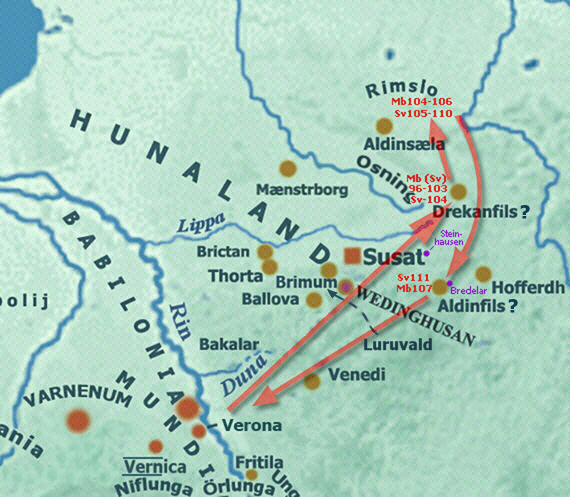
|
Dietrich’s
trip to the Osning by the Thidrekssaga and the Old Swedish
texts.
|
|
Ekka the
Hero
counter to the
Eckenlied
|
| |
|
The Old Norse + Swedish
texts provide Mb 96–103 and Sv 96–104 with an appearance of Ekka,
future son-in-law of the late king Drusian
(Sv: Drocian) who, however, is not depicted
as a giant in contrast to the southern Eckenlied.
Friedrich H. von der Hagen, translator of the Old Norse manuscripts,
proposes Drusian’s seat on the Drakenburg on the river Weser,
whereas Ritter supposes this place at the
Externsteine (elder form: Ecksternsteine).
Since the Old German spelling forms egge
and ekke, ecke are interchangeable, the source provider of the
Old Norse + Swedish texts could have also ascribed Ekka’s
region to the
covering Eggegebirge. Besides, an Extern
valley, called nowadays Externtal, can be found c. 30 km to
NNE.
|
| |
|
The
E2 or L manuscript of the Eckenlied
expressively underlines the land Gripiân, hence with
Cologne on the Rhine, as the northern central region already in its
first strophe; cf. Roswitha Wisniewski, Mittelalterliche
Dietrich-Dichtung, p. 219. This may to point to rather a northern
based template of an Ekka tradition
which the southern or Italian author has so illustriously magnified.
However, its seems less likely that the very first Ekka
tradition was brought from an Italian
location to a northern German(ic) area and afterwards
re-imported from
there for the Tyrolian creation of the extant eldest Eckenlied
(c.
1230). Regarding the chronology and history of Ekka’s
transmission, Joachim Heinzle rejects a sense making connection of an
archaic local legend about three hoary witches on this mountain, who
could cause thunderstorm which had to be driven away by a ffasolltt,
with the three queens appearing in the Eckenlied; see Heinzle, Einführung
in die mittelhochdeutsche Dietrich-Epik, pgs 121–122.
Besides, he does only compare the contents
of the Eckenlied with the motif reflecting or spending passages
which are forwarded by the Thidrekssaga. In so far, in
particular for undetectable source context, he would not
draw any speculative conclusion.
|
| |
|
It
seems obvious that the primordial author of Mb 96–103 and Sv 96–104,
identifying a Drusian in the Teutoburg Forest, apparently at the
Externsteine, knew of Tacitus' annales
II,7 that relate in its region a mound and an altar in memory of the
Roman general Drusus, as this spatial interpretation was assumed by
Gudmund Schütte, Gotthiod und Utgard (1936,II, p. 198).
However, we have to concede that the reception of
the Roman politician and eminent general Drusus – by the Old Swedish
texts originally Drocian (geonymically Drakian?) – for
the hero’s adequately ranked
father-in-law is nowhere serving for any political or
consequent important effect in the accounts of the Old Norse
+ Swedish manuscripts. Admittedly, in the MHG Wolfdietrich
(B&D)
the protagonist rescues Sigeminne from the giant Drasian
(B) on
a castle called Altenfelse (only D), but it seems unlikely that
the author of Thidrek’s Osning adventure took pattern
from this part of the MHG epics; cf. Pfaff op. cit. 1959 pgs 15–16.
|
| |
|
Aldinsæla
— Rimslo — Aldensele
|
| |
|
The historical
background of the Rimslo episode is based on
the authentic appearances of large prehistoric animals a few miles
north of Riemsloh, see Mb 104–106 and Sv 105–110. The impressing tracks
of such
reptiles, officially found in 1921 (!) near Barkhausen village and
classified at that time
as ‘Elephantopoides barkhausensis and Megalosauripus barkhausensis’,
inspired the primordial author to enrich the story of Thidrek
and Fasold
with a ‘horrifying fil and a flying dragon’, the former likely an
animal of the kind called an elephant (Haymes). Ritter
adverts that Thidrek and his follower Fasold (cf. Sage
und Wirklichkeit, pgs 424–426 onto ancestral items of the latter)
could have originated this story when encountering these traces on
their Osning expedition, as in this case they were ready
to show an ‘everlasting evidence’.
|
| |
|
Interestingly, the Karlamagnús saga forwards that Roland
wins a horn called ‘Olifant’ from the Saxons.
|
| |
|
Godelinda
and/or Gothelinde?
|
| |
|
Since we can detect
related
name forms of the spouses of
Thidrek & Theuderic, the author
remarks at https://www.badenhausen.net/harz/svava/ZwoelfumDietrichvonBern.htm
(retrieved Oct. 2015):
|
| |
Auch die Gattin
des Markgrafen von Bakalar führt den Namen Gudelinda
oder Godelinda. Nach Mb 240 wird also eine weitere und hier in
Svava
erkannte oder platzierte Gothelinde vorgelegt, der anspielende
Name für Dietrichs Braut als Tochter eines ihm ebenbürtig
darzustellenden historischen Schwiegervaters. Mit diesem lässt
sich ein offensichtlich
anachronistisches Erzählmotiv festmachen, das sich der
Historiograf wegen damit nicht verknüpfter politischer oder
anderer
Entwicklung jedoch leisten konnte (…) Zu
Dietrichs Vermählungen dankt der Verfasser dem Lektorat für
einen nachträglichen Korrekturhinweis zu Bild 7 auf S. 179 in
„Sage und Wirklichkeit”: Nach Mb 240 heiratet der junge Dietrich
zuerst eine Tochter Gudilind (Gudelinda
– Got(h)elinde)
des verstorbenen Königs Drusian,
siehe Osning-Berichte der Thidrekssaga.
Diese Partie erscheint manchem Leser als pointierte Anspielung
auf die Gemahlin Suavegotta – Suavegotho von
Theuderich I., deren Name und definitive eheliche
Beziehung mit diesem Frankenherrscher bei Flodoard von
Reims auftaucht. Die Forschung möchte sie als Tochter aus
der Verbindung des Sigismund von Burgund mit Theoderichs
Tochter Ostrogotho-Ariagne identifizieren, was jedoch zu
einem erheblichen chronologischen Problem mit Suavegotho (* um
504) als Mutter der regina Theudechildis führt. Siehe
dazu
die Vita von Theuderich I.
Die geografische Interpretation des Eigennamens der Gemahlin
Theuderichs würde auf deren blutsverwandtschaftliche Herkunft
außerhalb von Burgund hindeuten.
Siehe zum Zeitstellungsproblem
z. B. Eugen Ewig
1991:50–52.
|
| |
[Transl.:
The wife of
the margrave of Bakalar is also called Gudelinda or Godelinda.
Mb 240 thus introduces a further Gothelinde,
recognized or intentionally situated in the geographical Svava,
to be Dietrich’s (= Thidrek’s) bride as daughter
of a very worthily introduced
historical father-in-law. Thus, we can apparently fix this as an
anachronistic narrative motif which the
historiographer nonetheless could bring in the narrative
milieu of an unrelated political or
other development (…) Regarding Dietrich’s marriages, the author
thanks the
publisher’s lecturer for a corrective reference to fig. 7 on page 179
in "Sage und Wirklichkeit": According to Mb 240 the young Dietrich
marries at first a daughter called Gudelind (Gudelinda –
Got(h)elinde)
of the late king Drusian, see the Osning reports of the
Thidrekssaga.
This part
may appear to some readers as a pointed allusion to Theuderic’s the
wife Suavegotta
– Suavegotho
whose name and definite marital relationship with this
Frankish ruler provides Flodoard of Reims. Researchers like to identify
her with
a daughter from the matrimony of Sigismund of Burgundy with
Theoderic’s daughter Ostrogotho-Ariagne which, however, leads to a
significant chronological problem with Suavegotho (* c. 504) as the
mother of regina Theudechildis, see the vita of Theuderic I.
The geographic
interpretation of the name of Theuderic’s wife would
point to their blood-related origin outside of Burgundy.
For more
information about the deadline problem, see e.g. Eugen Ewig 1991:50–52.]
|
| |
|
All Thidrekssaga
redactions neither mention forms of
‘Burgundy’ nor provide the revenge based epic depiction of Didrik’s
death. (Note that the chapters Sv 383–386 have been ascribed to a later
edit!)
|
| |
|
As
concerns the Brictan episode
on the river Lippá (Mb 84–89, cf. Sv 83–89 quoting a
forest called lyrowoll
instead), the author of this part
might have magnified his story
with some pattern taken from a continental narrative or just a scheme
which had already inspired Chrétien de Troyes for his Erec
and Enide. William J. Pfaff
(op. cit. 1959 pgs 46, 124–125) tried to show that the author of this
episode has
borrowed from Solomon and Marcolf.
|
| |
| Sigurð’s dragon |
| |
|
Regarding Mb 166 and
Sv 158, dealing with Sigurð killing the
‘dragon-worm’,
Ritter agrees and interprets with Paul Hermann’s German
translation of the Vǫlsunga saga, see Ritter, Sigfrid ohne Tarnkappe,
p. 235, en. 14. Lethally wounded, the brother of the sly smith finally
made this confession, see Fáfnismál:
|
| |
|
Hattest
du nicht gehört, wie alles Volk sich fürchtete vor mir und
meinem Schreckenshelm? (…) Den Schreckenshelm trug ich zum Schutz
gegen
alles
Volk, seit dem ich auf dem Erbe meines Bruders lag (…) dass niemand
noch
mir zu nahen wagte; kein Schwert schreckte mich, und nie fand ich so
viele Männer mir gegenüber, dass ich mich nicht weit
stärker dünkte,
alle aber hatten Angst vor mir…
|
| |
|
[Transl.:
Haven’t
you heard how that all folk was afraid of me
and my shocking helmet? (…) I had on the shocking helmet
to protecting myself against all folk for all the time I was keeping my
brother’s heritage (…) so that nobody
else dared to approach me; no sword was frightening me, and I never
found so many men against me, methought being much stronger than them,
so all were afraid of me…]
|
|
|
21 ii.
In
contrast with Peringskiöld’s short consideration of sources
that render interpretations of dwarves and giants (1715, ‘fōretal’),
the Addendum Writer of the Heldenbücher editions (‘Books
of
Heroes’, prose part) inter alia establishes nothing less than a
special kind of biblical genesis. In this way providing
‘proof of origin’, he institutes this figment of the poetry’s
suggestive imagination:
|
| |
|
There is
further to know why God created the small dwarves and the
large giants and, after that, the heroes. First, he created the dwarves
because the lands and mountains were wild and unexplored1,
and there was plenty of good ore, silver, gold and pearls in the
mountains. Therefore, God made the dwarves even witty and wise, so that
they could distinguish evil from good and know about the right use of
all things. They also knew about the use of gemstones. Many of them
gave huge
strengths, while quite a few made the bearer invisible. This does ‹
also › a so-called fog cap2.
Therefore, God gave the dwarves artisanship and wisdom. Thus, they made
fine hollow caves, and nobly given to them kingship and upper class the
heroes alike, and given to them great wealth.
|
|
And then
God created the giants because they had to slay the wild beasts and big
worms3, so that the dwarves were more
safe for
exploring the land. Then, after a few years, the giants caused the
dwarves much suffering, as they even became evil-minded and unfaithful.
|
|
After
that God created the strong heroes, of middle rank within these three
folks. And there is to know that the heroes were faithful and befitting4
for many years. And so they were helping the dwarves
against the unfaithful giants, the wild beasts and worms. In those
times the land was totally unexplored5.
For this
reason God created strong heroes, and gave them such nature that their
boldness and sense were based upon honourable manfulness for quarrels
and wars. There were many kings under the dwarves who had to serve the
giants in some waste world, rough land and mountains near their
dwellings. Furthermore, the heroes saw women of discipline and honour
all around, and were obliged to the rightfulness to protect widows and
orphans. They did not harm the women unless becoming destitute
themselves, and came always to help the women in distress. On insult
and severity, the heroes performed many deeds for the women’s sake.
There is further to know that the giants were in all positions,
emperors, kings, dukes, counts, and lords, vassals, knights und
servants. They all were noblemen, and a hero never was a peasant.
Therefrom came all lords and noblemen.
|
| |
|
Quotation from chapter Wō
den gezwergē, cf. ‘Dresden edition’ printed with added prose
text at Hagenau, 1509.
|
| |
________________
|
| |
|
1
Neo-Germ. unbebaut
(cf. ‘unbuilt’).
|
2
See annotation Neffel
in the author’s online article
The Nibelungen Saga: The True
Core by the Svava?
|
|
3
Commonly equated with dragons.
|
|
4
Neo-Germ. bieder.
|
|
5
See above.
|
| |
|
The so-called
‘Historische Dietrichepik’, keenly fabulating epics
which are included in (e.g.) the Ambraser Heldenbuch,
significantly
contradict some important relation in acknowledged vitae of ‘apparently
comparable individuals’ who were participating in or forming real
historical events.
|
|
|
|
22 The
Franks and Burgundian allies invading southern Gaulish territories
of the Visigoths were afterwards repelled at first from Septimania and
the Provence by Theoderic’s general Ibba, 508–c.510.
Gregory’s ‘summary’ for the Franks: hist.
III,21.
|
| |
|
Furthermore, however, the Frankish historiographer claims that Clovis
placed himself a diadem on his head after an appointment to the
‘honorary
consulship’ from the emperor Anastasius in 508, hist.
II,38. This seems to indicate nothing more or less than a concordance
or an
intended alliance between them, likely based on preceding development
which made the Eastern Roman emperor and
Theoderic the Great in opposition at that time. Since the
former was sending a fleet to ravage the Italian coast in the year of
Clovis'
pretty
appointment, modern research presumes a ‘foedus’ between the Byzantine
sovereign and the Gaulish king, notably Patrick J. Geary, Guy Halsall.
However, there are no reliable sources which allow to
substantiate that the Italian Theoderic was definitely coerced into
terminating
his campaign against the Franks and Burgundians henceforth, and it
seems less likely that Theoderic the Great, guarantor of
the Pax Gothica, had accepted the Franks as
sovereigns of Auvergne and, consequently, Aquitaine
with the Albigeois and the Rouergue after the deposition of
Visigothic king Gesalec by Theoderic in 511. With Gregory’s
words accordingly: Gothi vero cum post Chlodovechi mortem multa de
id quae ille adquesierat pervasissent...; confirmably Herwig
Wolfram, History of the Goths (1988) p. 245–246; cf. also
Jonathan J. Arnold, Theoderic, the Goths, and the
Restoration of the Roman Empire. Doctoral thesis,
p. 241, fn. 170.
|
| |
|
Gregory involves Theuderic in dubious relationship with the Auvergnat
episcopates of Quintianus and Apollinaris, notably e.g. Ian.
N. Wood (op. cit. 1983, 1994) and Edward James (op. cit. 1985/1991)
with revised dating. Thus, a
persistent Frankish authority over the Auvergne in the 1st
quarter of
the 6th century appears less believable when
considering Theuderic’s extensive reconquest of this territory in c.
525, as this dating seems most acceptable from Gregory’s less
reliable chronological background contexts.
However, the obvious intention of Clovis and Theuderic to gain access
to the Mediterranean Sea, contextually since 508, was doomed to
failure: Under the command of Theoderic’s general Ibba, as Roman
sources provide, more than 30,000 Franks were killed; Narbonne and
Arles, conquered by Burgundians allied with the Franks, were released.
An Eastern Gothic army under its leader ‘dux’ Mammo plundered Gaul and
returned in 509 with rich prey to Italy. The Ostrogothic Theoderic
himself was able to free Carcassonne, where he found and released the
treasure of
the Visigothic king, his grandson Amalaric, from the booty of Frankish
besiegers. As regards Theuderic’s reconquest of the Auvergne, it is
strikingly evident that Gregory has suppressed
the name of the enemy whom the Frankish king defeated with this
obvious forceful military campaign. Since fratricidal Frankish war at
this time as well as up to Theuderic’s Thuringian campaign would
be not probable, cf. Gregory’s hist.
III,11 and 21, Theuderic recaptured the Auvergne from an obvious
Ostrogothic
occupation. Interestingly, as mentioned above, Gregory remarks a dux
Hilpingus as Theuderic’s intimate advisor to
this
conquest (Liber Vitae Patrum IV,2).
|
| |
|
hist. III,3–5 apparently date from
c. 515 to c. 524. As he reports at hist.
III,4, Theuderic rendered successfully military support to Herminfrid
in Thuringia who had promised him on their common victory the
half of Baderic’s realm, albeit Matthias Springer claims
this account as Gregory’s untrue construction in order to
justify Theuderic’s later military campaign against the
Thuringian king (Theuderich I. in RGA 30, pgs 459–463).
|
| |
|
Following Gregory’s Liber Vitae Patrum VI,2, reporting on
Theuderic and the cleric Gallus from Cologne (apparently between
524–525), there was
serious menace to their obvious short Christian mission
to most important Lower Rhineland area in the first half
of 6th century. Incidentally, this item does
not question the ‘Return
of Thidrek’, who dangerously crossed the region
of Babilonia and
defeated on his route its ruler Elsung the Younger
(Sv 341–346, Mb 399–406).
|
| |
|
Furthermore, critical research in Gregory’s text at
hist. III,6 neither strongly
suggests
nor conclusively recognizes Theuderic’s participation in Burgundian
War of 523/524, see again RGA 30 (2005) p. 462. While Matthias
Springer, editor of this article, would not confirm
Theuderic’s active involvement in this war, Ian N. Wood (1994)
moreover constates Theuderic ostentatiously avoiding the Burgundian
campaign.
Besides, according to Gregory’s hist.
III,21, the first or second recapture of the
Auvergne under Theuderic’s command seems not believable after the
Thuringian campaign of c. 531, whose beginning has been dated already
in 528 by Herwig Wolfram. Rather, Gregory has already mentioned
him
as authority over the clerics at Clermont in his report on the
inauguration of Bishop Nicetius, who needed further support at the
metropolis of the Treveri, see Liber Vitae Patrum VI,2.
Since Gregory contextually remarks in the following chapter that the
episcopal clerics Aprunculus (of Trier) and
Quintianus died soon after, we have to chronologize these three points
in time between 524 and 526.
|
| |
|
Regarding the basic understanding of the protagonist’s
‘exile’, the sources just allow to conclude that Theuderic
was driven out of Auvergne (since 508) and thereafter could
not rule over this most attracting Gaulish region (seemingly
suggested by Gregory) until c. 525. Not contradicting this
item, the other northeastern sources of apparently stronger limited
geographical horizon relate that Thidrek was coincidentally
chased away from his Bern location by a kinsman ruling Roma
II.
|
|
|
|
23
The Old Norse + Swedish texts do not provide
that
Thidrek
himself had initiated this military expedition against the kingdom or
territory of Soest, his place of exile. This Frankish campaign,
although unsuccessful in the end, seems to continue soon the
expansionism of Clovis who already had taken over
Sigibert’s kingdom
of Cologne.
|
| |
|
The
Frisian ‘chronicler’ Suffridus
Petrus, certainly not exempt from justifiable criticism particularly
for some patriotic distortion, relates that Soest was sieged and
conquered by Frankish
king Dagobert I, although this city was apparently lost again to the
Saxons later
on; cf. e.g. Eugen Ewig & Knut
Schäferdiek, Christliche
Expansion im Merowingerreich, in: Kirchengeschichte als
Missionsgeschichte, Band II: Die Kirche des früheren
Mittelalters,
pgs 116–145, see p. 132.
|
| |
Suffrid’s
De
Frisiorum antiquitate et origine libri tres
II, 15, further provides that Dagobert confronted the local commander Yglo
Galama, apparently of ‘Frisian
descent’, with invading forces. Following the Frisian author,
Dagobert’s large Austrasian campaign against Saxon tribes, most likely
or at least between 623 and 625, was
significantly supported by his
father Chlothar II († 629 or 630). Regarding this Frankish
campaign against the Saxons, there are some obvious parallels between
Suffridus
and accounts by the Liber historiae Francorum, 41 (MGH SS
rer.
Merov. II, ed. B. Krusch 1888, pgs 311–314).
|
|
|
24
As noted farther above, he is also serving as treasurer for his king,
titled ‘fiarhirdi’ (Mb 127,
cf. Latin manuscript, ch. CIII: quæstore ex ærario
pecuniam).
His name forms by all texts – but none of his contextual
actions being connected with ‘Ermenrik’ and Thidrek –
seem to remember ‘Seafolan’ by the Widsith
and/ or/ ‘who is’ the Byzantine commander (‘consul’) Sabinianus
Magnus. The latter finally attacked successfully the rear
part of Theoderic’s army in 479, but he was nowhere
recorded as plotting advisor of Odoacer or any other
historical foe of Theoderic the Great! Marcellinus Comes,
chronicler of the Eastern Roman Empire, regards Sabinianus as a severe
military disciplinarian of the old school, see PLRE.
|
| |
|
Interestingly, both Sabinianus and
Clovis (cf. the South Gaulish campaign and the Alemannic conflicts of
the latter) can be interpreted as geostrategical antagonists of
Theoderic the Great by means of historical sources.
|
| |
|
The Widsith
(115–116):
|
| |
|
Seccan
sohte ic ond Beccan, Seafolan ond Þeodric,
Heaþoric ond Sifecan, Hliþe ond
Incgenþeow.
|
| |
|
There
are at least two different ‘Sifkas’. Who is the right one?
The apparent hero or very important individual at the
beginning of 116 has been not satisfyingly identified by R. W. Chambers
(1912). Explicitly contradicting him, Kemp Malone (1962) recognizes
this
figure as protagonist of the Hervarar saga, and with him agrees
R.
Wenskus (1994, op. cit.) who also allocates Hliþe ond
Incgenþeow to the select circle of this tradition. The father
of these half-brothers Hlǫðr
and Angantyr is King Heiðrek, the capturer of a Húnalandish
Sifka, King Humli’s daughter (!)
who became mother of the illegitimate Hlǫðr. Heiðrek
seems responsible for the death of
either her or,
by confusing later edit, ‘another female Sifka’, as
she was not willing to keep a fateful secret she had received from
him. Called Sváfa in redaction U, her vita
has consequently nothing to do with all those plots
provided by Thidrekssaga and ‘Didriks chronicle’.
Nonetheless,
Ritter remembers the rôle of Sifka’s wife in the Old
Norse + Swedish
transmissions, submitting that Ermenrik had used violence on her (Dietrich
von Bern, München 1982, p. 299, en. 96).
|
| |
|
As noted by A. Raszmann 1858, J. de Vries 1957, and H.
Ritter 1982, ‘Sifka’ seems to reflect the meaning of the Nordic Bikkja,
cf. the English bitch. Regarding the bandwidth of
historiographical forwarding,
‘Sifka’ appears in our context as Nordic originated
curse word for an advisor, hence serving as literary supplement.1
The hard sounding that forms the beginning of its second syllable does
contradict a derivation based on the Roman
‘Sabinianus’, however. Regarding more corresponding forms like this,
Karl Müllenhof (op. cit.) already placed at the disposal an
ethnographical and geonymic origin of Ermenrik’s advisor, as taking
into consideration a Jutlandic Sabalingi and an Upper German Savalinheim,
the latter mentioned in the CODEX LAURESHAMENSIS, likely
meaning Savelheim as provided by the Topographia
Alsatiae. However, Malone reasonably constates that Seafola
and High German Sabene should not be equated uncritically in
order to make Þeodric the great Ostrogothic king (1962,
p. 195; 1959, p. 53, fn. 90).
|
| |
|
Malone presents an attention calling interpretation of Frankish
individuals (!) with Theuderic I, his son Theudebert, and the Sigiwalds
(father and son, the former put to death by Theuderic) by means of
Gregory of Tours (hist. III,13,16,23,24), the Wolfdietrich
cycle and the knowledge of the Deor
poet. After considering scholarship who has rashly equated this þeodric
with the Theoderic the Great, Malone does not see him in a convincing
historical or plausible
literary connection with the other line-115-individual(s):
|
| |
| But according to Guest
1838, 77 "the conqueror of Italy is not once alluded to" in the poem;
so also Müllenhoff 1848, 458 and others. As is generally
recognized, the identification of
Þeodric 115 depends on that of
Seafola , the name it is paired with in the off-verse of
the line. Since Jiriczek’s paper of 1920 (in
Englische Studien liv. 15ff.) this question may be looked upon as
settled:
Seafola is the
English equivalent of the villainous Sabene of the Wolfdietrich saga.
In other words, the þeodric of
Widsith 115 is
þeodric the Frank (1962, p. 195 &
pgs
204–205;
cf. 1959, pgs 164–167). |
| |
_______________
|
| |
1 A
mediaeval
historiographer may augment in rhetorically sophisticated manner, to a
certain extent even speculatively or untrustworthily, as
we may regard this as an either subjective emendation or just an
endeavour to achieve ‘comprehensiveness’ of his work. However, these
kinds of ‘amalgamation’ must not necessarily corrupt the basic
narrative consistency of a historical exposition.
|
|
25
«…
So, wie die Einzelsagen nunmehr erscheinen, fügen sie sich doch
eher
zu einer Chronik aus dem 12. und 13. Jahrhundert zusammen.»
(op.
cit. p. 406). After the translations by F. H. von der Hagen 1814,
A. Raszmann 1852 and F. Erichsen 1924, Hube provides the fourth
German publication of the saga’s contents (‘Nacherzählung’) with
geographical annotations generally complying with Ritter’s
localizations.
|
|
|
26
i. See from a similar perspective the review of Ritter by Henry Kratz, The
German Quarterly 56/4, pgs 636–638, which, however, does not play
a reliable
rôle for progressive circumspect studies, as Ritter has already
responded to inappropriate analytic approaches of scholars who either
base their arguments on genuine but unproven pseudo-historical
intention of the manuscripts or oversimplify history by focussing
on monocausal ambit and explanation.
|
| |
|
Compare, for example,
Ritter’s riposts in
|
| |
|
Sigfrid
ohne Tarnkappe,
Munich 1990, pgs 189–197: Irrwege bei der Deutung der
Thidrekssaga.
Die neue Sicht und ihr Echo, pgs 199–206. In Soester
Zeitschrift, 1985, Nr. 97, pgs
26–28; ibid. 1986, Nr. 98, pgs 150–154.
|
| |
|
See also
the reviews pro Ritter by
|
| |
|
Hans den
Besten, Bemerkungen zu
einer Kritik. Johannes Jonata
u.a. zu Ritter-Schaumburgs ‘Die Nibelungen zogen nordwärts’,
in: Amsterdamer Beiträge zur Älteren Germanistik, 33,
1991, pgs 117–130. Fritz Droste, Der Nibelungen Not in
Westfalen, in: Sauerland, 1982, Nr. 1, pgs 4–8; id. Sauerland,
1984, Nr. 1, pgs 13–15.
|
| |
|
Werner Hoffmann’s
criticism of Ritter’s book Sigfrid ohne Tarnkappe may be partly
justified because Ritter has not
delineated clearly enough some of his conjectures based on ‘possible
facticity
and less believable speculation’ to the heroised and mystified
Sigurð
image in all transmissions – as scholarly research on Siegfried
in the Nibelungenlied has been tending to
divergent interpretations. If Hoffmann had been less concerned
with polemical sophisms against Ritter, he could have pointed
to e.g. the Legend of Genevieve of Brabant (see above) as a subtle
adaption for Sigurð’s birth, which has been left
unnoticed by Ritter. But Hoffmann does neither refer
to a historical prototype of Dietrich
in the Thidrekssaga nor
to its general historiographical trustworthiness; cf. Werner Hoffmann: Siegfried
1993 (...)
in: Mediaevistik 6 (1993),
pgs 121–151.
|
| |
|
|
| |
|
In
contrast to Heinrich Beck’s less convincing approach
against Ritter, another example of an inexpedient perspective for a Thidrekssaga-Diskussion,
being based to a certain extent rather on the imperative twinship of
monocausality and Migration Period historiography written in High
Middle Ages, as to be connected nonetheless
with ‘literary transformation’ (cf. Beck op. cit. 1993),
some scholarly reviewers seem more amenable to reason.
Therefore, especially contradicting also Kratz and Müller, Ritter
does not proceed from Upper German poetry as the decisive standard
of evaluation for the postulated history in the core content of
the Thidrekssaga. Rather, according to Ritter, the
historiographical
disposition of the Old Norse and Old Swedish
texts must be compared with the significant contradictions to
the fragmentarily provided history/historiography of North European
5th and 6th
century.
|
| |
|
Focussing on
Ritter’s general conclusion on the eminent
campaign and route of the Niflungs,
Dietrich Hofmann, formerly Christian-Albrechts-Universität zu
Kiel, German
and Scandinavian Studies, argues onto the main
pretensions that, first, «the people of
Westphalian Soest had taken outlandish legends for own historical
accounts» and, second, «they
had little or no knowledge of their own history»:
|
| |
Die beiden Aussagen
sind nun aber doch noch etwas zu
modifizieren. Zum einen wird man annehmen dürfen, daß manche
Menschen in Soest und anderswo über die wahre Geschichte der Stadt
besser Bescheid wußten als der Erzähler der
Niflungengeschichte. Schon wegen der Besitzverhältnisse
müßte man wohl nicht nur beim Erzbischof in Köln,
sondern auch in der Soester Geistlichkeit über den "Schlangenturm"
richtiger informiert gewesen sein. Es ist aber damit zu rechnen,
daß der Glaube an die Historizität der Niflungengeschichte
als Soester Lokalgeschichte in der Bevölkerung weit verbreitet und
stark verwurzelt war. Sonst hätte der Erzähler sich nicht so
überzeugt äußern können, und diese Version hatte
sich ja offenbar auch weit über Soest hinaus verbreitet. Einzelne
"Intellektuelle" kamen dagegen nicht an. Die mündliche Tradition
war im Mittelalter eine große Macht, weil man sie für
historisch hielt und weitgehend halten mußte. Jahrhunderte –, ja
jahrtausendelang hatte es überhaupt keine andere Art der
Geschichtsüberlieferung gegeben, und die sich erst allmählich
entwickelnde schriftliche Überlieferung war den meisten Menschen
nicht zugänglich, so daß sie kaum Möglichkeiten hatten,
die zur Sage gewordene mündliche Überlieferung an den
historischen Fakten zu überprüfen und zu korrigieren. Deshalb
treffen die oben gemachten Aussagen zur Geschichtsauffassung der
Soester Bürger im 12./13. Jahrhundert nicht diese allein, sondern
dürften für die Geschichtsauffassung breiter
Bevölkerungsschichten im Mittelalter allgemein typisch sein.
Durch eine weitere notwendige Modifikation der beiden
Aussagen bekommt Ritter bis zu einem gewissen Grade doch noch Recht.
Man muß nämlich auch die Frage stellen, wie es
überhaupt dazu hatte kommen können, daß die Soester
fremdes Sagengut als eigene Geschichte rezipierten. Die Existenz alter
Mauerreste und eines verlassenen Turms, in dem Schlangen hausten,
reicht allein sicher nicht aus, um das zu erklären. Man kommt hier
nur weiter, wenn man annimmt, daß es in Soest schon vor der
Rezeption der Nibelungensage alte Erzähltraditionen gegeben hatte,
die man für historisch hielt, Geschichten etwa über einen
mächtigen König in vorchristlicher Zeit, über schwere
Kämpfe an der Westmauer der alten Stadtkernbefestigung usw.
Ähnlichkeiten im Handlungsverlauf und in der Personenkonstellation
könnten dazu geführt haben, daß man die Nibelungensage,
die vor allem von fahrenden Sängern in der Form von Liedern in
ganz Deutschland und darüber hinaus verbreitet wurde, in Soest mit
Geschichten der eigenen Tradition – auch sie wohl in Liedform –
identifizierte. Gleiche oder ähnliche Namen handelnder Personen
konnten die Identifikation und somit die Rezeption der Nibelungensage
natürlich wesentlich fördern.
Von daher gesehen ist es keineswegs abwegig – wenn auch
rein hypothetisch –, auch den Namen At(t)ano
auf der Soester
Scheibenfibel (Ende des 6. Jhs․) in die Diskussion einzubringen, wie
Ritter es getan hat (S. 207ff.). In mittelniederdeutscher Zeit
wäre *Attene daraus geworden, eine Namensform, die sehr
wohl Anlaß zu einer Identifikation mit Attila hätte geben
können – dies übrigens eine literarisch
beeinflußte Namensform, die zeigt, daß bei der Darstellung
der Þidreks saga ein bißchen Gelehrsamkeit im Spiel war,
die aber den Glauben an die Richtigkeit der mündlichen Tradition
offenbar nicht beeinträchtigte (…) Entsprechendes wie
für
den Soester Teil der Niflungengeschichte gilt natürlich auch
für deren in anderen Orten und Gebieten Westfalens und des
Rheinlandes lokalisierte Bestandteile, über die Ritters Buch – wie
schon seine vorausgegangenen Aufsätze – wichtige Erkenntnisse
bringt. Natürlich konnten auch die Geschichten in den Bannkreis
der Nibelungensage geraten, zu denen es keine Entsprechungen in ihr
gegeben hatte, so möglicherweise eine Lokaltradition über den
eingemauerten Toten im Hoh(l)en Stein von
Kallenhardt im
Sauerland, die auf Attila übertragen worden sein könnte. |
| |
|
[Transl.:
However, the two statements are still to be
modified a tad. On the one
hand, one may assume that some people in Soest and elsewhere knew
better
about the true history of the city than the narrator of the Niflungs
history. Because of the conditions of ownership, not only the
archbishop of Cologne but also the Soest clergy ought to have been more
accurately informed about the ‘snake tower’ than anybody else. It is
rather to be expected that the belief in the historicity of the
Niflungs history
as a local history of Soest should have been widespread and strongly
rooted in the people’s mind. Otherwise the narrator would not have been
able to express himself so convincingly, as this version had apparently
spread even far beyond Soest. Some ‘intellectuals’, on the other hand,
could not argue to the contrary. The oral tradition was a great power
in the Middle Ages because it was thought to be historical and largely
supported. There was no other form of historical tradition
since centuries – even millenniums. The gradually developed
written tradition was not accessible to most of the people. Thus, they
had scarcely any means of examining and correcting the oral tradition
in the matter of historical facts. For this reason, the statements made
above on the conception of history might not only concern the citizens
of Soest in 12th/13th
century, but generally the perceptive opinion of history in the broad
population of the Middle Ages.
Ritter is, to a certain extent, still right by further
necessary
modification of the two statements. One must also query how it could
have happened at all that the Soesters had a reception of a foreign
legend as their own story. The existence of remains of old walls and an
abandoned tower in which snakes were living is by no means sufficient
to
explain this. We can only proceed on the assumption that old
traditions were extant in Soest and esteemed there as historical before
the reception
of the Nibelungensage; for instance, stories about a mighty king in the
pre-Christian era, about heavy fighting on the western wall at the old
fortifications of the inner city, etc. Similarities in the course of
action
and the constellation of persons could have led to the fact that the
Nibelungensage, spread mainly by minstrels all over Germany and beyond,
was identified in Soest with stories of own tradition, presumably with
ballads. Of course, identical or similar names of acting persons could
significantly induce the identification and therewith the reception of
the Nibelungensage.
From this point of view it is by no means absurd, albeit
purely
hypothetical, to argue with the name At(t)ano on
the disk fibula,
dated into the end of 6th century, as Ritter
has
done it, see pp. 207f.
In the Middle-Low-German period, the name would have developed to the
form *Attene
which might well have given an inducement to
an
identification with Attila. This, incidentally, is a literary
influenced form which shows that in Þidreks saga’s presentation a
portion of scholarship was involved who,
however,
obviously did not affect the believe in the correctness of the oral
tradition (…) Of course, as regards the Soest part of the
Niflungs history, comparably the same influenced constituents being
localized in other
places
and regions of Westphalia and the Rhineland, on which Ritter’s book
as
well as his previous treatises provide important awarenesses. It seems
clear
that the stories could also have gotten into the influential circle
of the Nibelungensage which, however, had no inherent correspondences
such as, potentially, a local tradition about the walled-up dead in the
Kallenhardt cave ‘Hohler Stein’ in the Sauerland, and which could have
been transferred to Attila.]
|
| |
|
(Dietrich Hofmann, "Attilas
Schlangenturm" und der "Niflungengarten" in Soest,
in: Jahrbuch des Vereins für niederdeutsche Sprachforschung,
104, 1981, pgs 31–46, see pgs 44–45..)
|
| |
|
Hofmann concedes that a pallatium sive turris
(residence building or tower), ‘occupied by reptiles and other
creatures‘, is provable to high mediaeval Soest. Regarding also its homgarðr,
William
J. Pfaff does reasonably argue (op. cit. 1959 p. 175) by means of
Henrik
Bertelsen’s source transcriptions and Ferdinand
Holthausen’s Studien zur Thidrekssaga:
|
| |
| A document on
the authority of the archbishop of Cologne
(c. 1178) relates that a ‘palace or tower‘ next to the old church of
St. Peter had been full of reptiles, etc., and was then being used for
charitable purposes, probably a reference to the Hohe Spital southwest
of the church. There is no trace of the Nibelung name; perhaps
Högnagarðr
(B) and Niflungagardr
were added when Hom appeared (for bom) and the
obscurity had led to confusion
with Holm- (II,310) for Norwegian scribes. There is, however,
ample evidence that the Norwegian was not inventing these details;
Holthausen (464) suggests that the Eddaic author may have taken
the snake-pit motif from northern Germany. |
| |
|
Challenging Ritter, Dietrich Hofmann attempted to indicate
alternatively the
possibility that the Soest localities, as specified by the manuscripts,
had inspired a high mediaeval narrator for a pseudo-historical
relocation. However, Hofmann apparently disregards that this
‘reteller’ – more likely – might have had only very little or no
knowledge
of the exact townscape in much former times and, therefore, had to
refer to contemporary structural development for an impressing
imagination of a former 6th-century
‘Franco-Saxon’ battle which,
however,
cannot be excluded. Furthermore, it seems less probable that the
composer(s) of the Atlakviða, one of the eldest Eddaic
lays of 9th/10th-century
tradition, had taken its ormar
garðr motif from an apparently later erected episcopal site, a pallatium
sive turris, which was reported unkempt and, thereafter, noted on
its restoration in 1178.
|
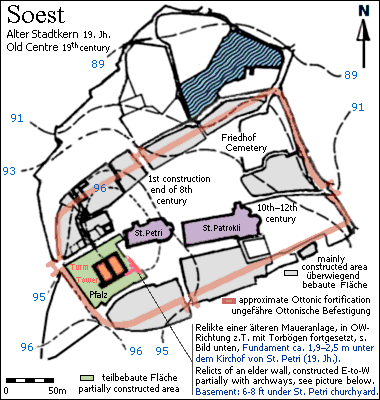
|
A plan with
contour
lines of
the old centre by municipal registry of
1830. Hofmann refers to a corresponding reconstruction drawing by F. W.
Landwehr, see p. 40. See Ritter 1981:193 who does not estimate the
large
building at the episcopal place of residence ‘Pfalz’ as Gunnar’s
‘snake tower’, see also pgs 199–203.
According to the manuscripts, Hǫgni had left in Soest the obvious most
impressive actions, as these are his bursting through the western wall,
fighting ferociously against Irung and then Thidrek, and,
finally,
generating a son for revenge on the patron, ‘father’ or ‘Ata’ of Soest.
Since the place of Hǫgni’s ancestors has
been suggested at Troyes, see
https://www.badenhausen.net/harz/
svava/svava_en.htm#Annotation_07,
we should think more complexly
about the reasons why Archbishop Bruno of Cologne had the mortal
remains of St. Patroclus transferred from Frankish Troyes via Cologne
to Soest as its new Christian
patron. This ‘installation’extended from 962 to 964. |
|
|
The Old
Norse scribes could have provided Iring
(cf. notably Widukind of Corvey, Frutolf von Michelsberg, Annales
Quedlinburgenses, De Origine Gentis Swevorum) as Irung
at the court of Susat, where he appears on Grimhild’s side.
Hilkert Weddige considers
the possibility that ‘Iring’s Way’ or ‘Iring’s Wall’ of Soest
could be geometrically derived from a circulus, a ring-formed
passage or
wall. Supporting his proposal, Weddige (op.
cit. p. 66, 101–102) quotes an example from the Royal Frankish Annals
whose user Regino has converted a fort hringum gentis Avarorum
into a
chieftain Avarum principe Yringo.
|
| |
|
Dr
Heinrich ten
Doornkaat
Koolman, a former mayor of Soest, wrote on the obvious relicts of an
elder or, relatively, the eldest known wall:
|
| |
Wie
in der Zeitschrift des Soester
Geschichtsvereins
Nr. 14 Seite 22 ff. berichtet wird, kamen 1884 bei den
Ausschachtungsarbeiten für ein neues Pfarrhaus an der Ecke des
Petrikirchhofes und der Hospitalgasse alte Mauerreste zum Vorschein.
Gücklicherweise hat man den Fund sorgfältig aufgemessen, und
eine von dem Baumeister Lange am 16.7.84 angefertigte
maßstäbliche Zeichnung ist in dem Heft 14 S. 24/25
wiedergegeben.
Danach hat eine von Norden nach Süden
verlaufende, 1,80 m in die Tiefe reichende Mauer den Petrikirchhof von
dem zum Hohen Hospital gehörenden Gebiet geschieden. In einer
anschließenden von Osten nach Westen verlaufenden, aus
großen behauenden Quadern aufgeführten Mauer von reichlich 1
m Dicke befanden sich unter der Erdoberfläche zwei etwa 2,20 m
hohe und etwa 1,80 m weite rundbogige Torbogen. Weiter befand sich
ein Haufen Bauschutt untermischt mit Resten verkohlten Gebälks.
In dem Bericht ist weiter vermerkt, diese Mauer
müsse zum Hohen Hospital in Beziehung
gestanden haben,
wenn sie auch keineswegs einen Teil des Gebäudes gebildet habe.
Dafür, daß dies nicht der Fall gewesen, spreche die
völlige
Verschiedenheit des Mauerwerks.
Dies Alles deutet auf eine ältere
Burganlage hin, die vor der Errichtung der merowingischen Pfalz
bestanden hat.
(Heinrich ten Doornkaat Koolman, Soest
die Stätte des Nibelungenunterganges? Rochol, Soest
1937, see pgs
10–11.)
Drawings on the right are taken from the article quoted by
H. ten Doornkaat Koolman.
|
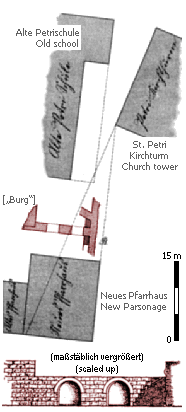 |
|
|
[Transl.:
As reported in the magazine of the Soester
Geschichtsverein, No. 14, page 22f., 1884, old fragments of the
wall came to light during the
excavation work for a new vicarage at the corner of the Petrikirchhof
and the Hospitalgasse. Fortunately, this find was carefully measured,
and a scaled plan drawn on 16 July 1884 by Mr. Lange, master builder,
is reproduced in issue 14, pgs 24–25.
According to that a wall extending from north
to south, reaching a depth of 1.80 m, separated the Petrikirchhof from
the area belonging to the Hohen Hospital. In an adjoining wall
extending from east to west, not less than 1 m in thickness and
consisting of large chiselled cuboids, two bows of arched gates, c.
2.20 m high and c. 1.80 m wide, were found under the ground. There
was also a heap of building rubble mixed with the remains of charred
timberwork.
The report also notes that this wall must
have been related to the Hohen Hospital, even though it was by no means
a part of the building, as this might be supported well enough by the
complete difference of the stonework.
All this points to an older fortification
which existed before the erection of the Merovingian Palatinate.]
|
| |
|
Ritter supplements
on
this article an obvious later excavation,
‘commissioned by the Historischer
Verein
of Soest in 1951/1952’ as he writes, whose experts had uncovered a wall
(c. 2.5 m
thick) even under the foundation level of the Pfalz. Ritter
summarizes that
the archaeologists of this excavation found under this wall strata with
remains of
carbonized
material and scattershot skeleton fragments and, thereupon, drew the
assumptive conclusion that on this location ‘heavy combats had taken
place in the
early Middle Ages’. Ritter quotes as follows from its report by
Hubertus Schwarz, Soest in seinen
Denkmälern, Bd. 1, (Soest 1955) p. 134:
|
| |
Unter den Fundamenten (…)
fanden sich unter einer gleichmäßig waagrechten,
tiefschwarzen Holzkohlenschicht von 2 cm Dicke in 1,30–2,30 m Tiefe
(…)
»in
ihrer ganzen Stärke, besonders aber nach unten
hin, wahllos zerstreut, menschliche Knochenreste, die zumeist, auch die
Schädel, zertrümmert und zum Teil auch angebrannt waren. In
2,20 m Tiefe konnte noch eine 1–2 cm starke, scharf abgesetzte
Holzkohlenschicht festgestellt werden, unter welcher unmittelbar wieder
menschliche Schädel- und Knochenfragmente lagen. Da diese
Schichten nur an der Südseite der sogenannten ›Wittekindsmauer‹
auftreten und noch weiter in die Tiefe gehen, liegen sie im Innern im
Keller eines alten Bauwerks, das als Vorläufer des ›Hohen
Hospitals‹ (= Veste) angesehen werden
muß.«
(…)
»Das ganze
Auftreten dieser Schichten mit ihrem auffallenden Inhalt in den Kellern
eines Bauwerks, dessen Mauern 8 Fuß =
rund 2,50 m
breit waren,
läßt an dieser hervorragenden Stelle des alten Burgbezirks
schwere Kampfhandlungen im frühen Mittelalter
vermuten.«
|
| |
|
[Transl.:
Downward the foundations (…) under a deep
black
charcoal stratum of 2 cm thickness, running undisturbed horizontally at
a depth of 1.30 to 2.30 m were found (…)
«in
all of its
dimension, increasingly downward, randomly
scattered human bone remains and skulls which were smashed and partly
burned. Further, then at a depth of 2.20 m, a sharply stepped 1 to 2 cm
thick charcoal stratum was localized again with fragments of human
skulls
and bones. Since these strata were found only under the south side of
the so-called ‹Wittekindsmauer› and lie farther in the depths, they
meet the inner domain of the basement of an old structure which must be
regarded as the previous building of the ‹ fortification =)›
‹Hohen Hospital›.»
(…) «The whole appearance of these strata, with their
striking contents in the basement of a building, whose walls were
8 feet or 2.50 m wide, admits to presume heavy fighting in the
early Middle Ages at this eminent place related to the old
fortification.»]
|
|
|
26 ii.
Further narrative and archaeological remarks
|
| |
|
If the ancient
morticians of Soest had intended to leave remembrances
of the most impressive occurrences on this location, a narrative
exploration of the reports by the Old Norse +
Swedish texts would provide these complying deductions:
| 1. |
No
male kingly burial chamber since Atala
died in
Sigurð’s treasure cave. |
| 2. |
For that reason
not less than two noble female burial chambers to be found side by
side, because Atala married the
mother of
Hagen’s
son Aldrian after
the death of Grimhild. |
| 3. |
Since Aldrian, the
obvious son of Atala and
Grimhild,
died early by
Hagen’s sword, his
grave must be found close to one female burial chamber – the ‘royal’
one. |
| 4. |
Regarding an
important symbol for King Atala’s
death, one
female burial chamber,
that of the concubine who shared with Hagen his deathbed, ought to
contain a piece that either shows or is a key. |
| 5. |
The female burial
chamber of previous item should contain otherwise, or in addition, a
symbol that expresses an intimate ratio for the generation of Aldrian,
designated avenger whose father’s coat of arms features an uncrowned
eagle. |
In
springtime of 1930, about a mile to the south of the old town centre of
Soest, a burying place was found at an excavation work for a
prospective building. The
archaeological diggings and examinations of this discovery were
directed by August Stieren.
|
| |
|
The most preciously equipped grave chambers are reckoned
to Frankish burying, at least partially, and they might comply well
with the aforesaid five conditions. For instance,
there is a small male but distinguished burial chamber,
archaeologically catalogued as a boy’s grave No. 17, between two noble
female chambers (No. 106 and 105).
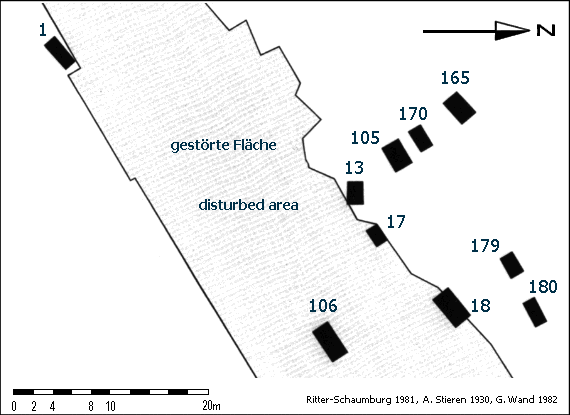 Soest Chamber
Graves: 1, 13, 18, 165, 170, 180 are female. Male chamber 179 is
less precious for minor weapon parts of iron. Soest Chamber
Graves: 1, 13, 18, 165, 170, 180 are female. Male chamber 179 is
less precious for minor weapon parts of iron. |
| |
|
According to
conclusive indication based on strontium isotope analysis, the female
chamber No. 106 belonged to woman who grew up in the area of Soest.
Thus, this chamber seems not to be Grimhild’s final resting place.
Nonetheless, this item does correspond with two Old Norse traditions,
the Atlakviða and the Atlamál,
which relate that Grimhild = Guðrún survived the battle of
their
brothers against the Hunas at the seat of her husband Atli. According
to the Atlakviða and also the later written
Vǫlsunga saga, she got married a third time. However, the
scribes of the Nibelungenlied maintain that Grimhild was killed by
Hildebrand, but according to the Thidrekssaga and the Old
Swedisch
transmission she said to be slain by Dietrich
himself. It therefore
seems obvious that her death was made up by the authors of these
traditions.
|
| |
|
Prof. August Stieren estimates that some
of these wooden burial chambers must have belonged to a burial mound.
Furthermore, prints of a wooden bench were incontestably found in the
female chamber No. 105. Hence, this chamber could have been accessible
for a certain period after the time of burial. As regards numismatic
dating, a coin or some other burial gift could have been deposed later.
Some German criticism against Ritter, levelled at the key or other
grave
goods of chamber No. 105 (cf. items 4–5, a picture of its amulet
below),
appears inconsistent, however: The key could be either a symbolic
replica or the death and burial of the involved person took place after
Aldrian’s revenge.
|
|
|
26 iii.
The Golden
Almandine Fibula
|
| |
|
This so-called garnet
or
Cloisonné fibula of burial chamber No. 106, a picture below,
appears as the most attracting piece. The younger solidus of this
chamber, found close to this fibula, is a mint of East Roman Emperor
Justinian I (527–565). It displays almost no evidence of usage. The
elder solidus is a worn coin of Roman Emperor Valentinian I.
|
| |
|
As
regards the history and dating contexts of the Cloisonné fibula
and its chamber No. 106,
it seems less likely at the first glance that either this brooch or its
youngest rune engraving should have been created in the Christian
reigning periods of the Austrasian kings succeeding Theudebert I
(533–547/548). Gregory of Tours remembers that (c. 525) his father
Theuderic himself was already on a Christianizing mission to Cologne.
As noted above, however, Suffridus Petrus relates the Frankish conquest
of Soest under Dagobert I who obviously made this campaign in the last
years of his father Chlotar II, whilst the Liber historiae
Francorum, 41, situates at that time a course of Weser river as
Franco-Saxon
demarcation line.
Since Theuderic consolidated Trier
sustainably about 525, Cologne could have been already under the reign
of a Christian governor when Theuderic’s son took over Austrasian
kingdom at
least one decade later. Thus, it seems less probable that the rune
inscriptions on this piece were made on the left side of the Rhine
after these time stamps.
|
| |
|
With
respect to chronological specifics
related to this brooch, the archaeological expert Daniel Peters,
formerly at German
LWL organization, deduces:
|
| |
| Hier sprechen
Abnutzungsspuren und
mehrphasige Beschriftung mit Runen für eine spätere
Deponierung eines benutzten persönlichen Besitzes. (2011:151)
|
| |
|
[Transl.:
Here, wear marks and multi-phased rune
engravings indicate
a deposition of a used personal possession.]
|
| |
| Referring to the
cross-type monogram on the fibula, he constates: |
| |
| Dieses Runenkreuz, als
eine Art
Verschlüsselung oder Geheimzeichen, ist zeitnah nur in einem
weiteren Fall, dem Schretzheimer Männergrab 79 der zweiten
Hälfte des 6. Jhs., bekannt geworden und wurde dort anhand der
Kenntnisse der Soester Inschrift entziffert. (2011:57) |
| |
|
[Transl.:
This rune-cross-type, as a sort of
encryption or secret
code, is only known in another case closer to the time,
that one the Schretzheim male grave No. 79 of the second half of the
6th century, which has been deciphered there
by means of the knowledge
about the inscription on the fibula of Soest.]
|
| |
| – since: |
| |
| Eine wenige Funde
umfassende frühe
Gruppe begegnet im nordgermanischen Gebiet bis etwa 500 n. Chr., die
Soester Fibel ist dagegen einem schwerpunktmäßig in
Südwestdeutschland verbreiteten Horizont von etwa 60–80
Inschriften zuzuordnen, die auf Gegenständen der relativ kurzen
Zeitspanne von 530/40 bis 600/20 n. Chr. vorliegen (2011:55).
|
| |
[Transl.:
A small group of early finds encompasses
the North German
region until c. A.D. 500, while the fibula of Soest has to be assigned
to a broadly circumscribed South German horizon of c. 60 to 80
inscriptions on objects of the relatively short period from A.D. c.
530/540 to 600/620.]
|
|
|
Max E.
Martin connects the rune
inscriptions on fibulas of an early Christian horizon of the Franks
with the ‘beginning of Merovingian rune writing of c. 530/40’, as
Theuderic’s conquests of Thuringian territories seem to indicate the
geocultural context of rune usages also in more northern regions.
Regarding bow fibulas with rune inscriptions, which have been found
commonly in southern areas of Germany, Martin estimates that its former
upper class leadership, eventually related with northern dynasties,
might have played a transferring rôle. Furthermore, it seems
noteworthy to remark that Volker Bierbrauer, another modern
archeologist, describes a fibula of Dunningen, Black Forest, whose
basic structure on its obverse is formed by five concentric circles.
Thus, this piece of the Dunningen parish grave No. 17 does correspond
well with the very noticeable pattern of the Soest version, albeit the
inner circular area of the former is domed shaped and, therefore, may
point to a younger creation of c. 600.
|
| |
|
As far as
presently known,
apart from speculative estimations based on relative visual dating,
absolute
physicochemical dating methodologies have not been applied to skeleton
fragments and inorganic material of the aforementioned chamber graves.
Regarding numismatic aspects, the youngest coin of grave 106, of
Justinian I period (527–565), could have been already available for
Frankish acquisition in the early 2nd
half of 6th century.
|
| |
Related bibliography:
|
| |
| Volker
Bierbrauer, Alamannischer Adelsfriedhof und
frühmittelalterliche Kirchenbauten von St. Martin in Dunningen,
in: Heimat an der Eschach, 1986, pgs 19–40. |
| |
| Max Martin, Die Runenfibenn aus
Bülach Grab 249 (…)
in: K. Stüber, A. Zürcher (Hrsg.), Festschrift f.
Walter Drack (…) Zürich 1977, pgs 120–128; ibid.: Kontinentalgermanische
Runeninschriften und „alamannische Runenprovinz” aus
archäologischer Sicht, in: Alemannen und
der Norden (…) RGA Eränzungsband (‘supplemental edition’) 43
(2004), pgs
165–212. |
| |
| Daniel
Peters, Das frühmittelalterliche Gräberfeld
von Soest. Aschendorff 2011. |
| |
| Heinz
Ritter-Schaumburg, Die Nibelungen zogen nordwärts,
Munich 1981, pgs 203–216. |
| |
August Stieren, Ein neuer Friedhof
fränkischer Zeit aus
Soest. Germania, Korrespondenzblatt der Römisch-Germanischen
Kommission des Deutschen Archäologischen Instituts, XIV 1930. Heft
3. (Pgs 166–175.)
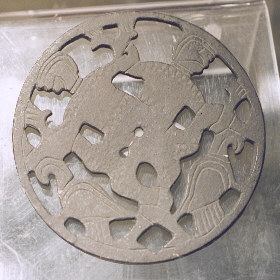 |
|
Top
picture on the left: The medallion (c. 10 cm in diameter) of burial
chamber No. 105 which also contained an iron made key. Top picture on
the right: The filigree disc fibula of grave No. 165 (c.
3.5 cm in diameter).
Both photos by the author. |
|
| Pictures
below: Golden Cloisonné rune fibula of chamber No. 106 and its
contour sketch from the reverse (c. 5 cm or c. 2 inches in diameter).
Several rune-reading analysts read the cross-type engraving A-T-A-N-O
or A-T-A-L-O.
See also: Further information
to read the fibula. |
|
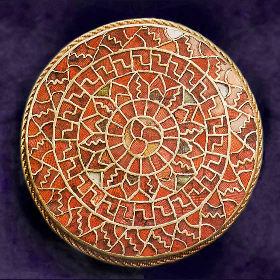 |
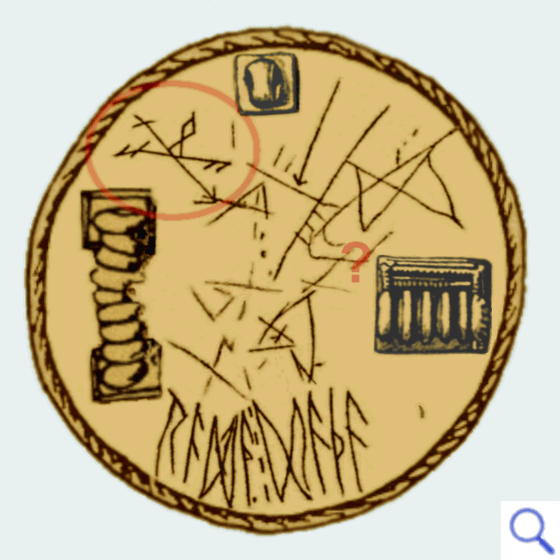 |
|
| |
|
|
27 i.
The so-called Prologue of Thidrekssaga, evaluated by
elder and newer scholarship for suggesting its transmission or content
rather
‘Ostrogothic’, is not provided by its eldest manuscript. This text, an
obvious
assumption of an unknown author, has been critically reviewed by
Frantzen (Neophilologus 1916), notably also Ritter
(Reprint of German translation by F. H. von der Hagen, pgs 743–744) and
Hube (op. cit. p. 410).
|
| |
|
Roswitha Wisniewski
provides this hierarchical diagram on an interrelated connectivity
of traditions related to Dietrich von Bern and the Nibelungen:
|
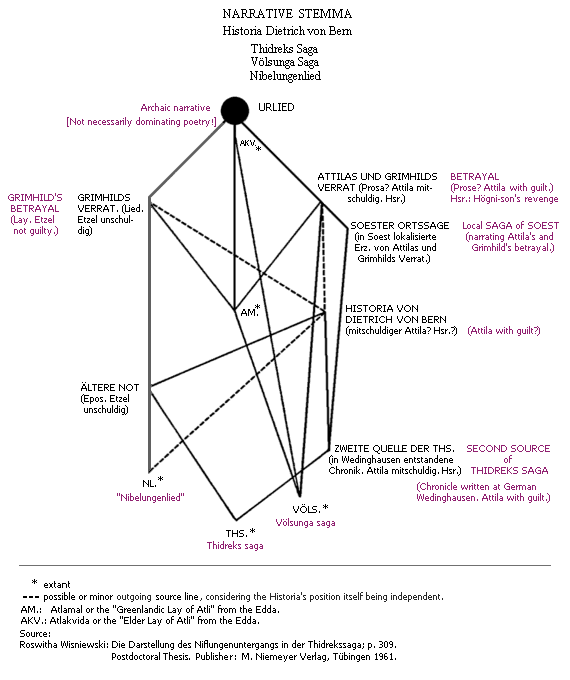 |
|
The Upper
German stem on the left represents epic tradition that detracts the
Burgundian
fall to the homeland of a fictive ‘Hungarian king’ called ‘Etzel’.
Roswitha Wisniewski notes well that her so-called ‘Zweite Quelle’ has
to be regarded as principal source of Thidrekssaga, while she
regards the ‘Ältere Not’ rendering epic influences of ‘Duna
crossing’, recovery at Margrave Rodingeir’s ‘Bakalar’ (MHG: ‘Markgraf
Rüdiger’s Bechelaren’) and the arrival of the Niflungs at the
residence of King Atala. We may also consider the ‘Ältere
Not’
which may have originally introduced the Nibelungen character
‘Giselher’.
He seems to be taken as ‘Gislahar(ius)’ from the ‘Lex Burgundionum’,
apparently an
interfigural character in order to boost the Old Norse Gunnar with an
‘accompanying actor’; notably Léon Polak and Roswitha
Wisniewski. As the texts relate, he
defeated Rodingeir who may also represent an interpolative figure.
His German noble title ‘Markgraf’ has been ascribed to the era of
Charlemagne.
|
| |
|
Hilkert
Weddige (Ludwig Maximilians University Munich, Institut f. Deutsche
Philologie, em.) notes generally on Roswitha Wisniewski’s narrative
stemma:
|
| |
|
Angesichts
dieser Symbiose von mündlichen und schriftlichen, von
ober- und niederdeutschen, von altnordischen und lateinischen Quellen
in ungebundener und gebundener Rede wird man mehr noch als beim
Nibelungenlied dazu übergehen müssen, die Thidrekssaga in
ihrem »Sosein« synchronisch zu erfassen. Gleichwohl ist es
Roswitha Wisniewski zu einem guten Teil gelungen, die Kontaminationen
in der Darstellung des Niflungenunterganges zu entwirren:
Sie
erschließt für die Saga im genauen Vergleich mit dem
Nibelungenlied konkrete Züge eines »zweiten«
Quellenbereichs neben der Älteren Not. In jenem scheinen
niederdeutsche Dietrich-Dichtung und eine Historia Dietrichs von Bern,
die womöglich im Kloster Wedinghausen aufgeschrieben und mit
Soester und westfälischen Lokalisationen versetzt wurde,
zusammenfließen. Die Methode, nach Dopplungen zu suchen, deren
Ergiebigkeit Bumke für die Vorlagen-Rekonstruktion der
Brünhildfabel demonstriert hat, wird hier allerdings gelegentlich
überstrapaziert, weil jede Dopplung systematisch auf zwei
Vorlagen, nämlich auf die Ältere Not und jene zweite Quelle
zurückgeführt wird.
|
|
Hilkert
Weddige, Heldensage und
Stammessage (op. cit.) p. 112f.
|
| |
|
[Transl.:
In view of this symbiosis of oral and
written sources, from Upper and Low
German, Old Norse and Latin sources in prose and verse, one will
have to go beyond the Nibelungenlied to synchronizing the Thidrekssaga
for its «being so». Nevertheless, Roswitha Wisniewski
succeeded to a
great extent in unravelling the contamination in the presentation of
the Niflungenuntergang:
In close comparison with the Nibelungenlied,
alongside the ‘Ältere Not’, she extrapolates concrete features of
a «second» source account. In the latter seem to conflate a
Low
German Dietrich poetry and a Historia of Dietrich von Bern which may
have been written down in Wedinghausen monastery and set up in a
transferring manner with locations of Soest and Westphalia. The method
of searching for duplicates, the yielding that
Bumke has demonstrated for the original reconstruction of the
Brünhildfabel’s source is, however, occasionally overstretched
here, because each doubling is systematically recurring to two
source based templates, namely the ‘Ältere Not’ and that second
source.]
|
| |
| |
|
Clearing
the authoress of the latter argument, there is however no
sufficient literary indication that, first, we must actually
refer to more than the two basic sources, conceivable rather as two
complex source cycles she has been dealing with,
and, second, the so-called Zweite Quelle (= second source)
of the Thidrekssaga would not predominantly reflect basic
historical accounts of Migration Period.
|
| |
|
Regarding the generic ‘process operative’ of compiling and
interpolating
by different sources of apparently different gender, as a result
seemingly provided by the Thidrekssaga, Roswitha Wisniewski
(op. cit. 1961, pgs 1–22) introductorily summarizes the suggestions
made by B. Döring (1870), Hermann Paul (1900), Waldemar Haupt
(1914), Andreas Heusler
(1914, 1920, 1955), Friedrich Panzer (1945, 1948, 1950, 1953, 1955),
Dietrich von
Kralik (1941) as essentially inadequate, apart from more critical but
still
doubtful reappraisals by
August Raßmann (1877 against Haupt), Karl Droege (1909,
1921–1934 against Heusler), Heinrich Hempel
(1926, 1952), Gerhart Lohse (1955), Gustav Neckel (1927), and
the developable, but amongst themselves still more or less
contradicting approaches made by Adolf Holtzmann (1854), Hugo Busch
(1882), Wilhelm Wilmanns
(1903, in common with the review by Joseph Seemüller in
A.f.d.A.30),
Richard Constant Boer (1906, 1907, 1909), Léon Polak (1913,
1917).
|
| |
|
Roswitha
Wisniewski reminds us on the
subject of literary composition of heroic transmissions by chronicles
and historiae which James Westfall has reworded as
fundamental characteristics of both narrative forms:
|
| |
The
medieval Chronicle
was neither a mere table
of dates nor the representation of a time; it was a detailed
arrangement of events in the order of time. The medieval History was neither a generic
term
encluding all classes of materials nor the simple narration
of a spectator. Whether according to its earliest use, it
may have been an exposition of the results of research, or of
the process of research itself, it was now understood to mean
an exhibition of events in their deeper relations of cause and
effect, in their moral and political bearings, and in an
approach to a dramatic or pictorial form. The history was a work
of art, the chronicle a faithful narration of acts and an
orderly arrangement of dates.
|
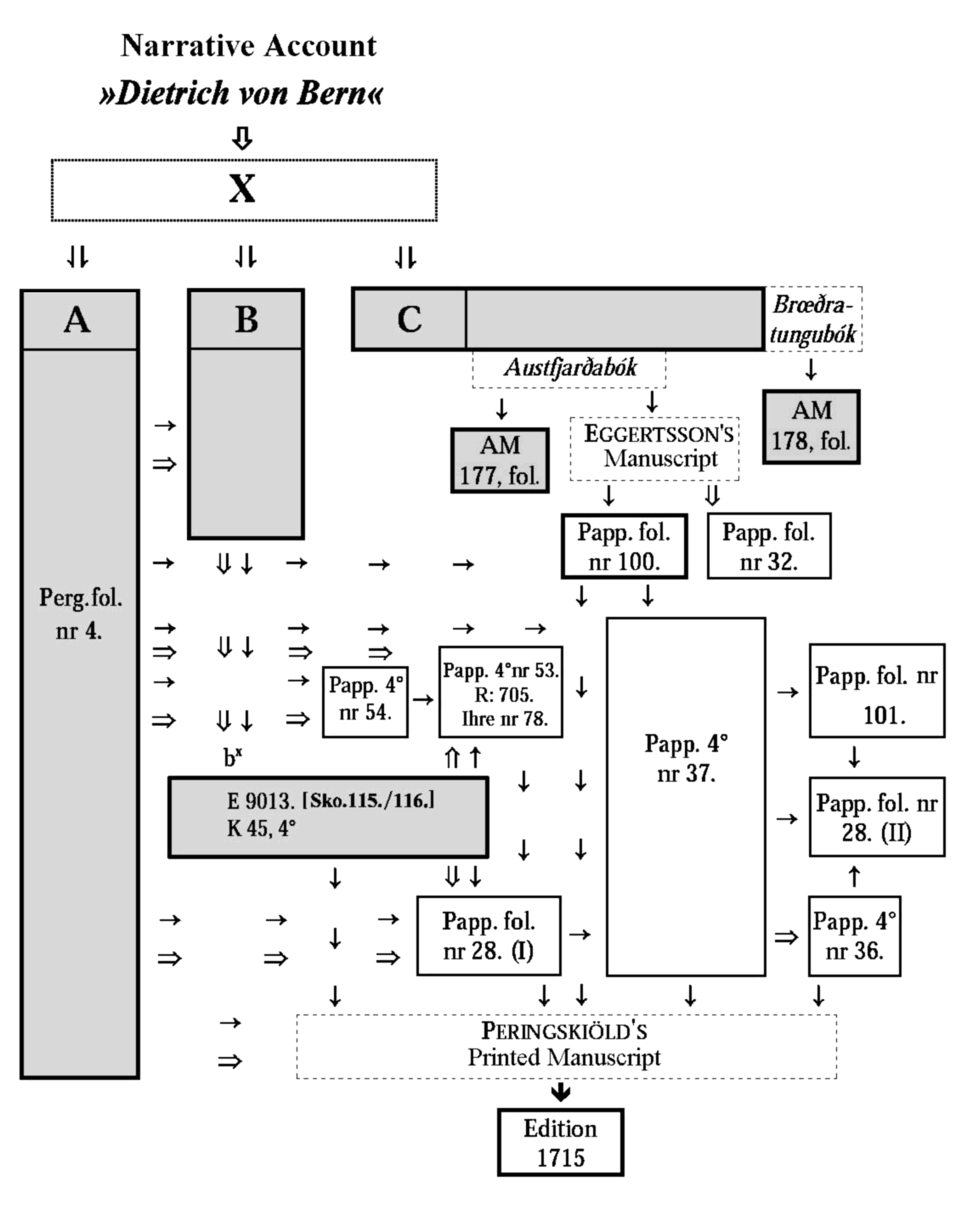 |
|
Progressive
survey of Old Norse ‘Membrane’ (A), Swedish (B
), and
Icelandic (C) manuscripts; cf. Rolf Badenhausen 2007 referring
to Kay Busch, Grossmachtstatus
& Sagainterpretation.
Doctoral thesis, FAU Erlangen-Nürnberg 2002. As regards
Peringskiöld’s own bibliography, however, he did
not consider B- and/or C-branch to complete
the
A-manuscript for his edition of 1715.
|
|
|
Hermann Reichert (op.
cit.)
convincingly underlines that the immediate prior source serving for
the A-B-C manuscript branches cannot be oral tradition.
Regarding the results and conclusions by Reichert’s diligent analysis
of the A-B-C manuscript family, we are certainly allowed to replace the
hierarchical placeholder Narrative Account «Dietrich von
Bern»
with a paper manuscript called ‘Großwerk’ or ‘*Th’ by Reichert.
His analysis generally deals
with substance and philological place value of phrasemes,
theoretical aspects of phraseological research and, consequently,
practical application. Regarding some outstanding passage in the MSS,
Reichert has been able to show mainly by comprehensive synoptical
recognitions of the A-B-C texts that the Icelandic +
Swedish MSS are more related to each other than
the
elder Membrane
(Perg. fol. nr 4) to both younger texts of the C-branch.
|
| |
27 ii.
The author’s article Wadhincúsan,
monasterium Ludewici
introduces special referential phrases in the manuscripts of
the Thidrekssaga that apparently point to a predecessive
Low
German author
of rather a ‘Großwerk’. For example, just compare the severe
humiliations of the queens Erka and Brynhild: Completely disappointed
by the refusal and departure of her beloved cousin Thidrek, Erka tears
her dress (Mb 302), as does Brynhild (Mb 344) in utter despair at the
disgrace which Sigurð and Grimhild have caused her. See also these
items:
|
| |
|
‘ex turris’ – From
the Tower
|
| |
|
This peculiar
characteristic setup, emphasizing scenically the appearances of kings
and heroes on a tower, does widely recur in the texts of the
Thidrekssaga:
|
| |
|
Regarding the Gransport
campaign, King Atala turns from a Susat
tower to his
people (Mb 321, Sv 271), while King Ermenrik was standing in one of the
highest towers of his Romaburg to encourage
his subjects against the threat of
Thidrek (Mb 324, Sv 274 without comparative form). We may
also consider Samson at Mb 2 who
appears on the highest tower of a fort to woo for a jarl’s
daughter (cf. Sv 1 without comparative form). In Mb 78 and Sv 74 Weland
lands with his flying machine on the highest tower of King Nidung’s
castle. According to Mb 265 King Salomon goes to a tower to meet the
imprisoned Jarl Iron. In an account of the Niflungs fighting at Susat,
see
Mb 380 and Sv 324, Atala stands on a
towered
building (‘kastala’)
to spur his subjects against the warriors of Gunnar, Hǫgni and their
younger brothers, while Grimhild
was expecting their arrival also on a tower of Susat castle (Mb
372). The author of Atala’s campaign
against the eastern ruler Valldemar exposes
Thidrek of Bern in the highest tower in the residence of his
host, see Mb 293 and Sv 248. According to the Old Icelandic texts, he
appears as a statue on a tower of his Bern residence (Mb 414).
|
| |
|
Furthermore, already in
addition to Grimhild’s
appearance on the arrival of her brothers in Susat, we may also
come across female expectations of heroes on a tower. In Mb 101 and Sv
102 Drusian’s widow went to a tower of her castle in order to see the
arrival of her fiancée. In a passage dealing with the eastern
war between Atala and Valldemar,
see Mb 303 and Sv 257, a jarl’s daughter was also in the tower
of a Wilzian castle where she recognized Valldemar’s son
and
then Thidrek of Bern. In Mb 420 Queen Isollde waits in
vain for
the arrival of her husband Hertnit in the highest tower of the royal
castle, cf. Sv 362 without comparative form.
|
| |
| Gold ring donations |
| |
|
There are obviously
more textsymptomatic turns of narrational emphases that suggest
a monographic work – written by one author – as the source of the
Thidrekssaga. For example, we apparently have to consider
gold ring gifts serving for scenical accentuation:
|
| |
|
At Mb 51 Erka,
daughter of King Osantrix, hands over a gold ring to Margrave Rodinger,
bride wooer on behalf of King Atala, in
support
of her
commitment (cf. Sv 46). At Mb 81 and Sv 78 Widga receives a gold ring
when saying
goodbye to his parents, which he gives away to Hildebrand in Mb 91 and
Sv 92. Likewise, Þettleifr
receives a gold ring from his mother
in Mb 117 and Sv 118. Mb 122 relates that he gave away a gold ring to a
helpful stranger on
his route to King
Thidrek; then Mb 125–126 and Sv 125 recall that he gave the
gold ring he
had received from his mother to Isung
the master minstrel.
Already in Mb 107 (cf. Sv 111 without the name of the castle owner)
Thidrek received a gold ring from the
nobleman Loðvigr, lord of Burg Altenfels.
Apollonius receives from his sister-in-law a magical gold
ring that he devotes to King Salomon’s daughter Herborg, see Mb
246–247. At Mb 251 Apollonius' brother Iron
exchanges
his garment for
the dress and headscarf of a woman who gains a gold ring for this deal.
Only a little time later, in Mb 269, he gives the gold ring, that his
brother had put on a finger of Herborg, to Duke Ake’s wife Bolfriana.
At Mb 340 and Sv 290 Hildebrand receives from the dying Queen Erka her
most
beautiful gold ring. At Duna Crossing, on the route of the Niflungen to
Susat, Hǫgni rewards the ferryman with a gold ring (Mb 365, Sv 309).
Thereafter
Hǫgni donates either this or another gold ring to a sentinel of
Margrave
Rodinger (Mb 367, Sv 311). In Mb 387 and Sv 332 Grimhild decorates the
helmet of her
devoted fighter Irung with two gold rings. At Mb 404 and Sv 348
Hildebrand rewards
a servant of Duke Lodvigur (‘Lodvik’)
with a gold ring. A short time
later, in Mb
411 and Sv 354, King Thidrek receives a gold ring from
Hildebrand’s son
Alebrand. And, understandably, it was the finest gold ring that King
Nidung’s daughter had broken and was to be repaired by Velent, see Mb
74 and Sv 73. It seems superfluous to mention the ‘corpus delicti’ of
Sigurð’s
and Brynhild’s common night on
the castle of the Niflungen, cf. Mb 229, Mb 343, Sv 292.
|
| |
|
We can further supplement
that Widga notes in Mb 132 and Sv 131 a valuable thick gold ring around
Vildifer’s arm in the
accounts on the unification of Thidrek’s heroic circle. It may
seem noteworthy that the reports on the eastern wars, as waged by King
Atala and
Thidrek, do not mention a gold ring or a similar piece of
jewellery. However, there are certain recursive narrative references
in these reports on the eastern wars, for instance from Mb 303 to Mb
278 (Sv 257 to Sv 231) on the death of Ermenrik’s son Fridrek. As
another example, cf.
Atala’s
campaign against
Osantrix, the origin of Vildifer’s beary dress has been
allocated to the woodland Lyravald/Luruvalld, the region which
encompasses the Westphalian monastery Wedinghausen.
|
| |
‘conversio in pretium – Goldmark’
|
| |
|
Text-critical
explorations of the Old Norse + Swedish
manuscripts
have already noticed currency units pointing to German tradition.
|
| |
|
The pedantic listings of costs and pawn sums of marka gulls
and peninga (Old German Pfenninge) in Mb 125 and Sv 124
speaks
against oral tradition as the source of the Old Norwegian texts. See
also this Old German Goldmark currency already in Mb
58–59 (cf. Sv 57–58), dealing with Vaði and Velent
at Balve; Mb 81 and Sv 78, where Widga leaves for
Thidrek; Mb 117, 121 and Sv 118, where Þettleifr
receives spending money for his trip to Thidrek; Mb/Sv 127,
where he
doubles his total pawn debt of 30 Goldmarks in the hearing before
King Ermenrik; Mb 340 and Sv 290, where Thidrek receives 15
Goldmarks from the dying Queen Erka.
|
| |
|
In common with other textsymptomatic conspicuousnesses, this
narrational
feature may also indicate the re-classification of the
Thidrekssaga
into the Old Norse translation literature based on a ‘Großwerk’.
Thus, with respect to its coherency,
it seems unlikely that all accounts with this Old German based currency
were based on own creativity of the diverse redactors of
the eldest extant manuscript.
Much more speculative, on the other hand, could be a subtle-ironic
allusion of the most likely primordial German author by equating those
‘twelve Pfennigs’
in Mb 125 with the number of Thidrek’s heroes.
|
| |
|
Heimir at
Wadhincúsan monastery
|
| |
|
The
Old Norse + Swedish texts, see Mb 434 and Sv
378, leave
no doubt that
the author of this episode,
whom Roswitha Wisniewski recognizes rather at this Westphalian
monastery
on Ruhr river, nonetheless already knows of some other accounts across
the
Thidrek
saga because of this
dialogue between Heimir and
Thidrek at the monastery:
|
| |
Mb
434
…King
Thidrek turned
toward the man and thought he recognized Heimir, his good comrade, and
he spoke: "Brother, we have seen many great snows since we parted good
friends, and so we shall meet again. You are Heimir, my good friend."
The monk answered: "The Heimir you seek, I never
knew him, and I never
saw him, and I never became your vassal as long as I have lived."
The king replied: "Brother, do you remember how our
horses drank so
much in Frisia that they lowered the water level?"
Heimir answered: "I cannot remember that I have ever
watered horses
with you because I have never seen you before that I can remember."
King Thidrek spoke: "If you do not wish to recognize
me, then you will
still remember the day I was driven out of my kingdom and you
accompanied me, and then when you returned to King Erminrek, he drove
you away as an outlaw. You will certainly remember that, even though
you claim that you have never seen me."
Heimir answered: "I cannot remember what you have
said now. I have
heard King Thidrek of Bern mentioned as well as King Erminrek of Rome,
but I know nothing more of them."
"Brother," said King Thidrek, "many snows have fallen since we saw each
other. You should be able to remember about when we rode to a feast in
Rome, when we found Earl Iron before the gates with his great wound,
and remember his hawks, how they cried out over him when he was dead;
and his dogs, how they whined over him, and his horse neighed and how
all of his men loved him so much that they did not want to part from
him."
Heimir said: "I do not remember that I was at the
place where Earl Iron
fell."
King Thidrek replied: "Since then have fallen
many snows, and now you
should remember how we came to Rome to King Erminrek and how our horses
neighed and stood in the noblest fashion. We had then hair colored like
gold and curled fairly. We are both now gray as doves, both you and I.
All of your clothing is colored like mine. Do you remember now, friend,
what I am reminding you of, and do not make me stand any longer before
you.“
Heimir laughed and spoke: "Good Sir, King Thidrek, now I
remember everything you have been reminding me of…
|
| |
|
[Translation
by Edward R. Haymes]
|
| |
|
On the one hand, of
course, one may claim the possibility that
this dialogue could have been created in either Norway or Iceland, or
even by a redactor from the workgroup of the fragmentary
‘Stockholm manuscript’ (= Membrane). But on the other, a Low
German author could have intended to leave this passage as his
signature of rather a Großwerk
author. But why should a Norwegian or an
Icelandic scribe recall some accounts previously given by his
colleagues? Moreover, if the former case were right, we then may
also wonder where he found all the other structural and local details
for not only the Wadhincúsan
Episode but also Thidrek’s fight against an huge animal in
the Osning. Nonetheless, it
seems obvious that the supplemental creation
of the dialogue between Heimir and his king could be chosen as the only
smart way for the monastic
scribe to present
himself humbly and obscurely as the author of the complete work.
Besides, as already
annotated above at endnote 23 i (Nordic
Giants, 2nd para.), it is noticeable that
even the narrative
mountain forest called (e.g.) Lur(n)valld, which
surrounds the Westphalian monastery, was not translated to an ending
form with -holt, -mǫrk, -skógr,
-viðr.
|
| |
|
The MHG Wolfdietrich
versions seem not to contribute to the reception motives of the Wadhincúsan
Episode. Although Wolfdietrich does also retire to a monastery,
where
he finds a redemptive death after repeated visits by the devil (A), his
campaign aided by the monks against the pagan ruler Tarias, who had
threatened the monastery (D only), contradicts Mb 435 (Icel. MS A)
according to which Thidrek
is said to have robbed and burnt down the monastery of Wadhincúsan.
|
| |
| A further
estimation of Low German authorship |
|
|
On the route from the Osning
back to Bern Thidrek meets a greive
Loðvigr on Aldinfils castle, cf. the map of
Thidrek’s Osning route. Together with
the monastic
installment of Heimir/Heym as Lodvigur
at Wadhincúsan/Wedinghusan, the stopover episode
in Mb 107 and Sv 111 seems to point again to the authorship of the
Wedinghusian scribe. By means of Johann
S. Seibertz’ Urkundenbuch zur Landes- und Rechtsgeschichte des
Herzogthums Westfalen (op. cit. pgs 193–194), the Aldinfils
castle towers well over the home region of the clerical scribe’s close
relatives: As
certified in 1217, the brothers Ludewici
‘fratris nostri sacerdotis’, Henricus
and Lambertus de stenhus
(Steinhausen) were owners a farmstead with a piece of land in
Thidericheshusen, a location called later Wermarsegen, and transferred
this estate to the Cistercian monastery of Bredelar. Incidentally,
their brother Hartmodus (‘Hartmud’) von Steinhausen was at that
time recorded provost
at Wedinghausen.
Seibertz comments this certification, as being placed ahead
of the account he quotes from the copied records of this monastery:
|
| |
|
150.
|
|
|
| 1217. |
bekunden Graf Gottfried II. v. Arnsberg
und Hartmodus Probst
zu Wedinghausen, wie die
Brüder des Letzten, Ludwig
Priester Heinrich
und Lambert von Stenhus eine Hofstelle mit
15 Morgen Land in Thidericheshusen,
dem Kloster Bredelar
geschenkt haben, welches ihnen dafür in einer Gefahr Leibes und
der Seele, Fraternität und ein Klosterbegräbnis bewilligt
hatte. |
|
|
Nach einem Copiarium des Klosters Bredelar.
|
|
|
|
Godefridus
dei
gratia Comes Arnesburgensis vniuersis fidei
cultoribus ad quos presens scriptum peruenerit salutem et veritatem
diligere. Notum esse volumus tam presentibus quam futuris quod dominus
Heinricus et frater suus Lambertus de Stenhus diuina
admonicione inspirati, pro remedio animarum suarum Quindecim iugera cum
area de proprietatibus suis in Thidericheshusen que vocantur
Wermarsegen contulerunt ecclesie in Breidlar,
et dominus Thetmarus Abbas Totusque Conuentus iam dicte
ecclesie, eis conpacientes, cum vita et anima periclitarent, pro multa
dilectione et deuotione fraternitatem
et sepulturam eis concesserunt. Nos vero beniuole hiis consencientes
quicquid iure dominii nostri inde cedit totaliter iam dicte ecclesie
libenti animo conferrimus Et ut hec rata maneant et inconuulsa, hoc
scriptum sigillo nostro signauimus. Hartmodus dei gratia
prepositus in Wedinghusen. Omnibus hoc scriptum inspicientibus salutem
et orationes in domino vniuersitati vestre significamus et secundum
meram veritatem testamur sicut ex relatione fratris nostri Ludewici
sacerdotis audiuimus quod ipse cum fratribus suis
Heinrico et Lamberto Quindecim iugera in
Thiderikeshusen que vocantur Wermarsegen et proprie
possederunt, ecclesie
in Breidelar libere contulerunt verum quoque hanc collationem
eidem ecclesie dominus Godefridus Comes Arnesbergensis
priuilegio suo roborauit. Rogamus obnixe ut iam dictam ecclesiam in
percipiendis illis agris omnimodis promouere curetis Acta sunt hec Anno
gratie M° CC° XVII° Indictione quinta.
|
| |
|
It could be argued
that the identity
of the ‘fratris nostri Ludewici sacerdotis’ with the equally named
clergyman and scribe of Wedinghausen Monastery seems not clearly proven
therewith. But the context in question points to a very significant
blood-brotherly and monastic
relationship with the provost of Wedinghausen.
|
| |
|
The Aldinfils
(Altenfels, a mediaeval ‘twincastle’, Icel. MS
B: Alldinfils)
belonged to the property of Siegfried of Boyneburg IV († 1144).
According to allodial registries and other mediaeval certifications, he
was feudal lord of estates i.a. in Thiderikeshusen. As concerns the
family circumstances and the literary context related to Ludewicus,
there is little doubt that Aldenfils castle appears as a
regional witness of personal matters between Thiderikeshusen and
Bredelar Monastery.
Or in other words: The writer of Mb 107 and Sv 111 did not have to
think twice about the place where he, as a castle owner in this
stopover story, could get over the transfer of the estate of his
brothers.
|
| |
|
May we expect a
further meeting of a ‘Lodver’ or ‘Lodvigur’
with Thidrek again at a stopover site if the king of Bern
would
return once more from the Lur(u)vald (Lurnvald) to his
residence on the
other side of the Rhine? Indeed, we have to forecast this for
Thidrek’s and Hildebrand’s return to Bern from Susat,
their place of exile for many years. Thus, the participation of a
correspondingly spelled
duke (hertugi(nn)/jarl) Lodovigur
in Mb 405 (see contextually Mb 403–411, see Bertelsen op. cit. pgs II,
3464,9,16,
3471, 3541) and Sv
347–354 may underline now a further ‘authorgraph’
left by the monastic scribe Ludewicus of Wedinghausen. It seems worth
to remark here that the noble titles greive/greife and hertugi
are based not on Old
Norse/Icelandic but German language (Graf, Herzog). The Old
Swedish texts claim Lodowik’s
castle in Humlungaland (that
has been equated with Amlungaland),
while the scribes of the Icelandic manuscripts determine his castle at
or in the Mundia, as preferred also by the translator Fine
Erichsen. Ritter
proposes Lodvigur’s seat in
its southern part which may include the Middle Rhenish region of both
Siegburg and the property related to the ancestry of Hildebrand, see Dietrich
von Bern, p. 254.
|
| |
|
Another subtle allusion by the author of this episode seems to be
connected
with the name of Lodvigur’s
son Konrádur:
According to the Upper German transmission Nibelungenklage, a
scribe called ‘Master Konrad’ wrote the text of an obvious potential
but still
missing archaic Latin version of the Nibelungenlied on behalf of the
Passauian Bishop Pil(i)grim. The involvement of this Lodvigur and his
son in Hildebrand’s genealogy may thus be ‘purely fictitious’ at the
first glance. However, it must remain open whether the scribe Ludewicus
of Wedinghausen could have had an ancestral line at Wenden
but not Venice and, furthermore, could have named a potential son after
a South German writer.
|
| |
|
27
iii. Apart from the
accounts on Thidrek’s
trip to Bergara, and the deaths of Heimir and those of the last
fights of Widga and Thidrek (Sv 384–385),
which all seem less historical, the monastic installment dealing
with Heimir at Wedinghausen is missing in Johan
Peringskiöld’s trilingual manuscript edition
as being released in 1715 – after all, he was the
leading bibliographer of the Swedish kingdom at this time.
However, it may be surprising that the Wedinghausen narrative provide
the elder
Icelandic manuscripts of the Arnamagnæan collection, which are AM
177 fol. (= manuscript B, late 17th
century, in the Codex Austfjarðabók or Eiðagás)
and AM 178 fol. (= manuscript A, mid 17th
century, in the Codex
Broeðratungubók).
|
| |
|
Since the Old Swedish manuscripts, dated from the end of 15th
till the
beginning of 16th century, already deliver
the monastic installment of Lodwik at Wadhinkusan (with
a lacuna from
Sv 372 to 374),
there must
have been at least one unknown and missing transmission serving as
the source for the editors who presumably were working at
Vadstena Abbey ‘of Our Lady and of St. Bridget’. Furthermore, as
regards the intertextual research by Hermann Reichert (op. cit.), this
source must have had more in common with both Icelandic MSS
than
the Stockholm MS.
|
| |
|
Susanne Kramarz-Bein points out synoptically the basic
differences
between the redactions written by the Membrane scribes Mb2
and Mb3 (who re-edited
the former) and the writers of the Icelandic
manuscripts A and B of the C-branch in her postdoctoral
thesis Die Thidrekssaga im Kontext der
altnordischen Literatur. As she annotates, she follows the analysis
by Thomas Klein who graphically provides this special narrative
relationship
in his article Zur Thidrekssaga,
in: Heinrich Beck (Hrsg.), Arbeiten zur
Skandinavistik. 6. Arbeitstagung der Skandinavisten des Deutschen
Sprachgebietes, 26.9.–1.10.1983 in Bonn. Frankfurt a.M./Bern/New
York (= Texte und Untersuchungen zur
Germanistik und
Skandinavistik, vol. 11); pgs 487–565, see pgs 516–517.
|
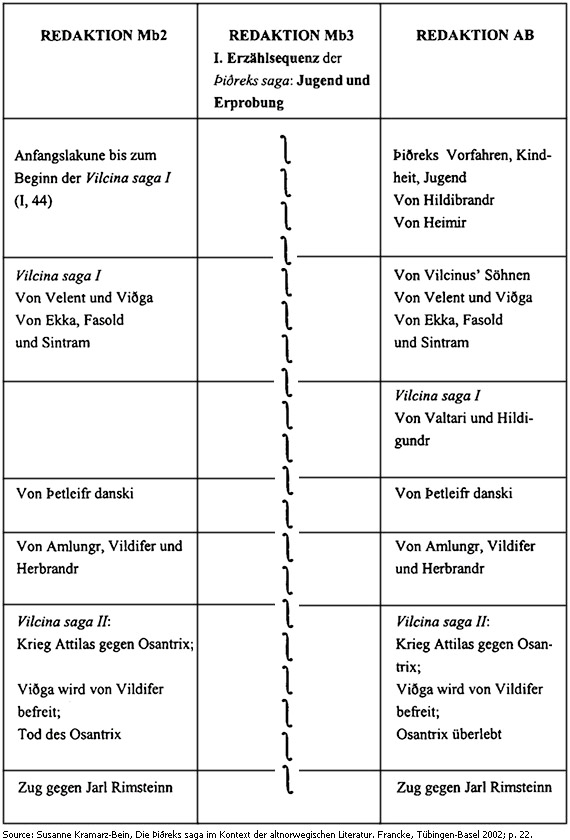
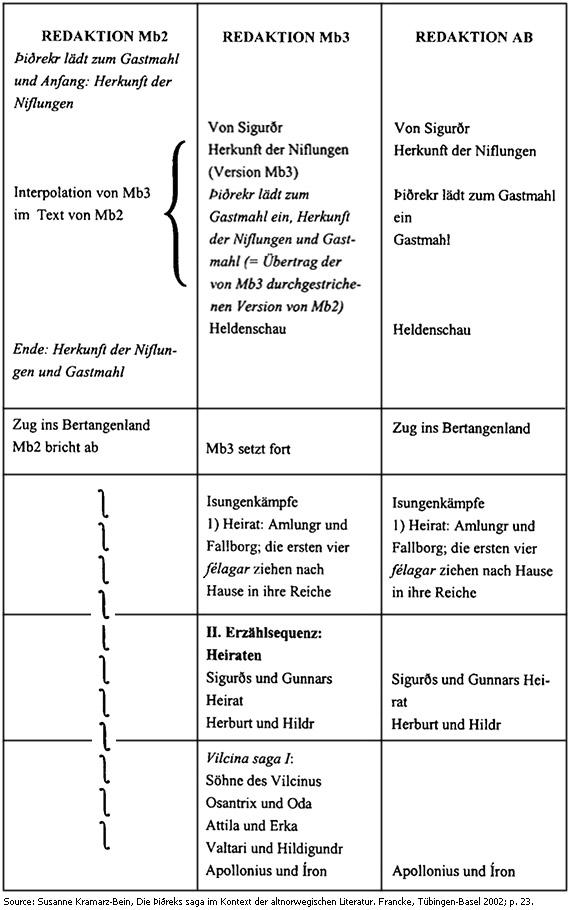
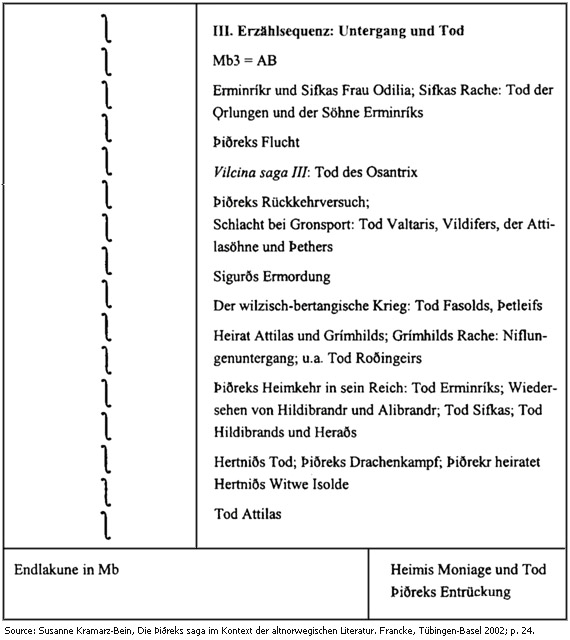
|
|
27 iv.
Some
general
remarks with respect to the Old Swedish manuscripts
The
treatise which Ritter has appended as epilogue to his translation of
the
Old Swedish manuscripts provides strong indication that the
‘chronicle Didrik af Bern’ cannot be a mere
translation from Thidrekssaga. As Ritter points out in his
book Die Nibelungen zogen nordwärts, the
Old Swedish ‘Haghen’ cannot be taken directly from a Old Norse source
that spells ‘Hǫgni’, while ‘Goroholth’ may not represent
a
translated ‘Gernoz’, ‘Gislher’ not result in ‘Gyntar’ (!).
Regarding the original source context of/for the Old Swedish scribes,
the lingual pattern shining through their work shows rather more
Danish than Norwegian influence, as Ritter cites Bengt Henning who
underlines that the so-called ‘Norvagism’ are playing almost no
rôle
against the ‘Danism’ of remarkable frequentness. Henning
nonetheless votes for the Old Norse-Norwegian manuscripts as the source
of the Old Swedish scribes, whereas Ritter would not follow this
estimation.
|
| |
|
Regarding both a Thidrekssaga manuscript, brought early
enough to the Östergotlandish Monasterium sanctarum Mariæ
Virgìnis et Brigidæ at Vadstena, and, apparently,
a further important source of the Old Swedish redactions
which are so consequently dealing with both ‘Gyntar’ and ‘Gunnar’ through
all chapters,
it seems less likely that this special bifigural configuration
could be based on an unintentional permutational action by the Old
Swedish scribes; cf. Ritter who contradicts some arbitrary assumption
on
this subject. As already placed
at the disposal, the Old Swedish scribes might have been either
actively reorganizing or fairly reproducing an
historiographical (con)text that does not deal with any
factual
appearance of the two younger Nibelungenlied brothers of Burgundia.
Interestingly, however, Ritter has not sufficiently
discussed this item which might appear to some
philologists as subtle emendation by the Old
Swedish scribes.
|
| |
Thus, we may be obliged to postulate a significant source reference
which the Old Swedish scribes have been forwarding besides
the texts written by the Old Norse redactors. Not without reason,
Roswitha Wisniewski
starts her postdoctoral thesis with the approach that the basic source
of the Old Norse manuscripts came rather as a comprehensive work from
Low Germany, as she reasonably suggests a ‘chronicler’ at
Wedinghausen monastery near Soest; cf. the author’s supplementary
article Wadhincúsan,
monasterium Ludewici.
|
| |
|
Regarding missing and unequal narrative elements in the Old Norse
texts, apart from the aforementioned interfigural divergence
related to the Niflungs, it seems evident in case of some synoptical
item that the Old Swedish scribes added some minor but not major detail
which, incidentally, could be found also in the Nibelungenlied with its
significant anachronistic composition of history. For instance, they
knew of a lønnaløff
(maple leaf) that has been causing the vulnerability of the hero (Sv
158),
while the Nibelungenlied rhymes with a linden leaf. However, neither
the
former nor the latter was regarded as an important narrative detail by
the editors of the Old Norse and Icelandic manuscripts.
|
| |
|
Since these and the Swedish texts are
significantly based on closely related source material, we
thereby can not generalize that Ritter has committed a fundamental
anachronism for his differentiated intertextual analyses, i.a.
considering that the manuscripts may provide territorial
ascriptions referring to geographical relationships in High Middle
Ages.
For example, we have to understand Polarnaland as region of
the later Poland ‘Pulina’. However, the Icelandic texts do
occasionally replace ‘Vilkinaland’ by noncontemporary ‘Pulina
land’ (see Mb 294, Bertelsen: ch. 3484). Almost
correspondingly, the Old Swedish scribe just discards the
former geonym. Historically, the Wilzians, equated with the Veleti
(‘Wiltians’),
were apparently moving from Migration Period to Middle Ages at
least to western parts of the later Pomerania.
|
|
|
|
28
Regarding ratiocinative localization of the chronicler by means of the
texts,
Pfaff has not proceeded from a misunderstood or miswritten
transference of the Low German Lürwald, where there is the
Wedinghausen Monastery of mediaeval literary reputation, directly to Langbarða-land
which, however,
seems most likely based on a phlegmatic transcription from (e.g.) Luruvalld
(V4B), Lurnualld (MS B) via Lumbald
to Lumbardy,
Lombardy (cf. Old Swedish MS). Though he
likes to
affirm that
|
| |
|
surely
many of the errors on geography and
legendary history are more likely to have been made in Bergen than in
Westphalia
|
| |
|
– his
closing words in his review of Roswitha Wisniewski’s
postdoctoral thesis –,
|
| |
|
he
nonetheless has
continued afore to deduce on the probability of Latin source
transmission (op. cit.
1962 p. 951):
|
| |
|
It
seems hard to believe, however, if the
saga writer were working with a chronicle written in Wedinghausen, that
he would place the monastery in Italy or that he would have found the
form Wadhincusan before him.
|
| |
|
Before his review of
Roswitha Wisniewski’s source-critical analysis of the Niflungenuntergang
in der Thidrekssaga,
William J. Pfaff has committed to the one and
only localization of Thidrek’s seat in the Italian Verona.
Thus, with regard to his book The Geographical and Ethnic Names in
the Þíðriks Saga,
he would not tolerate the possibility Bonn–Verona for the
residential Bern, see pgs 34–35. Yet he states
under Húna–land (p. 106) that later German poems
even place Þíðrikr
at Bonn because of the town had been known as Verona Cisalpina in
earlier times (Schneider, I, 434). Furthermore, as another example
for his apparent ambivalence, now pointing to Bertelsen’s
transcriptions (II, 46 and II, 43 → AB MSS), he additionally concedes
under Iverne
& Weronni
(p. 109) that the AB variant Weronni, if not an error for
Verona in Italy, may reflect a German localization of
the story in Bonn (Verona Cisalpina; Schütte, II,
211).
|
| |
|
Regarding the chronical second source, being claimed to
guiding the Darstellung des
Niflungenuntergangs in der Thidrekssaga, Pfaff estimates in his
review of
Wisniewski’s postdoctoral thesis (op. cit. 1962, pgs 950–951):
|
| |
The
defense ‹ of
her argument that the ‘second source’ represents a
northern German chronicle in Latin › widens
into an excellent description of
the versions of heroic legend in
chronicles: these versions share a preference for certain political and
social ideals, for similar courtly settings, for established manners
and forms of address; they are interested in genealogy; they feel
impelled to cite authority, usually in the form used in official,
government papers; they carefully avoid the extended dramatic dialogue
favored in the poetry. After investigating parallel prose and verse
versions of episodes in other cycles of heroic material produced in
France and elsewhere, the author concludes that these chronicles
constitute an international genre. Indeed she finds chroniclers
borrowing details from other chroniclers in order to give both prestige
and mysterious, supernatural associations to the rulers they describe;
it is suggested that the demonic origin and character of Högni may
owe much to chronical accounts of Alexander. She goes on to conclude
that the chronicle was in Latin because the peculiar forms of several
place names and personal names in Thidreks saga — for example,
Susat, Wer‹n›iza,
Attila, Sigfroeðr and Gernoz — can be explained as
misunderstandings of
the irregular orthography employed in medieval Latin chronicles. She
believes, finally, that this Latin chronicle, "the second source," was
written at Wedinghausen monastery, some twenty miles south of Soest,
and argues that the episode concerning Heimir’s association with the
monks at Wadincusan reveals
knowledge of events and personnel at the monastery that only a member
would be likely to have, and that the proximity of Soest explains the
saga’s detailed knowledge of the town.
|
|
|
29 The
Gothic imaginations in the Old Norse texts appear roughly mapped with a
central ‘Adriatic Sea’ and, regarding a later geographical
development related to the expansion of Frankish kingdom, the
territorial importance of Bulgaria in 9th and
10th
century; cf. its eminent alliance with Charlemagne and bounding to
the west on the great Frankish empire stretching out its influence to
the Tisza after 796. It seems unnecessary to annotate that also
the Balkan Peninsula has not been connected with any scene of action
in the manuscripts. Contextually regarding ‘Greece’, its special
meaning is subject of bibliographical sightings by Hans-Jürgen
Hube. He reminds us i.a. that a northern German historiographer of
High Middle Ages evidently preferred to write down ‘Graecen’
instead of ‘Slavs’ (see above).
|
| |
|
However, the Old Swedish texts do not provide these paralogisms
and distracting statements, see Sv 10, Sv 230.
|
| |
|
Thus, Hans-Jürgen Hube (op. cit. p. 24, fn. 2)
evaluates the Ostrogothic geonyms in Mb 13 and Mb 276 as being based on
misunderstanding/misleading later edits made by the Old Norse redactors
(‘compilers’):
|
| |
| Die
späteren nordischen Kompilatoren dachten aber eher
an italienische Gebiete und das Reich der früheren ostgotischen
Könige.
Auch Greken, eigentlich Graach, wurde in diesem
Zusammenhang als „Griechenland” gedeutet, und damit hatte man eine
„europäische Dimension” und Thidrek von Bern/Bonn
gleichsam mit Theoderich gleichgesetzt. |
| |
|
[Transl.:
The later Nordic compilers, however, rather
tought of
Italian
territories and the empire of the former eastern Gothic kings. Greken,
rather Graach, was interpreted as "Greece" in this context.
Thus, there was a ‘European dimension’ which seemed sufficient enough
to
equate Thidrek of Bern/Bonn with Theoderic.]
|
| |
| Hube op. cit. p. 233, fn. 2: |
| |
| Bolgernland: Bulgarien. Der
norwegische Kompilator denkt hier an die Reichsdimensionen nach
Theoderich und an
oströmische Kaiser. |
| |
|
[Transl.:
Here the Norwegian compiler thinks of the
regnal dimensions of
Theoderic and of the East Roman emperors.]
|
| |
As regards
the area just north of the afore-quoted ‘Bolgernland’, some modern
scholar attempted to point out the ‘obvious anachronistic appearance of
high mediaeval Hungary’ by means of contemporary Teutonic/German Order;
see, for instance, its seat Kronstadt built by Germans as
the ‘City of the Crown’. However, the prominence of this nation, which
is not connected with any place of action thereabout, but on the
subject of nothing more than the
authorship’s intention of his own great national identification,
would be more likely ascribable to a German manuscript provider than
mainly translating Old Norse redactors. Not less interesting, likewise
for
interpretation of the national identity of the predecessive
‘Großwerk’
author, some Baltic report appears connected with a 13th-century
point of presence of German Order. Regarding an
‘Hungarian area’ reckoned to a great kingdom of a Slavic
ruler (cf. Mb 22, Sv 17), the eastern wartime
accounts can nevertheless relate historical events in
this large area of Migration Period; cf. Ella Studer, Russisches
in der Thidrekssaga. Doctoral thesis,
University of Bern, Switzerland 1929. Reprint 1931.
|
|
|
30 While
the source material of the Thidrekssaga, most likely written
in Wedinghausen (cf. Wisniewski, Pfaff, Badenhausen), could have
been shipped to Norway already in the second
quarter of the 13th century, the obvious
archaic accounts of intertextual significance
were keyed to an Italian saga milieu in its 3rd
to 4th
quarter, as this may remarkably concern Dietrichs Flucht
and Rabenschlacht:
|
| |
[The
historical situation in the Roman-German Empire of the 12th/13th
century is important to understand the literary-cultural contexts.
Starting with the Carolingians/Franks (768–911),
the Ottonians/Saxons (919–1024) and the Salians/Franks-Burgundians
(1024–1125), the political power – and thus the cultural centre – had
shifted from the Lower German to the Upper German area of the Swabian
Hohenstaufen dynasty (1138–1250) and then – after a changeable period
of so-called interregnum, e.g. with William of Holland (1234–1256) – to
the Austrian Habsburgs (from 1273).
The period of the Staufer emperors Frederick I (Barbarossa, 1147–1190),
Henry VI (1190–1197) and Frederick II (1220–1259) was a cultural heyday
with the emergence of court epics and the promotion of the Upper
German or MHG language. At the same time, the German rulers of this
period were not only German kings, but also kings of Italy and mostly
emperors of the Roman-German Empire.
To secure their claims to power in Italy, under the Staufers Frederick
Barbarossa and Henry VI, the Swabian and Bavarian princes in particular
were enfeoffed with titles and rulerships in Italy(…).
Consequently, there is also a close material and cultural exchange
between the Swabian/Bavarian homeland and the (Italian) venues, as this
is
clearly reflected in the MHG Dietrich epics.
As early as 1061, Emperor Henry III granted the margraviate of
Verona/Bern to Duke Berthold I of Zähringen, who bequeathed the
title ‘margrave’ to his son Hermann and whose sons subsequently called
themselves ‘von Baden und Berne’.
Around 1176, Frederick I Barbarossa
enfeoffed Konrad of Irslingen(…)
(district of Rottweil) with the
Italian duchy of Spoleto. Henry VI additionally appointed him imperial
administrator in Sicily and Konrad of Lützelhard (district of
Ortenau) margrave of Ancona and prince of Ravenna around 1195. Their
names or their noble families are immortalised in the MHG Dietrich
epics.
Probably as a reaction to this foreign rulership, there were several
revolts of the northern Italian city-states(…)
against the
‘German’ Roman-German emperors in the
12th/13th
century. In 1164, the Veronese League was formed starting from
Verona/Bern with Mantua, Padua and Venice, and in 1167, with the
addition of the cities of Milan, Bologna, Vicenza and others, the
Lombard League.
The Hohenstaufen emperors Frederick I, Henry VI and Frederick II, for
their part reacted with campaigns and battles in Italy from 1162
onwards: Milan, Bologna and Ravenna (Raven) are cities we encounter in
the MHG Dietrich epics. Significant are:
1176: Battle of Legnano: victory of the Lombard League against
Emperor
Frederick I.
1237: Battle of Cortenuova: victory of the imperial army under
Emperor
Frederick II.
We find the events with the constellation Roman-German Emperor ↔
Bern/Verona mirrored in the MHG Dietrich epics. We see, for
example,
the dukes of Zähringen (→ Fridung and Sigher)
on the side of the
Roman emperor ‘Erm[en]rich’ against a duchy/kingdom of Bern,
cf. Dietrich’s Flight [DF] and Rabenschlacht [RS]:
DF (lines
2834ff.): nu reit er
[Ermrich] ... – ze Spolet in daz
herzentuom – ..., – ze Ankone uf der marke –
do wuoste er liute unde lante.
DF (line 8637): Fridunc von
Zæringen [listed e.g. next to Walter von Kerlingen].
RS (line 716): Sigher hiez der
hôchgemuot – er was von Zæringen.
These
examples with reminiscences of
southern German princes can be
continued at will, just as in the Nibelungenlied the Staufers,
Babenbergs and other upper German
imperial princes are addressed in particular.] i
___________________
i Ulrich Steffens, Die
zeitliche
Entwicklung der Dietrichsage – Teil II. In: DER BERNER 88
(2021) pgs 31–42. Translation from pgs 35–36.
Original text:
|
| |
(9.1:)
Zum
Verständnis der
literarisch-kulturellen Zusammenhänge ist
die historische Situation im römisch-deutschen Reich des 12./13.
Jh. von Bedeutung. Ausgehend von den Karolingern/ Franken (768–911),
den
Ottonen/Sachsen (919–1024) und den Saliern/Franken-Burgundern
(1024–1125) war die politische Macht – und damit das kulturelle Zentrum
– vom niederdeutschen auf den oberdeutschen Raum der schwäbischen
Staufer (1138–1250) und dann – nach einer wechselhaften Zeit des sog.
Interregnums, z.B. mit Wilhelm von Holland (1234–1256) – zu den
österreichischen Habsburgern (ab 1273) gewandert.
Die Zeit der Staufer-Kaiser: Friedrich I. (Barbarossa, 1147–1190),
Heinrich VI. (1190–1197) sowie Friedrich II. (1220–1259) – war eine
kulturelle Blütezeit mit Entstehung der höfischen Epen und
Förderung der oberdeutschen (mhd.) Sprache. Dabei
sind die deutschen Herrscher dieser Zeit nicht nur Deutsche
Könige, sondern auch Könige von Italien und meist Kaiser des
römisch-deutschen Reiches.
Zur Sicherung ihrer Machtansprüche in Italien wurden unter den
Staufern Friedrich Barbarossa und Heinrich VI. insbesondere die
schwäbischen und bayrischen Fürsten mit Titeln und
Herrschaften in Italien belehnt(…). Folglich
findet auch
ein enger materieller und kultureller Austausch zwischen der
schwäbisch/bairischen Heimat und den (italienischen)
Schauplätzen statt, wie sich dies entsprechend in den
mhd. Dietrichepen deutlich erkennbar widerspiegelt.
Bereits 1061 verlieh Kaiser Heinrich III. die Markgrafschaft
Verona/Bern an Herzog Berthold I. von Zähringen, der den Titel
„Markgraf“ an seinen Sohn Hermann vererbte und dessen Söhne sich
danach „von Baden und Berne“ nannten.
Um 1176 belehnte Friedrich I.
Barbarossa Konrad von Irslingen(…) (Landkreis
Rottweil)
mit dem italienischen Herzogtum Spoleto. Heinrich VI. ernannte ihn
zusätzlich zum Reichsverweser in Sizilien und Konrad von
Lützelhard (Landkreis Ortenau) um 1195 zum Markgraf von Ancona und
Fürst von Ravenna. Ihre Namen bzw. deren Adelsgeschlechter finden
sich in den mhd. Dietrichepen verewigt.
(9.2:) Wohl als Reaktion auf diese Fremdherrschaft kam es im 12./13.
Jh. zu
mehreren Aufständen der norditalienischen Stadtstaaten(…)
gegen die „deutschen“ Römisch-Deutschen Kaiser. 1164 bildete sich
– ausgehend von Verona/Bern mit Mantua, Padua und Venedig – der
Veroneser Bund und 1167 mit Erweiterung um die Städte Mailand,
Bologna, Vicenza u.a. der Lombardenbund.
Die Staufer Kaiser Friedrich I., Heinrich VI. und
Friedrich II.
reagierten ihrerseits ab 1162 mit Feldzügen und Schlachten in
Italien: Mailand, Bologna und Ravenna (Raben) sind Städte, die uns
in den mhd. Dietrichepen begegnen. Bedeutend sind:
1176 Schlacht von Legnano: Sieg des Lombardenbundes gegen
Kaiser
Friedrich I.
1237 Schlacht von Cortenuova: Sieg des Kaiserheers unter Kaiser
Friedrich II.
(9.3:)
Die Ereignisse – mit Konstellation: Römisch-Deutsche Kaiser ↔
Bern/Verona – finden wir in den mhd. Dietrichepen gespiegelt. Wir
sehen
z.B. die Herzöge von Zähringen (→ Fridung und Sigher)
auf
Seiten des römischen Kaisers „Erm[en]rich“
gegen ein Herzogtum/Königreich Bern,
vgl. Dietrichs Flucht [DF] und Rabenschlacht [RS]:
DF (Z.
2834ff.): nu reit er [Ermrich]
… – ze Spolet in daz herzentuom – …, –
ze Ankone uf der marke – do wuoste er liute
unde lante.
DF (Z. 8637): Fridunc von
Zæringen [gelistet z.B. neben Walter von Kerlingen]
RS (Z. 716): Sigher hiez der
hôchgemuot – er was von Zæringen.
Diese Beispiele mit Reminiszenzen an
süddeutsche Fürsten sind
beliebig fortsetzbar, so wie im Nibelungenlied insbesondere die
Staufer, Babenberger und weitere oberdeutsche Reichsfürsten
angesprochen werden.
|
| |
See also the early
basic conclusions
by Wilhelm Wackernagel, Die deutsche heldensage im lande der
Zähringer und in Basel
in: Zeitschrift für deutsches Alterthum, 6. Bd. (1848),
pgs 156–161.
|
|
31 As
already mentioned, both the Thidrekssaga and the Old Swedish
manuscripts do not connect the Niflungs to any Burgundian
geonym. Conclusively, source research has been rightly
considering an archaic material for the works written by
the postulated Low German source provider(s), the Old Norse + Swedish
scribes and those Upper German authors. Considering the premise made by
Roswitha
Wisniewski, the Old Norse + Swedish texts were
augmented with some receptive detail provided
by the Nibelungenlied, resp. its suggested earlier version Ältere
Not.
|
|
A1 Remarks on the evaluation
of Thidrekssaga manuscripts
(Quotation
from
the author’s online article The
Nibelungen – The True Core by the Svava?
Ritter’s
method of dealing with the Thidrekssaga is principally based
on his answer to the cardinal question whether a
tradition being assumed remarkably pregnant with historical
facts may be dissected in twilight mixture of mythological
narratives. As Ritter has expressively underlined at his
lectures, rather less significant as well as detectable
noncontemporary adapting implementation by an evident group
of Old Norse editors might have induced the majority of scholars
to estimate the Thidrekssaga basically as less authentic or
fabulous pool
of originally unrelated single tales. Furthermore,
Ritter regards the source of the Old Swedish manuscripts
principally ‘guiding’ Thidrekssaga, and he considers these
texts of such recognizable literary style and selectivity which
subsequently will allow efforts to estimate them as
historiographical sources.
|
| |
|
Theodore M. Andersson, reviewer of a symposium based
supplement edited by Susanne Kramarz-Bein for Walter de Gruyter’s
encyclopaedia of Germanic antiquity, comments the contradicting
cataloguing of the Thidrekssaga.
Andersson was apparently remembering
Ritter’s publications with this introductory remark of 1996:
|
| |
|
…
Thidrekssaga, which had not
received much scholarly attention for several decades,
came back into fashion about ten years ago…
|
| |
This English review, available at http://userpage.fu-berlin.de/~alvismal/7susanne.pdf
(retrieved
May 2005), follows Heinrich Beck’s general position by means of (e.g.)
his paper Thidrekssaga als Gegenwartsdichtung?
who, stringently against Ritter’s postulation and reasoning,
notoriously exposes the Thidrekssaga to the light of poetry
which appears somewhat and somehow inspired by history. Andersson
writes:
|
| |
| …
Heinrich Beck’s "Thidrekssaga als Gegenwartsdichtung?"
(…) points out that Thidrekssaga (…) synchronizes events
from legendary prehistory with near-contemporary events
in the twelfth century (campaigns against the Slavs on
the eastern frontier of Germany). Time in Thidrekssaga
is thus a variable quantity…
|
| |
|
Moreover, Heinrich Beck classifies the message of the Thidrekssaga
expressively more subtle than its naïve reader would
imagine. Obviously addressing Ritter, he underpins Germanism’s
fundamental attitude toward the general understanding of
SAGA with this manifesto:
|
| |
| Germanistic
saga research has recognized long since (…) that saga
tradition is not an ancient forwarding but derives from topic
adoption. (Transl. from Zur
Thidrekssaga-Diskussion, in: Zeitschrift für deutsche
Philologie. 112, 1993, pgs 441–448.) |
| |
|
However, Ritter’s research does not disregard the fact that the Old
Norse scribes evidently processed to title translated historiographical
and chronicled material as ‘saga’.
Thus, in so far, critical research would be not satisfied
with some subtle or at least ‘very interpretative’ explorations of the
Old Norse
texts which have been provided by Heinrich Beck and other scholars in
literature.
|
| |
Ritter’s translation of the Old Swedish ‘Didriks chronicle’ was
not called in question on literary subject. For elaborating
research he therein left his comparing analysis of both
chronological and historiographical structures of the Svava
and Thidrekssaga manuscripts. In the addenda provided with
his translation (pgs 399–455) he calls into question
the Svava’s dependency from the Membrane
and Icelandic manuscripts against scholastic
evaluation of mainly Scandinavian researchers. He also implemented
into his posthumous publication Der Schmied Weland
exemplary synoptic studies that point out the different literary
styles of these texts which, for instance, provide the
Thidrekssaga’s predilection for certain subjective notional
forwarding and, presumably, for mythologizing; cf. Quotations
from Der Schmied Weland
(German).
|
| |
|
Seasoned practitioners have not rejected Ritter’s methodical
deciphering of ‘the geographical and ethnic names in the Didriks
Saga’, an analysis of noteworthy consistency that considers
rational contemporary circumstances of time and location. In 1959
William J. Pfaff had already introduced an equally titled book
with ‘a study in Germanic heroic Legend’, who, however, failed in
geostrategical plausibilities when turning to the less believable
Ostrogothic
milieu, as this has been scholastically but undifferentiatedly
attributed to the texts by means of Upper German poetry in particular.
As regards the
source material of the Thidrekssaga, there is no convincing
evidence that the Old Norse editors had done essentially more than a
mere translation of an imported tradition which appears as a Low
German Historia
Dietrich von Bern
– even considering that, apart from only a (very) few cases of
Ostrogothic misunderstanding and misinterpreting, the translators
obviously never attempted to change the most important location names
of the texts which have been re-allocated plausibly by Ritter.
To boot, it seems implausible that the Old Norse scribes of King
Hákon IV would have had any good reason to implant any own
narration or compilation on such unfamiliar small locations
as Vernica, Thorta, Brictan,
such rivulets as Duna, Wisara, Eydissa, such
mountain forests as the Osning
and Valslanga.
|
|
| A2 Edward R. Haymes on
oral tradition and Thidrekssaga |
|
|
Haymes'
competence in the analysis and interpretation of oral tradition has
been massively doubted by Joachim Heinzle, who reviewed Das
mündliche Epos (Sammlung Metzler, 1984)
nothing more than going wrong: mißraten;
see J. Heinzle, Anzeiger
für deutsches Altertum und deutsche Literatur, vol. 99, 1988,
p. 82.
|
| |
|
Thereafter Haymes fails again in common with his co-authoress
Susan Samples. In particular, both ignore important differences of the
literary plus historical milieus of the northern and southern
transmissions between Thidrek and Dietrich,
the northern Niflungen and
Burgundian Nibelungen. In so far, as regards at least interliterary
geostrategical relationship, they discriminate the more plausible
historiographical reports by the Thidrekssaga
unconvincingly against both the Nibelungenlied and H. Ritter. Referring
to Haymes & Samples, Legends of the
North,
Routledge/CRC
Press, 1996, p. 75, this edit was made on Ritter at Wikipedia’s
‘Legends about Theoderic the Great’:
|
| |
|
Edward
Haymes and Susan Samples in their introduction
simply summarize his work saying it
"[i]t relates the historical
events of the
Nibelungen legend to the questionable geography of the
Thidrekssage rather than that of the Nibelungenlied".
|
| |
|
This statement was created at en.wikipedia on 26 March 2018, but
deleted
already on 17 April 2018 by an obvious less competent user ‘Ermenrich’,
who actually calls himself a ‘PhD’ without his real name, and who
finally ascribes this article, predominantly based on quotations of
reputable elder German scholarship, Kemp Malone and other philologists
for identifications of Thidrek
of Bern with Frankish king Theuderic I to garbage at the Revision
history of https://en.wikipedia.org/wiki/Thidreks_saga
(13 April 2018).
|
| |
|
Apart from joining
William J. Pfaff’s interpretations of some Italian places – in so far
following the
lesser
appropriate ‘Ostrogothic saga milieu’ (except of some rather
coincidental congruousness with Ritter) – Haymes tries to provide a
verbatim translation of The Saga of Thidrek of Bern.
His introduction to the translation nonetheless considers
scholars who apparently want to promulgate any mediaeval narrative
account of hunting a deer or winning a bride as a remarkable indication
of an unbelievable historical source. Haymes
estimates that the
Thidrekssaga in particular seems to propagate an image
of kingship based on the support of the nobility
and turns to some questionable perspective of Artistic Achievement
which, however, would basically lose rational ground of
reality, at least of potential authenticity, when ascribing a numeral
quantity of a dozen to an only poetic dimension. He is certainly
right in case of some evident incongruity the saga bears
in its texts, but he would not specify in detail the major
contradictions in
the story apart from at least two different deaths in Osantrix'
vita. Incidentally, the Old Swedish texts do not refer to the second
death of Osantrix provided by Mb 292. Regarding Sv 247 instead, which
relates the battle at Brande(n)borg, the scribe of
the Old Swedish text does only convey this notice on rather Osantrix'
successor:
|
| |
|
‘Osantrix
king had a brother’s son in Wilcinaland called Hernid. He became
king of Wilcinaland.
|
| |
|
Of
course, there is also some literary influence mainly of Greek
antiquity (notably Roswitha Wisniewski) that seems to ‘contaminate’ the
original purport of both the ‘saga’ and the Old Swedish
texts – just as the bulk of chronicles and historiae from or
referring to Late Antiquity and Migration Period may be also concerned
to a certain extent. Some example of these so-called ‘amalgamations’
can be
recognized in the Thidrekssaga, e.g. the birds
advising Sigurð to slay his foster father which, however, might be
rather an author’s showing-knowledge-reception of e.g. the Greek Augur
and Melampus.
|
| |
Haymes furthermore notes conservative scholars who obviously have no
idea of northern German(ic) Húnaland as
already
specified by William Pfaff and Late Antique literates,
who would not allow the historical roots and
appearance of these ancient people in that time which Haymes
rightly calls ‘Period of Migration’, who turn a blind eye
to Frankish actions of 5th and 6th
century in that large area
he already specified as (a part of today’s) Low Saxony.
|
| |
|
One
of the most incredible points recalled by Haymes is scholarship’s
opinion that the Swedish texts have to be regarded as an obvious mere
or pruning translation of the Old Norse texts, though he states that
the Old Swedish version
|
| |
|
provides useful information when the other sources
disagree.
|
| |
If
he had explored the source he lists as Roswitha Wisniewski’s
postdoctoral thesis under his Select Bibliography
even in this connection, he would have been able to conceive
the significance of her so-called ‘Second Source’ (see endnote 27) and draw his
conclusions more exactly against the work of those authors who
naïvely believe in a dominating Italian milieu of
Thidrekssaga.
|
|
A3 Supplementary
articles by the author
A3.1
Publications 2019–2022
Die
italo-normannische Ouvertüre der Thidrekssaga
In: DER BERNER 78 (2019), pgs 45–49
(Lectured at Soest, Germany, October 5, 2019)
Gransport – Mysterium oder Faktum?
In: DER BERNER 79 (2019), pgs 34–39
Zur Historizität der Thidrekssaga:
Teil I: Frühmerowingische Herrscher und „Samson“
In: DER BERNER 80 (2020), pgs 24–38
Zur Historizität der Thidrekssaga:
Teil II: Theuderich I. — der historische Thidrek!
In: DER BERNER 81 (2020), pgs 3–29
Der gallisch-fränkische
Wiedereroberungszug von
Theuderich I. als „Thidrek von Bern”
In: DER BERNER 82 (2020), pgs 42–51
Zum sächsisch-gallischen Odoaker
In: DER BERNER 83 (2020), pgs 32–33
War Theuderich I. ein Sohn von Chlodwig?
Zu Heinz Ritters Genealogie des Dietrich von Bern
In: DER BERNER 85 (2020), pgs 28–40
Zur
Historizität der Thidrekssaga
Teil III: Zur interliterarischen Identität von Ermanarich
In: DER BERNER 83 (2020), pgs 34–50
In: DER BERNER
85
(2021), pgs 41–60
In: DER BERNER
86
(2021), pgs 36–52
Gallorömische Warlords: ›Samson‹ -
Childerich - Odoaker
Zur dynastischen Kontinuitätsfrage der Thidrekssaga
In: DER BERNER 87 (2021), pgs 29–53
Iron und Apollonius mit ›Salomon‹ in der
Thidrekssaga
Zur geopolitischen Aussagedimension ihrer „Spielmannsdichtung”
In: DER BERNER 88 (2021), pgs 8–19
Origo
gentis Francorum
und die Thidrekssaga
Stationen historischer Frankenwanderung?
In: DER BERNER 89 (2022), pgs 39–56
Zur
„Originalität“ des Dietrich von
Bern
In: DER BERNER 90 (2022) pgs 33–49
Das VERONA-Siegel
von Bonn —
sphragistisches Rätsel?
In: DER BERNER 90 (2022) pgs 58–59
Nibelungenzug
und
Thidrekssaga
Versuch
einer transliterarischen Geschichtsfindung
Lectured
at the Kolloquium der Nibelungen Gesellschaft Worms e.V.
Wormser
Kultur- und Tagungszentrum, 2022-07-28
In: DER BERNER 92 (2022)
pgs 3–15
————————
Note:
The periodical DER BERNER [ISSN 1610-8191] is published by
Dietrich von Bern Forum – Verein für Heldensage und Geschichte e.V.
This magazine is archived (e.g.)
in
the Bavarian State Library,
Munich (BSB München), and the University of Cologne
Library (Universitäts-
und Stadtbibliothek
Köln). Both libraries are connected with subito-doc.de, which delivers
digitized articles from scientific journals and copies of portions of
books.
A3.2
Appended documents
•
Ritter-Schaumburg on the criticism by Gernot Müller (German
review, 1985-1999)
•
Who is King
Atala?
•
Summaries
of Scientific Analyses: Weland’s Steel
•
Frankish and Merovingian
Origin Location(s)
•
The
Nibelungen – The True Core by the Svava?
•
Geographical and Ethnic Glossary of Thidreks Saga – ‘Svava’ (=
ThsGlossary.pdf)
•
Ritter’s Timeline of Thidrek Saga – ‘Svava’
•
Translation: The Niflunga
Parts of the Old Swedish ‘Didriks chronicle’
•
Chapter Allocation ‘Didriks chronicle’ to Thidrekssaga
•
Chapter Allocation ‘Mb’ to H. Bertelsen (1905-11)
German articles
• Dietrich
von Bern – Chronicle or Poetry?
•
Ritter
about his Principle and Position of Researching the Thidreks saga
•
Ritter’s
Priority of the Old Norse and Swedish texts – An extract from Der
Schmied Weland
• Zur
Schuldfrage von „Attila” und Grimhild, Atli und Guðrún
• Swanhilds
Spuren in der Thidrekssaga?
•
Zwölf
um Dietrich von Bern – Heldenphysiognomie aus der Retorte?
• Zur
Transmission der Thidrekssaga und altschwedischen ‘Didrikskrönikan’
• Die
Mosel im Licht von Thidrekssaga und Dietrich-Chronik
•
Wadhincúsan,
monasterium Ludewici
• Theuderich
I,
Vita Rex Francorum
|

|
|
Hardcover
Edition, 2005
|
|
301
pages [ISBN 978-3-86582-044-1]
|
|
|
|
Hardcover
Edition, 2007
|
|
574
pages [ISBN 978-3-86582-589-6]
|
|
|